20th century Literature, American literature, Book review, Vonnegut

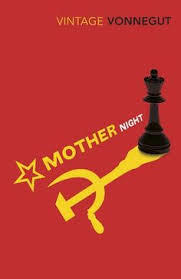
Mother Knight – Kurt Vonnegut – 1966

Released a few years before ‘Slaughterhouse 5’, ‘Mother Knight’ is probably best seen as a companion piece to that work. In some ways a more conventional narrative, it tells in diary form the story of Howard W. Campbell Jr, an American, who moved to Germany in 1923 as a child, and became a well-known playwright. Married to a German woman, he is approached by an American shortly before the second world war starts, and asked to stay in Germany and become a spy for the Americans. This he does, reluctantly, because in order to maintain his cover he has to become an enthusiastic propagandist for the Nazis. As he observes “we are what we pretend to be, so we must be careful about what we pretend to be” – pretending to be a Nazi for so long corrupts his soul, and he finds it hard to argue with or oppose the Americans he meets later in life who hate him, as a symbol and public face of the Nazis.

I don’t know if there was a real-life American equivalent of Campbell, but the obvious English parallel is with William Joyce, Lord Haw-Haw, who must surely have provided some inspiration for the novel, even if unlike Campbell, Joyce remained an unrepentant Nazi.
The reader is left in doubt throughout the novel whether his defence – that he was acting as a spy – is genuine. He presents no evidence in support of it, and the suggestion that he was conveying messages in his broadcasts through coughs and hesitations is implausible, to say the least. However, the final dénouement reveals his story – his defence – was actually true all along. By then it is too late for Campbell, having lost everything he values he passes his own sentence on himself.

Vonnegut is novelist of ideas – he throws them around casually, sometimes following them through, but often discarding them. This makes ‘Mother Knight’ a surprisingly easy and enjoyable read – the cast of characters was entertaining, including some cutting portraits of American Nazis, and the shifts of mood from comedy to black farce worked well. It’s also quite a brave novel – it addresses serious themes and topics such as the holocaust, the rise of fascism, and nationalism. The central character is perhaps hard to like – as narrator of his own story we should normally be sympathetic to him – we understand his motivation, even when what he does is questionable. Campbell never attempts to justify his actions in the war, but he is not prepare to accept some of the lazy condemnation thrown at him which has parallels with the way opponents of the Nazis were treated (the stealing of the light bulbs for example). Just to illustrate the point, there is a brief discussion of nationalism which quite bravely in post-McCarthy America rejects the whole concept of being proud of one’s country:

“You hate America, don’t you?’
That would be as silly as loving it,’ I said. ‘It’s impossible for me to get emotional about it, because real estate doesn’t interest me. It’s no doubt a great flaw in my personality, but I can’t think in terms of boundaries. Those imaginary lines are as unreal to me as elves and pixies. I can’t believe that they mark the end or the beginning of anything of real concern to a human soul. Virtues and vices, pleasures and pains cross boundaries at will.”

You can see Vonnegut warming up for ‘Slaughterhouse 5’ here, although without some of the surrealist components of the later novel. I also caught some echoes of ‘Lolita’ as well – both novels being the posthumous prison diary of someone reviled by society. I will definitely be returning to Vonnegut – he writes well, entertainingly, is refreshing unstuffy and unpretentious, but at the same time deals with serious themes. Recommended.
Standard
Book review

An Artist of the Floating World – Kazuo Ishiguro – 1986

This novel addresses what most be one of the most difficult issues a country has to ever face – how to come to terms with overwhelming military defeat. For Japan, that defeat was all the more painful because its involvement in World War 2 was completely avoidable; and the end of the war, at Hiroshima and Nagasaki was so shocking and final. Ishiguro’s approach to this subject is to walk slowly round it, quietly approaching and then stepping quickly away as soon as the subject becomes too raw.

I am being oblique myself, so let’s explain. The narrator is a painter, Masuji Ono. He has lost a son and a wife in the war, but his two daughters survived. One is married, one going through the complex engagement process used by some Japanese families at the time (and for all I know is still in use). The time structure used in the novel is complex; although each section is dated, giving the reader a misleading reassurance as to the date of the events of that part of the novel, Ono’s account wanders across time, gradually revealing details of his career as a painter. Discouraged by his father from becoming a painter, he runs away from home, and becomes an artist of the floating world – a particular genre of art in Japanese culture. Very slowly Ono reveals his involvement in the rise of Japanese nationalism, and his subsequent disgrace and the rejection of his values by the new, post-war generation. This reveal takes the whole of the story arc, and even then one is left with the distinct impression that we have only been shown a small part of the story.

Ono is a reflective character – he is certainly a deeply flawed narrator, as one would expect, but he is not delusional – he knows that his involvement in Japanese nationalism, painting pictures encouraging the expansion of the empire, was wrong, although the extent of that recognition is unclear: at one point he admits “There is certainly a satisfaction and dignity to be gained in coming to terms with the mistakes one has made in the course of one’s life”, although this is more of a tactical admission than a confession. Ono’s grandson plays an important part in the narrative – he is a really brattish, unpleasant little eight year old, who is encouraged (by his grandfather) to believe that his gender gives him authority over his mother.

There is a profoundly hesitant, tentative feel to the novel. Ono tiptoes around his story, rarely revealing much, and constantly admitting that his recollection may be flawed, The reader is given enough information to piece together the outlines of his story, but only through hints and only rarely through actual events – at one point we are shown him visiting the house of one of his students, who he has reported for anti-nationalist feeling, and it is clear that the authorities reaction has been extreme – we found out earlier that the student was imprisoned for a long time, and apparently tortured. Ono doesn’t understand, or refuses to understand, his responsibility for this situation.

Ishiguro is clearly a writer of some considerable skill – the novel is quite deliberately like a delicate Japanese watercolour, done with great finesse. But the characters – other than Ono himself – are only tentatively drawn – we only see them through Ono’s eyes, and he doesn’t trouble to sketch them in any detail. The language is equally delicate and riven with hesitation, again quite deliberately, giving a very authentic flavour to the narrative, but leaving the reader a little bit detached and remote – the speeches are overly polite, and you need to listen carefully to the subtext to understand what the speakers are really saying, even if the narrator usually misses the point.

Japan clearly went through a huge, if self-imposed trauma before, during and after the Second World War. The price paid was enormous, and understanding how that come to happen is important. Ishiguro gives us one witness’s flawed account, but it is very much that of someone who had only a small, marginal involvement in the tragedy, and I am not sure that it tells enough of the story to be of any value. The book ends without any big reveal, and so does this review.

Standard
100 Best Novels Guardian list, 20th century Literature, Graham Greene' The End of the Affair

The End of the Affair – Graham Greene – 1951

I am ashamed to admit that this is the first Greene novel I have read; I fear it may be the last, at least for now. ‘The End of the Affair’ tells the story of an adulterous affair between Maurice Bendrix, an author on the cusp of, if not fame, popularity, and the wife of a neighbour and friend, Sarah Miles. Bendrix’s narrates the story in flashback, returning to the present often and thereby constructing a complex time scheme that only coheres at the end of the novel. The affair lasts for four years, the first four years of the Second World War. The war is largely background noise to the events of the novel, although it does intrude at one point when a V2 bomb, strangely called here a ‘robot’ lands very close to Bendrix’s house, knocking him out. Thinking him dead, Sarah prays for him to be saved, promising god that if he does survive she will reward him (that is, god) by leaving Bendrix and being faithful to her husband.

Bendrix survives, in fact is largely unhurt, and true to her perverse bargain with god, Sarah leaves him. Leaves is a misleading term, in that she has never actually left her husband, who working late at the Ministry and already living a sexless life, doesn’t notice the affair. She finds the separation painful, so perversely pursues other affairs – the deal with god was very specific apparently – but eventually relents and decides to resume the relationship. The reader is invited to see the hand of god in the various bits of fairly clumsy sit-com style incidents that prevent this resolution being carried out, and Sarah finally succumbs to the irresistible charms of the Catholic Church, before catching a cold and dying. Colds are pretty ferociously dangerous in romantic novels; in fact it would be nice some time soon to read a novel where the resolution is not provided by someone conveniently dying, even if the death as here is signposted a long way in advance, and comes as nothing of a surprise. Cuckolder and cuckolded commiserate one another after Sarah’s death, and eventually become an odd couple of their own, pottering down to the pub each night to drown their sorrows.

Much of the novel is dominated by a discussion of religion, and more specifically Catholicism. God intervenes in the life of the characters, and while they resist fiercely, they eventually accept his gifts. Even though Bendrix ends the novel by rejecting the roman god, he does so more through stubbornness and anger than any lack of belief. Frankly, this is largely tedious, unconvincing preaching – of course god can appear in the lives of characters if the author simply invents “coincidences” to persuade them of his existence. Rosencrantz and Guildernstern in Stoppard’s play about their deaths show infinitely more faith in the power of coincidence, denying the existence of an external power, even when that power is the author himself. All it takes here, by comparison, are some simple coincidences before Bendrix begins to start doubting his agnosticism, ending with a suggestion reminiscent of the conversion at the end of “Brideshead” that he too has accepted the inevitable (even if this suggestion comes at the very beginning of the novel: “If I had believed then in a God”.)

In an insightful introduction in this Vintage edition, Monica Ali surgically pinpoints many of the faults in the novel – the poor characterisation in particular, and the failure of the religious conversion scenes. I agree, but I think she is too kind on Greene. We are invited to see Bendrix as a tragic anti-hero – he is the victim of his own sad story – but if you remove his point of view from the events of the novel and look a little more objectively, he is really a nasty piece of work. He cuckolds Miles, simply at first to get some material for his novel. He has sex with Sarah in her own house while Miles is upstairs, and later has sex with her in a ditch, overlooked by a farmer on a tractor who passes “at the moment of crisis”. Nothing gets in the way of his determination to sleep with Sarah – at one point he even is grateful for the war for the opportunities it provides: “War had helped us in a good many ways” (page 45). He is casually arrogant about his writing and his attractiveness to women, and treats his lover appallingly, employing a private detective, the gormless hat-tipping Parkis, to steal her diary.

Greene’s reputation as one of England’s foremost post-war novelists cannot be evaluated on the strength of a single novel, but this is not a strong exhibit for the defence. ‘The End of the Affair’ is a confident, well constructed novel full of strong descriptions and turns of phrase, but I suspect it won’t linger long in the memory. It has not aged well – I appreciate that 1951 was a long time ago, but there is a bit of a dated, Edwardian feel to this tale – the characters still have maids to answer the door. Perhaps I need to take a look at ‘Brighton Rock’ or ‘Our Man in Havana’ after a suitable period of reflection?

Standard
100 Best Novels Guardian list, 20th century Literature, Book review, Elizabeth Taylor, Elizabeth taylor. Mrs Palfrey at the Claremont, Mrs Palfrey at the Claremont

Mrs Palfrey at the Claremont by Elizabeth Taylor, 1971

I confess I had never heard of Elizabeth Taylor before her appearance in the Guardian best 100 novels in English list. One of the hope-for benefits of working through this list was the discovery of some hidden gems, a writer whose back catalogue would open up to exploration. Having now read the clumsily titled and thinly written ‘Mrs Palfrey at the Claremont’ I know why she is so unknown – her inclusion on this list is puzzling, when you consider the authors such as Tolkien and Rowling who missed the cut. There’s nothing wrong with ‘Mrs Palfrey’ as a novel, and if you try hard you can find some features of interest – but little that will occupy you for long.

Laura Palfrey who in Taylor’s somewhat spiteful description ““would have made a distinguished-looking man and, sometimes, wearing evening dress, looked like some famous general in drag”, is recently widowed. She arrives at the Claremont hotel in London, one rainy Sunday in January. The novel immediately strikes a false note – the taxi driver is unfamiliar with the hotel. Taylor is telling the reader that the hotel is obscure and forgotten, like Mrs Palfrey herself, but she surely under-estimates London cabbies? After years as a colonial ex-patriot wife she faces the fact of her isolation, and the inevitability of decline and death.
There is a strangely dated air to both the Claremont and the novel itself. Although published in 1971 the setting is firmly in the sixties, with references to the Beatles and hair-length being a cause for disproportionate anger in the elderly. At one point, a young man refers to his girlfriend as a “bird”. (Quite genuinely, for a split second I took this as a reference to him having bought himself a parrot or canary, so dated is this slang). In fact, although the setting is the 60’s this novel could easily have been published several decades earlier with only minor edits. Mrs Palfrey’s back story is strangely blank – while we know her husband was in a colonial role in Burma, that would have ended in the late 1940’s; we aren’t told when or how he died, where Mrs Palfrey lived after that, or much about her strange decision to move away from her daughter in Scotland to the most expensive city in the country, rather than the more sedate and welcoming south coast, for example.
The Claremont becomes in the words of the Guardian’s reviewer “a genteel antechamber to oblivion”. Mrs Palfrey and her fellow long term inhabitants are waiting for death, bored silly, whiling their time away with banal occupations – patience, short walks, crosswords – waiting for the next meal or the next infrequent visitor. This is more a retirement home than a hotel. Even great writers struggle to generate interest from a story of bored people with nothing to do, and while Taylor captures the sense of ennui well, it’s not enough to keep the reader engaged.
As a substitute for incident or plot, Taylor introduces Ludovic (Ludo) Myers a struggling writer. Ludo rescues Mrs Palfrey after a geriatric fall, and becomes, through a series of misunderstandings, her substitute grandson. Ludo has fallen straight out of the pages of ‘New Grub Street’ – he is trying to write a novel, keeps warm by working during the day in Harrods Banking Hall, (not the British Library, just for variety), subsists on tinned goods, and only puts his fire on a single bar when he is feeling extravagant. His friendship with Mrs Palfrey is the only thing that enlivens her days, but there is little of substance to it and it quickly fades.
Taylor is felt by some to be an undiscovered genius, a novelist spoken of in the same breath as Jane Austen. The comedy in the novel is ineffably slight – if you find old people being pompous and falling over funny then this is for you, but I found the novel’s ending, when Mrs Palfrey has another fall, and dies alone, unremembered, something of a release.
Standard