
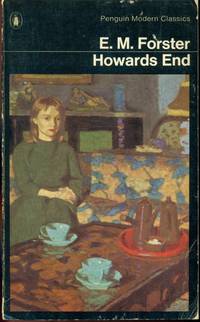
Set in Edwardian England at the beginning of the 20th century, during that brief but now seen as idyllic decade when the full horrors of the twentieth century were yet to emerge, ‘Howards End’ concerns three families: the Wilcoxes, the Anglo-German Schlegels, and the Basts. Each family is very precisely defined in terms of their class. The Wilcoxes are the more prosperous family, but their money derives from business rather than inheritance. Mrs Wilcox is differentiated from the rest of her family by her inheritance of the family home, the ‘Howards End’ of the novel’s title. The Wilcoxes are determinedly conservative and patriarchal, fiercely rejecting women’s suffrage and ordering their servants around brusquely. The Schlegels sisters, Margaret and Helen, are more urban and liberal, interested in the arts and living on inherited money without having to work for a living. The Basts are working class, and while Leonard is an insurance clerk he has aspirations for a life of culture. His wife appears only briefly in the novel, but plays a crucial part in one of its moment of melodrama.
After the Schlegels and Wilcoxes meet on holiday in Germany, Helen visits the Wilcoxes at their country home, (Howards End), where the novel opens. Impetuously she becomes engaged to the younger son, Paul, although they both almost immediately realise this has been a silly mistake, and call the whole thing off. The Wilcoxes move to London, abandoning Howards End until the end of the novel, into an apartment close to the Schlegels’ home. Margaret Schlegel and Ruth Wilcox become unlikely friends, but this friendship is cut short by Mrs Wilcox’s unexpected death. On her deathbed she bequeaths Howards End to Margaret but the bequest is informal and Margaret does not become aware of it until many years later. The Wilcox’s burn the note and agree never to speak of it, considering it a betrayal.
In a parallel plot line, the Schlegel sisters meet Leonard Bast at a concert. Leonard is an impoverished clerk about to marry a much older woman. Leonard yearns for a life of culture and the arts. Mr Wilcox warns the sisters that the insurance Leonard works for is likely to go bust – they in turn warn Leonard, who quits his job for something less well paid, only for that advice to turn out to be completely wrong.
Another time jump, and Henry Wilcox, the family patriarch and widower, and Margaret (the older Schlegel sister) become friends. Unsuited for the life of a bachelor, Henry proposes to Margaret. This is a marriage of opposites, and it is uncomfortable to a modern reader to see Margaret bullied into submission by her boorish husband, devoid as their relationship is of any outward sign of affection or compatibility. (In a horrible parody of affection, Henry refers to Margaret as “it” – “What a practical little woman it is! What’s it been reading” (chapter 31). Henry’s children are unhappy with this marriage – Margaret is an outsider, and their opposition is focussed on a suspicion that this is a long term plan to claim her rights to Howards End.
The melodrama really starts in earnest at the fateful wedding of one of Mr Wilcox’s children, Evie, in Shropshire. Distressed by finding the Bast’s living in poverty, and blaming Mr Wilcox for their situation, she bizarrely drags them to Shropshire to confront him. Unsurprisingly that doesn’t go well – in fact it goes horribly wrong, and from this point the events of the novel spiral badly out of control.
Forster is usually considered a liberal novelist, a defender of the arts and liberal values against the barbarism of the Wilcoxes and their ilk. Certainly the Schlegels are the more sympathetic personalities in the novel, but the whole thrust of the narrative is an attempt to reconcile the different aspects of the national character, bridging the gap between progressive and conservative, rich and poor, rural and urban – all of which is brought together in the novel’s central location, Howards End, and the very modern blended family that eventually comes to live there.
‘Howards End’ is usually considered a “state of the nation” novel, in which the central theme concerns how the country is emerging from the Victorian period to face the challenges of the twentieth century. In this reading the Wilcoxes can be seen as the confident, bullying imperialist, always ordering the working classes about. Mrs Wilcox represents the aristocracy, unifying the disparate elements of the novel through her house, ‘Howards End’. The Schlegels are the cultural life of the country, and Leonard Bast the apologetic and slightly pathetic representative of the working class. I’ve picked out a few quotes which illustrate this discussion of class:
“Dear Margaret, do come into the library and shut the door. Your maids are dusting the banisters”. (Chapter 2)
This is Mrs Munt, the sisters’ aunt, speaking. There are a number of things that jumped out at me when reading this sentence. First, they have a library. This is a novel in which lots of contrasting homes feature, and this is one of the central locations. The dimensions of the Schlegel’s London home in Wickham Place (a fleeting reference to Austen perhaps?) are never given. But it must be a decent size to have a library. Second – and this point is made several times elsewhere in the novel – it is not the done thing to speak of private or personal matters in front of staff. But third, and possibly most noticeably, the sisters have at least two, and possibly more, maids. Servants feature extensively in ‘Howards End’, although they are rarely given a voice (I think one of the chauffeurs might have a line or two) but essentially they are a servile underclass treated as disposable items of equipment. There is a passing indication that employing and retaining servants is something that is becoming increasingly hard in Edwardian England, and of course that situation was to get markedly worse during and after the Great War, but there is a strong line linking the maids, valets and butlers of Austen’s Regency novels and the Schlegel’s and Wilcox’s domestics nearly 100 years later.
“’Esprit de classe’…was strong in Mrs Munt. She sat quivering while a member of the lower orders deposited a metal funnel, a saucepan, and a garden squirt beside the roll of oilcloth.”
(Chapter 3)
Mrs Munt is essentially comic relief in this novel, and we are presumably intended to find her sense of outrage at the way she is being treated, her silent impotence, amusing. There certainly is something comic in the list of miscellaneous objects being loaded in to the car from the ironmongers – but class and class instincts are never far below the surface in ‘Howards End’. Here the shop-keeper is a representative of the lower orders, in front of whom class spirit dictates that emotions, particularly those of women, must be strictly checked.
“She (Mrs Wilcox) approached just as Helen’s letter had described her, trailing noiselessly over the lawn, and there was actually a wisp of hay in her hands. She seemed to belong not to the young people and their motor, but to the house, and to the tree that overshadowed it. One knew that she worshipped the past, and that the instinctive wisdom the past can alone bestow had descended upon her – that wisdom to which we give the clumsy name of aristocracy.” (Chapter 3).
Forster returns to the issue of class, claiming here that aristocracy is ‘the instinctive wisdom of the past’ – which is why the country and its assets should be left in the hands of the upper classes, not people with pretensions above their stations such as Leonard Bast. This is profoundly conservative perspective, and there is little reason to believe it is not the author’s as well as the narrator’s. incidentally, that wisp of hay in Mrs Wilcox’s hands makes a reappearance almost 300 pages later in chapter 43, as Margaret considers the aftermath of the confrontation at Howards End between Charles Wilcox and Leonard. “Life was a deep, deep river, death a blue sky; life was a house, death a wisp of hay”. This echo from the novel’s opening to its conclusion can’t be an accident (death is not, after all, a wisp of hay) and I suspect is Forster’s way of linking the opening scenes at Howards End with the novel’s conclusion.
At Mrs Wilcox’s funeral the narrator describes a woodcutter high in a tree, looking down at the ceremony. “With a grunt he descended, his thoughts no longer on death, but on love, for he was mating”. I can’t recall any ever reading about someone engaged in an ongoing sexual relationship – which is what Forster means – described in this way. It is coarse and animalistic – it implies that is all he is doing, copulating, rather than being in love. Without question he would not describe the relationships between the other characters in the novel in this way. The conception of Helen’s baby is virtually immaculate by comparison. Put simply, this is the language of class hatred. Is this the narrator who finds working class people no better than animals, or is it Forster? I could scour Forster’s diaries and correspondence to try and identify his personal opinions on class and sexual relationships, but that wouldn’t really answer the question. Certainly the perspective is consistent with the narrator’s other comments on class, such as the equally brutal and faintly ludicrous “We are not concerned with the very poor. They are unthinkable, and only to be approached by the statistician or the poet.” (Chapter 6)
There’s much to enjoy in ‘Howards End’. It is a thoughtful novel of ideas. At times the writing goes over the top, and the narrator becomes more of a preacher, such as here:
“Margaret realized the chaotic nature of our daily life, and its difference from the orderly sequence that has been fabricated by historians. Actual life is full of false clues and sign-posts that lead nowhere. With infinite effort we nerve ourselves for a crisis that never comes. The most successful career must show a waste of strength that might have removed mountains, and the most unsuccessful is not that of a man who is taken unprepared, but of him who has prepared and is never taken. On a tragedy of that kind our national morality is duly silent. It assumes that preparation against danger is in itself a good, and that men, like nations, are the better for staggering through life fully armed. The tragedy of preparedness has scarcely been handled, save by the Greeks. Life is indeed dangerous, but not in the way morality would have us believe. It is indeed unmanageable, but the essence of it is not a battle. It is unmanageable, but the essence of it is not a battle. It is unmanageable because it is a romance, and its essence is romantic beauty.”
I am afraid this means very little to me, and I don’t read novels for this level of patrician pomposity. But if you skim over these paragraphs, and I recognise you really shouldn’t have to, then what remains is an important novel that bridges the gap between the authors of the Victorian era and the modernist writers of the twentieth century.
 The Reading Bug
Lovely review! Forster is one of my favorite writers. Which book of his have you enjoyed the most? Although I liked Howards End, I enjoyed A Room With a View and A Passage to India a lot more. And Maurice too!
LikeLiked by 1 person
I have just finished Where Angels and am planning to write up my review in the next day or so. I have got to be honest – I thought the ending was unsuccessful, although I am not sure any other ending would have worked either given the context. Still working things out though so let;s see.
LikeLiked by 1 person
Pingback: Book review: Collected Short Stories, by E. M. Forster, 1947 | The Reading Bug