
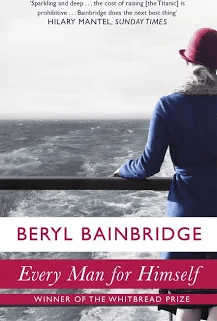
Every Man for Himself by Beryl Bainbridge, 2002
Half past four on the afternoon of 8th April 1912 – the weather was mild and hyacinths bloomed in window boxes – a stranger chose to die in my arms. “Please,” I said, as he pitched forward and clutched me round the waist. We both fell to our knees. Over the road a crocodile of Girl Guides sashayed sing-song through the ornamental gates of the public gardens.
I wrote some time back about my policy of avoiding reading much, if anything, about a novel before reading the novel itself. Apart from the obvious risk of spoilers, pre-reading can influence your reaction to a book, shaping it in a certain direction. For example, if you are told a novel is ‘a work of genius’ it might encourage you to overlook any flaws you identify in it. A similar problem occurred after I read Beryl Bainbridge’s book about the Titanic disaster, Every Man for Himself, when I came across this article she wrote in the Guardian in 2009. In it she describes the process of negotiating a new contract with her publisher:
“I’d been about to seek another publisher, one who would offer me money, and told Baird-Smith that I was willing to stay with him if he granted me a three-book contract, something miraculous I’d heard of in regard to other authors. When he asked me what themes I was considering, from the top of my head I blurted out Scott going to the pole, the sinking of the Titanic and the Crimean war. Baird-Smith then offered me a substantial advance, which shook me; I wasn’t used to payments.”
Bainbridge was true to her word, writing Master Georgie about the Crimean War, The Birthday Boys about the Scott Polar expedition, and Every Man for Himself. Does it matter that Bainbridge was writing to order rather than being genuinely inspired by her subject matter? A bit, yes. Because I think it shows in the novel itself. The writing is rather ‘by the numbers’ and only sporadically shows a real interest in the subject matter. Most of the novel sees the characters in a holding pattern, running up the word count and down the clock until the iceberg strikes.
As a thought exercise, imagine you were the author in this situation, committed to writing a novel about the Titanic. How would you go about addressing the central challenge of this scenario, which is obviously the lack of any suspense about the overall ending? The first thing you would do, I would suggest, is try to make your central character or characters people the reader cares about, wanting to know whether they survive – in other words you reframe the question ‘What happens?’ to ‘What happens to X?’ This would involve giving the character a backstory and the reader a reason to care about them. The other element I think the hypothetical novel would need would be some depth – for example consideration of social issues or class. The differential in survival rates on the Titanic – 62% of first-class passengers survived, against only 24% of third class passengers (41% for second class if you were interested) – has always struck me as something worth detailed analysis. Was it because the first-class passengers were prioritised in the evacuation and in life-boat spaces, or was it more to do with where they were in the ship when the collision occurred? (To be clear, I am 100% sure that this differential has been analysed very fully by historians – I just don’t think the issues have ever been explored by novelists). And then there’s the crew, who had to supervise the evacuation and enforce the ‘women and children first’ protocol, many of whom stayed behind to carry out their duties to the last minute. The Titanic sinking has so many dramatic stories, conflicts, moments of tension and so on that it would be almost impossible to write a novel that didn’t engage the reader in the drama of the situation.
And yet….
Every Man for Himself tells the story of the sinking of the Titanic through the eyes of one of the first-class passengers, 22 year-old Morgan, part of a very wealthy banking family. Morgan is an orphan who was brought up relatives. Before boarding the ship he sees a man who has fallen onto some railings, dying in a rather clumsy piece of foreshadowing. Once onboard he spends his time socialising with the other first class passengers. He shows some interest in the construction of the ship (having worked on some aspects of its design – presumably the author providing us with a reason to care a little more about the outcome?) and finds out that it set sail with a fire in one of the coal holds not completely under control. There are also occasional mentions of warnings from other ships about icebergs ahead. But the Titanic was unsinkable, so there is nothing to worry about…. He is attracted to socialite Wallis Ellery, who flirts with him while all the time having a fling with one of the other passengers, but he recovers fairly quickly when he finds this out.
The Titanic’s evacuation order (which, from what I can tell, was a long-established protocol) was the very opposite of the novel’s title – not ‘every man for himself’ but ‘women and children first’ – an order that was largely voluntarily complied with. I think the author chose this title as a commentary on the behaviour of the first-class passengers prior to the collision, where their personal interests, well-being and finances are prioritised over everyone else. Every man for himself was the spirit of the age.
Bainbridge does her best to differentiate the large cast of characters, but at times they blurred into one another. Everyone seems to know everyone else (Morgan even knows the captain). This privileged social circle is intimate and hostile to outsiders. Morgan describes his first dinner on board thus:
Dinner that evening was a boisterous affair. Ours was a small world and between the soup and the fish we were all constantly bobbing up and down to acknowledge people we knew; but for the intermittent and minute flickerings of the electric lights we might have been dining at the Ritz in Paris. The Thayers stopped at our table, the Daniels, Mrs Snyder, the Speddens of Tuxedo
Park, Colonel Gracie, jolly Mrs Hogeboom with the excessively ritual eccentric Mrs James Brown, her bridge crony from Denver, in tow. As usual, the latter was dressed inappropriately and wore a gigantic hat across whose brim languished an entire stuffed bird. Colonel Astor and his young bride passed by without a nod, leaving Ginsberg on his feet with his hand held foolishly out. He said he knew Vincent, the colonel’s older son, and had often fenced with him.
Most of these characters are not mentioned again and are just passing across the stage, mildly comically, to make the point as to how close this circle is. But it makes it hard to care about the characters who do eventually emerge from the throng. Morgan fails to make any real new associations with other passengers and neither does the reader. Second and third class passengers, and the crew, are restricted to walk on parts. So I am not sure we really care who lives and who dies when the novel reaches its inevitable climax. In other words this was a disappointing effort, going through the motions by a novelist who at her best was very much better than this.
 The Reading Bug
Your comment about whether you are commissioned to write about something could be a writing by numbers has made me think on this question… but I wonder… She committed to the Titanic, but it could have been anything really.. it could be a current day love story with a historic connection and flash back overlaps, it could be a person in the museum who looks after the titanic collection… It could be the story of a survivor with survivor’s guilt… lol. I think she could do with this ‘subject’ as she liked, but what is interesting from your review is that she decided to tackle it ‘vanilla’ and that has been done before…
LikeLiked by 1 person
I think that’s right – there are lots of ways this topic could have been made fresh again, but the approach Bainbridge used was very traditionally linear. The characters did not come to life at all. Disappointing because she was usually much better than this.
LikeLike