100 Best Novels Guardian list, 20th century Literature, Book review, Lolita, Vladimir Nabokov

Lolita by Vladimir Nabokov, 1955

Lolita’ is not an easy book to review. Perhaps more than any other novel that I have reviewed on this blog thus far, ‘Lolita’ comes with a burden of critical responses that make it hard to see the novel for itself. It is an elusive text at the best of times, with its classically flawed narrator, constantly challenging the reader to ask whether Humbert’s words can be taken at face value, as they rarely can. ‘Lolita’ has lost none of its power to shock, even after the passage of more than fifty years since it was published, possibly gaining even more potency as our awareness of child sexual abuse has increased.

So I think I ought to start on safe ground, with a summary of the events and characters of the novel itself. The narrative is told as a recollection of events by the narrator, Humbert Humbert. An introductory chapter purporting to be by the book’s editor, but in fact forming part of the narrative, sets the scene – this is Humbert’s jail-cell confession, written shortly before his death. As with Nabokov’s earlier work, ‘Pale Fire’ there is a significant and palpable gap between the narrator’s view of events, and that of the reader’s, and it is navigating that gap that makes reading ‘Lolita’ both challenging and rewarding.
Humbert is a predatory paedophile, who after a period of grooming establishes a sexual relationship with his orphaned step-daughter, Dolores. It is significant that her name is not Lolita – this is a label given her by Humbert, as part of his attempt to erase her individuality and to control her. It is representative, if you will, of his abuse.
Nabokov set himself a huge challenge here – how to portray a monster through his own eyes, without utterly repulsing the reader. And make no mistake, Humbert is repellent. His abuse of Dolores is charted with euphemisms which do little to disguise the nature of the abuse. Some reviewers and critics (and to be clear, this is not an academic work, so I am not going to provide references to support this claim – assume when I write things like this I simply mean “stuff I have read on the Internet”) fall for Humbert’s version of events, and portray Dolores as the under-age predator, sexually precocious beyond her years, and responsible for seducing poor, vulnerable Humbert. The term ‘Lolita’ has over the years been used generically in this manner, which is a pity, because it should mean “victim”. Indeed, in most popular culture representations of Lolita she is portrayed in Humbert’s terms – sexually precocious, mature, even provocative. I even read one review online which suggested that ultimately the great achievement of this novel is that it makes the reader “fall in love” with Humbert, and that it is a love story. I recognise I am taking a very moral tone here, but part of the reason for keeping this blog in the first place was to chart my authentic reactions to what I read.
What might be interesting would be to give Lolita back her voice. Not as an imaginative exercise, but simply to look at what she says, as recorded by Humbert, but without his commentary. In the first part of the novel Lolita is only glimpsed, and is almost completely silent. When she is collected from camp by Humbert following her mother’s death, she has a few lines, but these are mainly every day observances. Of her thoughts on her abuse we have scarcely half a dozen lines, including (and to be clear, this is not an exhaustive list of her comments, but I think quite representative):

Before Humbert begins to rape her:

Don’t drool on me. You dirty man” (130)

“Look, let’s cut out the kissing game”

“Lay off , will you”

And after the attacks begin:

“You revolting creature. I was a daisy-fresh girl, and look what you’ve done to me? I ought to call the police and tell that you raped me. Oh you dirty, dirty old man.” (159)

“Can you remember, you know….the hotel where you raped me”.

“An ominous hysterical note rang through her silly words. Presently, making a sizzling sound with her lips, she started complaining of pains, said she could not sit, said I had torn something inside her” (159)

While you could expect Humbert to do everything possible to avoid this self implication, Nabokov has him implicate himself time and again. He is fully aware that he has no defence to his actions, and that Lolita is far from a willing accomplice, nor partially responsible for the crimes, as some commentators (see above) would have it. Apart from her age, and the significant age gap between them, he is a twice married man, and her step-parent, in loco parentis. He bribes her with clothes and treats, and finally pays her per sexual transaction. He threatens her with entry into the care system if she reports his attacks. He attempts to render her unconscious with sleeping pills in order to facilitate his attacks. None of this is consensual, even were consent to be possible.

“Eventually she lived up to her I.Q. by finding a safer hiding place, which I never discovered, but by that time I had brought prices down drastically by having her earn the hard and nauseous way permission to participate in the school’s theatrical programme. (209) With this clear illustration that even delusional Humbert realises his attacks are nauseating, can critics still describe this as a love affair? (I have found one reference to the magazine ‘vanity Fair’ describing ‘Lolita’ as “the only convincing love story of our century”.)

She had entered my world, umber and black Humberland, with rash curiosity; she surveyed it with a shrug of amused distaste; and it seemed to me now that she was ready to turn away from it with something akin to plain repulsion. Never did she vibrate under my touch, and a strident ‘what d’you think you are doing?’ was all I got for my pains. To wonderland I had to offer, my fool preferred the corniest movies, the most cloying fudge. To think that between a Hamburger and a Humburger, she would – invariably, with icy precision – plump for the former” (Nabokov, 166).

Some kind of normality settles on their existence as Humbert and Dolores restlessly criss-cross the country, always on the move to prevent her from making any friends or appealing to anyone for help. But Humbert lets slip that Dolores never comes to terms with the tragedy of her situation, her captivity:

“I catch myself thinking today that our long journey had only defiled with a sinuous trail of slime the lovely, trustful, dreamy, enormous country that by then, in retrospect, was no more to us than a collection of dog-eared maps, ruined tour books, old tires, and her sobs in the night – every night, every night – the moment I feigned sleep. (199)

Is this the behaviour of a young women enjoying the company of her older lover, (as Humbert would love it to be, but cannot persuade himself it is) or that of a deeply traumatised hostage?

‘Lolita’ is an extraordinary novel, written in a complex, allusive and elusive style which almost demands a re-reading. Its subject matter makes it hard to read at points, and I found myself immune to the charms of the monster that is Humbert Humbert. You have to admire Nabokov’s bravery in tackling what remains a taboo subject, and doing so by rejecting an easy stereotypes. In looking for a key to understanding this novel, a fruitless search I know, I keep coming back to the author’s post-script, where he describes the germ of the novel. A newspaper story told of an experiment where a chimpanzee was taught to draw, and eventually drew the bars of its cage. We can ignore the reality of the chimp’s life, but when given the ability to communicate it is the thing it draws. Lolita was caged, imprisoned by Humbert, and deprived of a voice, and we can catch glimpses of the horror of her situation all the more vividly because we see them through the soft-tinted lens of Humbert’s perspective.
 
Standard
100 Best Novels Guardian list, American literature, Booker Prizewinner, gothic fiction, horror, http://schemas.google.com/blogger/2008/kind#post

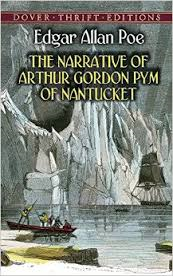
The Narrative of Arthur Gordon Pym of Nantucket by Edgar Allan Poe (1838)

One of my reasons for exploring the Guardian’s ‘best 100 novels written in English’ list is to try and find some hidden gems – books that I have not come across before that are really worth reading. Poe’s only novel, “The Narrative of Arthur Gordon Pym of Nantucket‘ meets only one of these criteria – I had not heard of it before – and now I know why.

The novel is an adventure story, following Pym as he stows away in a ship, running away to sea against his father’s wishes. He is aided by a friend, one of the crew members, and plans to reveal his presence when the ship is past the point of no return. However, a mutiny spoils this plan, and he has to remain hidden, without help from his friend, for a long time. His privations are detailed in the first person narrative in considerable, not to say tedious, detail. Finally he emerges from his hiding place, and helps in a counter-mutiny. Having secured control of the ship Pym and friends are immediately struck by a storm, which rages for days, leaving them with very little food or drink, and their ship a wreck. Again Poe details the long days of surviving on the wreck – this is actually a very short novel, but it certainly didn’t feel it while reading – until they finally resort to cannibalism, choosing one of their number to eat by lots.

Finally rescued, Pym joins another ship voyaging to the southern seas. Previous voyages of exploration are recounted in yet more detail. The purpose of all this detail is presumably to give the narrative a sense of realism, although I found the various adventures completely unconvincing. While stowed away on his first ship, for example, Pym is joined for several days by his pet dog, who his crew-member friend just happened to take along with him. Despite the ship having been taken over by the mutineers the dog at no point barks or otherwise makes his presence know. As soon as the storm arrives the dog stops being mentioned, presumably thrown overboard.

The voyage ends in the discovery of a mysterious island group deep in the Antarctic, when the rest of the group apart from Pym and a friend are massacred by duplicitous natives. Escaping from the island by canoe, Pym travels south towards the pole, when the novel ends abruptly with the appearance of a mysterious figure.

I’ve read incomplete novels where the author died mid-composition that end with more coherence and naturalism than this. It just stops, and it is obvious that the author, having reached a word count (or equivalent) thought “that will do” and moved on. The “editor’s” postscript (which incidentally is not included in the kindle version of the novel I initially read, which is really irritating) is a fig leaf that does nothing to compound the absurdity of the ending.

I look for at least one of the following in any novel: characterisation, a decent story, some interesting use of language, or some ideas. Poe provides none of the above. Pym himself hardly emerges from his narrative at all – we really have no idea what he is like, other than extraordinarily lucky in surviving his various in extremis situations, which of course we know he does from the novel’s ludicrous subtitle. (Comprising the Details of Mutiny and Atrocious Butchery on Board the American Brig Grampus, on Her Way to the South Seas, in the Month of June, 1827. With an Account of the Recapture of the Vessel by the Survivors; Their Shipwreck and Subsequent Horrible Sufferings from Famine; Their Deliverance by Means of the British Schooner Jane Guy; the Brief Cruise of this Latter Vessel in the Atlantic Ocean; Her Capture, and the Massacre of Her Crew Among a Group of Islands in the Eighty-Fourth Parallel of Southern Latitude; Together with the Incredible Adventures and Discoveries Still Farther South to Which That Distressing Calamity Gave Rise.) The story is extremely episodic and predictable, a loosely connected series of incidents. The language is inoffensive, at best, and the only idea worthy of the name is the suggestion that the south polar regions might lead to undiscovered continents, peoples, and species. I am a little more sympathetic to this final point – the world was still being explored in the 1830’s, and new species being found, so this wasn’t as ludicrous as it sounds.

Poe introduces some classic elements of gothic horror into the narrative – cannibalism, pirates, a ghost-ship, entombment, and so on, but ultimately the novel is as spooky as a Halloween costume in June.

<iframe frameborder=”0″ height=”0″ id=”google_ads_iframe_/183932232/GS_300x250_BTF_1_0__hidden__” marginheight=”0″ marginwidth=”0″ name=”google_ads_iframe_/183932232/GS_300x250_BTF_1_0__hidden__” scrolling=”no” src=”javascript:””” style=”border-image: none; border: 0px currentColor; display: none; vertical-align: bottom; visibility: hidden;” width=”0″>I’m not alone in finding this all quite ridiculous. In an introduction to the novel, Jeremy Meyers wrote that Poe’s choice of the incomplete journal form “allows Poe to disguise and excuse his own inability to control the plot and complete the novel.” Poe himself called it a “very silly book.” Indeed. I don’t know whether the unhappy experience of writing this novel led Poe to concentrate on poetry and short stories, but it is probably a good thing if it did.

Standard
Book review, Bryson, travel writing

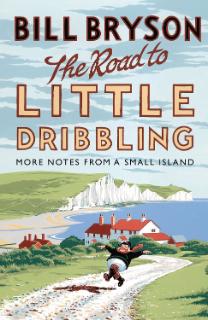
The Road to Little Dribbling: More Notes From a Small Island – Bill Bryson – 2015

Many books are commissioned, but few as nakedly as this – Bryson openly admits that it was his editor’s idea to revisit the places he passed through for his earlier, and hugely successful, ‘Notes from a Small Island’ on the twentieth anniversary of the first book. Bryson has little interest in the idea, but has to make a living, and there are worse ways of doing so than this. In case we were in any doubt that this is a Notes Mark 2, the subtitle rubs the point in. As a result it is unavoidably obvious that Bryson is on auto-pilot for much of this book, going through the motions in a fairly loveless way.

Notes Mark 1 had a certain charm. It showed the newly arrived Bryson falling in love with 1970’s UK, rather remarkably given the many things he found profoundly wrong with the country, from its racist television programmes to its appalling customer service. A lot has changed since Notes Mark 1, and while Bryson clearly realises that revisiting the poorly remembered scenes of his first trip round the country is a mistake, he does it anyway. At least, he takes the trip after a fashion, although the visits to various locations are completely haphazard, fitted in around his busy schedule of readings and family commitments, giving the book a very fragmented flavour.


Some reviewers have been appalled at Bryson’s grumpiness at what he finds, and they have a point. But Notes Mark 1 found much to be grumpy about first time round, and the second time round the block he finds many things much improved. Inevitably much has also deteriorated, and many of Bryson’s complaints will be familiar – poor customer service, the loss of individual high street shops, green belt development, and so on. If this was all the book consisted of – a long whine about how things were so much better in the good old days – then I doubt I would have ever made it to the end, completist though I am. (Word doesn’t recognise that word, which is strange as it is in lots of online dictionaries. Go away red-underlining. Clicks ignore. That’s better). But happily there is more. Bryson has a wide range of anecdotes to tell about the places he visits, and some of these are entertaining and informative. I suspect his working method is something along the lines of telling a researcher he is going to Telford (or wherever) the following week, and asking them to come up with some interesting “QI” style facts about the town and its inhabitants, which he can then discover on location.

Now here is something slightly interesting – the American version of this book has a different subtitle, to whit “Adventures of an American in Britain”. This is wrong in several ways – Bryson isn’t an American, having taken British citizenship recently as explained in the book. He certainly doesn’t have any adventures – unless you call walking rainy streets looking for something to do, finding a discarded newspaper in the corner of a dingy backstreet pub, flicking through it, giving us one or two headlines, then retiring for a curry somewhere, adventurous. Bryson does little to disguise the fact that he often finds the whole exercise quite boring, and wishes it were over and he could go back to his family.
In between all the nonsense, Bryson occasionally has something interesting to say about the changes he sees in the country, best described here:

It was known as the Sick Man of Europe. It was in every way poorer than now. Yet there were flowerbeds on roundabouts, libraries and post offices in every village, cottage hospitals in abundance, council housing for all who needed it. It was a country so comfortable and enlightened that hospitals maintained cricket pitches for their staff and mental patients lived in Victorian palaces. If we could afford it then, why not now? Someone needs to explain to me how it is that the richer Britain gets the poorer it thinks itself.”

Well said – only disappointing that he doesn’t follow this through to its inevitable conclusion about the way money is spent in this green and pleasant land.

There are also occasional glimpses of genuine wit, even if these stand out by their isolation, such as:

According to Time Out magazine, at any given moment there are 600,000 people on the Underground, making it both a larger and more interesting place than Oslo.”

I’ll keep reading Bill Bryson, because I always feel slightly virtuous when doing so, but I am not sure I am ever going to enjoy him in the way I did when we were both a bit younger.  
Standard
Book review, children's literature, Neil Gaiman, The Graveyard Book

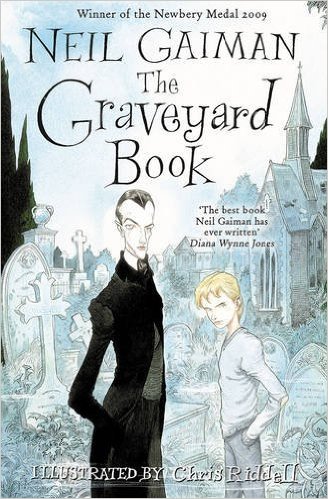
The Graveyard Book – Neil Gaiman –

Among the candidates for award for the best opening line to a children’s novel, this has got to be in with a shout:

“There was a hand in the darkness, and it held a knife. The knife had a handle of polished black bone, and a blade finer and sharper than any razor. if it sliced you, you might not even know you had been cut, not immediately.
The knife had done almost everything it was brought to the house to do , and both the blade and the handle were wet.”

Pretty chilling stuff. ‘The Graveyard Book’ opens with the murder of the parents and sister of a young child, Bod (short for Nobody) who escapes the attacker and ends up in a graveyard. Here he is protected, and eventually brought up by, the ghosts and other phantasmical creatures that live there. I have read that this book draws inspiration from Kipling’s ‘The Jungle Book’. That makes sense – young child brought up by non-humans, gradually comes into contact with the outside world and learns its strange ways, all the while menaced by the killer who claimed the lives of his family, and finally getting his revenge. But to be honest the parallel was not all that obvious when reading this book. Gaiman may borrow the structure of ‘The Jungle Book’, but he makes the material entirely his own. In part that comes from the supernatural element, which he has a lot of fun with. All the ghosts are introduced by their gravestone inscriptions, (“She sleeps, aye, yet she sleeps with angels” or simply “son of the above”) and their lives and deaths all form part of their characters. But Gaiman also adopts a much darker tone for the novel – whether it be in the real menace provided by the murders of Bod’s family, the repeated further attempts on his life, or the sad fate of some of the graveyard’s inhabitants.

‘The Graveyard Book’ will appeal most to pre-teens with a taste for the macabre and supernatural, but there is plenty of interest for all readers, not least (in this Bloomsbury edition) the wonderful illustrations by Chris Riddell. Personally what I enjoyed most, and what I suspect was the original inspiration for the novel, was the extraordinary sense of place. The graveyard itself is really the central character of the book, and Gaiman recreates and imagines it in wonderful detail – I find it hard to imagine that it is not based on a real location. Some novels start with a location, a setting, which then become the backdrop for a series of adventures. In using this approach, in which the majority of the events of the novel are set within the confines of the graveyard itself, Gaiman ran the risk of the whole thing becoming quite claustrophobic, but overcomes this by breaking free from time to time, and by exploring the graveyard itself as if it is Bod’s whole world. Because he spends all his time with ghosts, Bod is utterly unafraid of death, and sees nothing to worry about in the fact someone is determined to murder him. The other principal achievement of the novel is in its creation of a set of villains – the Jacks of All Trades – a sinister, other worldly conspiracy – that are genuinely scary.

Standard
100 Best Novels Guardian list, 20th century Literature, American literature, Animal stories, Book review, Jack London, The Call of the Wild

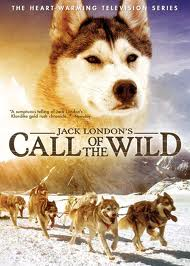
The Call of the Wild – Jack London – 1903

‘The Call of the Wild’ follows the adventures of Buck, a St Bernard/Collie cross. Buck is stolen from his Californian home, and sold to fuel the need for sled dogs in the Yukon as part of the 1880s gold rush. Buck goes from being a relatively pampered pet to being a possession, to be used and treated as a commodity, beaten close to death, worked even closer. London was a socialist and had first hand experience of the privations of the Yukon and the brutal treatment of animals, but I couldn’t avoid thinking that the story is more than just about dogs. 

Aren’t there clear parallels between the way Buck is broken and abused, and the treatment of slaves in America? I’m not suggesting the novel is a metaphor or parable – it could just be a story “about dogs” (I often check the Amazon reviews on books I am planning to write about, to get a feeling for the overall response, and see if there’s anything significant I have missed. One reviewer for ‘The Call of the Wild’ claims to have been disgusted upon finding out that the novel was “about dogs”, which I have to say I found wonderfully dumb) – but London’s political background suggests that his sympathy for the literal underdog extended beyond animals.

Buck is trafficked together with other captured and bought slaves, sorry dogs, to the Yukon, where he is savagely beaten until the fight goes out of him. He learns his new role chained to the straps of a sled. He is given bare rations, and slowly finds a place in the pecking order amongst the team. Once his job is done he is casually discarded, bought at a discount because he is no longer needed, and once again placed in chains. He finally finds an owner who treats him with love, but this relationship ends brutally, and Buck surrenders to the primal instincts he has been fighting for some time, and gives in to the ‘call of the wild’, becoming leader of a wolf pack.

This is not a story for animal lovers, or at least not those with any trace of sentimentality. Dogs die throughout the book, often killed by Buck himself, but also in a wide variety of other manners. Dogs are portrayed as fierce animals, following instincts derived from their days as man’s earliest companion, when the world was much darker and more dangerous. The novel of course anthropomorphises Buck, giving him human feelings and thoughts, and an understanding of the world far beyond what any pet would ever actually have, but he remains an animal, killing when he has to, and following his instincts – well, almost all his instincts – London understandably doesn’t goes down that road!

At just over 100 pages long this is a short adventure story that can be read in an afternoon or less. The Yukon is captured realistically through Buck’s eyes, and there is a wide cast of characters – I particularly enjoyed the stupid family who ignore the advice of experienced trappers and disappear through a hole in the ice, as we knew they would. The novel is carried forward at a frenetic pace, and the exercise of seeing the world through an animal’s eyes is well done. But at the end of the day this is just an adventure story, and I suspect London wrote books other than ‘Call’ more appropriate for adult readers. Whether I will seek them out is another matter.

Standard
100 Best Novels Guardian list, Book review, gothic fiction, http://schemas.google.com/blogger/2008/kind#post, Nightmare Abbey, satire, Thomas Love Peacock

Nightmare Abbey – Thomas Love Peacock – 1818

bey‘Nightmare Abbey’ is probably as heavy-handed a piece of satire as you will find in the whole of literature. Neither nightmarish – there are none of the traditional characteristic features of gothic fiction – nor set in an abbey, this short novel is partly a thinly disguised portrait of some of the romantic poets of the time, and partly a pastiche of their works.

It is tedious in the extreme. Some of this is deliberate – in parodying cloying philosophical nonsense it is hard to avoid writing philosophical nonsense. The trick is I suspect in providing just the right amount. There’s little or no characterisation here – all the characters are cyphers – Mr Lackwit, Mr Toobad, or the Reverend Mr Larynx. There’s also little or no narrative. The characters assemble in the abbey, which is really a moated country home on the remote Lincolnshire coast, where Scythrop Glowry, (admittedly, a pretty magnificent name) falls in and out of love as eligible females are paraded before him. Even Robert McCrum in choosing this novel for his list of 100 best novels in English for the Guardian in 2013 describes the plot as “cardboard-thin”. This is because the novel is simply a vehicle for Peacock’s friendly commentary on the lives and love affairs of the romantic poets. It may have had them rolling in the aisles in the early nineteenth century, but surely quickly lost its humour in a decade or two, and today provides many tumbleweed moments. Only one comment hit a chord; when, for the umpteenth time Mr Flosky, a friend of Mr Glowry senior is pontificating on his obscure theories, the narrator notes that he “suddenly stopped: he found himself unintentionally trespassing within the limits of common sense”.

The narrative voice is deeply cynical. Romantic relationships are purely commercial – “marriage is a lottery, and the less choice and selection a man bestows upon his ticket the better” – and married life is a burden – “Mr Glowry used to say that his house was no better than a spacious kennel, for every one in it led the life of a dog”. Jane Austen wrote about relationships and courtships with a similar scepticism, but her characters are far more three dimensional and believable, and if you want a light-hearted commentary on the gothic novels of the period ‘Northanger Abbey’ is an infinitely better choice. That this novel squeezed out ‘Lord of the Rings’, the Gormenghast books, and others from the Guardian’s top 100 novels makes its inclusion all the harder to understand.

Standard
Autobiography, Book review, Mark Seddon, Politics, Standing for Something

Standing for Something, Mark Seddon, 2011

This book is a curious combination of political biography and a rant against Blairism. As the former it is a mess; as the latter it is powerful and persuasive.

The political biography parts of the book, scattered throughout without any apparent structure whatsoever, whether chronological or otherwise, are written in a gossipy, laddish way, and consists almost entirely of anecdotes in which Seddon meets someone famous. These read like jotted down notes, and suffer greatly from lack of context – Seddon was largely an observer of events, rather than a participant. Even though he was a member of Labour’s NEC for eight years, he is the first to admit that during that period the NEC was neutered and largely irrelevant. His anecdotes are all quite slight, and have a half remembered vagueness that suggest he didn’t keep diaries.

But I don’t want to spend too long on what is wrong with this book, because when Seddon starts writing about the failures of the Blair/Brown coup of the Labour Party, and the political betrayals, some of which he clearly feels very personally, the book acquires an authenticity and passion. He has genuine insights into where Labour lost its way, and how it might recover its radical roots. For example:

My hunch is that Labour will eventually be re-radicalised in opposition. It won’t take long before the howls of anger and pain from those at the sharp end – Labour’s natural constituency – will be heard as the coalition cuts bite ever deeper. And this time the newly insecure and visibly more impoverished middle classes, those who work for less pay and pay more in taxation in an intended decade long Tory attempt to claw back the deficit, will become more and more angry. Whereas a quarter of a century ago it was working class jobs that were going in their hundreds of thousands, by the end of the first decade in the twenty-first century middle-class jobs had become increasingly casualised.” (251)

“And as the first decade of the twenty-first century ended it was fast becoming apparent that the ordinary people of these islands were being forced to pay in their jobs and taxes for the greed of the bankers, the industrialisation and pauperisation of an economy” (257)

Obviously this was written in 2011 or 12, long before the end of the coalition and the rise of Jeremy Corbyn, but I am fairly sure I know who Seddon will be cheering on now, albeit from the New York sidelines.

P.S. I did say I wanted to avoid spending too long on the negatives, but I don’t at the same time want to self-censor. The editing of this book was really poor. Here’s one example:

‘Greeting Marra’ was his opening gambit before heading upstairs to plan our trip on an Eastern Counties double-decker bus to the sleepy Essex port of Wivenhoe, where coal was being landed. Our first outing as flying pickets, in an Eastern Counties double-decker bus, ended comically with us getting lost on the way…” (131/132)

Two sentences, both mentioning the same trip on the same bus, probably written a different times, and then stitched together without anyone noticing the repetition. This happens quite a bit. Also wearying was the staleness of some of the language:

“The expenses scandal crossed a new Rubicon“; “the icing on the cake was provided by the Murdoch media, which had managed to cast its baleful spell over the political class”; “Standing for Something finally opens the lid on the New Labour years, casting light into dark places“; all tired clichés from page 2 – on the following page “leading lights”, “warts and all”, “behind the scenes” (twice) and “rubber stamping” all jumped out, or rather limped out as I got increasingly frustrated with the important but poorly expressed thoughts Seddon or his editor were trying to convey. Of course look back through these blogs and you will find worse and more, but then I’m not a professional journalist, and don’t enjoy the benefits of an editor (except the occasional glance over the shoulder).

Standard
21st century literature, Book review, David Nicholls, humour, The Understudy

The Understudy by David Nicholls

Sometimes novels don’t quite work. They really ought to, but at the end you are left with a vague feeling that the author missed an opportunity to write an entertaining, satisfying relationship novel, and instead wrote three quarters of one. This was Nicholls’ second book after ‘Starter for Ten’, which has a single white young man as its central character, through whom we see the events of the novel, as does ‘The Understudy’. While the protagonist in ‘Starter for Ten’ is relatively easy to identify with – he is fallible, but charming (although I am not sure female readers would agree) – the central character in ‘The Understudy’ is far less engaging. For a start Nicholls has given him a silly name – Stephen McQueen – and the joke “Stephen with a ph” wears thin pretty early on. Each time it was repeating I was reminded of the fact that as an aspiring actor he would have adopted a different professional name after about 30 seconds. He is dishonest, unsuccessful, profoundly so, divorced, and quite bitter about his lack of success. 

I am not sure if we were supposed to identify with McQueen, or find him in any way endearing, but I didn’t. He is manipulated and walked all over by Josh, the obnoxious character he understudies (if Josh is a portrait of anyone Nicholls knew in real life, they should sue!). Nobody really likes him, his life is a complete mess, his pursuit of acting success at the cost of his marriage is quite clearly pointless, rather than noble, and while the novel ends with him recognising that, failure isn’t entertaining or funny. He does – kind of – get the girl – but the attraction is really hard to understand or believe, and only the abrupt ending prevents us from seeing the inevitable rejection. I suspect Nicholls’ made Stephen so unlikeable in an attempt to avoid the standard rom-com clichés, but he didn’t follow this through – the character may be creepy and unloveable, but the situations he finds himself in are predictable and lame, all informed by a self-consciousness and determination to demonstrate that this isn’t ‘Love Actually’, actually.

The plot revolves around McQueen’s part as an understudy in a successful stage play about Lord Bryon, in which Josh has the lead. Each night McQueen has little to do except hope Josh is ill or has an accident, which he never does. Josh invites him to a party – and the comedy set up here is that Josh is actually asking him to help out as a waiter, while Stephen thinks it is an actual invitation. I saw that coming a mile off, but it doesn’t make sense – if you are having a party professionally catered, you don’t supplement the staff with vaguely worded invitations to casual acquaintances. That gives you a good flavour of the comedy incidents that are scattered through the novel, and which aren’t really that funny. Nicholls does his best, and there are plenty of drinking to excess, unsexy sex scenes, and theatrical failures – but its all a bit laboured and predictable. As an example, Stephen accidentally steals (whilst drunk) a BAFTA trophy from Josh’s flat. You know that the chances of him returning it with an apology, anonymously if necessary, are nil, this being a relationship comedy. So it’s just a question of when, not if, this theft is discovered, and sure enough, the award is found at the back of a wardrobe just in time for it to be used as an impromptu weapon.

‘One Day’ and ‘Starter for Ten’ have both been made into reasonably successful films, and my suspicion is that ‘The Understudy’ would actually make a better film than a novel. Some of the physical comedy would work better – for example the scene with Stephen dressed up as a squirrel for a children’s ‘How to count’ film, which he has lied about to his family, describing it as a crime drama – and some of the dead wood could be pruned. But if you are looking for a follow-up for ‘One Day’, ‘Starter for Ten’ would be a much better (forgive me) starter for ten.

Standard
100 Best Novels Guardian list, 20th century Literature, A Clockwork Orange, Anthony Burgess, Book review, Books made into films, Clockwork orange

A Clockwork Orange by Anthony Burgess, 1961

clockwork‘A Clockwork Orange’ is narrated by the main character, Alex, a teenage boy in a near future but very recognisable society. Alex leads a gang of ultra-violent thugs, who every evening rape, murder, steal, and commit crimes with impunity. Alex really enjoys this aspect of his life, and the casual nature with which he describes his crimes is chilling. This effect is compounded by several other features of the novel – his age, his love of classical music (which poses the question how could one love music and yet be a monster) – but principally through the use of nadsat, an invented teenage slang. Burgess had noticed that teenagers adopt a specialist argot to confirm membership of their tightly knit group (which of course is the whole point of slang) and writes almost exclusively in this language. Alex can speak conventional English, and does so when the occasion requires (when he is pretending to be civilised, usually in furtherance of a crime) but his language of choice is nadsat. Just to give a flavour of this:
“There was me, that is Alex, and my three droogs, that is Pete, Georgie, and Dim, Dim being really dim, and we sat in the Korova Milkbar making up rassoodocks what to do with the evening, a flip dark chill winter bastard though dry. The Korova Milkbar was a milk-plus mesto, and you may, O my brothers, have forgotten what these mestos were like, things changing so skorry these days”.

Don’t let the apparent impenetrability of the language put you off – most words can be understood from their context – droogs here being gang-members for example – and even where the exact meaning is not immediately apparent, the overall meaning is usually very clear. The use of an alternative language reinforces the sense of alienation Alex and his droogs feel for the oppressive society they live in.

Burgess tackles several big themes in this novel. Violence and the degeneration of society – Burgess looks at the gang culture of post-war Britain, and anticipates it getting more prevalent and extreme. Free will is another central theme – once imprisoned, Alex is treated, brainwashed, so that any attempt at violence makes him feel immediately unwell, reducing him to a clockwork orange i.e. something apparently natural, but not so). In an aside, it is mentioned that the Government needs this treatment to be effective, to create more prison space for an anticipated influx of political prisoners. Language is also central to the novel, not only to express Alex’s alienation, but also that of his peer group – teenagers literally talk a different language from their parents; Burgess also notes that some ten year old girls that Alex picks up and brutalises speak a different argot – so each group is developing its own language. Burgess isn’t critical of this – he seems to accept it as inevitable, and while nadsat may not be the language of Shakespeare, it is creative and very expressive, both in its adoption of new terms (I particularly like the term “horrorshow” for “extremely”) and rhetorical phrases such as “Oh my brothers”.

Burgess undoubtedly wrote better books than ‘A Clockwork Orange’ – I have written here previously about my love for the Enderby novels for example – but none made a bigger impact, either at the time of publication, or more infamously with Kubrick’s film adaptation. The principal accusation is that the novel (and the film) glamorised and celebrated violence. There are certainly aspects of the novel that could justify that claim. The language used to describe violence reflects Alex’s enjoyment of the same:

“And, my brothers, it was real satisfaction to me to waltz-left two three, right two three-and carve left cheeky and right cheeky, so that like two curtains of blood seemed to pour out at the same time, one on either side of his fat filthy oily snout in the winter starlight”

The novel ends with Alex recognising that he is growing up, and there might be a future for him in settling down, getting a normal job, and raising a family. It is a strange, downbeat note on which to end, and apparently this final chapter was omitted from the American version, and the film adaptation. While the novel positively fizzes with ideas it is not, however, didactic – I doubt if anyone ever had their ideas or lives changed by it. I recognise that this may not have been Burgess’s intention – he once described the novel as “a sort of tract, even a sermon, on the importance of the power of choice” – but if it is, it is an unconvincing one. Would we really prefer pre-treatment Alex in his raping, murdering, ultra-violent glory to compliance, obedient post-treatment Alex? Yes, the loss of freedom of choice is painful, but so is the lawlessness and anarchy Alex creates when free. That of course is an entirely academic debate – the Ludovico treatment is fictional – so it is hard to get too exercised by the issue. Instead, the film generated a more pressing debate on whether portraying violence in a glamorous way can incite it. The relationship between film violence and criminality is not actually raised in the book – Alex not once attempts to justify his behaviour by reference to anything he has watched – in fact his cultural interests are completely high-brow.

Given a choice between more time in the bleak, post-war urban landscapes of ‘A Clockwork Orange’ and the wit and erudition of Enderby, and I choose the lonesome poet every time.

Standard
21st century literature, Book review, children's literature, Palacio, Wonder

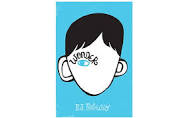
Wonder, by R.J.Palacio, 2012

‘Wonder’ is an American children’s novel about August “Auggie” Pullman, and 11-year-old living in Manhattan. Auggie has a rare medical condition giving him a severe facial deformity. Until now, Auggie has been home-schooled by his mother, but the book opens at the point his parents decide to enrol him in a private school. It charts through a series of first person narratives his first year at senior school.

The book has become something of a word of mouth success, and I can certainly see why. It is incredibly heart-warming – a classic story of an outsider overcoming adversity. It is full of positive, reassuring aphorisms such as “funny how sometimes you worry a lot about something and it turns out to be nothing” and “When given the choice between being right or being kind, choose kind”.  

If the novel had just followed Auggie through his first year at school through his eyes only, the narrative might have become stale, but Palacio adopts an interesting structure to avoid this. After each few chapters the narrative baton is passed to another character. This person then recaps the previous events from their perspective, giving a new version of events, then takes the story forward. This structure keeps things moving, and together with the very short chapters, most no longer than three pages, often fewer, the books 250 odd pages zip by.

The author has some real insight into the challenges of living with a condition such as that Auggie has, and shows this in various ways. As an example. Auggie has been growing a braid for several years, similar to that worn by trainee Jedi apprentices in the Star Wars universe. In a symbolic act of growing up he cuts this braid off, in an attempt to gain acceptance from his schoolmates. All children, whether living with a disability or condition, or not, will have experienced similar pressures. Auggie is shunned by some of his classmates, bullied, spoken about behind his back, but with the support of his family, friends, and teachers, he overcomes, and ends the year with a school medal for bravery.

Auggie has an older sister just starting high school. She experiences similar challenges – fitting in, dealing with the cool kids, starting dating etc – which gives the book a broader appeal than the 9-12 year olds that will be the majority of its readers. But I suspect the book will not have a wider cross-over appeal into the adult market (despite it being chosen as a book group read according to some of the Amazon reviews I have looked at), unlike, say, ‘The Curious Incident’. It is, despite its subject matter, simply too safe and saccharine. Almost everyone is just so nice. Yes the kids shun Auggie at first, but ultimately it is the instigator of this treatment (Julian) who is the loser, and end up leaving the school. There is a scary piece of bullying by some 13-14 year olds at the end of the novel, but these are brushed off relatively easily, and end up paying the price. Auggie starts wearing a complicated hearing aid part way through the school year, which in any other school would have been the start of a tsunami of jokes about androids and aliens, but in the privileged halls of Beecher Prep goes without comment. The book lacks any serious menace or peril.

Despite these reservations, I would recommend the novel for any child about to change school, or faced with a challenging difference. They will find it reassuring and if just one child is persuaded to be kind instead of mean, it will be worth it.

Standard