20th century Literature, American literature, Book review, Vonnegut

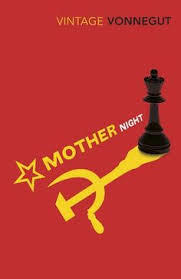
Mother Knight – Kurt Vonnegut – 1966

Released a few years before ‘Slaughterhouse 5’, ‘Mother Knight’ is probably best seen as a companion piece to that work. In some ways a more conventional narrative, it tells in diary form the story of Howard W. Campbell Jr, an American, who moved to Germany in 1923 as a child, and became a well-known playwright. Married to a German woman, he is approached by an American shortly before the second world war starts, and asked to stay in Germany and become a spy for the Americans. This he does, reluctantly, because in order to maintain his cover he has to become an enthusiastic propagandist for the Nazis. As he observes “we are what we pretend to be, so we must be careful about what we pretend to be” – pretending to be a Nazi for so long corrupts his soul, and he finds it hard to argue with or oppose the Americans he meets later in life who hate him, as a symbol and public face of the Nazis.

I don’t know if there was a real-life American equivalent of Campbell, but the obvious English parallel is with William Joyce, Lord Haw-Haw, who must surely have provided some inspiration for the novel, even if unlike Campbell, Joyce remained an unrepentant Nazi.
The reader is left in doubt throughout the novel whether his defence – that he was acting as a spy – is genuine. He presents no evidence in support of it, and the suggestion that he was conveying messages in his broadcasts through coughs and hesitations is implausible, to say the least. However, the final dénouement reveals his story – his defence – was actually true all along. By then it is too late for Campbell, having lost everything he values he passes his own sentence on himself.

Vonnegut is novelist of ideas – he throws them around casually, sometimes following them through, but often discarding them. This makes ‘Mother Knight’ a surprisingly easy and enjoyable read – the cast of characters was entertaining, including some cutting portraits of American Nazis, and the shifts of mood from comedy to black farce worked well. It’s also quite a brave novel – it addresses serious themes and topics such as the holocaust, the rise of fascism, and nationalism. The central character is perhaps hard to like – as narrator of his own story we should normally be sympathetic to him – we understand his motivation, even when what he does is questionable. Campbell never attempts to justify his actions in the war, but he is not prepare to accept some of the lazy condemnation thrown at him which has parallels with the way opponents of the Nazis were treated (the stealing of the light bulbs for example). Just to illustrate the point, there is a brief discussion of nationalism which quite bravely in post-McCarthy America rejects the whole concept of being proud of one’s country:

“You hate America, don’t you?’
That would be as silly as loving it,’ I said. ‘It’s impossible for me to get emotional about it, because real estate doesn’t interest me. It’s no doubt a great flaw in my personality, but I can’t think in terms of boundaries. Those imaginary lines are as unreal to me as elves and pixies. I can’t believe that they mark the end or the beginning of anything of real concern to a human soul. Virtues and vices, pleasures and pains cross boundaries at will.”

You can see Vonnegut warming up for ‘Slaughterhouse 5’ here, although without some of the surrealist components of the later novel. I also caught some echoes of ‘Lolita’ as well – both novels being the posthumous prison diary of someone reviled by society. I will definitely be returning to Vonnegut – he writes well, entertainingly, is refreshing unstuffy and unpretentious, but at the same time deals with serious themes. Recommended.
Standard
Book review

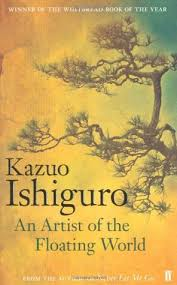
An Artist of the Floating World – Kazuo Ishiguro – 1986

This novel addresses what most be one of the most difficult issues a country has to ever face – how to come to terms with overwhelming military defeat. For Japan, that defeat was all the more painful because its involvement in World War 2 was completely avoidable; and the end of the war, at Hiroshima and Nagasaki was so shocking and final. Ishiguro’s approach to this subject is to walk slowly round it, quietly approaching and then stepping quickly away as soon as the subject becomes too raw.

I am being oblique myself, so let’s explain. The narrator is a painter, Masuji Ono. He has lost a son and a wife in the war, but his two daughters survived. One is married, one going through the complex engagement process used by some Japanese families at the time (and for all I know is still in use). The time structure used in the novel is complex; although each section is dated, giving the reader a misleading reassurance as to the date of the events of that part of the novel, Ono’s account wanders across time, gradually revealing details of his career as a painter. Discouraged by his father from becoming a painter, he runs away from home, and becomes an artist of the floating world – a particular genre of art in Japanese culture. Very slowly Ono reveals his involvement in the rise of Japanese nationalism, and his subsequent disgrace and the rejection of his values by the new, post-war generation. This reveal takes the whole of the story arc, and even then one is left with the distinct impression that we have only been shown a small part of the story.

Ono is a reflective character – he is certainly a deeply flawed narrator, as one would expect, but he is not delusional – he knows that his involvement in Japanese nationalism, painting pictures encouraging the expansion of the empire, was wrong, although the extent of that recognition is unclear: at one point he admits “There is certainly a satisfaction and dignity to be gained in coming to terms with the mistakes one has made in the course of one’s life”, although this is more of a tactical admission than a confession. Ono’s grandson plays an important part in the narrative – he is a really brattish, unpleasant little eight year old, who is encouraged (by his grandfather) to believe that his gender gives him authority over his mother.

There is a profoundly hesitant, tentative feel to the novel. Ono tiptoes around his story, rarely revealing much, and constantly admitting that his recollection may be flawed, The reader is given enough information to piece together the outlines of his story, but only through hints and only rarely through actual events – at one point we are shown him visiting the house of one of his students, who he has reported for anti-nationalist feeling, and it is clear that the authorities reaction has been extreme – we found out earlier that the student was imprisoned for a long time, and apparently tortured. Ono doesn’t understand, or refuses to understand, his responsibility for this situation.

Ishiguro is clearly a writer of some considerable skill – the novel is quite deliberately like a delicate Japanese watercolour, done with great finesse. But the characters – other than Ono himself – are only tentatively drawn – we only see them through Ono’s eyes, and he doesn’t trouble to sketch them in any detail. The language is equally delicate and riven with hesitation, again quite deliberately, giving a very authentic flavour to the narrative, but leaving the reader a little bit detached and remote – the speeches are overly polite, and you need to listen carefully to the subtext to understand what the speakers are really saying, even if the narrator usually misses the point.

Japan clearly went through a huge, if self-imposed trauma before, during and after the Second World War. The price paid was enormous, and understanding how that come to happen is important. Ishiguro gives us one witness’s flawed account, but it is very much that of someone who had only a small, marginal involvement in the tragedy, and I am not sure that it tells enough of the story to be of any value. The book ends without any big reveal, and so does this review.

Standard
100 Best Novels Guardian list, 20th century Literature, Graham Greene' The End of the Affair

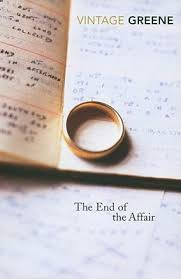
The End of the Affair – Graham Greene – 1951

I am ashamed to admit that this is the first Greene novel I have read; I fear it may be the last, at least for now. ‘The End of the Affair’ tells the story of an adulterous affair between Maurice Bendrix, an author on the cusp of, if not fame, popularity, and the wife of a neighbour and friend, Sarah Miles. Bendrix’s narrates the story in flashback, returning to the present often and thereby constructing a complex time scheme that only coheres at the end of the novel. The affair lasts for four years, the first four years of the Second World War. The war is largely background noise to the events of the novel, although it does intrude at one point when a V2 bomb, strangely called here a ‘robot’ lands very close to Bendrix’s house, knocking him out. Thinking him dead, Sarah prays for him to be saved, promising god that if he does survive she will reward him (that is, god) by leaving Bendrix and being faithful to her husband.

Bendrix survives, in fact is largely unhurt, and true to her perverse bargain with god, Sarah leaves him. Leaves is a misleading term, in that she has never actually left her husband, who working late at the Ministry and already living a sexless life, doesn’t notice the affair. She finds the separation painful, so perversely pursues other affairs – the deal with god was very specific apparently – but eventually relents and decides to resume the relationship. The reader is invited to see the hand of god in the various bits of fairly clumsy sit-com style incidents that prevent this resolution being carried out, and Sarah finally succumbs to the irresistible charms of the Catholic Church, before catching a cold and dying. Colds are pretty ferociously dangerous in romantic novels; in fact it would be nice some time soon to read a novel where the resolution is not provided by someone conveniently dying, even if the death as here is signposted a long way in advance, and comes as nothing of a surprise. Cuckolder and cuckolded commiserate one another after Sarah’s death, and eventually become an odd couple of their own, pottering down to the pub each night to drown their sorrows.

Much of the novel is dominated by a discussion of religion, and more specifically Catholicism. God intervenes in the life of the characters, and while they resist fiercely, they eventually accept his gifts. Even though Bendrix ends the novel by rejecting the roman god, he does so more through stubbornness and anger than any lack of belief. Frankly, this is largely tedious, unconvincing preaching – of course god can appear in the lives of characters if the author simply invents “coincidences” to persuade them of his existence. Rosencrantz and Guildernstern in Stoppard’s play about their deaths show infinitely more faith in the power of coincidence, denying the existence of an external power, even when that power is the author himself. All it takes here, by comparison, are some simple coincidences before Bendrix begins to start doubting his agnosticism, ending with a suggestion reminiscent of the conversion at the end of “Brideshead” that he too has accepted the inevitable (even if this suggestion comes at the very beginning of the novel: “If I had believed then in a God”.)

In an insightful introduction in this Vintage edition, Monica Ali surgically pinpoints many of the faults in the novel – the poor characterisation in particular, and the failure of the religious conversion scenes. I agree, but I think she is too kind on Greene. We are invited to see Bendrix as a tragic anti-hero – he is the victim of his own sad story – but if you remove his point of view from the events of the novel and look a little more objectively, he is really a nasty piece of work. He cuckolds Miles, simply at first to get some material for his novel. He has sex with Sarah in her own house while Miles is upstairs, and later has sex with her in a ditch, overlooked by a farmer on a tractor who passes “at the moment of crisis”. Nothing gets in the way of his determination to sleep with Sarah – at one point he even is grateful for the war for the opportunities it provides: “War had helped us in a good many ways” (page 45). He is casually arrogant about his writing and his attractiveness to women, and treats his lover appallingly, employing a private detective, the gormless hat-tipping Parkis, to steal her diary.

Greene’s reputation as one of England’s foremost post-war novelists cannot be evaluated on the strength of a single novel, but this is not a strong exhibit for the defence. ‘The End of the Affair’ is a confident, well constructed novel full of strong descriptions and turns of phrase, but I suspect it won’t linger long in the memory. It has not aged well – I appreciate that 1951 was a long time ago, but there is a bit of a dated, Edwardian feel to this tale – the characters still have maids to answer the door. Perhaps I need to take a look at ‘Brighton Rock’ or ‘Our Man in Havana’ after a suitable period of reflection?

Standard
100 Best Novels Guardian list, 20th century Literature, Book review, Elizabeth Taylor, Elizabeth taylor. Mrs Palfrey at the Claremont, Mrs Palfrey at the Claremont

Mrs Palfrey at the Claremont by Elizabeth Taylor, 1971

I confess I had never heard of Elizabeth Taylor before her appearance in the Guardian best 100 novels in English list. One of the hope-for benefits of working through this list was the discovery of some hidden gems, a writer whose back catalogue would open up to exploration. Having now read the clumsily titled and thinly written ‘Mrs Palfrey at the Claremont’ I know why she is so unknown – her inclusion on this list is puzzling, when you consider the authors such as Tolkien and Rowling who missed the cut. There’s nothing wrong with ‘Mrs Palfrey’ as a novel, and if you try hard you can find some features of interest – but little that will occupy you for long.

Laura Palfrey who in Taylor’s somewhat spiteful description ““would have made a distinguished-looking man and, sometimes, wearing evening dress, looked like some famous general in drag”, is recently widowed. She arrives at the Claremont hotel in London, one rainy Sunday in January. The novel immediately strikes a false note – the taxi driver is unfamiliar with the hotel. Taylor is telling the reader that the hotel is obscure and forgotten, like Mrs Palfrey herself, but she surely under-estimates London cabbies? After years as a colonial ex-patriot wife she faces the fact of her isolation, and the inevitability of decline and death.
There is a strangely dated air to both the Claremont and the novel itself. Although published in 1971 the setting is firmly in the sixties, with references to the Beatles and hair-length being a cause for disproportionate anger in the elderly. At one point, a young man refers to his girlfriend as a “bird”. (Quite genuinely, for a split second I took this as a reference to him having bought himself a parrot or canary, so dated is this slang). In fact, although the setting is the 60’s this novel could easily have been published several decades earlier with only minor edits. Mrs Palfrey’s back story is strangely blank – while we know her husband was in a colonial role in Burma, that would have ended in the late 1940’s; we aren’t told when or how he died, where Mrs Palfrey lived after that, or much about her strange decision to move away from her daughter in Scotland to the most expensive city in the country, rather than the more sedate and welcoming south coast, for example.
The Claremont becomes in the words of the Guardian’s reviewer “a genteel antechamber to oblivion”. Mrs Palfrey and her fellow long term inhabitants are waiting for death, bored silly, whiling their time away with banal occupations – patience, short walks, crosswords – waiting for the next meal or the next infrequent visitor. This is more a retirement home than a hotel. Even great writers struggle to generate interest from a story of bored people with nothing to do, and while Taylor captures the sense of ennui well, it’s not enough to keep the reader engaged.
As a substitute for incident or plot, Taylor introduces Ludovic (Ludo) Myers a struggling writer. Ludo rescues Mrs Palfrey after a geriatric fall, and becomes, through a series of misunderstandings, her substitute grandson. Ludo has fallen straight out of the pages of ‘New Grub Street’ – he is trying to write a novel, keeps warm by working during the day in Harrods Banking Hall, (not the British Library, just for variety), subsists on tinned goods, and only puts his fire on a single bar when he is feeling extravagant. His friendship with Mrs Palfrey is the only thing that enlivens her days, but there is little of substance to it and it quickly fades.
Taylor is felt by some to be an undiscovered genius, a novelist spoken of in the same breath as Jane Austen. The comedy in the novel is ineffably slight – if you find old people being pompous and falling over funny then this is for you, but I found the novel’s ending, when Mrs Palfrey has another fall, and dies alone, unremembered, something of a release.
Standard
Language

Comment: Emojis

This is one of those posts where I am going to try and work out a train of thoughts as I write, which is a bit of a high-wire act (two metaphors for you there, one dead, one ailing). Written language started with pictures – man (person), antelope, water, food, etc. My guess is that these symbols once introduced (together with the appropriate materials for recording them, cave walls having their limitations) were quickly and very widely adopted. Hierogylphs are essentially these ideographs – symbolic pictures representing at first things, and then later more abstract concepts such as actions. From here the development of written language with letters representing sounds may have been quite a leap, but an inevitable one. There are whole libraries worth of study on this topic, so I am not going to embarass myself by trying to summarise this evolution, but wanted to introduce some thoughts about the direction of language today, as influenced by the introduction of emoticons and emojis.

Because there is an argument, which I wanted to test, that emojis represent a reversion of language back to its earlier origins, a degradation of the complexity of writing to drawing. Pictures with their limit range of meaning are in this context replacing words. Emojis can have a range of meaning depending on the context within which they appear, but they hardly have the subtly of the tens of thousands of words in the English language, nor are they likely to be as dynamic and fluid in their meaning. We have already seen some wit translating the Bible into cockney – will an emoji version be long in following? Probably not, which probably means that the range of meaning we can convey in these symbols is so profoundly limited that they will not replace words. Probably. Will people communicate solely in emojis in future, the written equivalent of grunting at one another? Written language started as drawings – is it reverting back to its origins?

On the whole I think not. There’s no evidence that emojis are anything other than a fun way of supplementing short written messages, often in a clever way, breaking out of the tyranny of 26 characters. A winky face can make the ironic tone of a message clear in a much simpler way than laboriously spelling it out. One to watch – will these symbols begin to proliferate and intrude into more formal contexts, outside the setting of texts and emails, and increase in volume and complexity, or have they found their niche?

Standard
100 Best Novels Guardian list, Book review, George Gissing, http://schemas.google.com/blogger/2008/kind#post, New Grub Street

New Grub Street, by George Gissing, 1891

Gissing isn’t really read very much today. His novels – or at least some of them – are still in print, but I doubt if he makes his way onto many syllabuses or reading lists. Certainly I would not be reading him now if ‘New Grub Street’ hadn’t appeared on the Guardian’s best 100 list. Does that really matter? There is a relentless Darwinism at work in determining what books are read and which are forgotten, and if Gissing is steadily dropping out of sight it is probably for a good reason.
‘New Grub Street’ tells at considerable length the story of a small group of lower middle class but educated people trying to make a living from professional writing. Some write novels, others articles for publication, reviews, and short stories. All are utterly obsessed with their financial situation.
“Poverty is the root of all social ills; its existence accounts even for ills that arise from wealth. The poor man is a man labouring in fetters. I declare there is no word in our language which sounds so hideous to me as “Poverty”” (page 33)
George Orwell, in an article about Gissing which ironically was probably written simply to keep the writer’s income flowing, claimed that we had “very few better novelists”, although he does go on to say that “His prose, indeed, is often disgusting”. Disgusting is a bit strong, but clumsy, undoubtedly. Take this sentence for example:

“Fixed in his antipathy to the young man, he would not allow himself to admit any but a base motive on Milvain’s side, if, indeed, Marian and Jasper were more to each other than slight acquaintances; and he persuaded himself that anxiety for the girl’s welfare was at least as strong a motive with him as mere prejudice against the ally of Fadge, and, it might be, the reviewer of ‘English prose’.”

But it’s not all stodge – some of the descriptive writing, of which there is admittedly little, is very well put, as in here when he describes one of his younger female characters:

“So exquisitely fresh in her twenty years that seemed to bid defiance to all the years to come”. (70)

There is a relentless focus in ‘New Grub Street’ on money – who has how much, what interest can be expected from savings, how much an article of novel might bring in, and so on, at extraordinary length. Rarely a chapter goes by when money, and its absence, is not the focus of the narrative. Even when ostensibly the story moves on to a discussion about relationships, these are determined solely in respect of the relative wealth of the participants. Creative endeavour can only be measured by the income it generates. Despite the grinding poverty that most of the characters suffer, the distinction between this group of people, who earn their living, such as it is, by writing, and the social group immediately below them who work for a living, is preserved at all cost. One character, Edwin Reardon, is actually left by his wife because he proposed to take a clerical post, rather than continuing to try to earn a living by writing novels.


New Grub Street is a depressing place to be. One writer dies of a consumptive-like illness which is not specified by is clearly derived from years of poverty; another commits suicide when the failure of his magnum opus becomes apparent, a third marries purely for money and social advancement, abandoning a young woman as soon as her inheritance falls through. It’s not just the world of writing that Gissing is condemning, but the society in general – Reardon, the one person who throws it all in and gets a proper job suffers just as badly as the rest.


A novel about writing is bound to break the narrative fourth wall from time to time. It is obvious at points that Gissing is writing from personal experience about trying to earn his living. The scenes where Reardon suffers horribly from writer’s block also have a poignancy suggesting Gissing had probably suffered similarly, as well as having felt the pain of having to write for payment by the page. But overall it is hard to feel too much sympathy for most of his cast of characters, and I feel no compulsion to seek out any of Gissing’s other novels for now. Just to end with one of my favourite quotes from an Amazon reviewer of ‘New Grub Street’. Missing the point with uncommon accuracy – “It’s not funny at all”


Standard
100 Best Novels Guardian list, 1984, 20th century Literature, Book review, dystopian fiction, George Orwell

1984 by George Orwell, 1949

When I re-read a novel (as here) for the umpteenth time, I always look carefully for things I have forgotten or overlooked the last time. It’s surprising what you miss – I wrote about this here a while back. The first thing that struck me about ‘1984’ is what a brilliant opening it has. Not just the extraordinary first line – “It was a bright cold day in April, and the clocks were striking thirteen” – but the opening chapter. Orwell packs so much into these few pages it positively fizzes – Big Brother, the anti-sex league, the two minute hate, the Ministry of Truth, doublethink and newspeak. It’s such a detailed and comprehensive evocative of the new world we are plunged into that it is shocking.

Orwell was the first writer who spoke to me personally through his works, and I absorbed all his novels, even those he wrote simply for financial reasons, and would have been happy to have seen pulped, as well as his journalism, letters, and anything else available. So making a dispassionate judgment about 1984 is impossible, and I am not even going to try. Orwell’s fierce intellect shines from every line – this has to be the most quotable novel ever written, particularly when you think that it was not written as a series of epigrams (unlike, say ‘Dorian Gray’) but as a dystopian horror story. The concepts that Orwell develops in this novel have become part of our popular and political culture – ‘Big Brother’ for example, as a short-hand phrase to describe the over-intrusion of the state into our private lives, (as well of course as a reality TV gameshow). 1984 is a passionate warning cry against the evils of totalitarianism.

But, and there is always a but, post-war ration starved Britain had already rejected the hopelessness of ‘1984’. In electing a Labour Government with a mandate for radical change, they had decided that they didn’t have to settle for the permanent rule of the party, and that things didn’t always have to be dreary and hard. The proles had rejected the lie of the ruling class that things can never get any better. Orwell seems to have completely missed that sense of optimism. Winston Smith believes that if there is hope, it is with the proles, the working class. But the proles of 1984 are so easily distracted by pulp fiction, machine produced porn, and a fake lottery that there is never any prospect of them organising and gaining a class consciousness which would allow them to “rise from slumber, in unquenchable number”. By 1949 the Attlee Government was clearly struggling – was that really the time to warn of the risks of a Soviet takeover of Western Europe?

I can’t find the faintest trace of hope in 1984. Some readers claim the post-script essay on the introduction and development of Newspeak suggests IngSoc did not last, but that seems clutching at straws. By the end of the main novel, Winston is broken, looking forward to the bullet in the back of his head as a mercy. There is no suggestion that the future holds anything but the stamping of a boot on a face, forever.

Eton-educated George, or should that be Eric, was always a stranger in the slightly smelly, uncomfortable world of the working class. His sense of alienation from the working class – even, one could argue, his submerged class hatred – is vivid in 1984. They are an utterly alien species, with goldfish like memories, no class consciousness, and representing nothing of value. Winston is amazed at their stoicism, as well as their ability to reproduce so prolifically – Orwell shares similar sentiments in, for example, ‘The Road to Wigan Pier’. If the proles are the only hope, then there is no hope. I appreciate I am criticising ‘1984’ for not being a socialist manifesto, when of course it was never intended as such. But it handed a potent weapon to the critics of socialism, and all Orwell’s subsequent comments about the intention of his writing had little impact on the perception that he was a trenchant critic of English Socialism. Which is a pity, because there are few writers in the twentieth century who wrote as interestingly or as well as Orwell on social issues.

Standard
100 Best Novels Guardian list, 20th century Literature, Book review, H G Wells, HG Wells, humour, The History of Mr Polly

The History of Mr Polly by H G Wells, 1910

Most Victorian novels were about prosperous people. Yes, they sometimes had money worries, but they weren’t urban working class. Dickens changed all that, and people from all parts of the class spectrum became suitable subjects. However, the petit bourgeoise, the shop keeping class, technically bosses in that they were self employed, but dirt poor nonetheless, were largely ignored. That changed with the Grossmiths’ ‘Diary of a Nobody‘ in 1892, and ‘The History of Mr Polly‘ is an early entry in this ‘little man and his troubles’ or ‘white collar’ genre.

Mr Polly‘ opens with him sitting on a stile, grumbling. He hates his life. He doesn’t love or particularly even like his wife, he finds his job as a shopkeeper dull and unfulfilling, and he mourns the absence of any romance or culture in his life. He also suffers horribly from chronic indigestion, representative of his dissatisfaction with life. The first half of the novel is a flash-back from this point, chronicling how he has always felt this way, more or less, and how he reaches this nadir. He settles on suicide as the only logical escape and having made that decision implements his plan quite calmly. Inevitably he botches the job and in the process burns half his street down. Ironically this provides him, in the form of insurance money, an escape route and he runs away. The final section of the novel sees him settled as a handyman at a country pub, living a bucolic but largely culture-free lifestyle that seems to suit him. This life is threatened by uncle Jim, the nephew of the landlady, a thug who menaces her for money. Polly discovers the hero inside himself, stands up to Uncle Jim, and in comic bumbling fashion defeats him.

Polly is quite an engaging anti-hero. He reminded me of Anthony Burgess’s Enderby, one of my comic legends. He has a kind heart, and does his best to avoid causing harm. he takes the hardships in life as they come and looks for pleasure in small things. He has a way of mangling the language which is intended as humorous, and which just about manages to raise a smile. Despite his ineptitude in most things, somehow he manages to come out on top. Some of the set-piece scenes in the novel, such as his father’s funeral, where remote relatives descend on the wake and have a great day insulting one another, are enjoyable. If one looks hard for more serious themes, such as any traces of Wells’ Fabianism, they can be found, but the novel is not openly political. The main ‘message’ of Mr Polly’s history is that one should be true to oneself:

when a man has once broken through the paper walls of everyday circumstance, those unsubstantial walls that hold so many of us securely prisoned from the cradle to the grave, he has made a discovery. If the world does not please you, you can change it. Determine to alter it at any price, and you can change it altogether. You may change it to something sinister and angry, to something appalling, but it may be you will change it to something brighter, something more agreeable, and at the worst something much more interesting. There is only one sort of man who is absolutely to blame for his own misery, and that is the man who finds life dull and dreary”

Mr Polly didn’t have such a terrible life. While slowly going bust in his shop, he didn’t suffer the privations many people experienced, and enjoyed many of the comforts of his Edwardian idyll – an idyll that was to be lost forever just a few years after this novel was published.

Standard
21st century literature, Ben Elton, Book review, Time and Time Again, time travel

Time and Time Again by Ben Elton, 2015

Time travelling. Could there be a more tired, worn-out plot line than time travelling? If 50 years of Dr Who hasn’t explored every single crevice and wrinkle of the multiverse, Ben Elton decided to give it a go. And for 95% of the book he very nearly gets away with it.

Hugh Stanton, ex-special forces, and recently widowed, is asked by his old Cambridge history professor for a Christmas drink. Here he is inducted into a secret society preserving the mystery of time travel, and in fairly quick order he is off to 1914, to save Franz Ferdinand, and kill the Kaiser. We all by now know enough about chaos theory to know that the chances of it all going smoothly are slim, and sure enough, despite mission being (sort of) accomplished, the law of unintended consequences kicks in and things start to go pear-shaped.

Elton has clearly done a lot of research into the origins and causes of the first world war, and the assassination of Franz Ferdinand. Sarajevo and the events of the day of the assassination are recreated faithfully and realistically, as Stanton casually stalks Gabriel Princip.

In telling a time travel story the reader is invited to accept one huge implausibility. Having done so, with however much pseudo-scientific hoopla to provide a veneer of credibility, we then reasonably expect that the rest of the story will have an internal coherence, complying with the rules of common sense and order. So when Stanton is propositioned by a young woman on the train to Berlin, who proceeds to sleep with him at the first opportunity, something that in 1914 would have surely been pretty exceptional, alarm bells start to ring. This character, Bernadette, an Irish suffragette, is there to provide romantic interest and an opportunity for Elton to contrast 21st century social and sexual attitudes to those of 100 years earlier. It’s all a bit worthy and predictable.

Stanton is incidentally a rubbish time-traveller – he can’t avoid using 21st century slang, for example, and his lover stumbles across his laptop and guns.

The novel has some interesting things to say about history. When considering the question “if you could go back in time and change one thing, what would it be?” (Stanton actually changes two things, but that’s being picky) Stanton’s history professor proposes two alternative positions – either history is about individuals and the choices they make and the things they do, or it isn’t. if the latter is right, intervening in Sarajevo in 1914 will have little or no impact on the broad sweep of history. Elton proposes a third choice – that people can make a difference – Gabriel Princip clearly did for example – but chaos theory then kicks in, and the world can be dramatically different from just one simple action. Ray Bradbury did this so much better in ‘A Sound of Thunder’ (https://en.wikipedia.org/wiki/A_Sound_of_Thunder) to which this and all subsequent time travel stories owe a debt. If we can’t know whether our intervention will make things better or worse, then probably best to leave well alone, is the overall point being made. The problem with this analysis is that it doesn’t just apply to time travellers – it could equally apply to those of us living today. It’s an argument for political inactivity. For what it is worth, while Franz Ferdinand’s assassination was clearly the trigger for world war one, my view is that the European powers had been shaping up for a fight for a long time – hence the arms race – and if the assassionation had been prevented another reason would have come along soon enough.

At the end, the novel implodes in on itself, collapsing under the weight of its absurdities. (Avoid this next bit if you don’t like spoilers). We are asked to believe that Stanton is only the most recent in a long line of travellers returning to correct the future, each making it that little bit – or in Stanton’s case a hell of a lot – worse. We are asked to accept that each Master of Trinity would open Newton’s “this is what you need to know to travel in time” letter from 300 years previous, successfully form a secret society of supporters to organise the trip, that each time traveller would succeed in their mission, realise that things had not gone as planned, write a letter to the future warning them, but that none of these letters would be found. As usual, unless you skate over the timey-wimey stuff pretty quickly, the ice cracks and you fall in.

Elton writes well, and his short chapters and frequent changes of focus keep the reader engaged, even when we have a pretty good idea where it is all going. The desire to frustrate that predictability leads Elton up some dead ends but does ask an entirely reasonable question – given that the 20th century ended with the end of totalitarianism across almost the entire world, civil liberties making progress in most countries in a way Edwardians would find hard to believe (actually, time travellers from the 1970’s sometimes find it hard to believe) and technology that is as close to witchcraft as make no difference – why would we change anything? He invites us to consider whether the world wars and the Holocaust were the price of all this progress? I don’t accept that for one second,  nor that we are now living in the ‘best of all possible worlds’ century, but it’s a question worth asking.

Standard
100 Best Novels Guardian list, 20th century Literature, Book review, humour, Joy in the Morning, P G Wodehouse

Joy in the Morning by P G Wodehouse, 1946

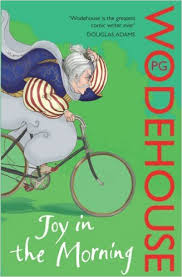
I had a fairly strong reaction when I last read some Wodehouse, and I suspect my record of the event is intemperate. Having calmed down I returned to ‘Joy in the Morning’ determined to be fair minded. In that same spirit of fairness I ought to acknowledge that Wodehouse has some heavy-weight admirers whose opinion I have rarely had occasion to doubt. Douglas Adams no less is quoted on the cover of this Arrow (2008) edition saying “Wodehouse is the greatest comic writer ever”, and Stephen Fry is on the frontispiece describing Wodehouse as the “funniest and finest writer”. High praise indeed.

Written in the early 1940’s during Wodehouse’s internment in France and Germany during the second world war, this novel tells in Bertie Wooster’s first person narrative the story of his adventures at his uncle’s country home in Steeple Bumpleigh, or in Wooster’s words “the super-sticky affair of Nobby Hopwood, Stilton Cheesewright, Florence Craye, my uncle Percy… is one of those imbroglios that Bertie Wooster believes his biographers will refer to as “The Steeple Bumpleigh Horror”.  The Guardian’s recent review described the novel as “both an elegy and an encore” – an elegy for a lost Edwardian Britain, and an encore because this is very familiar ground – Wodehouse recycled this very limited set of characters and situations endlessly. “


‘Joy in the Morning’ (and in my head I keep mixing this title up with ‘Morning Glory’ which is something entirely different) is a ‘greatest hits’ selection of comedic situations: the imposed engagement; a blazing country cottage; a nocturnal confrontation; a fancy-dress ball. The novel also contains an element of self-justification for Wodehouse’s involvement in what some considered war crimes, namely broadcasting on German radio from Berlin. “I doubt,” says Bertie, speaking of the writer Boko Fittleworth, “if you can ever trust an author not to make an ass of himself.”


Despite my best intentions I did find myself laughing out loud at some passages. Wooster is such an idiot. But overall the novel is not a success. It is over-long and predictable. Wodehouse claimed to work tirelessly on his plots, and farce well done does require tight plotting in order to be plausible, but the plotting here is a mess. It depends on people behaving in ways that are more than just ridiculous but utterly unbelievable: schoolboys burning houses down, successful businessmen agreeing to conduct private meetings at a fancy dress ball, policemen leaving their uniforms on the riverbank while taking a dip in the river, and so on. The resulting comic situations lose a lot of their impact when they are set up so clumsily – we know Wooster is going to lose an important birthday gift brooch, that Jeeves is going to come up with a cunning plan to rescue the situation, that the imposed engagement will fade away by the end


Wodehouse may have been a collaborator, and may have romanticised a lost Britain that depended on a rigid class system that virtually enslaved the working class to preserve the privilege of a small minority, but he could turn a phrase, for example “There was a sound in the background like a distant sheep coughing gently on a mountainside. Jeeves sailing into action.”


Wodehouse is adept at using the gap between Wooster’s weaknesses, his village idiot view of the world and reality, to comic effect; many of them are having an affectionate nod towards Shakespeare:


 “It was one of those cases where you approve the broad, general principle of an idea but can’t help being in a bit of a twitter at the prospect of putting it into practical effect. I explained this to Jeeves, and he said much the same thing had bothered Hamlet.”


“She came leaping towards me, like Lady Macbeth coming to get first-hand news from the guest-room.”


“You can’t go by what a girl says, when she’s giving you the devil for making a chump of yourself. It’s like Shakespeare. Sounds well, but doesn’t mean anything.”


The bromance between Wooster and Jeeves is as strong as ever, and even in this strangely sexless world, in which all a chap ever wants is to avoid being ensnared by an eligible young woman (what possible reason could Wooster have for not wanting to get married or be involved with any of the women who circle around him?) is quite touching. Jeeves and Wooster are only going to be apart for a few hours, but still say a tearful goodbye:


 “We part, then, for the nonce, do we?’

‘I fear so, sir.’

‘You take the high road, and self taking the low road, as it were?’

‘Yes, sir.’

‘I shall miss you, Jeeves.’

‘Thank you, sir.’
‘Who was that chap who was always beefing about gazelles?’
‘The poet Moore, sir. He complained that he had never nursed a dear gazelle, to glad him with its soft black eye, but when it came to know him well, it was sure to die.’
‘It’s the same with me. I am a gazelle short. You don’t mind me alluding to you as a gazelle, Jeeves?’
‘Not at all, sir.”

Standard