19th Century literature, Book review, Bram Stoker, Dracula, horror, http://schemas.google.com/blogger/2008/kind#post

Dracula by Bram Stoker, 1897

Thrilling and Repulsive – an oxymoron perhaps, but one that neatly summarises the central theme of Dracula. The broad elements of the plot of Bram Stoker’s 1897 novel will be familiar to most if not all, but the text is unlikely to have been read by many outside those compelled to do so by college curricula, horror enthusiasts, or, like me, the Kindle-curious.
As a construct the text is highly complex – Stoker aspires to give the reader an up-to-the-minute account of events, but eschews the use of an omnipresent narrator – instead the story is told through a variety of diaries, notes, letters and newspaper articles. The diaries in particular are often presented as being hurriedly written shortly after the events being described. This is a really interesting and original technique – we see events through the eyes of the participants, although it is hard to imagine even the most obtuse of reader not realising what is going on – “He’s a Vampire!” – before the characters. They really need to have things spelt out for them by Van Helsing. Through this flawed and partial perspective, the narrative jumps around both in terms of location and time.


However imposing physically the Count may be, Dracula the character is in many ways a weak opponent – like Sauron or He Who Must Not be Named he doesn’t personally engage in the struggle with the rather Scooby-Doo like gang assembled to fight him, and is far too easily despatched when finally cornered. His inability to walk during the day, to be seen in mirrors, to rest outside his coffin filled with Transylvanian earth, combined with extreme allergies to garlic, crosses, holy water, and peanuts (I may have made the last one up) makes it hard to fear him. The only character he is able to conquer misses multiple opportunities to avoid him (eg closing her bedroom window at night – Doh!).


The cast of characters are noble, brave, and fearless in their pursuit of Dracula – but boy are they dumb! Jonathan Harker sees that Dracula has no reflection in a mirror in just the second chapter of the novel – but lets it pass without much concern or interest, and continues to treat his client as an eccentric European gentleman. Now I appreciate some of the vampire traditions had yet to be firmly entrenched in western consciousness, but how dense do you have to be not to spot that something supernatural is going on there? The long slow reveal of Dracula’s identify would be spoiled by too much emphasis or scrutiny of this episode, and that to Victorian readers the penny would take longer to drop, but still!.
There are some genuinely chilling moments in the novel. A small child is kidnapped and thrown to the three female vampires as a snack. The child’s mother is torn apart by wolves. A mental patient breeds and then eats insects – I am surprised he has not been included in the film adaptations of the text. The ghost ship pulling into Whitby harbour is equally effective.
Finally, and most strikingly, there is so much sex. This isn’t a new observation of course, and I know critics have seen descriptions of every form of sexual behaviour in this text, but the lasciviousness of the characters – compared to what we would normally expect in a late Victoria novel – is genuinely shocking. Although the sex act itself is not explicitly described, little else is left to the imagination. Innuendo stalks every chapter. When Harker first meets the three female vampires in the Count’s castle, he describes their encounter in highly and specifically sexual terms: one of them says “He is young and strong. There are kisses for all of us”. Harker then says “I lay quiet, looking out from under my eyelashes in an agony of delightful anticipation….The girl went on her knees and bent over me…There was a deliberate voluptuousness, which was both thrilling and repulsive.” (Chapter 3).  I think you have the heart of the issue there – sex in all its delicious variety was to the Victorians both thrilling and repulsive.  Or take this description of one of the fallen characters being “staked”: 
Arthur never faltered. He looked like a figure of Thor as his untrembling arm rose and fell, driving deeper and deeper the mercy-bearing stake, whilst the blood from the pierced heart welled and spurted up around it […]. And then the writhing and quivering of the body became less, and the teeth seemed to champ, and the face to quiver. Finally it lay still. The terrible task was over.”
Coitus interruptus indeed.
Standard
Book review, http://schemas.google.com/blogger/2008/kind#post, humour, Jasper Fforde, Something Rotten, Thursday Next

Something Rotten by Jasper Fforde

Something Rotten is the fourth in Jasper Fforde’s “Thursday Next” series. I am a big fan of Fforde – he has a comic inventiveness mixed with erudition that is rare in today’s literature. He is hard to categorise – comic fiction certainly, but that is only the start of it. In Thursday Next he has created an original character that you genuinely care about (if not identify with) and her separation from and eventual reunion with her husband is quite touching. So why was I left a bit underwhelmed at the end of this book?

I am pretty sure it is not because his standards are slipping. There are some negative features of a series of novels that are unavoidable – for example we know the principal character will almost certainly survive, no matter what – in this case a bullet to the head is shrugged off in a couple of chapters – so there is little if any tension about the final outcome. As we know what is going to happen, the only interest rests in how we get there, not where we are going. That’s not to say that there aren’t challenges ahead for Thursday in the rest of the series I am sure.
I think the heart of the problem is in the way I have been reading these books – that is, altogether, without any significant breaks. Imagine if you read all of the Harry Potter series in one go, not over the ten or so years they were published. The impact would have been completely different. The suspense would be seriously diminished, the changes in style and pace would be much more obvious, plot discrepancies would jump out at you, and the point at which Rowling’s editors gave up – at the end of “Prisoner” – would be stark. Even knowing that there were seven books in the series, and that it has a definition conclusion, would make the experience different to reading each as it was published (or in my case joining the party at 4 and working back, hurriedly). That experience would be hard but not impossible to create, but I think explains some of my staleness with Fforde. So the simple prescription is a break from this series – the only remaining question is – Where next?
Standard
19th Century literature, Book review, http://schemas.google.com/blogger/2008/kind#post, Jules Verne, science fiction', The Mysterious Island

The Mysterious Island by Jules Verne

I have written previously about one of the probably unintended but positive consequences of the Kindle and its free books – namely that it has led me (and I doubt if it is just me) to read things I wouldn’t have dreamt of reading previously, and would probably have struggled to got my hands on even had I had the inclination to do so. This is a great example of that happening – I don’t remember even having read anything by Jules Verne before my Kindle ownership, despite being well aware of his prominence as the father of science fiction and the general outline of most of his major works eg Round the World in 80 days.

If you were to try to predict what you would find in a 19th century novel called the Mysterious Island I expect you would include dinosaurs/extinct creatures, long lost explorers rediscovered living surprisingly well, gold/lost treasure, and  volcanoes that destroy the island seconds after the last-minute rescue. (Or was that the plot of Alvin and the Chipmunks’ recent film ?) Some of these conventions are honoured here, but not at all in the way I expected.

The mysterious island is set in the uncharted waters of the Pacific, and the explorers are escapees from the American Civil War (which at the time of publication (1860’s) was just ending), blown off course in their escape balloon. Well it might happen. They go about mastering their environment with an extraordinary efficiency, helped by a particular genius with engineering and a sufficiency of natural materials wherever they look, such that by the end of their second year of captivity they are enjoying virtually every luxury afforded by modern life. Nothing seems too complex or technical to be beyond their grasp. This is the age when man was master of his environment, and where Robinson Crusoe made himself comfortable on his island, these guys turn it into a virtual metropolis, so much so that they don’t particularly want to leave.

So apart from the unnatural biodiversity of the island, what is the mystery? At first this is very lightly done – this is no Prospero’s Island, haunted by voices. But there are hints that there is more to this island than the castaways think, and these hints steadily accumulate so that by the time of the final “reveal” – and I won’t spoil it for you – the resolution is worth the wait, and it was definitely not one I would have predicted. In terms of echoes of modern productions, there is a strong hint here that the writers and producers of the TV series Lost must also have read this novel once upon a time – the unseen hand that guides their time on the island is a common thread between the two works.

Verne clearly was an enthusiastic amateur scientist, and spends a disproportionate amount of time walking the reader through detailed technical explanations of the islanders’ various innovations and inventions. Generally I have a rule against skimming sections of text – it is cheating really – but I made a few exceptions here, although far fewer than in “From the Earth to the Moon & Around the Moon” which is weighed down with some fairly obscure and quite possibly nonsensical analysis of the mathematics of space flight. In this novel, one of the earliest about space travel, some comic American gun enthusiasts fire a massive cannon with a manned capsule at the moon. The travellers survive the return journey – they don’t actually land on the moon, but “slingshot” round it in a way similar to Apollo 13 many years later – by landing in the ocean.

I am not sure if I will continue with Verne for now, or go in a different direction – perhaps some more non-fiction?


Standard
21st century literature, Arthur and George, Book review, Julian Barnes

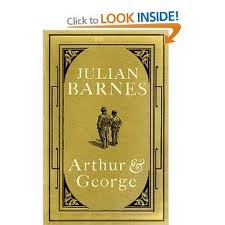
Arthur and George by Julian Barnes

Arthur and George
 
This blog was never intended as a long list of books I have enjoyed. It is a record of my impressions of the books I read in 2012, good bad and indifferent. This is the first occasion I have written on this blog about a novel I haven’t really enjoyed, and I don’t want to spend too much time taking it apart – that isn’t something I am interested in doing. If I didn’t enjoy it – and the reviews on Amazon make it clear I am in a small minority – make a brief note and move on.


Having said that, and having made it to the end of Julian Barnes’s fictionalisation of a minor event in the life of Sir Arthur Conan Doyle, I am still left asking – why? What was the point of that?

The story keeps reasonably faithfully to the known historical events, and is clearly the product of very careful if ultimately pointless research. Over 500 relentless pages we are taken through the parallel lives of Arthur Conan Doyle and George Eldjali, a victim of an injustice which led ultimately to the formation of the Court of Appeal, Criminal Division. Their lives do not intersect until more than halfway through the novel, by which time ACD is an established and famous novelist, and GE has been convicted, served his time, and released. Eldajli is a unsympathetic, cold character, who develops little in the course of his life. He is the classic little man who features in much Edwardian literature – see for example Well’s Kipps, or Mr Polly, or Grossmiths’ Diary of a Nobody. Novelists were beginning to explore and celebrate the ordinary, but 100 or more years on the interest remaining in such figure, even one with some drama in his life, is minimal. ACD is equally a well known figure about whom Barnes has little to add.

Describing how ACD became a spiritualist is one source of potential interest, but the key events in this journey – the series of personal tragedies he experienced at the end of the Great War – are passed over in a couple of paragraphs right at the end of the novel. The crime ACD investigates during the second half of the novel is mundane, and the explanation offered is routine and obvious.
This novel was shortlisted for the Booker, and Barnes has subsequently won that award, so I am obviously missing something.


Like most of us with the reading bug I have more than one book on the go at any one time, and while I was reading this I was also coincidentally reading The Lost World, which is by Conan Doyle. This was not planned, just a question of what came to hand at the time. The Lost World is a far more interesting read, almost a romp, albeit a period piece that comes across as both absurd and racist to a 21st century reader. Written in the early years of the 20th century, the Lost World establishes many of the features of the genre which have long become clichés. Dinosaurs and apemen roam an isolated jungle plateau explored by intrepid English journalists, adventurers and scientists. All problems can be solved by a biff to the natives jaw or a blast of the old elephant rifle at an oncoming stegosaurus. The handling of ideas about evolution is interesting, but apart from this there is little here that would trouble a pre-teen.

Standard
100 Best Novels Guardian list, Book review, Cold Comfort farm, Conference at Cold Comfort Farm, humour, Starkadder, Stella Gibbons, Uncategorized

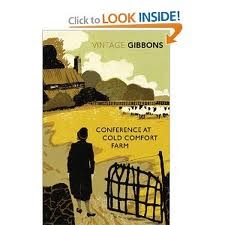
Conference at Cold Comfort Farm by Stella Gibbons, 1949

More on Cold Comfort – not that I am obsessed or anything. The original novel, Stella Gibbons’s first, was published in the early 1930’s. It has a wonderful period feel – although it is set a few years in the future, and there are glimpses of how the world has changed, with video phones and passing references to a recent war, for example. Despite this the world described is comfortably Edwardian, with strong echoes of Waugh and Saki in the opening chapters on Flora and Mrs Schilling’s life in London. The move to deepest darkest Sussex, even then surely not as isolated and backward as Flora describes it, provides a contrast to the metropolitan life she has temporarily abandoned. That contrast is kept in focus by the introduction of Mr Mybug (what a great name – he is Flora’s pest, but she has a soft spot for him nonetheless) with his gloriously stupid theories about Bramwell Bronte.

Mybug “works” in the novel as a contrast to the mad rural folk around him and as a foil for Flora, but the decision to take his character and turn it into the central theme of the Cold Comfort sequel, Conference at Cold Comfort Farm, has to be one of the most bewildering a writer has ever made. The yearning to return to the Starkadders, especially when her subsequent novels had never made the same mark as her first, must have been irresistible. We all wanted to know what had happened to the farm and the cast of characters – but cared very little about the intellectuals that Mybug represented. Yet in the sequel the original cast of characters is largely forgotten or treated as marginal. We are introduced to a series of grotesque caricatures of writers and artists from Mybug’s world at whom we are invited to sneer. It is car crash writing, and how it got past an editor I will never know. It is disrespectful to the original novel, and if it has been written as fan-fic it would have been rejected by Gibbons’s estate with barely a glance.

And yet I still love it. Written in the 1950’s, with of course the world an utterly darker place, it was out of print for a long time. I originally came across it as a library copy, and pounced, desperate to know what had happened to Flora, Charles, Seth, Reuben, and the whole grisly crew. We go back to a farm transformed into a prettified National Trust venue that has been turned, utterly improbably, into a conference centre. Flora goes down to help Mr Mybug run a cultural event there for no good reason (she has a large family with Charles by now) and not much happens until the Starkadders return and all is righted. Everything funny from the original novel, including the invented language (sukebind, mollocking) has gone. But it is still Cold Comfort Farm, and we love it. We love our parents when they grow old, we love footballers who retire and get fat because of their past glories, we love the town we grew up in even though they have paved over it and erected a shopping centre – we love them despite all that, not because of it, and I still treasure the glimpses of the world Stella Gibbons unforgettably created in her original burst of genius.

Standard
100 Best Novels Guardian list, 20th century Literature, Book review, Cold Comfort farm, humour, Stella Gibbons

Cold Comfort Farm – a classic

I have a confession to make – I love Cold Comfort Farm so much that I/we named my firstborn after two of the principal characters. I figured this would at least give him a great conversation opener when he finally gets interested in girls.
CCF is in my top three works of fiction of all time. On my desert island it would share a shelf with the Collected Works of Shakespeare, and, oh, probably the Gormenghast trilogy (if I could get away with having a trilogy).
The clichés about CCF are all, sadly, true. Stella Gibbons never wrote another word coming close to its genius, and the introductions to her recently reissued novels by Vintage acknowledge as much. That’s not to say her other work isn’t worth reading, (and I will write separately about Conference at Cold Comfort Farm, and Christmas at CCF) but you can never for a second forget that they are written by the same person who wrote Cold Comfort Farm. The contrast can be painful.
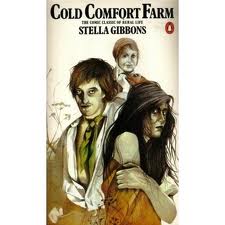
(this cover illustration is wrong is so many different ways, but is from the first edition I owned)
Anatomising why the novel is such a delight is in some respects pointless – it doesn’t bear too much analysis and inspection. The plot is flimsy, the minor characters deliberately (and joyfully) muddled up, the purple prose is flagged for the reader’s ease of appreciation. But some observations can’t be resisted. The romance between Flora and Charles, drawn with an economy that Austen would be proud of, is a particular delight. At the end of the novel (spoiler alert) they fall into one another’s arms, and are virtually speechless with genuine delight. Another joy is the use of names – Urk and his water voles, Richard Hawk-Monitor the local gentry from Haut-Couture (“Howchicker”) hall, Adam Lambsbreath (Adam has strong echoes of Joseph, the irascible and largely incoherent rustic who haunts Wuthering Heights) and of course, Aunt Ada Doom, matriach of the Starkadders.
The cliche that one could not love someone who did not love (insert cultural artifact of choice) is over-used, but I am so glad that the person I chose to spend my life with loves Cold Comfort as much as I do.
Standard
Book review, humour, Jasper Fforde, The Well of Lost Plots, Thursday Next, Uncategorized

The Well of Lost Plots, by Jasper Fforde

Today I finished the Well of Lost Plots, the third in the Thursday Next series. This is great fun – Fforde is respectful towards his far ranging sources, the central character is a strong resourceful woman and he throws ideas around with an energy that has drawn justifiable comparisons with Douglas Adams. Justifiable but we need to draw a clear line – Douglas Adams is a literary god, who if he had only left us the babelfish alone would have earned his place at the top table of writers – whereas Fforde has yet to break out of the niche he occupies. Perhaps a television series would earn him the audience he deserves – although how you would film some of his scenes escapes me. The obvious answer is a radio series – don’t tell me, they have already done one? My 16 year old son has been reading this series one book behind me, and has been enjoying them, although I flatter myself he probably hasn’t got all the literary references that Fforde throws in. Recommended if you are looking for something light, amusing, and clever, without taking itself too seriously.

Standard