21st century literature, Anne Enright, Book review, Booker Prizewinner, The Gathering

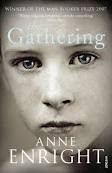
The Gathering by Anne Enright, 2007

Read in the Vintage 2008 edition shown

The decision of the 2007 Booker prize judges to give this book the nod over On Chesil Beach must rank as one of the all-time puzzling decisions of a prize panel. Because this was lame. The novel’s central premise is very traditional – a family member has committed suicide, and the clan gathers to mourn their loss and review his life. This is shown us by Veronica Hegarty, the book’s narrator, sister of the suicide, Liam. We are told early on that Liam’s death can be traced back to an event in his childhood. The traditional dark secret revolves around her grandmother, Ada – I was irresistibly reminded of another Ada, great-aunt Ada Doom, who saw something nasty in the woodshed, and has never been the same since.

The reveal – that Liam was sexually assaulted by a friend of the grandmother. (he was staying with his grandmother as his mother went through yet another pregnancy) is underwhelming. The line between this assualt and his eventual suicide decades later is never drawn – in fact Liam is a very lightly sketched character, and we understand little about his life and why he took it. The disclosure of this incident from the past is not the turning point we are led to expect – it is not revealed to the wider family, and nothing comes from it.

Stylistically the prose is wooden and at times comically so. When the narrator has sex with her husband she describes lying there “quartered like a chicken”. The narrator says of the young undertaker “You could unpeel him and he would still be true” (75) which is not just a whacky metaphor but gibberish isn’t it? Whether this disjointed narrative is supposed to reflect the distressed psyche of the narrator is besides the point – it is still clumsyily written.
The central character is unsympathetic and the fact that her mother often is unable remember is unsurprising.
Novels where nothing happens, and the events just consist of unstructured memory – and the point that Veronica’s memory is flawed, and is constantly being reconstructed is laboured to death here – flowing back and forth across the events of the past – are getting tired. I am really crying out for a novel where something happens and the characters are believable and interesting. Not much to ask for is it?

P.S. As with The Accidental, negative reviews on Amazon outweigh the positive – and I genuinely don’t believe this is just Booker bashing.

Standard
20th century Literature, American literature, Book review, John Steinbeck, Of Mice and Men

Of Mice and Men by John Steinbeck

Of Mice and men – John Steinbeck read in the 2010 New Longman edition
Spoiler alert – this review gives information about what happens at the end of the story. If you don’t want to find out what happens before you have read the book itself, please do not read any further.
I have a theory about “of Mice and Men”….
If George were to be tried for the murder of Lenny, he would be convicted. Everything Steinbeck writes leads us to avoid this judgment. At the end of the novel the murder is portrayed as a kindness. What is interesting to me is how Steinbeck manoeuvres the reader into this position, where we have sympathy for the killer, and empathise with his actions. How does he do this?

Firstly, we are encouraged throughout the story to think of Lennie as an animal – all of the imagery used to describe him focuses on this aspect of his appearance and behaviour. When we first see him he is described as “dragging his feet a little, the way a bear drags his paws” (page 19);  later he is said to be “as strong as a bull” (43); and later still he “came as silently as a creeping bear” (140). Bears and bulls are of course dangerous, and frequently killed by man.

The story is set in a world in which it is legitimate for man to destroy animals – for example to avoid unnecessary suffering. We are given two examples if this in the text – the killing of Candy’s dog, and the killing of four of Slim’s puppies. The putting down of Candy’s dog is particularly poignant and telling – Candy is told it is the right thing to do, and the reasons are compelling, but at the same time we can clearly see that it is not a straightforward decision. He is told to shoot the dog in the back of the head, which prefigures Lennie’s death. And of course it is Candy’s gun which is used to kill Lennie, underlining the connection between the two deaths, if such emphasis were needed. So Lennie is little more than an animal, and it is acceptable to put animals down when their owners feel it is appropriate to do so, therefore….

But Lennie isn’t an animal, and killing him is not legitimate.

The case for the defence is that this was a mercy killing. Lennie is about to be shot by Curley, and suffer a slow drawn out death. If this is somehow avoided then he would in likelihood be judicially murdered, or left to rot in a “booby house”. Even in the unlikely event of them escaping sooner or later the inevitable will happen and Lennie will be killed. Best for him to die in a moment of sublime happiness than be butchered.
The problem with this defence is that it is based on a number of false premises, albeit ones that the author has very carefully constructed. Firstly, it assumes the inevitability of Lennie’s death at the hands of the lynch mob. Well Lennie and George have some experience in escaping from mobs before, and the case that capture is inevitable is not made. Secondly, George has some responsibility for them reaching this point. While not directly responsible for Curley’s wife’s death (and how sad that anonymity is, like the other great anonymous character of GCSE fiction, Piggy) George did not do enough to avoid what was a foreseeable conclusion. We are told clearly she is “trouble” and Lennie begs George to leave the ranch – even he can tell things are going to go agley. George is well aware of Lennie’s exceptional strenght, and that he kills animals accidentally, so it didn’t take a leap of imagination to see that Curley’s wife was at risk. George admittedly warns Lennie to stay away from her, but then leaves him unsupervised while he plays ring-toss with the other ranch hands.

Lennie is brain-damaged and disabled, and whatever his crimes did not deserved to be put down like a dumb beast. Across the Atlantic, the Nazis were treating disabled people in pretty much the same way as George does Lennie, weighing their value in the balance and killing those found too much of a burden.

So why, when George kills Lennie, do so many readers see it as nothing less than an act of love, more than a mercy killing, a gift, sending Lennie to the promised land he has no prospect of inheriting on earth? Steinbeck spends the whole book leading us to this point, painting the choices George makes as unavoidable. We are told of their near escape from their previous town, when Lennie scares a young woman, sparking a manhunt. We are told of Lennie’s troubled childhood and George’s charity in taking him on. We see Lennie’s propensity for killing animals accidentally. And George loves Lennie, cares for him as best he can, and doesn’t want him to suffer the painful death Curley threatens.

So which is it – a mercy killing of a dear friend to avoid further suffering, or a cold, callous murder to relieve the burden of caring for a disabled relative? And how are we led to think it is the former, when all the circumstances suggest the latter? And finally, if we can be led into accepting a murder so easily, what else could we accept?
Standard
20th century Literature, Book review, Michael Frayn, Towards the end of the morning

Towards the End of the Morning by Michael Frayn

Read in a Faber and Faber 2005 edition. This is one of Frayn’s early (1967) novels about life in the newspaper industry pre-Wapping. It is an affectionate portrait, which some well observed scenes, but overall it is the slight kind of novel that can slide over your eyes without ever entering your brain. You really get no sense of the highly skilled writer Frayn was to become. The story, such as it is, follows two men in one of the backwaters of an unnamed Fleet Street newspaper, pointlessly churning out unread copy to fill gaps in the paper. Churning is a poor choice of verb actually, because we rarely see them doing any work before going to the pub, and their colleague sleeps extensively, then dies, at his desk, without anyone noticing for some time. His replacement is a charmless character who is never really fleshed out at all. The men are unlovable buffoons, tolerated with a deep sigh by their womenfolk. They have various mildly amusing situations before the novel peters out inconclusively. The comic scenes, such as the freebie holiday one of the newspapermen goes on, are over-extended, and I found them tiresome and unfunny. This has all been done so much better by for example, Kingsley Amis.

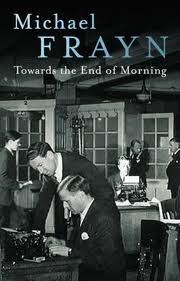
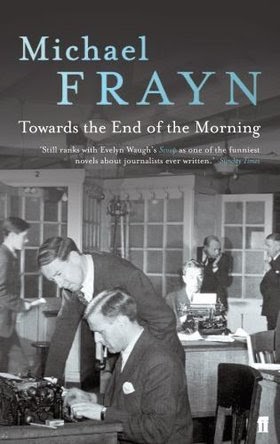
Frayn writes in his introduction that “No-one, for some reason, can remember the title I gave it” (the novel). This short essay, written presumably for the re-issue of the novel in 2000 on the back of some of his more successful, contemporary work, is arguably a more interesting portrait of the lost world of Fleet Street than the novel itself. But the reason the title is forgotten is the forgetability of the novel itself. If evidence of this were needed, look at these two book covers:

Spot the difference? The title of the novel!!

Frayn is one of our most interesting writers and probably doesn’t get the recognition he deserves. His craft is infinitely stronger these days, and while I thought Spies was flawed, it is still a great book. Hopefully I will get round to writing about it soon.

Standard
20th century Literature, A Handful of Dust, Book review, Evelyn Waugh

A Handful of Dust by Evelyn Waugh, 1934

First published in 1934, and read in a gorgeous Penguin Modern Classic Edition.  

Waugh is the great chronicler of mid-war upper class British life, and this is one of his bleakest, blackest novels. This savage, bitter comedy charts the end of a aristocratic marriage. The world the characters inhabit is not the comic, chaotic swirl of events seen in for example Vile Bodies, in which characters are not far from caricatures. Although all Waugh’s novel contain an element of bile, the taste here is particularly bitter – one would imagine the writer had experienced a relationship breakdown or divorce. There is a moment about half way through the novel when tragedy strikes. Even though I had read it before it still struck me with a visceral force, such is the quality of the writing and characterisation.


The title of the novel, in case you weren’t able to place it, is from the Waste Land:

“I will show you something different from either
Your shadow at morning striding behind you
or your shadow at evening rising to meet you;
I will show you fear in a handful of dust”
 

When I was taught Eliot at A level I was told I would find, or simply found, the Waste Land impenetrable, but looking back and re-reading it now I find lines like those above chillingly straightforward, even if they are open to many different readings. Here, a handful of dust can either be anything mundane – i.e. fear can be found in the everyday or ordinary, or the phrase can suggest the burial ritual, dust to dust.

 
The ending of the novel disappoints – there is a feeling of not knowing quite how to draw matters to a close, and it lapses almost into absurdity, as if the writer wanted to allow us to dismiss the novel as a straightforward, farcical comedy, rather than the tragedy which dominates the heart of the book.
 
If you haven’t read Waugh before this is probably not the best place to start, not because it is inaccessible – it is a compelling read – but because it is not the most representative of his writing. Try Vile Bodies or the Loved Ones for something less likely to leave you in quiet desperation.


Standard
Antony Beevor, Berlin, Book review, History, Second World War

Berlin by Antony Beevor, 2002

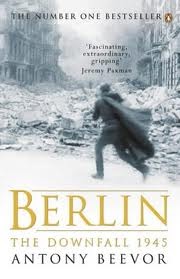
Berlin – The Downfall 1945 Antony Beevor, Penguin, 2002


You might get the impression from some of my recent posts that all I do is read German history, but it is fair to say that these entries are not entirely representative of my reading habits. Before I get to the book itself, a little gripe – this book’s cover includes the strap line “The Number One Bestseller”. It is amazing how often that line is used – I think it is largely devalued now. No doubt if challenged the publisher could justify it by selecting a very limited period of time, or category, or location. Number one in the non-fiction category on December 11th 2004 in Latvia doesn’t really count.


I am being overly cynical however, because this book is a highly authoritative account of the fall of Berlin. As you might expect, the horror is unrelenting, and while I now know more about this terrible period of history than I could possibly want, I confess the detail has not stuck – there is a long parade of generals with similar sounding names, battles across unknown terrain, without any clear overall picture of the progress of the war – there is simply too much detail for the non-academic reader.

What has stayed with me (as I usually find) are the images. History says that the fall of the Third Reich was a long but inevitable process. Where you start the beginning of the end from is a matter of choice – the Battle of Britain, Pearl Harbour (my choice, because after the USA joined the war there was really only one way it was going to end) D-Day or the end of the Battle of the Bulge, it all pointed to defeat for Germany at the end of the war. A negotiated peace was theoretically possible but the Nazis would never have let it happen. So the crushing of Berlin, principally by the Russians, was always going to be brutal. Despite this, it seems many Berliners tried to continue normal life right up to the end , rather than getting the hell out of there. They did not see the end as inevitable. The ability to deceive oneself despite all the appalling evidence to the contrary is quite chilling. Of course there were also many Berliners who could see what was coming but could do nothing about it.
 
When it was published I remember the book being controversial because of its focus on the systematic rape of German girls and women by the Red Army. While these accounts are hard to stomach, the context justifies their inclusion, and Beevor makes it clear that he is not taking sides or using this abuse as a justification for anti-Soviet propaganda, a pretty pointless exercise in any event. German atrocities are not the focus of this book but are referenced as part explanation for the brutalities of the Red Army.
 

This is “popular” history, that is history for the mass market, with half an eye on a TV series, but few concessions have been made to accessibility. It’s not an easy read, for many reasons, and even students of the period could probably find better, more digestible accounts. It is also one of those history texts that provide little in the way of food for thought. Compared to say When Money Dies, which can provide much to think about in the context of today’s society, all this book tells us is that when wars come to a bloody end there is an incalculable price to pay, which I think we knew.

Standard
Book review, Ian McEwan, On Chesil Beach

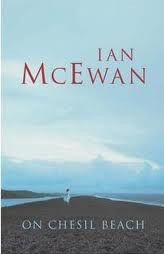
On Chesil Beach by Ian McEwan, 2007

I am going to break all my rules and say what I think this book is about, bearing in mind that I am not sure I even believe in the idea of books simply being “about” one thing.
The plot, such as it is, is quickly summarised in McEwan’s opening sentence:
They were young, educated, and both virgins on this, their wedding night, and they lived in a time when a conversation about sexual difficulties was plainly impossible”. 
We go on to find out that the couple are named Edward and Florence, are in their early twenties, and that the novel is set in summer 1962. Florence is terrified of the imminent consummation of the marriage – which never actually occurs, Edward suffering a spectacular bout of “over-excitement”. After this traumatic start the marriage, indeed the honeymoon, never recovers, and scarred by disappointment and fear they part.
When I first read this novel, shortly after the splendid Atonement, I thought it was about those moments in people’s lives where roads part, and where a word at the right time could change the course of events. The narrator in closing the book explicitly invites the reader to view it in that way. A kind word or words by one or other of the main characters could have rescued their relationship. Fear of sex combined with first night nerves probably feature in many honeymooners’ experience, but love manages to bring couples through the other side.
So why is Florence – (echoes of Florence Nightingale perhaps?) – so scared of sexual contact with her husband. She is clearly torn between her love for him, and her fear of sex – McEwan describes this as a “secret affair between disgust and joy”(page 23). Even French kissing, portentously reminiscent of intercourse itself, makes her want to gag.
The author never tells us directly what causes this fear, but “clues” are scattered throughout the text. On the opening page we are told Florence is an old hand at staying in hotels (a strange expression) “after many trips with her father”. Not with her parents note. Later, when describing Florence’s childhood, we are told (page 54) “Florence found it harder to contradict Geoffrey (her father). She could never shake off a sense of awkward obligation to him. Among the privileges of her childhood was the keen attention that might have been directed at a brother, a son. …And then the journeys: just the two of them, hiking in the Alps, Sierra Nevada and Pyrenees, and the special treats, the one-night business trips to European cities where she and Geoffrey always stayed in the grandest hotels.
Where is her mother, very much still part of the family, when these jaunts are going on? We are not told. Why is it “Geoffrey”, not “her father”?  The omniscient narrator appears to be viewing these jaunts as unexceptional, nothing out of the ordinary, but this is clearly Florence’s flawed perspective rather than a reliable viewpoint. Her relationship with her mother on the other hand is fragile and unphysical “Violet had barely ever touched her daughter at all” (Page 55) – we are left to infer why, but the mother must have withdrawn affection from her daughter for a reason.
When the dreaded moment approaches, and Edward is about to “make his move”, Florence lies back and thinks herself elsewhere. Her mind takes her to an occasion when she
was twelve years old, lying still like this, waiting, shivering in the narrow bunk with polished mahogany sides….her father was moving about the dim cramped cabin, undressing, like Edward now. She remembered…the clink of a belt unfastened…her only task was to keep her eyes closed and to think of a tune she liked. Or any tune. She remembered the sweet scent of almost rotten food
It can’t be a coincidence surely that her memory of this scene is prompted by her imminent if ultimately unsuccessful “deflowering”.  McEwan has given Florence this memory for a reason. Something has traumatised her. In both scenarios she feels a passive victim of male lust. So when Edward finally gives out a wail “the sort of sound she had once hear in a comedy film when a waiter appeared to be about to drop a towering pile of soup plates” (candidate for simile of the year in my book) her revulsion, as well as the immediate visceral objection, has
another element, far worse in its way, and quite beyond her control, summoning memories she had long ago decided were not really hers. … She was incapable of repressing her primal disgust”. (My emphasis)
Why would this incident summon memories she had decided long ago were not hers? What memories, and why were they far worse than her already strong reaction?
Finally, when they are on the beach itself, discussing her reaction, she jokes “perhaps what I really need to do I kill my mother and marry my father” (page 153). Indeed.
I think we are being invited by McEwan, without being told to do so, to consider the distinct possibility that this is a novel about how sex abuse can happen in the best of families, and how it can ruin lives. The final paragraphs telling us to think of the novel as being about turning points in our lives is misdirection.
Of course this is just one element to the book. There are many carefully drawn scenes, and the sense of time and place, that precarious moment in the country’s history “between the end of the Chatterley ban, and the Beatles’ first LP”, where memories of the war are still strong, and national service is still in force, is exquisitely drawn. The writing is confident and precise, and although only 150 pages long I believe this is McEwan at his best.
P.S. One final point, to indulge my hobby of joining the dots between books – I spotted a strong echo of Lawrence in the scene (page 46) where Edward cycles, “at reckless speed, for the brakes barely worked” which reminded me of Paul Morel’s barrelling around the lanes of Sons and Lovers on a bicycle without brakes, risking life and limb and demonstrating his manly bravado.
 

Standard
Book review, Collapse, Jared Diamond, Non-fiction

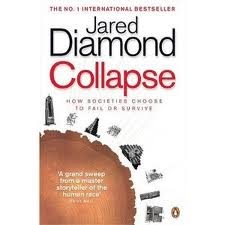
Collapse by Jared Diamond, 2005

Collapse – How Societies Choose to fail or Survive

Jared Diamond (2005)
An amazing book, which may well have finally cured me of my aversion to non-fiction. I am told it has since been made into a TV programme (or series) but not one which I caught.
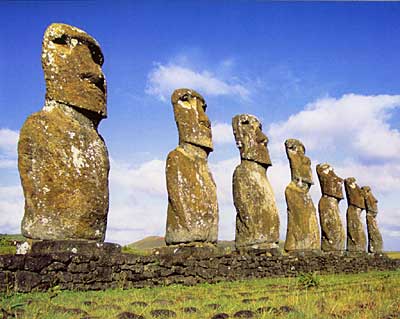
In brief, this is, as the title suggests, a study of how societies collapse. There are several very detailed case studies, including the Mayan civilisation in Mexico, Easter Island, the Norse settlement in Greenland, and American Indian civilisations. There are contrasted with similar civilisations that have persisted (although the reference to Iceland’s prosperity in comparison with Greenland is a bit of a sick joke post-bankruptcy in 2008/9) despite very challenging environments. The chapter on Easter Island (2) is a particularly interesting part of the book – it is argued compellingly that this extraordinarily mature and complex civilisation committed ecocide. Most of the collapsed civilisations studied here existed in marginal, challenging environments, and the sources of their collapse can be traced back to environmental destruction of one kind or another, whether it be deforestation, salinization of the soil, or soil erosion.
I wrote positively about Diamond’s earlier work, Guns, Germs and Steel in a previous entry. This book could easily have been alternatively sub-titled “Trees, Soil, and Water” given the central role these ingredients play in the survival or otherwise of civilisations. But Diamond’s choice of sub-title here, and especially that verb “choose” is both controversial and illuminating, and I keep coming back to that choice. His central thesis is clear – the survival of societies is not simply a matter of a natural rise and fall over time, but a result of the decisions and choices societies make. That’s not to say those decisions are easy or obvious, but nonetheless with the benefit of hindsight we can see how some societies prosper in almost impossible circumstances – he cites the example of the island of Tikopia in the Pacific which is less than two square miles in area, but on which people have survived for around 3,000 years – while others disappear more or less suddenly.
This is a hugely controversial topic or battleground, and of course Diamond’s cultural and academic perspectives come into play. His analysis of the massacres in Rwanda, attributing them in part to over-population, will be distressing to some, but he arrays a formidable amount of evidence to support his position.

Diamond is usually scrupulous in acknowledging when he is entering a field of potential or actual controversy – he recognises the existing debate, without hesitating to offer his own judgment or perspective. Which makes it all the more surprising that when discussing the use of infanticide as a method of population control, he does so in a quite chillingly dispassionate way, without giving the slightest nod to the possibility that there may be readers who do not accept that this was ever used in the way suggested. I have no doubt he has evidence to support his contention – presumably archaeological – but this is not cited or referenced.  


Diamond is handling some big themes here, so inevitably his work has attracted a fair amount of controversy. He anticipates some of this in his original text (so far as I can tell – the edition I read was a 2011 reprint, and there has been some revision and updating of the text). Firstly, the suggestion that native inhabitants of the Easter Islands and elsewhere could have wilfully destroyed their environment, leaving it uninhabitable, is seen by some as at best counter-intuitive, and worst simply racist. He stands accused of underplaying the role of slave traders and European illnesses in depopulating the island, where, it is claimed, indigenous peoples survived and prospered long after the largest trees were harvested. The counter thesis is that statue carving and erecting did not end with the felling of the largest trees, and the stone masons’ tools lie abandoned in the quarry not because people just walked away to participate in the collapse of the culture, but because they were attacked by slave traders.

Another controversy has centred on the puzzling question as to whether the Norse Greenlanders ate fish or not. The evidence of the animal bones in Viking rubbish studied by archaeologists suggested not, but other evidence of Viking bones themselves (and I admit I am not sure how analysing the chemical composition of people’s bones can tell you with much confidence how much fish they ate) claims that fish played an increasingly important part in people’s diets. This particular debate seems a bit of a non-issue to me and symptomatic of critics wanting to take chunks out of Diamond and taking any opportunity to do so – hence another “missing the point” article elsewhere claming that Australia’s agriculture is doing very well thank you very much. 

Diamond’s central thesis is actually very simple and in many ways unarguable. Over the course of human history some societies have prospered and survived, and others have collapsed. The survivors have certain characteristics that we can learn from, as do those which collapsed. The main learning point is that we should look after our environment, either by central Government taking the initiative (e.g. on forestry management), international co-operation (e.g. on climate change) or by “bottom-up” change initiated by local people and the choices they make e.g. lowering consumption, recycling. All of these actions will be fairly pointless if we don’t do something about population. I think we all know that population is increasing exponentially across the planet, and what we do about that is a subject that wouldn’t fit into Diamond’s analysis – he touches upon the issue but not in anything like the depth it requires. This is the Green political analysis, and it is well put, but I don’t see it as the whole answer, (of course).


Some minor complaints. At times this is a poorly edited, dull and self indulgent book, despite all the fireworks elsewhere. The opening chapter on Montana is a false start – Montana is in one of the most prosperous countries in the world, and this chapter reads as if Diamond is writing a postcard from his holiday home rather than opening an analysis of societal collapse.

Another grumble is on the absence of photographs/plates, which have been removed from this edition, presumably to save money (although £10.99 isn’t cheap for a paperback!) The references to the plates in the text have not been edited out. I found this disproportionately frustrating – each time the author reference to a plate he must have had reason to do so – the image or photograph would have illustrated a point that he doesn’t need to further elaborate. Basically it was just cheap of the publishers.
At the end of what was a bit of a marathon I feel very virtuous, having made it to the end, and what is more I want to know more – I have already followed up with various articles and Wikipedia entries – which is always a good sign.
 
Standard
19th Century literature, Book review, http://schemas.google.com/blogger/2008/kind#post, Jude the Obscure, Thomas Hardy

Jude the Obscure by Thomas Hardy, 1895

My campaign of self improvement and of reading books I should have read a long time ago continues. I have steered clear of Hardy previously largely due to prejudice – his poetry, which formed part of one of my school courses many years ago, felt sentimental and dull, and those of his novels that I had seen adapted for television or cinema were uninspiring pastoral pieces.


Having said that, I had read that Jude had been his last novel followed by a long silence filled only with the previously mentioned poetry. So I knew there was something which had scandalised some elements of late Victorian society, and my interest was pricked. Hardy deals with sexuality in a way that is immensely frustrating to the modern reader – the characters in the novel don’t seem to behave in a way recognisable to us, torn as they are between the strict conventions of the period and their own natural impulses. No one has what we would consider a healthy, “normal” attitude towards sex, and I found the scene where Sue forces herself to share a bed with her husband despite her profound disgust for what that implies – so strong that in one scene she junps out of her bedroom window to avoid him – quite disturbing. In some ways even the recognition of these issues, and especially of sex outside of wedlock, was shocking, and would not have featured in novels from just a few decades earlier in the century – no matter how impulsive and headstrong Heathcliff is (for example) he never oversteps this boundary. As such this novel is a bridge between the 19th century novels in which there is little or no suggestion of human sexuality – it was just taboo – and the more frank works of, say, Lawrence a few years later.


Having said that, I suspect that it was not the handling of sexuality that would have been really shocking to the Victorian reader – very little is explicit after all – but the deaths of the children towards the end of the novel, and the characters reactions to them, which really horrifies.


Other than the interest the novel carries in its treatment of these issues, what other features of the novel can recommend it? The description of country life in late Victorian England is well sketched, and the principal character’s frustrations with the lack of academic opportunities is of passing interest. Well, not really.


I was hoping that this introduction to Hardy’s novels would help me overcome my prejudice and inspire me to explore the rest of his works. Sadly that plan didn’t work – Jude was just too dull – but I haven’t given up on him yet!

Standard
100 Best Novels Guardian list, 19th Century literature, Book review, http://schemas.google.com/blogger/2008/kind#post, Robert Louis Stevenson, Treasure Island

Treasure Island by Robert Louis Stevenson

Earlier in the year, just after the Christmas/New Year break, I read “Treasure Island”, largely out of curiosity to see how close the TV adaptation was to the original. In some respects it was very faithful – for example in the way Silver kills the seaman (Tom) who will not join the mutiny once they land on the island – but in others it made massive changes, the most obvious ones being the death of Trelawney and the loss/abandonment of the treasure. Stevenson tells us almost nothing about what Jim and Co do with the treasure once home – the narrative slams shut once back in the UK, with only a paragraph about how Ben Gunn loses his money in 19 days – but that leaves it to the reader to imagine the high life they lead. One important thing the TV adaptation did reinstate was Silver’s black wife, although they make her a “tart” – possibly editions and adaptations from my childhood edited out references to this character because mixed relationships were frowned upon – just shows how racist the 70s really were. The TV version was careful to avoid all the pirate clichés, but they are there in the book, timbers being shivered, pieces of eight, Jim lad, etc. I guess this is from where they became clichés.


This was a very easy read – the narrative rattles along, with the only passages that drag being the technical/nautical descriptions of sails being unfurled, anchors being weighed and the like. The point of view is well manipulated to keep the reader in the dark as to the location of the treasure, what has happened to the rest of the crew, Silver’s sinister intent, etc.


However, ultimately this remains a children’s/young teenagers’ adventure story, with little to say on the issues of the time, unlike, say, Stevenson’s much darker “Dr Jekyll and Mr Hyde”. I recognise that Treasure Island is, like all texts, open to broader interpretation. The island can be taken to represent (for example) an alternative England where anarchy rules, and the struggle between the pirates and the other crew members could be taken as a comment on the ferocious class struggle rocking late-Victorian England. Islands are a great source of metaphor. But once you have made those connections, what then? I am not convinced that they give you anywhere to go in terms of understanding what was going on in the world, nor reveal subconscious attitudes to class or gender.

Standard
19th Century literature, Book review, http://schemas.google.com/blogger/2008/kind#post, The Moonstone, Wilkie Collins

The Moonstone by Wilkie Collins, 1868

Books aren’t hailed as classics, and don’t stay in print for 150 years, without good reason. Sometimes the challenge a reader faces is to find that reason. The Moonstone is a good example of this challenge – without it coming so highly recommended by a wide cross section of authors and critics I highly doubt I would have persisted with this Wilkie Collins novel to the end, nor felt so disappointed when I reached that point.
 
Often described as the original detective story, published in 1868, the eponymous moonstone is a fabled Indian diamond. The diamond is stolen from a temple by a dissolute army officer, and eventually left as a bequest to his niece. On the night she receives it it is stolen, and the primary part of the narrative is an investigation into the theft.
 
What struck me as remarkable about the story is how so many things don’t happen. A servant commits suicide, and remarkably doesn’t re-emerge months later having faked her death with the aid of accomplices. Who would have seen that one coming? A wily old detective from London is recruited to investigate the theft, after bumbling local constables make a mess of the initial investigation, and he doesn’t solve the mystery. There is no neat, it all make sense solution to the mystery, which is only explained by a combination of people behaving in ways we have been explicitly assured they would not, and some remarkable coincidences of which most mystery writers would be ashamed. I am not telling you too much when I reveal that the theft itself is committed by one of the house guests – shock – acting under the influence of laudanum, which had been administered by a medical acquaintance in a bizarre and to be honest utterly unbelievable “prank”. As the number of house guests is very small, the pool of candidates doesn’t leave the reader guessing for too long.
 
So what is there in this novel that can justify its status? Let me try. Firstly, the bulk of the narrative is told as a first person record by two of the relatively peripheral characters – a servant at the country house, and a spinster relative of the family. This unusual technique gives the reader more of a fly on the wall perspective – they see a lot of the action without participating in it – but an equally flawed vision – there is much they either don’t see, or don’t understand. The reader is able to decode their misunderstandings and misjudgments fairly easily – this is not a complex narrative in the sense of having to work out what is going on.
 
The conventions of the country house crime were not entrenched in Collins’s time, and to an extent he establishes many of them here, although as I have said above only to a very limited sense – for example the locked room “mystery” at the end of the novel lasts for a few seconds until the ladder out of the ceiling is spotted!.
 
Other than these admittedly limited reasons I confess I am struggling to explain the mystery of why this novel is considered a classic.
 
Standard