
What about Men? Caitlin Moran, 2023
What indeed? Caitlin Moran is an excellent columnist. I enjoy her writing; it is usually insightful and broadly progressive. But does her style of writing – pithy, with a punchline every few hundred words – convert well into a book that grapples with the serious question of the crisis of modern masculinity?
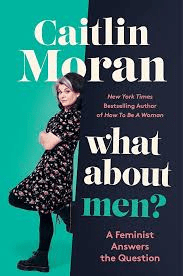
There are multiple issues with this book that undermine its overall impact and effectiveness. Stuart Jefferies, reviewing the book in the Guardian, does an extremely good job of identifying these issues and I am not going to try and duplicate his points, almost all of which I support (although re-reading the review at a later date he does give Moran both barrels and doesn’t take much time looking for any redeeming features). While reading the text I constantly found myself disputing Moran’s observations and not in a good way. They were not thought-provoking so much as smugly wrong. To offer one example, when the author uses the term ‘men’ she appears to refer to a very specific sub-set of men, largely defined as ‘blokes I know’. They are almost all in her age group, heterosexual, and British. A chapter about porn-addiction, based on an interview with a twenty-something young man, stands out because it gives a voice to a different group. Claims such as “your T-shirt collection is, to you, as your wife’s lovingly collated wardrobe of second-hand Chanel, designer jeans and Zara brogues is to her” just aren’t funny because they don’t derive from any observable reality. Isn’t that observation only true of Moran’s husband and their mates? Not many women I know have a collection of second-hand Chanel designer jeans and I am reasonably close to Moran’s demographic. I appreciate this is intended as tongue in cheek humour, but it falls at the first hurdle because it is neither funny nor relatable.
Which is a huge pity, because the subjects Moran writes about – the crisis of toxic masculinity in this country – is profoundly serious. It is literally killing men, through suicide, differential life expectancy, and poor health care. Moran addresses all these subjects, but rarely gets to grips with them before a punchline is required.
Perhaps the fault is mine, in reading this book as a text rather than a series of chapters grouped around the same topic. A fine distinction perhaps but what I mean is What About Men might work better if read one chapter a week rather than straight through like a novel. Some of the more
There is, unquestionably, a dialling it in aspect to this book. Her habit of twitter-sourcing content doesn’t inspire confidence that the book has been carefully researched for example. Most of the conclusions she draws about men are simply stating the obvious – the amount of original insight is minuscule. As a quick gallop through the main issues of modern masculinity, a starter text if you like, this would be fine for someone who hadn’t read a newspaper or spoken to a man in the last few years. Perhaps that’s the real audience – teenagers? But the problem with that idea is that in my experience teenagers are profoundly better informed on issues of sexuality and gender that 99.9% of people of Moran’s generation. I think, in fact I am pretty sure, that most teenagers would be appalled if they read her generalisations on sex, gender and masculinity. Her real audience is obviously the people who buy books and give them to one another for birthdays and Christmas without really expecting them to be read. Why would you bother properly researching a book if you know most people are going to skip to the chapters about sex?
 The Reading Bug