100 Best Novels Guardian list, 20th century Literature, American literature, Animal stories, Book review, Jack London, The Call of the Wild

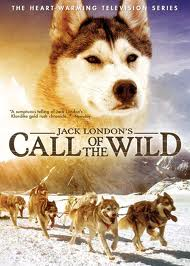
The Call of the Wild – Jack London – 1903

‘The Call of the Wild’ follows the adventures of Buck, a St Bernard/Collie cross. Buck is stolen from his Californian home, and sold to fuel the need for sled dogs in the Yukon as part of the 1880s gold rush. Buck goes from being a relatively pampered pet to being a possession, to be used and treated as a commodity, beaten close to death, worked even closer. London was a socialist and had first hand experience of the privations of the Yukon and the brutal treatment of animals, but I couldn’t avoid thinking that the story is more than just about dogs. 
Aren’t there clear parallels between the way Buck is broken and abused, and the treatment of slaves in America? I’m not suggesting the novel is a metaphor or parable – it could just be a story “about dogs” (I often check the Amazon reviews on books I am planning to write about, to get a feeling for the overall response, and see if there’s anything significant I have missed. One reviewer for ‘The Call of the Wild’ claims to have been disgusted upon finding out that the novel was “about dogs”, which I have to say I found wonderfully dumb) – but London’s political background suggests that his sympathy for the literal underdog extended beyond animals.

Buck is trafficked together with other captured and bought slaves, sorry dogs, to the Yukon, where he is savagely beaten until the fight goes out of him. He learns his new role chained to the straps of a sled. He is given bare rations, and slowly finds a place in the pecking order amongst the team. Once his job is done he is casually discarded, bought at a discount because he is no longer needed, and once again placed in chains. He finally finds an owner who treats him with love, but this relationship ends brutally, and Buck surrenders to the primal instincts he has been fighting for some time, and gives in to the ‘call of the wild’, becoming leader of a wolf pack.

This is not a story for animal lovers, or at least not those with any trace of sentimentality. Dogs die throughout the book, often killed by Buck himself, but also in a wide variety of other manners. Dogs are portrayed as fierce animals, following instincts derived from their days as man’s earliest companion, when the world was much darker and more dangerous. The novel of course anthropomorphises Buck, giving him human feelings and thoughts, and an understanding of the world far beyond what any pet would ever actually have, but he remains an animal, killing when he has to, and following his instincts – well, almost all his instincts – London understandably doesn’t goes down that road!

At just over 100 pages long this is a short adventure story that can be read in an afternoon or less. The Yukon is captured realistically through Buck’s eyes, and there is a wide cast of characters – I particularly enjoyed the stupid family who ignore the advice of experienced trappers and disappear through a hole in the ice, as we knew they would. The novel is carried forward at a frenetic pace, and the exercise of seeing the world through an animal’s eyes is well done. But at the end of the day this is just an adventure story, and I suspect London wrote books other than ‘Call’ more appropriate for adult readers. Whether I will seek them out is another matter.
Standard
100 Best Novels Guardian list, Book review, gothic fiction, http://schemas.google.com/blogger/2008/kind#post, Nightmare Abbey, satire, Thomas Love Peacock

Nightmare Abbey – Thomas Love Peacock – 1818

bey‘Nightmare Abbey’ is probably as heavy-handed a piece of satire as you will find in the whole of literature. Neither nightmarish – there are none of the traditional characteristic features of gothic fiction – nor set in an abbey, this short novel is partly a thinly disguised portrait of some of the romantic poets of the time, and partly a pastiche of their works.

It is tedious in the extreme. Some of this is deliberate – in parodying cloying philosophical nonsense it is hard to avoid writing philosophical nonsense. The trick is I suspect in providing just the right amount. There’s little or no characterisation here – all the characters are cyphers – Mr Lackwit, Mr Toobad, or the Reverend Mr Larynx. There’s also little or no narrative. The characters assemble in the abbey, which is really a moated country home on the remote Lincolnshire coast, where Scythrop Glowry, (admittedly, a pretty magnificent name) falls in and out of love as eligible females are paraded before him. Even Robert McCrum in choosing this novel for his list of 100 best novels in English for the Guardian in 2013 describes the plot as “cardboard-thin”. This is because the novel is simply a vehicle for Peacock’s friendly commentary on the lives and love affairs of the romantic poets. It may have had them rolling in the aisles in the early nineteenth century, but surely quickly lost its humour in a decade or two, and today provides many tumbleweed moments. Only one comment hit a chord; when, for the umpteenth time Mr Flosky, a friend of Mr Glowry senior is pontificating on his obscure theories, the narrator notes that he “suddenly stopped: he found himself unintentionally trespassing within the limits of common sense”.

The narrative voice is deeply cynical. Romantic relationships are purely commercial – “marriage is a lottery, and the less choice and selection a man bestows upon his ticket the better” – and married life is a burden – “Mr Glowry used to say that his house was no better than a spacious kennel, for every one in it led the life of a dog”. Jane Austen wrote about relationships and courtships with a similar scepticism, but her characters are far more three dimensional and believable, and if you want a light-hearted commentary on the gothic novels of the period ‘Northanger Abbey’ is an infinitely better choice. That this novel squeezed out ‘Lord of the Rings’, the Gormenghast books, and others from the Guardian’s top 100 novels makes its inclusion all the harder to understand.

Standard
Autobiography, Book review, Mark Seddon, Politics, Standing for Something

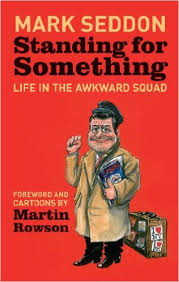
Standing for Something, Mark Seddon, 2011

This book is a curious combination of political biography and a rant against Blairism. As the former it is a mess; as the latter it is powerful and persuasive.

The political biography parts of the book, scattered throughout without any apparent structure whatsoever, whether chronological or otherwise, are written in a gossipy, laddish way, and consists almost entirely of anecdotes in which Seddon meets someone famous. These read like jotted down notes, and suffer greatly from lack of context – Seddon was largely an observer of events, rather than a participant. Even though he was a member of Labour’s NEC for eight years, he is the first to admit that during that period the NEC was neutered and largely irrelevant. His anecdotes are all quite slight, and have a half remembered vagueness that suggest he didn’t keep diaries.

But I don’t want to spend too long on what is wrong with this book, because when Seddon starts writing about the failures of the Blair/Brown coup of the Labour Party, and the political betrayals, some of which he clearly feels very personally, the book acquires an authenticity and passion. He has genuine insights into where Labour lost its way, and how it might recover its radical roots. For example:

My hunch is that Labour will eventually be re-radicalised in opposition. It won’t take long before the howls of anger and pain from those at the sharp end – Labour’s natural constituency – will be heard as the coalition cuts bite ever deeper. And this time the newly insecure and visibly more impoverished middle classes, those who work for less pay and pay more in taxation in an intended decade long Tory attempt to claw back the deficit, will become more and more angry. Whereas a quarter of a century ago it was working class jobs that were going in their hundreds of thousands, by the end of the first decade in the twenty-first century middle-class jobs had become increasingly casualised.” (251)

“And as the first decade of the twenty-first century ended it was fast becoming apparent that the ordinary people of these islands were being forced to pay in their jobs and taxes for the greed of the bankers, the industrialisation and pauperisation of an economy” (257)

Obviously this was written in 2011 or 12, long before the end of the coalition and the rise of Jeremy Corbyn, but I am fairly sure I know who Seddon will be cheering on now, albeit from the New York sidelines.

P.S. I did say I wanted to avoid spending too long on the negatives, but I don’t at the same time want to self-censor. The editing of this book was really poor. Here’s one example:

‘Greeting Marra’ was his opening gambit before heading upstairs to plan our trip on an Eastern Counties double-decker bus to the sleepy Essex port of Wivenhoe, where coal was being landed. Our first outing as flying pickets, in an Eastern Counties double-decker bus, ended comically with us getting lost on the way…” (131/132)

Two sentences, both mentioning the same trip on the same bus, probably written a different times, and then stitched together without anyone noticing the repetition. This happens quite a bit. Also wearying was the staleness of some of the language:

“The expenses scandal crossed a new Rubicon“; “the icing on the cake was provided by the Murdoch media, which had managed to cast its baleful spell over the political class”; “Standing for Something finally opens the lid on the New Labour years, casting light into dark places“; all tired clichés from page 2 – on the following page “leading lights”, “warts and all”, “behind the scenes” (twice) and “rubber stamping” all jumped out, or rather limped out as I got increasingly frustrated with the important but poorly expressed thoughts Seddon or his editor were trying to convey. Of course look back through these blogs and you will find worse and more, but then I’m not a professional journalist, and don’t enjoy the benefits of an editor (except the occasional glance over the shoulder).

Standard