Book review

Supplementary: Dress in Samuel Richardson’s ‘Clarissa’

Descriptions of clothing in ‘Clarissa’ are rare, which means that when they are included the reader pays particular attention. Two descriptions in particular stood out for me – one of Mr Solmes, and a little later, one of Clarissa:

Describing Mr Solmes

In volume 2, letter 34 of ‘Clarissa’, we are given our first clear description of her approved suitor, Mr Solmes, from the agitated perspective of her maid, Betty:

“Miss! Miss! Miss! cried she, as fast as she could speak, with her arms spread abroad, and all her fingers distended, and held up, will you be pleased to walk down into your own parlour?—There is every body, I will assure you in full congregation!—And there is Mr. Solmes, as fine as a lord, with a charming white peruke, fine laced shirt and ruffles, coat trimmed with silver, and a waistcoat

standing on end with lace!—Quite handsome, believe me!—You never saw such an alteration!”

Physical descriptions of characters in ‘Clarissa’ are rare, so when they do occur they stand out, as Mr Solmes’s waistcoat does here. He is dressed for a solemn meeting with his intended, with all the family in attendance. Clarissa is panicked by the maid’s enthusiastic description of the gathering, and Mr Solmes’s appearance in particular. The use of the term “full congregation” suggests this is going to be a ceremony, and Clarissa surely fears that the threatened marriage is being sprung upon her.

The peruke is a Georgian wig worn by gentlemen. It came in different lengths, from the relatively modest to the full Beau Brummell. It would not perhaps have been too distinctive on its own, but combined with the fine laced shirt with ruffles, waistcoat “standing on end” with lace, and a silver trimmed coat (which today one would describe as a jacket, I think) one can easily picture Solmes as a bridegroom. While wedding attire was not as prescriptive as it is in today’s Western society, this formal attire would not be unsuited to a wedding.

The marital atmosphere of the scene is amplified by the adjectives in the maid’s speech suggestive of suspense and extension – “arms spread abroad”, “fingers distended and help up”, “standing on end”. The room is full of anticipation, and perhaps there is even an echo of the phrase ‘to walk down the aisle’ in the maid’s ‘to walk down into your own parlour’.

Clarissa’s reaction can hardly be considered a surprise given this build up.

Describing Clarissa

If Solmes is a disappointed bridegroom, the same could be said of Clarissa from the intricate description of her in volume 3 letter 7. In this letter from Lovelace to Belford he describes Clarissa’s appearance on the night of her removal from her parent’s home. He has already told Belford, with a leer, that  “I am a critic, thou knowest, in women’s dresses. Many a one have I taught to dress, and helped undress”, and this boast of his observational skills in relation to the detail of women’s clothing seems justified.mob-cap
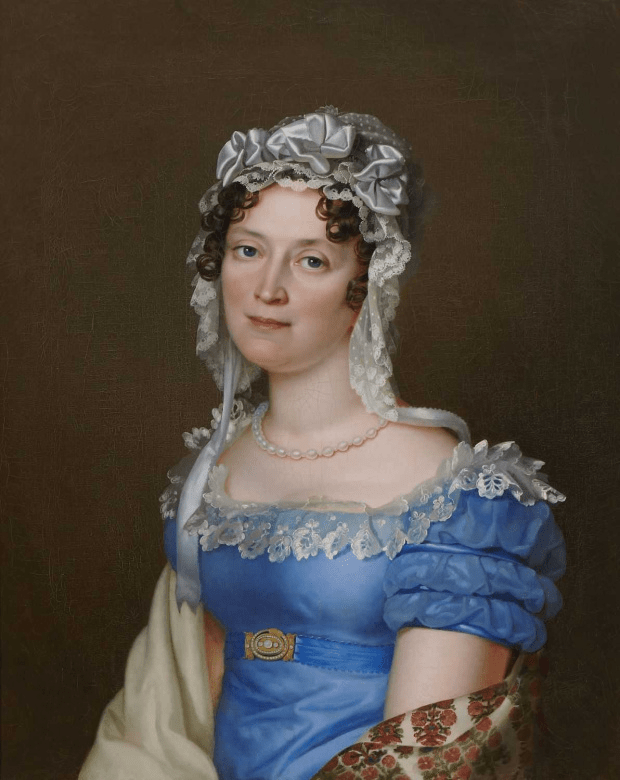
“Her head-dress was a Brussels-lace mob, peculiarly adapted to the charming air and turn of her features. A sky-blue ribband illustrated that. But although the weather was somewhat sharp, she had not on either hat or hood…

Her morning gown was a pale primrose-coloured paduasoy: the cuffs and robins curiously embroidered by the fingers of this ever-charming Arachne, in a running pattern of violets and their leaves, the light in the flowers silver, gold in the leaves. A pair of diamond snaps in her ears. A white handkerchief wrought by the same inimitable fingers concealed—O Belford! what still more inimitable beauties did it not conceal!—And I saw, all the way we rode, the bounding heart (by its throbbing motions I saw it!) dancing beneath her charming umbrage.

Her ruffles were the same as her mob. Her apron a flowered lawn. Her coat white sattin, quilted: blue sattin her shoes, braided with the same colour, without lace; for what need has the prettiest foot in the world of ornament? neat buckles in them: and on her charming arms a pair of black velvet glove-like muffs of her own invention; for she makes and gives fashions as she pleases.—Her hands velvet of themselves, thus uncovered the freer to be grasped by those of her adorer.

This is our first full description of our nineteen year old heroine. The context here is important, naturally. Clarissa has arranged to meet with Lovelace at the end of her extensive garden. Originally the plan was that they were going to leave Harlowe Place and run away to one of his relative’s many houses – the detail of the plan was never fully explored. Clarissa has had second thoughts, and decided not to go, despite an imminent moment of crisis in her family’s campaign to force her to marry Mr Solmes. She decided to tell him of her decision in person, lest he feels the need to burst into her house in an attempt at rescue – or at least that is what she tells herself. He is prepared for this change of heart, and bustles her into his carriage anyway. The other relevant aspect of the context is the date and time – it is late evening in April – Lovelace tells us that the weather was “somewhat sharp”. Clarissa is not dressed with a view to running away or eloping – Lovelace interprets this as a demonstration of her determination to remain with her family.

What stands out from this description is the level of detail – Lovelace has had plenty of time during the coach-ride to notice Clarissa’s apparel, but he picks up on every small detail, and believes Belford will be interested in his account. His account goes from head to toe in order, starting with her Brussels lace mop-cap. A mop cap was a lightweight piece of fabric of varying ornamentation Typically it covered all of the hair and was typically bordered by a broad ruffle or decorative frills. One made from Brussels lace was rather fine – and was largely ornamental (rather than functional). Whether this was standard day-wear for a Georgian young woman is hard to say. The impression I have, with only very limited evidence to support this, is that the mob-cap was a sign of respectability. The cap is secured by a sky-blue ribbon – the first of several images Lovelace draws from nature in his description. Her morning gown is standard day wear, but the material it is made from – paduasoy – is a heavy, rich corded or embossed silk fabric, quite opulent for everyday wear. While Clarissa may not be dressed to elope, she is dressed for more than a quiet evening meal alone in her garden – she is dressed to impress, whether she is prepared to admit it to herself or not.

Lovelace’s eye travels to her arms, covered in embroidered violets and their leaves. The choice of violets is of course deliberate, referencing as it does the story of one of the goddess Diana’s  nymph companions, who was pursued by Diana’s twin brother, Apollo. To protect her, Diana changed the nymph into a violet. Clarissa is to be the subject of a similar unrelenting pursuit – and possibly a similar fate? Richardson encourages this train of thought by invoking a more explicit classical reference, to Arachne. In Greco-Roman mythology, Arachne was a talented mortal weaver who challenged Athena, goddess of wisdom and crafts, to a weaving contest; this hubris resulted in her being transformed into a spider. Women being transfigured from their natural state into violets or spiders – what can this mean for Clarissa?

I am going to pass swiftly over Lovelace’s lascivious leering over Clarissa’s breasts, and consider the next phase of his description. As well as wearing a morning gown, Clarissa has on an apron, embroidered with flowers, continuing the nature theme, a white satin coat and a black velvet muff. This is quite an opulent ensemble, if not bridal then surely suggesting that the thought has crossed her mind. Clarissa’s ambivalence about Lovelace – she is attracted to him, but afraid of his reputation – is reflected in her costume. Despite her protestations to the contrary, it seems clear that Clarissa dressed carefully for this appointment, intending to make a positive impression on Lovelace.

 

Standard
100 Best Novels Guardian list, 17th century literature, Book review, Clarissa, Samuel Richardson

Clarissa, by Samuel Richardson, 1748, volumes 3 & 4

Back to ‘Clarissa’.  At the end of book 2, Clarissa has taken the bold, if not foolhardy step of running away from her family home with the blaggard Lovelace. While it looks to the rest of the world as if this was an elopement, the actual events were more confused – Clarissa intended to tell Lovelace the plan was off, and she was going to try one more time to persuade her family of her implacable opposition to the proposed marriage with Solmes. Well aware of this possibility, Lovelace arranges for their liaison at the end of her garden to be ‘discovered’, and bundled her into his carriage.lovelace

Volume 3 opens with the reader concerned for Clarissa’s fate – has she fallen foul of Lovelace’s dishonourable intentions? Not yet. Clarissa has exchanged one form of imprisonment for another. Lovelace keeps a close eye on his prize, but for now decides to continue to frighten her into submission rather than his usual technique of using violence, or as he would think of it, seduction.

Thus far we have had only a limited portrait of Robert Lovelace (‘loveless’?). We know of his reputation as a libertine, a seducer of innocent women, which he acknowledges is justified. He holds a grievance against all women as a result of an earlier failed romance, which he uses to explain his relentless philandering. The extent to which this is a true self-portrait, or simply a caricature, is at this point unclear. But in volume 3 and 4 he begins to emerge from the shadows, and he is a truly unpleasant creation.

In letter 12 to Belford he regrets that Clarissa and Miss Howe live so near one another,

Else how charmingly might I have managed them both! But one man cannot have every woman worth having—Pity though—when the man is such a VERY clever fellow!

In letter 14 he congratulates himself in his restraint in not pursuing other women while his focus is on Clarissa. He estimates he has been celibate for:

“let me see, how many days and nights?—Forty, I believe, after open trenches, spent in the sap only, and never a mine sprung yet! By a moderate computation, a dozen kites might have fallen, while I have been only trying to ensnare this single lark”.

In his exchange with his spy in the Harlowe household, Joseph Leman, (V3, letters 38 and 39), he freely admits an earlier affair with a Miss Betterton, dismissing it as “a youthful frolic” and while accepting an illegitimate child was born as a result, denies Leman’s claim that “there was a rape in the case betwixt you at furste”. He then immediately contradicts himself, saying

“It is cruel to ask a modest woman for her consent. It is creating difficulties to both”

Even his closest accomplice, Belford, pleads with him to behave honourably to Clarissa, and describes him as “cruel as a panther” (V3, letter 51).

Later in volume 4 Lovelace returns to his favourite topic, bragging about his ‘seduction’ technique (letter 16), which sounds a lot like rape to me:

Is it to be expected, that a woman of education, and a lover of forms, will yield before she is attacked?… I doubt not but I shall meet with difficulty. I must therefore make my first effort by surprise. There may possibly be some cruelty necessary: but there may be consent in struggle; there may be yielding in resistance.

His plan to ensnare Clarissa slowly unfolds. He manipulates her into moving into lodgings in London, where they live together to outward purposes as husband and wife. It becomes apparent that these lodgings, unbeknown to Clarissa, are nothing more than a high class brothel, run by Lovelace’s previous victims.

Lovelace thinks of himself as a master plotter, ensuring Clarissa is isolated from family and friends and surrounded by his agents. His plot is vulnerable to discovery at any time, but a more serious objection is that Lovelace hasn’t decided what his ultimate objective is – is it to deflower and then discard Clarissa, or to marry her? He enjoys the business of plotting and manipulating, being in control, but when his plans are foiled by Clarissa’s resolution to remain chaste, he is petulant and sulks. When pressed on this issue, he claims that his seduction of Clarissa is all a test – if she successfully resists him he will reward her with marriage; if she fails and succumbs to his charms then she was never worth his attention in the first place. This is contradicted by his boastfully predictions of success, even if he should need to resort to violence – I don’t think even Lovelace himself is persuaded by this flimsy justification. He is a hard man to dissuade however, and even Belford’s point, that in ‘ruining’ Clarissa he would be furthering the aims of her brother and sister, does not deflect him from his course.

Clarissa, meanwhile, remains highly suspicious. She realises that she has become ever more vulnerable, isolated from friends and family, with just her correspondence with Miss Howe as a lifeline. The tone of the novel shifts slowly in volume four as more letters from Lovelace are featured, and the authorial voice becomes more prominent. The correspondence, which in the earlier volumes is presented verbatim, is now quite heavily edited, with the narrator telling us what sections of letters he has excised, summarising others, and commenting on the characters’ behaviour.

When a reconciliation with her family is refused, and when hopes of assistance from her long-awaited cousin Morden evaporates, Clarissa accepts that marriage with Lovelace is now her only remaining option. The wedding, and the attempt on her honour that will precede and perhaps pre-empt it, are coming to a climax when volume 4 closes. However the final chapters, possibly as an attempt to secure readers for the following volumes, show Lovelace indulging in an extraordinary rape fantasy, in which he and his fellow ‘bravos’ kidnap and rape Miss Howe, her mother, and her maid. Lovelace enjoys the thought of his trial – in which he plays the central role of conquering hero – more than the ‘escapade’ itself, and brags of using his position to avoid conviction. These letters to Belford are unanswered, and are uncomfortable reading, out of tone with the rest of the novel. Having thought that Lovelace was finally coming to terms with the likelihood of marriage, it seems he has had a last minute change of heart, and is planning to continue Clarissa’s torture as long as possible, before she finally realises he is irredeemable.


Standard
Book review

Comment: Different types of reading

When presented with a list of “must read before you die/turn 50/graduate” novels, the instinctive response is to run down the list saying “read/not read/read” etc. In other words we treat the question of whether we have read a novel as a binary yes/no matter.

But if you think about it for a moment, that’s almost certainly wrong. reading abook
Why? Well, apart from reading or not reading a novel (or any other book) there are a number of other answers. I’ve come up with this list, but I suspect it’s possible to add more:

  1. I have read it, but got bored and skipped bits
  2. I read some or most of it but didn’t finish
  3. I read it in translation
  4. Someone read it to me
  5. I’ve seen the film/television adaptation
  6. I read an abridged version
  7. I listened to the audio book
  8. I read it a long time ago and can’t remember (hardly) anything about it
  9. I have read it and reread it so many times I can recite long chunks from memory
  10. I read it carefully because I knew I was going to have to write something sensible and coherent about it in my blog.

You will probably have guessed this, but nowadays when I say I have read a book, I usually mean the final category. I am not saying any of the others are in any way wrong – just pointing out that “I’ve read that book” can mean different things to different people.

Standard
Book review

Clarissa, by Samuel Richardson, 1748 – Volume 2

Volume 2 of ‘Clarissa’ is extraordinarily like volume 1 – Clarissa’s family send various people to try to persuade her to comply with their wishes, she in reply explains her adamantine opposition to Mr Solmes. Lovelace, the libertine suitor who her family have rejected, lurks in the background, waiting for his opportunity. Every word is recorded faithfully for Miss Howes, Clarissa’s faithful friend, who in return occasionally chips in with some moderately helpful advice. Miss Howes’ suitor Mr Hickman appears briefly, but is dismissed primarily as a nuisance to be dealt with once the main drama is concluded.

It is hard to avoid the suspicion at times that Clarissa is enjoying being the centre of attention, even though the threat she is living under is real enough. She generates vast volumes of letters, often several in one day, but her practical problems of getting these to Miss Howes – there is some clumsy business with a loose brick in the garden wall – are overlooked. Email would have been so convenient to imprisoned young women in the eighteenth century!

With so little ground to cover, and so many pages to fill, Richardson inevitably gets long-winded, as in this extract from letter 43, which for me is also an example of pretty clumsy writing

“If the thing requested be of greater consequence, or even of equal, to the person sought to, and it were, as the old phrase has it, to take a thorn out of one’s friend’s foot to put in into one’s own, something might be said— nay, it would be, I will venture to say, a selfish thing in us to ask a favour of a friend which would subject that friend to the same or equal inconvenience as that from which we wanted to be relieved, the requested would, in this case, teach his friend, by his own selfish example, with much better reason, to deny him, and despise a friendship so merely nominal.”

Moments of actual activity, rather than debate about a daughter’s duties, are rare, and the format Richardson has adopted makes it impossible for him to describe any such action when it does happen other than in retrospect. He increasingly resorts to having people scribble notes as they wait for someone to arrive, and then breathlessly report on what has happened, with the events themselves being the one time the screen goes blank. The constraints of the format occasionally lead to Richardson breaking his own rules – footnotes begin to appear from the anonymous editor of the correspondence, pointing out various contradictions in the characters’ behaviour. Using correspondence allows the author to give us directly and immediately the character’s thoughts and feelings, but the other shortcomings of the form are becoming more obvious as the novel progresses.

Despite being her intimate correspondence, Clarissa rarely tells us what she is really feeling – she instead spends a huge amount of time setting out what she believes she ought to think and feel. Which is why her dream recounted in letter 34, when the prospect of a forced marriage with Solmes seems imminent, is revealing:

‘Methought my brother, my uncle Antony, and Mr. Solmes, had formed a plot to destroy Mr. Lovelace; who discovering it, and believing I had a hand in it, turned all his rage against me. I thought he made them all fly to foreign parts upon it; and afterwards seizing upon me, carried me into a church-yard; and there, notwithstanding, all my prayers and tears, and protestations of innocence, stabbed me to the heart, and then tumbled me into a deep grave ready dug, among two or three half-dissolved carcases; throwing in the dirt and earth upon me with his hands, and trampling it down with his feet.’

There is a real and immediate physicality to this that is absent in the rest of Clarissa’s letters, real violence. Dirt and half-dissolved carcases are not the kind of things young Georgian ladies are meant to dream or talk about. It is tempting to interpret this as a sex dream, with its reference to stabbing and tumbling, and of course one would expect a young woman of this era to be apprehensive about the impending loss of her virginity – “innocence” – on her marriage, but I think the genuine fear here is palpable. For once this is no longer a game for Clarissa – she is slowly beginning to realise that sooner or later she is going to have to leave her warm protective family home with its servants and high garden walls, and have to face the real world in which she will be another man’s possession. No wonder she is terrified.


Standard
Book review

Clarissa Harlowe, or the history of a young lady, by Samuel Richardson, 1748

Further subtitled “Comprehending the most Important Concerns of Private Life. And particularly shewing, The Distresses that may attend the Misconduct Both of Parents and Children, In Relation to Marriage“.

The good news is that I have finally finished volume one of ‘Clarissa’.

The bad news – for me – is that I have another eight volumes to go! This is indeed a monster of a novel, running to over 1500 pages. To preserve my sanity I am going to approach it as a series of novels, and may well break it up with lighter reading,

First impressions:

Clarissa is an epistolary novel, where the narrative is progressed through the characters’ correspondence. This has the advantage of showing us their thoughts and feelings, and given the frenzy with which Clarissa and her friends and family write letters, sometimes several in one day, including to members of the same household, gives an immediate reportage feel to the novel. The disadvantage of this format is that without an omniscient narrator there is little in the way of descriptive writing – we are only told what the characters believe to be relevant, which excludes the setting, their appearance, etc.

Clarissa, a rich young lady, is the subject of a fierce battle of will between herself and her family. Her father and other relatives want her to marry Mr Solmes, an even richer young man, who promises to add to the family’s overall wealth and status, and believe it is their right to dispose of their daughter as they see fit. She is valuable property, the more so now her grandfather has recently bequeathed her some money. She is disinclined to accept these arrangements. The family believe her refusal stems from an attachment to an unsuitable young man, Mr Lovelace. She adamantly denies any such attachment, but Richardson skilfully uses the differences between her descriptions of events and those of others to allow the reader to deduce that there may be some truth in their suspicions. An impasse is reached, which is where volume one ends, with the family resorting to ever more forceful attempts to persuade Clarissa to accept Mr Solmes, and she equally forcefully rejecting him.

The bulk of the novel (this volume at least) is formed of letters between Clarissa and her friend, Miss Howe. It is a significant moment when a third voice is introduced, that of Lovelace, who reveals himself as the libertine Clarissa’s family fears him to be. In Letter 35 Lovelace boasts to a friend,

“I will throw myself into my charmer’s presence. I have twice already attempted it in vain. I shall then see what I may depend upon from her favour. If I thought I had no prospect of that, I should be tempted to carry her off. That would be a rape worthy of Jupiter!”

This is one of those sentences that brings the reader up short – is Lovelace really lasciviously anticipating raping Clarissa? My initial reaction was that he might be using the word ‘rape’ in a special, eighteenth century context, a robust form of seduction. The word ‘ravish’ is sometimes used in this way, implying a more complex relationship than a simple assault. But I think that would be letting Lovelace off the hook – he clearly has every intention of having sex with Clarissa, and her consent is of little concern to him. Richardson makes it clear that Lovelace considers having sex with women a form of revenge.

“A rape worthy of Jupiter”.

We are, in this one packed phrase, at the heart of the novel’s sexual politics – Clarissa is a possession, the most prized component of which (in addition to her grandfather’s inheritance) is her sexual attractiveness, and in particular her ability to provide an heir. It is that value which is threatened by the lothario Lovelace, and that which her family imprison her in order to protect. It is another example of the double standards of the time, that Lovelace’s reputation for immoral behaviour is something that can quickly be forgotten when it comes to considering him a potential groom, when set against his considerable fortune and expectations.

Only eight more volumes to go!

Standard
100 Best Novels Guardian list, Book review, Pilgrim's Progress

The Pilgrim’s Progress, by John Bunyan, 1678

Subtitled ‘From This World to That Which Is to Come; Delivered under the Similitude of a Dream’.

bunyanThis is the third time I have recently tried to read ‘Pilgrim’s Progress’ – each time previously I gave up simply due to lack of interest. Bunyan’s style is said to be straightforward, but I found the insistent preaching and sermonising soporific. This completed reading was finally achieved only through gritted teeth and from a stubborn determination not to be beaten a third time. Yet here’s the thing – ‘Pilgrim’s Progress’ has been in print for almost 350 years, has a strong claim to be the first novel written in English (it has characters, tells a story, and is in prose) and had a profound influence on many novelists. All stories of personal development or growth own a debt to Bunyan, and many including ‘Little Women’, ‘Oliver Twist’ and ‘Vanity Fair’ acknowledge their debt explicitly. Wikipedia claims that the novel “is regarded as one of the most significant works of religious English literature” and goes on to claim that it has been translated into more than 200 languages. So my challenge was to find the value in this novel despite the teeth gritting.
You will be familiar with the plot, such as it is. Christian, fearing for his immortal soul, leaves his life of sinfulness and goes on a pilgrimage to find the Celestial City. He meets a range of challenges to his faith, some trivial, some less so, all of which he overcomes, to finally arrive at the Promised Land and be welcomed into heaven. A sequel, published several years after the first part, follows Christian’s wife and children as they follow a very similar path to that of the first novel – after a bit of an internal debate I decided not to read the sequel, despite it being described on publication as the second part of the story.

The circumstances of the publication of this novel are almost as well-known as the story itself. Bunyan belonged to a very small non-conformist church in Bedford, and took to preaching around the countryside in direct convention of the strict laws of the time, following the restoration of the monarchy. His original sentence was three months, but as he refused to undertake to not repeat his offence his sentence was extended repeatedly – he eventually served twelve years, leaving his young wife and four children destitute.

It is easy to overlook the positives in ‘The Pilgrim’s Progress’. The problem in part is one of familiarity – we have all grown up with Giant Despair, The Slough of Despond, and Mr Worldly-Wiseman, and take their inventiveness for granted. But apart from this quality, taking the text as it reads in the present, I found very little else of value. Bunyan uses his parable to preach unremittingly at the reader. The formula he adopts is rigidly adhered to – his pilgrim, Christian, meets a character representing the personification of a sin, is tempted, (sometimes not), overcomes the challenge, and moves on. I am simplifying of course, but this is the structure for the whole novel, and there never comes a moment where the reader expects anything else to happen. Bunyan quickly runs out of serious sins, and has to resort to relatively innocuous offences – formalism, timorousness, discontent and talkativeness to name a few, which gives these sections of the novel a slightly ridiculous tone.

Later, Christian sees his fellow pilgrim, Faithful, brutally executed in Vanity Fair:
“They therefore brought him out, to do with him according to their law; and, first, they scourged him, then they buffeted him, then they lanced his flesh with knives; after that, they stoned him with stones, then pricked him with their swords; and, last of all, they burned him to ashes at the stake. Thus came Faithful to his end.

Despite the horrors of this death, Christian takes Faithful’s martyrdom in his stride and through divine intervention escapes a similar fate. Later he meets with another pilgrim, Hopeful, and together they bully a third pilgrim, whom Bunyan labels Ignorance. Ignorance is not English, nor a follower of the Church of England. He comes from “the country of Conceit”. He is described as “a very brisk lad”, and speaks respectfully to Christian:
“Sir, I was born in the country that lieth off there a little on the left hand, and I am going to the Celestial City.”
In answer to Christian’s questioning about his credentials – “what have you to show at that gate, that may cause that the gate should be opened to you?” he replies again respectfully
I know my Lord’s will, and I have been a good liver; I pay every man his own; I pray, fast, pay tithes, and give alms, and have left my country for whither I am going.”
Christian is having none of this
But thou camest not in at the wicket-gate that is at the head of this way; thou camest in hither through that same crooked lane, and therefore, I fear, however thou mayest think of thyself, when the reckoning day shall come, thou wilt have laid to thy charge that thou art a thief and a robber, instead of getting admittance into the city.”

In other words, living well, paying your way, and knowing the Lord’s will, isn’t enough for Christian. He takes it on himself to challenge Ignorance’s right to aspire to redemption in the first place. Ignorance politely asks him to leave him alone – this is becoming suspiciously like bullying:
Gentlemen, ye be utter strangers to me, I know you not; be content and follow the religion of your country, and I will follow the religion of mine”
That’s not enough for Christian who speaks to Hopeful, “whisperingly,
“There is more hope of a fool than of him.””
When Ignorance finally arrives at the Celestial City he is dealt with brutally,
the King…commanded the two Shining Ones… to go out and take Ignorance, and bind him hand and foot, and have him away. Then they took him up, and carried him through the air to the door that I saw in the side of the hill, and put him in there. Then I saw that there was a way to hell”
None of those nasty foreigners in our Celestial City, thank you very much!

Christians might enjoy having their beliefs confirmed by this novel, but otherwise I would not recommend exhuming this one from the archives.

Standard
20th century Literature, Book review, Doris Lessing, The Fifth Child

The Fifth Child, by Doris Lessing, 1988

thefifthchildThis disturbing novella by Nobel Laureate Doris Lessing was very different from what I expected it to be. The cover of the Paladin paperback edition is illustrated by what I immediately recognised as an enchanting picture of an impish young child by Mervyn Peake. As well as being one of my all-time favourite authors (and if you haven’t read the extraordinary Gormenghast trilogy, Titus Groan, Gormenghast, and Titus Alone, you really should) Peake was also an exceptional artist and illustrator. This drawing (probably of one of his sons) was done may years before this book was published, so quite how it came to be used to promote this novel is a bit of a mystery. Unsurprisingly, the picture is utterly inappropriate, as I will explain in a moment, but the combination of the cover, the price (£1 in a charity book shop) and some residual guilt that the only books I had read by Lessing was her disappointing ‘Golden Notebook’ and the more recent ‘The Good Terrorist’ made the purchase a no-brainer.

So to the novella itself. David and Harriet Lovatt, unconventional in their conventionality, meet, marry, and start a family in their huge house in the suburbs. All is bucolic and happy until Harriet falls pregnant for the fifth time. At this point the novel takes a very dark turn – Ben, her child is a violent, disturbed creature.
“He was not a pretty baby. He did not look like a baby at all. He had a heavy-shouldered hunched look, as if he were crouching there as he lay. His forehead sloped from his eyebrows to his crown. His hair grew in an unusual pattern from the double crown where started a wedge or triangle that came low on the forehead, the hair lying forward in a thick yellowish stubble, while the side and back hair grew downwards. His hands were thick and heavy, with pads of muscle in the palms. He opened his eyes and looked straight up into his mother’s face. They were focussed greeny-yellow eyes, like lumps of soapstone.”
(Someone must have seen the Peake drawing, and thought “that’ll do”)
Ben has all the makings of a psychopath, and in caring for him his family is torn apart. His condition is never diagnosed – his doctors and teachers refuse to acknowledge he is anything other than a little slow – and while the possibility of it being a form of autism isn’t considered in the novel, his condition is contrasted with that of a cousin with Down’s Syndrome. This refusal to name Ben’s condition allows the reader to project the ills of the world onto his broad misshapen shoulders – he represents whatever we want him to represent. Increasingly Harriet comes to speculate that he is a genetic throwback, a troglodyte or goblin, which is a horrible example of the stigmatisation of the disabled which may have been acceptable in the 1980’s but now seems barbaric, and which we rightly have come to reject in this century.
This book is hard to categorise. Certainly there are horror elements, and the book is sometimes marketed as a horror story. Equally, it is a commentary on child-rearing in modern society – Lessing seemed to be going through something of a ‘isn’t the modern world a terrible place’ phase, (compare the reactionary tone of ‘The Good terrorist’ for example – so the fact that Ben goes through school without learning how to read or write, and without his teachers really being concerned about that, is taken as an indictment of modern attitudes towards education. Law and order in society begins to break down and deteriorates throughout the novel, adding to the ‘things aren’t what they used to be in my day’ atmosphere.
There is an air of unreality to the novel which heightens the horrific element. The way Ben’s condition is portrayed varies wildly – although he is unwell enough to be consigned to an asylum he is also well enough to go through several years of school. Time flies past unevenly, and the whole family structure is funded by a rich yacht selling grandfather who turns up every now and then to write a cheque. The social commentary rarely goes beyond the clumsy portrait of doctors and teachers who blame Harriet for her child’s behaviour. The family portrait that initially promises to form the heart of the novel fragments after Ben’s birth, and the portrait of a marriage crumbling under the strains imposed by a disabled child are some of the most successful aspects of the book.
Overall, I thought that ‘The Fifth Child’ had more of the feel of an early or discarded draft. I feel Lessing really struggled to work out what she wanted to say with this novel, and in the end decided, like the novel’s cover illustration editor, ‘that will do’.
Standard
Book review, History, Second World War, Nazis, Stargardt, Holocaust

The German War: A Nation Under Arms, 1939-45 by Nicholas Stargardt, 2015

I don’t think we can ever understand too much about how the Second World War and the Holocaust happened – nor can we ever reach a complete understanding of these events. The approach Stargardt uses in this masterly, sweeping portrait of the German nation during the war is to describe events through the diaries and letters of ordinary German people. In the book’s opening he describes these as a “cast” of ‘dramatis personae’. In so far as such a thing is possible, these are a diverse range of people – farmers, artisans, veterans, Jews, Catholics and Protestants, men and women. Stargardt overlays their stories onto the events of the war itself.germanwar

This approach immediately destroys the simplistic notion that there is such a thing as a single, coherent German perception of Nazism – they all experience it differently, from enthusiastic nationalistic support through passive grudging acceptance, to resistance. Even within each personal experience perceptions change over time and the course of the war, so passionate Nazis eventually become reluctant defeatists.

There are inevitably shocking moments in a history of these events. For me two sections stood out, both related to the holocaust. The first is how widely the holocaust was known about. Stargardt illustrates this by showing that references to the extermination of European Jewry pervaded throughout German society, even down to playground chants and jokes. However powerful the German propaganda ministry may have been, it was powerless to prevent German soldiers taking photographs of mass graves and sending them home to be processed and shared. This may not be a new historical perspective – I understand from reading other reviews such as this fascinating account in the New York Times that the fact that the genocide was widely know about throughout German society has been demonstrated by earlier historians – but it was the first time I had read the detail of how commonly known the holocaust was. Of course it was in German post-war society’s interest to cover this up, developing the myth that the Nazi’s were some alien force that had been inflicted on the otherwise honourable German peoples, but to see in black and white the evidence that the holocaust was an accepted fact throughout Germany, and indeed the rest of Europe, was for me shocking and distressing.

I am also aware of the long running debate about the extent to which the Catholic Church in Germany (and Italy) collaborated with the Nazis. Again this book developed that debate further for me with its chapters on how the church responded to the Nazis programme of killing ‘defective’ patients in mental and maternity hospitals. Some Catholic bishops preached against this murder from their pulpits, and the Nazis briefly pulled back. The killings didn’t stop, they simply became more discrete and less open, and t
he clergy knew they were continuing – but for some this intervention probably saved their lives. Yet no similar intervention ever happened for the Jews, despite specific please for help – in fact the church spent most of its time justifying the defence of the fatherland from the atheistic Bolsheviks.

It is always a useful exercise to try to see events from another perspective. It is no surprise that the German people saw the war differently from the Allies – for example, the invasion of Poland was a response to incursions by Polish forces into Germany, and to prevent attacks on German nationals living in Polish territory; the blitz was bringing Britain to the brink of revolution, and was simply a response to terror attacks on German cities by the RAF, and so on. Sometimes this was simply a matter of Nazis propaganda being swallowed uncritically;  but at other times it was a more complex working out of the contradictions that inevitably arose when German culpability could not be avoided.

This is not a conventional history of the Second World War, the German War as Stargardt describes it, and it is certainly not an easy read – the paperback runs to over 700 pages, with more than 100 pages of notes, bibliography and references. The material is inevitably almost unremittingly bleak and hard to read, but there are lighter moments, occasionally, and some touches of humanity. Despite all this it is an important story – perhaps now more than ever with a demagogue looking to demonise minorities entering the White House – and I can’t recommend it highly enough.

Standard
100 Best Novels Guardian list, 20th century Literature, Book review, Penelope Fitzgerald, The Beginning of Spring

The Beginning of Spring, by Penelope Fitzgerald, 1988

The Beginning of Spring’ tells the story of the Reid family. Living in Moscow, (although originally from Salford and Norbury), the Reid’s are Frank, a printer, his wife Nellie, and their three lively children. The novel opens with Nellie’s apparently sudden decision to leave her husband and travel back to England. This breakup provides a backdrop to the novel, but the reasons for the parting are only returned to at the end of the story, and are not explored in any detail. If their married life together was unhappy we are not told in what way. Much of the novel is concerned with the day to day business of managing Frank’s household and print works, and while this is done in very convincing detail – I have no doubt the author’s research was immaculate – it felt like the inclusion of research detail without adding anything to the narrative. I need to consider whether that is fair – is the printing business a metaphor for the way the characters slowly and meticulously present their lives to one another? I suspect not. More convincingly, the printing industry is facing an imminent technological revolution – the introduction of ‘hot metal’ type setting, which foreshadows the revolution about to sweep across Russia. The other metaphor for the pending revolution Fitzgerald uses is meteorological – the beginning of spring in Russia sees the river ice melt, and the houses being thrown open to the mother of all spring cleans. While change is anticipated, and the Russia state is obviously close to breakdown, there is no real sense of menace or impending doom in the novel – Frank has carefully prepared his own retreat from Moscow should it be necessary, and we have no reason to believe that he would not be back in Norbury in time for Christmas should it be necessary.

This is all done with a light touch, but this isn’t a political novel, and despite the setting the real interest lies in the relationships between the central characters. Frank and Nellie’s marriage remains a largely closed book, but it is no surprise that when Frank employs a new nanny, Lisa Ivanovna, to care for the boisterous, confident children, he promptly and predictably falls for her. Lisa is impassive in the face of his tentative advances, and then also mysteriously leaves.

Fitzgerald disappointingly leaves her female characters largely silent. We get no direct insight into their thoughts and feelings; instead the focus remains on the male protagonists. While the narrator keeps a respectful distance we are told sufficient to allow us to work out what they are thinking – the reader is able to discern Frank’s blossoming affection for Lisa, for example, before even he is aware of it. Nellie is a “modern” woman (in the meaning of the phrase at the time, someone who is prepared to countenance pre-marital sex) and is prepared to follow her husband across Europe to preserve her family; she is also prepared to break her family up and abandon her young children. The reader can only guess at her reasons for leaving her husband, and for contemplating a relationship with Selwyn Crane, Frank’s aesthetic accountant.

This novel is full of gentle humour – I particularly liked the sister in law whose conversation revolved around damp – and the pages flew past very quickly, mainly it has to be said in search of something happening. There are some incidents in the novel, but they are sporadic and unconnected, such as the break-in at the print works, or the short holiday at the dacha. I know the intelligent reader will be saying at this point “Or are they?” (unconnected, that is) – and of course it wouldn’t be too hard to construct a narrative/interpretive thread between this series of incidents. This is the kind of novel where the reader has to do a lot of the work – and sometimes that is not worth the effort. There are enough clues in the novel, for example, to construct Nellie’s back story, an explanation for her departure at the beginning of the novel and her even more mysterious return, but I am not invested sufficiently in the characters to do this – I simply don’t care about them enough.

In her book about Fitzgerald, Hermione Lee quotes her as saying that she was very interested in the period 1912-13, just before the first world war. It was, she said, “a time of very great hope… of the coming of the 20th century, hopes of a New Life, a new world, the New Woman, a new relationship between the artist and the craftsman”. Seeing this novel in that light, as a portrait of possibilities, is helpful, but it still had an incomplete, snapshot feel to it that was unsatisfying. Is it unreasonable of me to want more? Surely it is in the nature of a novel rather than a short story to tell us more than “something happened”?

In preparing this review I came across this contemporaneous review in the New York Times. As well as being a worthwhile read on its own merits, I mention it because it mentions the echoes of E M Forster that I also noticed in reading this novel.

Finally, despite this novel’s fine writing, strong characterisation (of the male characters at least), the excellent research (into arcane and obscure details of the Edwardian printing industry in tsarist Russia) and dry humour, I have to wonder how it ended up on the Guardian’s list of the 100 best novel’s written in English. The citation – “a brilliant miniature…a short book with a sly and gentle sensibility, that somehow comprehends a whole world, and many lives.” – borders on hyperbole, but even if you take this commendation unchallenged still doesn’t approach the greatness the list aspired to classify.

Standard
Book review, ronson, shamed

So You’ve Been Publicly Shamed, by Jon Ronson, 2015

soyouvebeenpubliclyshamedThis book tells the salutory stories of people who were publicly shamed – and then pilloried, sacked, disgraced and hounded to severe depression and worse – for posting inappropriate comments and pictures on social media. In most cases the online response was massively disproportionate compared to the original offence. Ronson goes on to discuss public shaming in its historical context, and how people can now massage their online existence to hide previous offences.

‘Shamed’ is based around a series of interviews and follow up investigations. It is an easy, undemanding read, as anyone who has read any of his previous works will expect. Ronson has a bit of a butterfly mind – rather than being linear the narrative jumps around in a way that undermines the clarity of the point Ronson is trying to make, as if he is uncertain as to what that point really is. But there are enough interesting insights along the way to make this a worthwhile read, if not a manifesto for changing the way we behave online. Most of the lessons one might draw from the experiences illustrated are fairly obvious – don’t overshare online, dark or ironic humour doesn’t usually work online when stripped of its context, people sometimes overreact, often quite deliberately, and so on.

Most of the people Ronson interviewed for the book wanted to forget the whole incident and get on with their lives, and in featuring them here he has ironically given their mistakes a whole new lease of life. Why they agreed to be interviewed is unclear – Ronson is a sympathetic interviewer, and allows them to give their side of the story (invariably it is the same story, of a bad joke being taken seriously, because social media robs edgy humour of all its necessary context), but the end result remains a further round of publicity for their blunders.

This is a careful and balanced exploration of the risks and benefits of social media. Ronson explains that he has used Twitter himself to publicly shame people who he thinks have abused public platforms such as newspaper columns to make hurtful comments. Social media could be a force for good, giving a voice to the general populace. But more often than not it is used to undermine and abuse people who have either made a silly mistake, or who don’t deserve any criticism at all. This isn’t entirely persuasive – it sounds like a modern version of the conjugated verb “I use social media to highlight injustice, they abuse people behind the cloak of online anonymity, you are a troll”.

Although this book was only published last year, I couldn’t escape the thought that the events of November 8th 2016 had made it if not irrelevant then certainly out of date. In the book Ronson cites the example of Max Mosley, who was exposed as someone with esoteric sexual appetites and the deep pockets required to indulge them with professional escorts. His response when this was published was to sue the now defunct tabloid newspaper involved on the grounds that it had said the orgies were Nazi-themed rather than merely German military themed, a nuance that the judge found persuasive. Basically he rejected the narrative that said he should be ashamed of his conduct. But this response pales beside the behaviour of the President-Elect, the shameless one, who shrugged off being exposed as a tax-avoiding, draft dodging sex-offender with breath-taking chutzpah. Shame now seems so 2015.


Standard