
‘Gentlemen Prefer Blondes’ was published in the same year as ‘The Great Gatsby’, and provides an interesting contrast to that dazzling portrait of prohibition era America. ‘Laugh-out loud’ is an over-used expression but I genuinely (and slightly against my better judgment) found myself laughing out loud at this delightfully silly novel, which in diary form tells the story of Lorelei Lee’s uninhibited adventures in 1920’s New York and Europe. Continue reading
Author Archives: The Reading Bug
Voss, by Patrick White, 1957
Patrick White was awarded the Nobel Prize in Literature in 1973 “for an epic and psychological narrative art which has introduced a new continent into literature” (I think what this is saying is that White was the first great writer about rather than from Australia). Of ‘Voss’, the citation said it is “an intensive character study against the background of the fascinating Australian wilds”. Faint praise, don’t you think?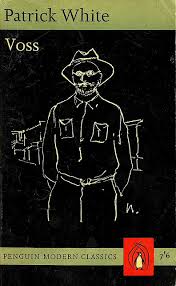
Briefly, ‘Voss’ tells the story of Continue reading
Sybil, by Benjamin Disraeli, 1845
“Would he have made the cut if he had not become prime minister?”
asks Robert McCrum in his Guardian article explaining why he chose ‘Sybil’ for his “top 100 novels written in English” list. He goes on:
”his literary contemporaries such as Dickens, Thackeray, George Eliot, and even Anthony Trollope are much greater novelists. Disraeli’s plots are far-fetched, and his characters balsa-wood. At the same time, he has flashes of brilliance that equal these greats at their best.”
This is where McCrum and I part company. I found no flashes of brilliance in ‘Sybil’ (and I did look carefully) and I don’t think anyone else would either. McCrum provides no quotes to support his contention, and if you look at this selection in Wikiquote I don’t think you will find anything there which justifies this description either. The weight of evidence to demonstrate the opposite, the wooden, flat, simply bad nature of Disraeli’s prose is overwhelming. I obviously can’t flood this review out with bad prose, but here are a couple of examples, from the 400 pages of possibilities: Continue reading
Supplementary: Hadrian 7th – F Rolfe – 1904 (Part 2)
Fans of obscure words might be interested in this.
In my review of F Rolfe’s Hadrian 7th (1904) I mentioned Rolfe’s predilection for using arcane language. I made a note of just a small selection as examples – see if you recognise any:
- koprolalian
- cardinalitial
- matutinal
- acolyth
- prooimion
- Sbdiaconate
- yearnest
- exoletes
- dicaculous
- dilacerated
- pachydermatosity
- juvence
- exsequies
- intagliate
- curule
- rascalt
- fulguration
How did you do? Obviously this exercise is made more difficult by the absence of context, and in any novel about the papacy you would expect a few obscure terms about the Roman Catholic liturgy and rituals. But Rolfe goes completely overboard, rooting out obscure 16th century terms, often adapting them into a form not normally found (so koprolalian would normally be rendered with a c not a k, meaning the obsessive use of scatological language). Others he more simply invents from their Latin and Greek roots – prooimion for example, with which he opens his novel.
The message is clear – Rolfe is more intelligent than the reader, whom he holds in contempt. If my earlier review hadn’t made the point clearly enough, unless you love weird obscure words – DON’T READ IT!! I do so you don’t have to.
Mrs Dalloway by Virginia Woolf, 1925
‘Mrs Dalloway’ is Woolf’s modernist masterpiece. Sadly, anything I have to say about it, as is so often the case when reviewing classics, is not now going to be original. If you want to know what happens in the novel Wikipedia is a click away, and the novel’s themes, language, characterisation and structures have been analysed to death over the years. Yet the purpose of this blog is not to break new ground in the field of literary analysis, (or even avoid tired clichés such as “break new ground”), but to record my honest impression of the novel, and leave me sufficient reminders that I did actually read it, once a few years have passed.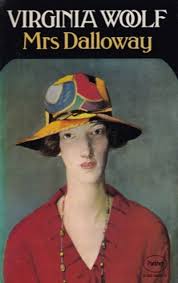
‘Mrs Dalloway’ follows Clarissa, the eponymous central character in a single summer’s day as she prepares for a party at her house in Westminster. It is set shortly after the end of the First World War, and the echoes of the war in people’s lives reverberate in the same way that Big Ben echoes throughout the course of the day/novel. ‘Mrs Dalloway’ is daring in its form – it draws a portrait rather than tells a story, and takes point of view narration to places it had not gone before. I have avoided using the term “stream of consciousness” thus far, but no further – but in fact that doesn’t tell the whole story, because as well as showing us the thoughts of her characters in a free form manner, the novel swoops freely from one mind to another as characters pass in the street. Woolf also uses another technique to unsettle the reader, leaving the object of sentences to the last possible moment in many of her sentences. This requires the reader to restart many sentences, once they have ascertained who is thinking or speaking.
The novel is daring in other ways. It introduces homosexual relationships in a coded way – but fairly explicitly nonetheless. It is clear that Clarissa had feelings for a female childhood friend, and fears that her daughter has come under the spell of a very serious lesbian acquaintance. Clarissa’s parallel character, Septimus Warren, avoids sex with his wife, which he finds disgusting, and is unable to come to terms with the loss of his close army friend, Evans.
I’ve described ‘Mrs Dalloway’ earlier as a masterpiece, and I wanted to try to illustrate this, not just with a short summary but a closer look at the novel’s opening paragraph. Here it is:
Mrs. Dalloway said she would buy the flowers herself. For Lucy had her work cut out for her. The doors would be taken off their hinges; Rumpelmayer’s men were coming. And then, thought Clarissa Dalloway, what a morning — fresh as if issued to children on a beach.
What a lark! What a plunge! For so it had always seemed to her, when, with a little squeak of the hinges, which she could hear now, she had burst open the French windows and plunged at Bourton into the open air. How fresh, how calm, stiller than this of course, the air was in the early morning; like the flap of a wave; the kiss of a wave; chill and sharp and yet (for a girl of eighteen as she then was) solemn, feeling as she did, standing there at the open window, that something awful was about to happen; looking at the flowers, at the trees with the smoke winding off them and the rooks rising, falling; standing and looking until Peter Walsh said, “Musing among the vegetables?”— was that it? —“I prefer men to cauliflowers”— was that it?
So why is this such exceptional writing? I wanted to pick out a few features. First of all the reader is only given clues as to who the characters are – we can guess that Lucy is a domestic servant – because Mrs Dalloway is doing a chore for her because she is so busy – and that Mr Rumplemayer is a tradesman, because his men are coming to remove the doors from their hinges. But this is very little to go on – and we have no clue (at this point) as to where Boulton is (a childhood country home, we can infer, but not where) or who Peter Walsh is – a family friend or member, past lover. The fact that he is given a full name, unlike Lucy or Mr Rumplemayer, tells us something about his relationship with Clarissa, but so far we know very little about her – she is prosperous enough to own a house where the doors need to be removed to accommodate a party, and has domestic staff, but that is just about it. This is clearly going to be a novel where the reader has to do a lot of work to understand what is going on, who is speaking, what their relationships are to one another, and so on.
This opening paragraph introduces us to Clarissa’s internal monologue, and several of her ways of thinking. This isn’t simply a replay of her thoughts – there is still a narrator here (not the direct reporting of thought as speech, “yes, I said yes, I will yes” but “it had always seemed to her” (rather than “it had always seemed to me”). The narrator is not a translator, simply leaving the reader small clues to follow. Her memories are very visual and sensual – she remembers the squeaking hinges on the French windows – but what starts as a very happy childhood memory – “what a lark, what a plunge” gradually becomes more serious. Look at the adjectives – “fresh” “calm” “stiller”, “chill”, “sharp” and “solemn” – all leading to the feeling “that something awful was about to happen”. She cannot avoid the darkness of her thoughts for long, and even something as pleasant as a summer’s morning leads her inexorably to a darker place. The reader is here introduced to the dark element Clarissa’s character which she will struggle unsuccessfully throughout the novel to escape from.
Clarissa also thinks in metaphor – the morning is fresh “as if issued to children on a beach” and the air is “like the flap of a wave; the kiss of a wave”. Another theme which is introduced here is the fallibility of memory “Was that it?” is repeated as a refrain.
Just one final thought on sentence structure. Stream of consciousness writing is sometimes thought of as inevitably leading to long cumbersome sentences. You can find these here if you look for them, of course, but there are also incomplete and fractured much shorter sentences – “For Lucy had her work cut out for her” – which accurately reflects the way thoughts will come to us, sometimes in long streams, and at others in short staccato bursts.
I hope I have written enough here to whet your appetite for some Woolf. I know she is not to everyone’s taste – but there are depths here that you could take many readings to explore, extraordinarily thoughtful and sensitive writing that are a pleasure to revisit.
Hadrian the Seventh, by F Rolfe, 1904
When undertaking to read my way through (and then blog about) the Guardian 100 best novels in English, I hoped to find some hidden gems, some novels which I had not come across previously, which would then lead me on to discover more works by the author. Sadly that hasn’t happened thus far. But equally there haven’t been any complete stinkers, novels I simply wish I hadn’t bothered to pick up in the first place. Until now. ‘Hadrian VII’ finds whole new ways of being bad, and the fact it found a publisher in the first place, let alone somehow found a place in the Guardian’s list, is a cause for astonishment.
The novel is a thinly disguised and infantile personal fantasy. The protagonist, William George Rose, applied to join the priesthood as a young man, and was rejected. No clear explanation is offered for his rejection, but there are sufficient hints relating to his personal life to suggest that inappropriate sexual conduct was suspected. He then spends twenty years in splendid, bitter isolation, nursing his wounds. Although he is the first person narrator, and as such profoundly blind to his own faults, it is clear that some people simply can’t stand him. I normally take great pains to distinguish between the narrator and the author, but given the autobiographical nature of the novel’s setting I am not sure that is possible here. In fact as a reader I felt largely superfluous to the exercise – Rolfe is exorcising his demons, settling scores with anyone who crossed him in his life, and imagining his glorious career in the Church, and I was not needed in that process. The novel is for him, not me. The telling of a story, development of character or any of the other traditional things one looks for in a novel are largely ignored. I get the impression Rolfe would actually have been quite happy if this novel had not been read – it would have just confirmed his persecution complex.
Out of the blue Rose is approached by penitent representatives of the Roman Catholic Church which has collectively come to its senses. He is offered the priesthood, and a few pages of ecclesiastical nonsense later sees him catapulted him into the papacy, becoming Pope Hadrian 7th. There he reforms the church, meddles with international politics, and bests all his remaining enemies, only to succumb to an assassin’s bullet at the novel’s close.
The novel is badly written, with Rolfe/Corvo’s tendency to use obscure religious words (acolyth, matutinal, among many others) and deliberately misspell others (e.g. chymist) particularly irritating. The central character is unlikeable – hugely egocentric, arrogant, and he most unlikely priest or pope you will ever find – he practices astrology and admits to detesting his fellow man. The minor characters are ill-defined, and one who eventually kills Rose for no apparent reason, Jerry Sant, adopts a range of accents throughout the novel. Rose interferes in European politics, encouraging Germany to annex Austria and invade France and Russia. While this latter point might look prescient, speculation of this kind was commonplace at the time, and doesn’t suggest any particular insight by Rolfe. Even Robert McCrum, in choosing the book for his “top 100” list, accepted that this “eccentric and weirdly obsessive” novel is “contrived”, and can only offer as an explanation for his choice that it is “entertaining” and that it sheds light on the author. The latter point is certainly the case – but hardly a recommendation. As for entertaining – I’m afraid not. Arcane catholic dogma, speculative European statecraft, and unfunny, spiteful ‘comic’ portraits of working class characters provide little interest.
It is rare that a novel is bad in unique and interesting ways – if they are that bad they usually fail to find a publisher. That Hadrian 7th remains in print suggests there is something here I am missing. I am quite prepared to accept that the failing is mine, but the author writes so poorly and takes everything so seriously and so tediously that I found locating any wit, erudition or interest not worth the effort. Don’t read it.
Tropic of Cancer by Henry Miller, 1934
‘Tropic of Cancer’ was banned in the UK and the USA for almost 30 years. Re-reading it after several decades, I am not surprised – it contains what were for the times explicit descriptions of sexual activity that you cannot find in any other conventional text of the time. Miller’s own description of the novel explained:
“This is not a book in the ordinary sense of the word. No, this is a prolonged insult, a gob of spit in the face of art”
George Orwell was an early defender of Miller, and in his 1940 essay ‘Inside the Whale’ wrote –
“I earnestly counsel anyone who has not done so to read …Tropic of Cancer. With a little ingenuity, or by paying a little over the published price, you can get hold of it, and even if parts of it disgust you, it will stick in your memory.”
He went on to say
“It is also an ‘important’ book, in a sense different from the sense in which that word is generally used. As a rule novels are spoken of as ‘important’ when they are either a ‘terrible indictment’ of something or other or when they introduce some technical innovation. Neither of these applies to Tropic of Cancer. Its importance is merely symptomatic. Here in my opinion is the only imaginative prose-writer of the slightest value who has appeared among the English-speaking races for some years past. Even if that is objected to as an overstatement, it will probably be admitted that Miller is a writer out of the ordinary, worth more than a single glance; and after all, he is a completely negative, unconstructive, amoral writer, a mere Jonah, a passive acceptor of evil, a sort of Whitman among the corpses. Symptomatically, that is more significant than the mere fact that five thousand novels are published in England every year and four thousand nine hundred of them are tripe. It is a demonstration of the impossibility of any major literature until the world has shaken itself into its new shape.”
“Whitman among the corpses” – what a phrase! It’s impossible (for me) not to read those words and recognise Orwell’s extraordinary powerful way with words. It was on the basis of this recommendation that I originally read ‘Tropic of Cancer’. My recollection is that I found it much more erotic than on re-reading, so much so that I began to wonder whether the Grove Press (no, me neither) edition I was using was bowdlerised – but apparently not. Memory can play tricks of course, which I suppose is one reason why I am re-reading many of these novels in the first place.
Briefly, ‘Tropic’ is a portrait of the life of an American expatriate down and out in Paris in the 1930s. The character is virtually penniless (or francless) and has a series of adventures, sexual and otherwise, while writing a novel. At times there is a semblance of a narrative, particularly in the novel’s closing scenes when the narrator teaches at a school in Dijon, and subsequently helps a friend escape from a relationship and return to America. It is written in a free form, stream of consciousness style, and Miller holds nothing back – it is scatological and sexually explicit. At times the narrative breaks down almost completely, and the text becomes simply layers of phrases:
“Tania is a fever, too – bright neckties on the Boulevard Montparnasse, dark bathrooms, Porto Sec, Abdullah cigarettes, the adagio sonata Pathetique, aural amplifiers, anecdotal séances, burnt sienna breasts, heavy garters, what time is it, golden pheasants stuffed with chestnuts, taffeta fingers, vaporish twilights turning to ilex, acromelagy, cancer, and delirium…” (page 5)
The first person narrator holds women in contempt – he describes them all routinely using the c-word, and there isn’t a single female character in the novel that isn’t either a prostitute or a sexual victim of one kind or another. Women exist only as objects. He describes female genitals as “that dark, unstitched wound, that sink of abominations” (251) and as an “ugly gash, the wound that never heals” and “this great yawning gulf of nothingness which the creative spirits and mothers of the race carry between their legs” (253). Later in a scene towards the end of the novel, the narrator visits a friend, who has been sleeping with a young woman:
“He came to the door stark naked. It was his night off and there was a c*** in the bed as usual. “Don’t mind her” he says, “she’s asleep. If you need a lay you can take her on. She’s not bad”. He pulls the covers back to show me what she looks like.” (291).
Freud would have a field day with this language and imagery – what psychological or sexual trauma led to Miller’s narrator feeling this way towards women?
Tempted as I am to dismiss this as misogynistic soft porn and move on, I can’t. For one thing, Miller can write;
“I am living at the Villa Borghese. There is not a crumb of dirt anywhere, nor a chair misplaced. We are all alone here and we are dead.”
He is also articulates the millennial nihilism that afflicted many in Europe as war threatened:
“For a hundred years or more the world, our world, has been dying. And not one man, in these last hundred years or so, has been crazy enough to put a bomb up the asshole of creation and set it off. The world is rotting away, dying piecemeal. But it needs the coup de grace, it needs to be blown to smithereens”
At times the tone is unsettlingly uneven – Miller moves from light comedy, such as the scene where a bidet is used inappropriately, to surrealist, fantastical descriptions, which are the parts of the novel I found the most challenging:
“Standing in the courtyard with a glass eye; only half the world is intelligible. The stones are wet and mossy and in the crevices are black toads. A big door bars the entrance to the cellar; the steps are slippery and soiled with bat dung. The door bulges and sags, the hinges are falling off, but there is an enamelled sign on it, in perfect condition, which says: “Be sure to close the door.” Why close the door? I can’t make it out. I look again at the sign but it is removed; in its place there is a pane of colored glass. I take out my artificial eye, spit on it and polish it with my handkerchief. A woman is sitting on a dais above an immense carven desk; she has a snake around her neck” (and so on – this goes on for a long time!)
Eighty years ago ‘Tropic of Cancer’ was banned because of its portrayal of sex – it is a sign of how we have moved on as a society that what is shocking about the novel today is its sexism, not its sex.
Song of Solomon by Toni Morrison, 1977
‘Song of Solomon’, makes an interesting companion text to Morrison’s later novel, ‘Beloved’ which I reviewed earlier this month. Both novels take as their subject matter the question of African American identity and experience, but while ‘Beloved’ looks unflinchingly at arguably the most difficult period of this experience, the nineteenth century, ‘Song of Solomon’ takes as its setting a later, less traumatic time span, approximately 1930-1963. 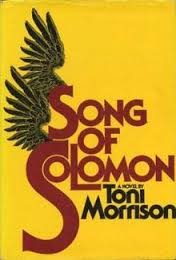 The novel opens with the death of an insurance agent, Robert Smith, who believes he can fly. From this opening scene Morrison introduces her cast, the Dead family, who witness Smith’s death, along with the rest of the community of Not Doctor Street, The family derives their name from the period immediately after the end of slavery, when all former slaves had to register with the Freedmen’s Bureau, and when the answer to a question about the character’s father (who was deceased) was mistakenly entered as his name. Other unusual names are a motif throughout the novel, either as nicknames – Milkman, Guitar, Sweet – or as family names chosen at random from the bible – First Corinthians, Pilate, and Magdalene called Lena
At first the novel is a wide-ranging saga following the interwoven relationships of the Dead family across several generations. The structure is complex, with revelations about the family’s past being revealed slowly in flashback. However the novel changes pace at roughly half way, (the original New York Times review called it an “abrupt shift”) and in this latter section the narrative becomes more akin to a thriller or a detective story. Here the search for buried gold, a midnight hunt, a secret society and above all an emerging mystery surrounding the origins of the Dead family are breathlessly presented. Eventually the novel’s protagonist, Milkman, so-called because his mother breastfed him into early childhood, learns his great-grandfather Solomon was said to have escaped slavery by flying back to Africa, bringing the theme of flight full circle. Finally, another leap into flight leaves the novel to end on an ambiguous note. Morrison uses this theme –flight – as both a symbol of empowerment and escape, and of self delusion and suicide.
Morrison took a risk in making Milkman her central character – he is not very sympathetic, particularly in his relationships with women, not least his cousin Hagar, who eventually dies of (to all intents and purposes) a broken heart. He is heavily influenced by his parents, but takes most of his advantages and friendships for granted. One of the best scenes is where his sister, after decades of silence, finally lays into him:
“Where do you get the right to decide our lives? I’ll tell you where. From that little hog’s gut that hangs between your legs. Well, let me tell you something… you will need more than that. I don’t know where you will get it or who will give it to you, but mark my words, you will need more than that…. You are a sad, pitiful, stupid, selfish, hateful man. I hope your little hog’s gut stands you in good stead, and you take good care of it, because you don’t have anything else.”
I can admire Morrison’s obvious skill in this novel. She combines a compelling storyline with wonderfully crafted imagery and insights into complexities of the African American experience in twentieth century America. The skill in construction of the novel is obvious in little scenes like the following, where Milkman and Guitar spot a peacock white incongruously in the street:
“How come it can’t fly no better than a chicken?’ Milkman asked.
Too much tail. All that jewelry weighs it down. Like vanity. Can’t nobody fly with all that [stuff]. Wanna fly, you got to give up the [stuff] that weighs you down.’
In just a few lines the themes of flight, commercialism and the pursuit of wealth are neatly tied up in a brief sketch. Morrison’s penetrating insight is also shown in the portrayal of relationships between men and women, for example when Milkman describes a conquest as a “third beer”.
“She was the third beer. Not the first one, which the throat receives with almost tearful gratitude; nor the second, that confirms and extends the pleasure of the first. But the third, the one you drink because it’s there, because it can’t hurt, and because what difference does it make.”
So why the hesitation? The simple truth is that I admired and enjoyed this novel, but wasn’t blown away by it. It lacks some of the power of ‘Beloved’, and while many of the characters are memorable, not least Milkman’s aunt Pilate, yet Milkman himself is not the character the reader wants to follow. The change of tone is at the time welcome – who doesn’t enjoy the occasional midnight chase or escape from sudden death – but the uneasy shift in tone left me wanting to know more about some of the threads left dangling. Lastly, I’ve written elsewhere at my frustration with authors using the device of killing off a key character simply to provide a convenient resolution (rather than as the fulfilment of an inevitable fate)– I was surprised to see an author of Morrison’s calibre relying on this approach as well.
Beloved by Toni Morrison, 1987
‘Beloved‘ addresses the issue of slavery in nineteenth century America. It is not an easy read – the novel does not shy away from the horrors of slavery; at the same time it avoids gratuitous descriptions of the physical, sexual and psychological tortures that slaves had to face. When dealing with nightmares such as this experience the author has to walk a tightrope – to deny the magnitude of the crimes against humanity that slavery represents would be wrong, but to simply show horrifically bad things happening to people would be unbearable, and quite possibly exploitative. Morrison manages this balance by giving a voice to the slaves themselves – the story is told through the eyes of the enslaved and the newly freed.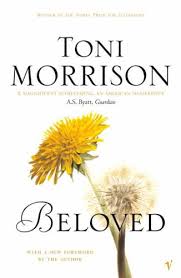
The book tells the story of Sethe and her daughter Denver after their escape from slavery. Their home is haunted by the ghost of Sethe’s daughter. Sethe’s teenage sons have run away from home, and her mother-in-law, Baby Suggs, for a long time a stabilising maternal figure in her life, has died. Sethe and her surviving daughter, are haunted by horrific events from their past which are revealed slowly through the course of the novel. In reconstructing the events for a summary of this kind it is convenient to present these events in a ordered, chronological structure, but in the novel itself there is no such order – events are presented in a chaotic, fractured manner with numerous jumps in time and space, representing the chaotic nature of the characters lives, and the difficulty they face in escaping their memories and pasts.
Paul D, one of the slaves from the plantation where Sethe and her family were once enslaved, arrives at her home, moves in, and (briefly) exorcises the ghost. But on the way back from a trip to a carnival, one of the few carefree moments the characters enjoy, they meet an ethereal young woman, calling herself Beloved, who we slowly are led to believe is the reincarnated spirit of Sethe’s murdered baby. Gradually, Paul D is forced out of the home by Beloved. At the heart of the novel is a terrible scene alluded to at several points, but finally shown, where to avoid being re-enslaved Sethe tries to kill her children, although ultimately only killing her eldest daughter, the eponymous Beloved.
Whether Beloved is an actual ghost, or a traumatised escaped slave assuming a role given to her, has diverted some readers, but Morrison quite deliberately leaves this question open, so trying to locate a definitive answer to this question is pointless. She is neither and both.
In ‘Beloved’ Morrison stares into the face of the horror that was slavery, and there are no easy escapes – although the characterisation of white people is carefully nuanced, (they are not all monsters), there is no avoiding that fact that even the ‘kind’ slave owners were guilty of a horrific crime against humanity. Morrison shows the fully diversity of the experience of black and mixed race people – some lead less tortured lives than others, but all are devastated by the experience in different ways, from the slaves who die needlessly in punishment killings and lynchings, to the free mixed race school teacher who cannot avoid the “taint” of her heritage. For too long I have known about the barbarism that was the 19th century slave trade, but avoided reading about the issue – this novel has inspired me to remedy that as soon as possible.
P.S. Just a note about the Virago edition – a really poorly printed version where the ink has bled slightly into the paper, making it all a little fuzzy. Even the cheapest mass produced editions are usually better than that!
To Kill a Mockingbird by Harper Lee, 1960
The subset of people who have read ‘Go Set a Watchman’ but have not read’To Kill a Mockingbird’ must be pretty small, and until this week included me, embarrassed although I am to admit it. Yes, until this week I had not read this the ultimate American classic. I had seen the film, of course, and the stage play, but somehow never got round to the novel, until now. 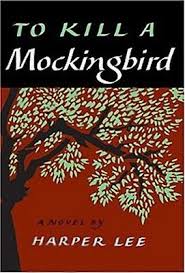
I can completely understand why the novel holds its place in the affections of American readers. It captures a lost America, and shows that while its passing is on the whole a good thing, particularly in terms of civil rights, something has been lost as well.
I wanted to address the question as to whether ‘Go Set a Watchman’ has in any way had a negative effect on the reputation of ‘TKAM’. I think this debate is based on a false premise, namely that ‘GSAW’ is a sequel to ‘TKAM’. Certainly it was published later than the original novel, and is set around 20 years later. In the later novel, Atticus is no longer seen through the innocent eyes of a young daughter’s hero-worshipping eyes, but from those of a mature, travelled woman. Of course he is no longer on a pedestal, and a lifetime of living in the deep South has taken its toll on his tolerances. Civil rights had not stood still in that time either, and what was once a liberal position had become reactionary, simply by staying still as the world moved on.
But. I think that it is important to remember that ‘GSAW’ is, in terms of composition, the earlier novel. It is in fact the first draft of ‘TKAM’. Looked at that way, Atticus doesn’t become more reactionary, but more liberal and tolerant as he developed as a character in Lee’s imagination. We also owe thanks to Lee’s editor for this metamorphosis.
There is a charming innocence to ‘TKAM’, achieved in large part through Scout’s narration. She is disarmingly honest, kind, and in the main unspoiled by the prejudices and racism around her. It has still taken its toll, of course – she uses the n-word and other insulting racial epithets freely, and would prefer Atticus to have refused to defend Tom Robinson. Tom’s tragic, off stage death doesn’t seem to trouble her, although neither does Bob Ewell’s at the end of the novel. Lee never seems entirely sure whether the trial at the heart of the novel is her focus, or the story of the agoraphobe Boo Radley which is more prominent at the novel’s opening and close. She manages to weave the two stories together at the death but it is not so much as climax as an end.
I suspect the other primary reason for the novel’s enduring importance is that it contains so many platitudes. Children believe that all the problems of the world can be solved if only people were nice to one another, and that is the principal sentiment of the novel. I started to keep a track of the platitudes, but gave up after a while:
“You never really understand a person until you consider things from his point of view… Until you climb inside of his skin and walk around in it.”
“real courage is, instead of … a man with a gun in his hand. It’s when you know you’re licked before you begin, but you begin anyway and see it through no matter what.
I think there’s just one kind of folks. Folks.”
“Atticus, he was real nice.””Most people are, Scout, when you finally see them.”
“Sometimes the Bible in the hand of one man is worse than a whisky bottle in the hand of (another)… There are just some kind of men who – who’re so busy worrying about the next world they’ve never learned to live in this one, and you can look down the street and see the results.”
People are nice, once you get to know them. Never give up. Folks are all the same under their skin. This homespun philosophy gets a bit overly saccharine after a while. TKAM is a plea for tolerance, not only for the rights of black people to a fair hearing under the country’s justice system, but also for the traditions of the South. Many white people in the South had felt under attack since before the end of slavery, and Lee also offers these people a voice, less explicitly here than in ‘GSAW’, but unmistakeably nonetheless. Lee explained this is a rare commentary on her own novel once, saying:
“Surely it is plain to the simplest intelligence that To Kill a Mockingbird spells out in words of seldom more than two syllables a code of honor and conduct, Christian in its ethic, that is the heritage of all Southerners.”
The heritage of all Southerners? Or all white Southerners? The idea that the Southern code of honor and conduct that led to mass lynchings, the KKK, and segregation was worth preserving despite everything is a challenge to the interpretation that this novel is a straightforward advocate for the civil rights cause. There is a risk that we sentimentalise the novel, and see it as a simple anti-racism tract, when the portrayal of the South is more nuanced than that.
I’d love to know if you agree?
 The Reading Bug