100 Best Novels Guardian list, 19th Century literature, Anthony Trollope, Book review, The Way We Live Now

The Way We Live Now by Anthony Trollope, 1875

One of the reasons for keeping this blog is to tackle novels that I would otherwise not even consider attempting. Trollope definitely falls into that category – not only have I never read any of his work before, but I had no intention of doing so. Trollope treated writing as a job, studiously putting in his three hours a day, and eventually produced 47 novels. I find this volume of output oppressive – you could read Trollope for a decade and still be reading.
TWWLNHowever, in recent years Trollope has enjoyed a renaissance, with the two hundredth anniversary of his birth last year not doubt being a factor. He is also, inevitably, a favourite of the Sunday afternoon television adaptation. His inoffensiveness and blandness, large casts and sedate plotlines suit this genre perfectly.

There is a Trollope Society (John Major is one of its Vice Presidents; the President himself is the Bishop of London) which has very smart website. In introducing its subject the site adopts a slightly defensive tone:

“Trollope wrote forty-seven novels – three times as many as Dickens – and many have long preferred Trollope for his subtle delineation of human character and middle class”

So Trollope is a better writer than Dickens because he wrote more? Not the strongest of arguments – an appreciation of quantity over quality would venerate Catherine Cookson over Jane Austen. I could also argue that “subtle delineation” is a tautology – delineation is by definition an act of precision. In any event, Dickens doesn’t need defending by me, but the test is in fact a simple one – can you recall any character from Trollope?

Which brings me to the over 900 pages of the Victorian soap opera that is ‘The Way We Live Now’. The plot is relatively simple for such a long novel – a series of characters attempt to arrange mutually satisfactory marriages, and after a long series of frustrations and rejections, finally most of them are successful. The central character, Auguste Melmotte, a financier, embezzles money, apparently, and when exposed commits suicide. His death precipitates a slightly frenzied tying up of plot lines as Trollope realises that with Melmotte gone, much of the interest of the novel has also expired. The large supporting cast are reasonably well delineated, to be fair, although many of the rich young men who gather at the BearGarden, an early incarnation of the Drones Club, are interchangeable, and the young women seem happy enough to swap one suitor for another as their financial positions change.

As a commentary on the way Victorian society encouraged dishonesty, in romance, finance, and public affairs, the satire is wooden and uninteresting – bad people do bad things, are exposed, and disposed of. Poor people are virtuous and stupid, and only happy when they learn to accept their place in life. It’s hardly surprising given the 100 chapters Trollope had to fill that he finds it necessary to repeat himself endlessly, recycling situations, recapping each time a storyline is revisited, and showing events from different points of view. To cap matters off, there is some deeply unpleasant anti-semitism in the closing chapters of the novel – it could be argued these attitudes are shown in order to expose them, but the only rebuttal offered is that times have changed, and what was once unacceptable is now less abhorrent.TWWLN2
Trollope is comfort food for those who like to think they have an appreciation of literature, but who actually enjoy having their prejudices confirmed. It really isn’t worth your time.

P.S. In an interesting article in the New Yorker last year, entitled “Trollope Trending – Why he’s still the novelist of the way we live now”, Adam Gopnik claimed that “The Way We Live Now” is the Trollope novel for people who don’t like Trollope novels.” Gopnik had a couple of other insights worth mentioning. He describes Trollope as

“not a sentence-by-sentence writer, or even a scene-by-scene writer; really, he is a character-by-character writer.”

He also claimed that

“Amateur readers have taken up Trollope as a cause and a favourite in a way that they have taken up perhaps no other nineteenth-century English novelist except Jane Austen.”

I have no idea if the concept of an amateur reader is intended as a joke – it must be, surely?
Standard
100 Best Novels Guardian list, 19th Century literature, American literature

The Scarlet Letter by Nathaniel Hawthorne, 1850

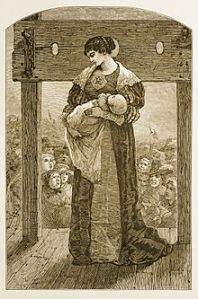
Hester_PrynneHawthorne’s ‘The Scarlet Letter’ is arguably the first classic of American literature. While the language Hawthorne uses is often archaic, this is in fact an astonishingly modern novel in its treatment of its subject matter, and in its construction. While the plot is quite straightforward, and the cast of characters limited, behind this relative simplicity is a novel of huge complexity and subtlety.
The novel is told by an anonymous narrator, who in a long introduction tells us the story on found contemporaneous records. ‘The Scarlet Letter’ is set in 17th century Puritan New England, and follows the story of Hester Prynne, a young woman found guilty of adultery. As punishment, lenient given the statute at the time, Hester is required to wear a scarlet “A” on her clothing. Thus is introduced the novel’s most powerful symbol. In an act of defiance, Hester embroiders the letter richly and lavishly, suggesting that the punishment can also be worn with pride. She refuses to hide the letter, and continues to wear it long after it is necessary.

Despite pressure from her judges, Hester refuses to name her child’s father. The paternity mystery is not really the focus of the novel – we are never told how her romance with her lover developed, and there is no great moment of epiphany when the paternity is eventually revealed. Hester’s husband, who has been presumed lost at sea, arrives in Boston just as she is forced to stand on a scaffold and face the condemnation of the townsfolk. He vows to find the father of Hester’s child, but decides to remain incognito in order to pursue his search in secret. He takes the name Chillingworth, and takes up work as a medicine man.

Following her release from prison, Hester settles with her daughter, Pearl, and earns a living with her needlework. Years pass. Pearl is a strange impish child, old beyond her years. She is fascinated by Hester’s scarlet letter. A discussion over Pearl’s care and moral well-being reintroduces the town’s clergyman, Arthur Dimmesdale. The Minister’s health is failing, and he is being cared for by Chillingworth, who slowly comes to suspect that the minister’s illness is the result of some unconfessed guilt. At some point this crystallises into the suspicion that Dimmesdale is Pearl’s father. Fearing her husband’s suspicions, and that he may reveal all or do his some harm, Hester meets the Minister in the forest. She tells him Chillingworth is her husband, and of his thirst for revenge. The forest setting for this scene is another potent and threatening symbol in the novel. After seven years of suffering and secrecy Hester and Arthur are reconciled, and realise they still love one another. She convinces Dimmesdale to leave America so they can start a new life together. Renewed by this plan, the minister returns to town, and shortly thereafter, just before the day appointed for their departure for Europe, he gives an inspirational sermon. Seemingly Inspired by the impact of this sermon Dimmesdale decides to publicly confess his sin. This seems to bring on a climax in his health, because no sooner does he do that that he dies in Hester’s arms. This melodramatic finale to the novel is followed by a short post-script which tells of Hester and Pearl’s later life.

The scarlet letter Hester wears is a potent symbol which changes its meaning through the course of the novel. Initially it is a brand of shame, but later, as Hester’s charitable woks in the community earn her peoples respect it is said “many people refused to interpret the scarlet A by its original signification. They said it meant Able, so strong was Hester Prynne, with a woman’s strength.” (161) At the climax of the novel, when Dimmesdale bears his breast to reveal, the reader is given what are in effect alternative endings to choose from. Either he has branded himself with a letter A, or a letter has been branded on him by the work of the devil. His words of confession are sufficiently ambiguous to allow of a further interpretation, rejected by the narrator but presented nonetheless and preferred by the Minister’s friends and supporters, is that “there was no mark whatsoever on his breast, more than on a new-born infant’s” (259).

The novel plays with lots of different contrasting ideas: purity and shame, town and forest, old and new England, men and women, settlers and natives, science and religion. Hawthorne is clearly interested in the impact that the settler communities of the 17th century have had on the America of his period, two hundred years later. He is surprisingly non-judgmental about Hester’s sin, which even in 19th century USA would still have been shockingly transgressive, particularly when committed with a clergyman. There is no suggestion that Hester is particularly culpable in the sin, that she seduced the otherwise morally upstanding Minister. There is however a subtle implication that Dimmesdale’s health degenerates because he has caught a sexually transmitted disease from Hester. His health fails slowly, over several years, and he becomes emaciated and pale. There is no known cure for his unnamed affliction.

‘The Scarlet Letter’ is an exceptionally complex, fascinating novel. It is decades before its time – I think it is best read as a very early symbolist novel, rather than a mystery or an historical romance, even though these readings are interesting in themselves. It is also a very brave novel, dealing as it does with issues of sex outside marriage, infidelity, and love. In fact it doesn’t just deal with love, it celebrates it:

“Love, whether newly born or aroused from a deathlike slumber, must always create sunshine, filling the heart so full of radiance, that it overflows upon the outward world”

It is sympathetic towards the fallen woman at the novel’s heart – it is the letter which is scarlet, not Hester. She is a strong, independent and sexual heroine, not a victim:

Let men tremble to win the hand of woman, unless they win along with it the utmost passion of her heart!”


Standard
19th Century literature, Book review, Bronte, Bronte Sisters, Charlotte Bronte, http://schemas.google.com/blogger/2008/kind#post, The Professor

The Professor by Charlotte Bronte (2)

Written in 1846, although not published during her lifetime, The Professor is a largely autobiographical account of Charlotte’s two years teaching in Belgium. Her attempt to narrate the story through a male character is at best a mixed success. There is, as with Villette, a degree of wish fulfillment, as the romance is successfully concluded with marriage, a child, and a comfortable country cottage. Reader, I married him. If this was all The Professor had to offer then its obscurity would be understandable, however well drawn the romance is. However, there are other elements that draw the attention.

One of the minor characters is Mr Hunsden (if he is given a first name, I missed it), an acquaintance and latterly friend of Mr Crimsworth, the eponymous professor. Despite being relatively prosperous, Hunsden is undoubtedly a radical. He describes England in terms which would surely have been shocking to Victorian England in its Imperious pomp

“A little, corrupt, venal, lord-and-king-cursed nation, full of mucky pride… and helpless pauperism; rotten with abuses, worm-eaten with prejudices. ….Come to England and see ….examine the footprints of our august aristocracy; see how they walk in blood, crushing hearts as they go. Just put your head in at English cottage doors; get a glimpse of famine crouched torpid in black hearthstones, of Disease lying bare on beds without coverlets, of Infamy wantoning viciously with Ignorance, though indeed Luxury is her favourite paramour, and princely halls are dearer to her than thatched hovels”. 175
This is purple but very effective prose which Dickens and other observers of Victorian England’s darker side would hesitate to use. The speech is dismissed by Frances Henri, the Swiss teacher and fiance of the Professor to whom it is addressed, and the theme is largely dropped.
In contrast the novel also has a vigorous anti-Catholic element. Frances is the spokesperson for this point of view:
“I know nothing of the arcana of the Roman Catholic religion, and I am not a bigot in matters of theology, but I suspect the root of all this precocious impurity, so obvious, so general in Popish countries, is to be found in the discipline, if not the docutrines, of the Church of Rome. …These girls belonged to what are called the respectable ranks of society. They had all been carefully brought up, yet was the mass of the mentally depraved.” (page 71)
“ I long to live once more among Protestants. They are more honest than Catholics. A Romish school is a building with porous walls, a hollow floor, a false ceiling. Every room in this house Monsieur has eye holes and ear holes, and what the house is the inhabitants are – very treacherous.” (page 106/7)
It is easy to forget in liberal, 21st century Britain how virulent anti-Catholicism was in this country for centuries – only 60 years earlier London had been torn apart by the Gordon riots (http://en.wikipedia.org/wiki/Gordon_Riots) – Frances’s anti-Catholicism can presumably be read as a simple reflection of Charlotte’s own feelings.
Finally, there is room in the novel for Charlotte’s defence of her occupation as a novelist. She clearly felt the prejudice against women writers deeply, as she puts these words in the mouths of another female character:
“It appears to me that ambition, literary ambition especially, is not a feeling to be cherished in the mind of a woman. Would not Mlle Henri be much safer and happier if taught to believe that in the quiet discharge of scial duties consists her real vocation, than if stimulated to aspire after applause and publicity? She may never marry, scanty as are her resources, obscure as are her connections, uncertain as is her health (for I think her consumptive).” (page 111) How many times must she have heard these sentiments, or suspected them. The final parenthesis – “for I think her consumptive” is sadly chilling.
Standard
19th Century literature, Agnes Grey, Anne Bronte, Book review, Bronte, Bronte Sisters, http://schemas.google.com/blogger/2008/kind#post, Victorian literature

Book review: Agnes Grey by Anne Bronte

There’s a Darwinism in play which determines whether novels continue to be read after the author’s death and the passage of a few decades. Authors that were once widely read and popular turn out over time to be of interest to only a very specific audience, and do not translate well into later periods. As the years pass the number of surviving and still read authors dwindles further, until even once great, Nobel-winning titles are only downloaded for £0.00 on the Kindle, to remain on aspirational reading lists but never quite got round to. But some novels buck the trend, going into hibernation for a century or more only to be rediscovered with a fresh relevance by a new generation. Agnes Grey undoubtedly is not one such novel. It is dull beyond comprehension, and only appears here a) because of the previously mentioned Kindle free availability, b) it is an AS text, c) it was written by a Bronte (Anne, her first novel).

There’s a Darwinism in play which determines whether novels continue to be read after the author’s death and the passage of a few decades. Authors that were once widely read and popular turn out over time to be of interest to only a very specific audience, and do not translate well into later periods. As the years pass the number of surviving and still read authors dwindles further, until even once great, Nobel-winning titles are only downloaded for £0.00 on the Kindle, to remain on aspirational reading lists but never quite got round to. But some novels buck the trend, going into hibernation for a century or more only to be rediscovered with a fresh relevance by a new generation. Agnes Grey undoubtedly is not one such novel. It is dull beyond comprehension, and only appears here a) because of the previously mentioned Kindle free availability, b) it is an AS text, c) it was written by a Bronte (Anne, her first novel).

A measure of the novel’s popularity is that it has never been adapted for television and screen. For good reasons – very little happens. We expect, from Wuthering Heights and Jane Eyre, for Bronte leading female characters to have some spirit, if not spunk, but Agnes is limp, passive, and dull. She gets her man in the end, but doesn’t really deserve him, AB simply rewarding patience and virtue with a predictable long foreseen happy ending which is a complete anti-climax. With most Bronte novels it’s not really about the destination, more about the journey, but with Agnes there is little if any self discovery or personal growth. Some novels deserve to be forgotten, not disinterred to torture A level students, when there is so much great literature out there waiting to be read and discovered. Sorry Anne.
Now I should end there, but I feel guilty. This novel must have some redeeming features, surely, and it is my self appointed task to seek them out. There’s a natural instinct to be protective towards Anne, a romantic figure over-shadowed by her sisters, dying tragically at a young age, a compelling part of the Bronte mythology. ( Forgive me, but I can’t resist mentioning here the academic discoveries of that great critic Mr Meyerburg who postulated, indeed demonstrated, that Bramwell was in fact the author of all the “Bronte sisters’ novels”, and that his alcoholism was all a heroic act to disguise the dissolute nature of his siblings.)

Agnes Grey, simply put, is juvenilia. It is an author learning her craft, using autobiography as material. No-one could possibly criticise Anne for writing this, following a path taken by many authors, but that doesn’t make the novel any more readable.

Standard
19th Century literature, Book review, Frankenstein, gothic fiction, http://schemas.google.com/blogger/2008/kind#post, Mary Shelley

Frankenstein by Mary Shelley, 1817

With 200 years of critical analysis weighing down on any critic or reviewer, what is one to do with a novel such as Frankenstein, or the Modern Prometheus? Trying to find new insight or interpretation is almost pointless. Such is the nature of the novel that it opens itself to an almost boundless variety of interpretations, on human relationships, sex and sexuality, or science and the modern world. That burden of scholarship can be oppressive and hamper the ability to say anything sensible or interesting about such a complex novel.


Let’s start at the beginning. The story of the novel’s genesis is well know, probably much better known than the novel itself. It did not come as a surprise to me, with the experience of reading Dracula last year, that the novel bears little or no relationship to its popular culture incarnation. Crucially, the monster is not an incoherent, stumbling beast, but a highly intelligent and articulate creature, albeit one which is monstrously ugly and extremely, dangerously strong. The sub-title of the novel, the Modern Prometheus, should not be overlooked. Wikipedia says that “Prometheus became a figure who represented human striving, particularly the quest for scientific knowledge, and the risk of overreaching or unintended consequences. In particular, he was regarded as embodying the lone genius whose efforts to improve human existence could also result in tragedy“. Quite. Is this then a straightforward anti-science parable – don’t meddle with nature because you will create a monster beyond your control? Certainly the anti-GM protagonists would support that reading. But simple readings of this kind, however attractive, are invariably over-simplistic and resisted by classic texts, and this is no exception. I suspect this is a bit of authorial mis-direction. The sub-title invites us to a simplistic don’t meddle with the unknown interpretation. Suspicion of science and where it might take us at the beginning of the 19th century was certainly understandable. For me the novel’s themes about parenthood and original sin are more interesting.

The narrative structure of the novel is the complex “Russian doll” approach much loved of 19th century novelists. To be honest this adds little to the story overall – you quickly forget you are reading a letter from the explorer who has met Frankenstein and is passing on his tale to his loved one, in much the same way you forget Wuthering Heights is told as a series of fireside gossipy chats from the ever present domestic servant to the new tenant of the neighbouring house. It is almost as if the truly omniscient narrator had yet to be accepted by authors or readers at this stage of the development of the novel, (which in the early 19th century was not quite so anachronistically named). The author appears to feel compelled to show the reader what happens by using increasingly artificial devices – someone claims to have observed what happened – rather than just tell the story. In this novel this is pushed to ridiculous extremes – so for example the monster lives for almost a year in a hovel adjoining the house occupied by the DeLacey family without their once wondering “I wonder who it is who lives next door?”. Dracula uses much the same technique, despite the almost 100 years between the two novels. Is this in homage to the early 19th century spirit of the novel?

John Sutherland’s book on puzzles in 19th century literature which I wrote about earlier this month has an interesting take on this novel, and in particular the question of how Frankenstein actually creates the monster. The author gives virtually no detail – there are glimpses of how he prepares, but the actual process itself is not described at all. Time and again Shelley uses the word “disgusting” to describe Victor’s reaction to his work. This could be a response to the body parts he is presumed to have used, but when he begins to create the monster’s partner later in the nvoel he does so in a remote Orkney croft-house with only his scientific equipment to hand, far from any mortuary or graveyard. Sutherland speculates a sexual component to Frankenstein’s disgust, which is a seductive interpretation. How does man create life, after all? This would go some way to making sense of the original sin theme of the novel – Frankenstein creates life, then rejects it, and reaps the consequences. All parents will have some sympathy with how he feels.

As a central character it is hard to warn to Frankenstein. He is a complete idiot – for example, despite the monster making it clear to him that he will make him suffer if he does not create him a partner, and that he will see him again on his wedding night, the penny does not drop that there might be a threat to his fiancee. He lives a life of considerable privilege, but wastes his energies and gifts on ultimately fruitless personal obsessions.  The monster is a more interesting character, although again his “no-one loves me so I am going to kill someone….Why does nobody love me?” wears thin fairly quickly.

As I mentioned earlier, there are many ways to read this complex novel. The one that appeals to me the most is that the monster is, like Mr Hyde, a product of his creator’s sub-conscious. Both doctors Jekyll and Frankenstein create monsters that run out of control and lead to their ultimate demise. Victor is arrested for the killing of Charval, and it is surprising that no-one suspects him of Elizabeth’s murder. Several people fear he is mad, and few other witnesses see the monster clearly. The sexual under-currents of the novel could also explain Victor’s terror of his wedding night. I appreciate I haven’t explored this idea in any depth, and no doubt there are scholarly articles and books out there which explain the idea far more coherently than I could ever do, but it is an interesting reading of the novel I think.

Standard
19th Century literature, Book review, http://schemas.google.com/blogger/2008/kind#post, Jude the Obscure, Thomas Hardy

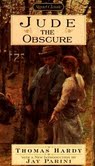
Jude the Obscure by Thomas Hardy, 1895

My campaign of self improvement and of reading books I should have read a long time ago continues. I have steered clear of Hardy previously largely due to prejudice – his poetry, which formed part of one of my school courses many years ago, felt sentimental and dull, and those of his novels that I had seen adapted for television or cinema were uninspiring pastoral pieces.


Having said that, I had read that Jude had been his last novel followed by a long silence filled only with the previously mentioned poetry. So I knew there was something which had scandalised some elements of late Victorian society, and my interest was pricked. Hardy deals with sexuality in a way that is immensely frustrating to the modern reader – the characters in the novel don’t seem to behave in a way recognisable to us, torn as they are between the strict conventions of the period and their own natural impulses. No one has what we would consider a healthy, “normal” attitude towards sex, and I found the scene where Sue forces herself to share a bed with her husband despite her profound disgust for what that implies – so strong that in one scene she junps out of her bedroom window to avoid him – quite disturbing. In some ways even the recognition of these issues, and especially of sex outside of wedlock, was shocking, and would not have featured in novels from just a few decades earlier in the century – no matter how impulsive and headstrong Heathcliff is (for example) he never oversteps this boundary. As such this novel is a bridge between the 19th century novels in which there is little or no suggestion of human sexuality – it was just taboo – and the more frank works of, say, Lawrence a few years later.


Having said that, I suspect that it was not the handling of sexuality that would have been really shocking to the Victorian reader – very little is explicit after all – but the deaths of the children towards the end of the novel, and the characters reactions to them, which really horrifies.


Other than the interest the novel carries in its treatment of these issues, what other features of the novel can recommend it? The description of country life in late Victorian England is well sketched, and the principal character’s frustrations with the lack of academic opportunities is of passing interest. Well, not really.


I was hoping that this introduction to Hardy’s novels would help me overcome my prejudice and inspire me to explore the rest of his works. Sadly that plan didn’t work – Jude was just too dull – but I haven’t given up on him yet!

Standard
100 Best Novels Guardian list, 19th Century literature, Book review, http://schemas.google.com/blogger/2008/kind#post, Robert Louis Stevenson, Treasure Island

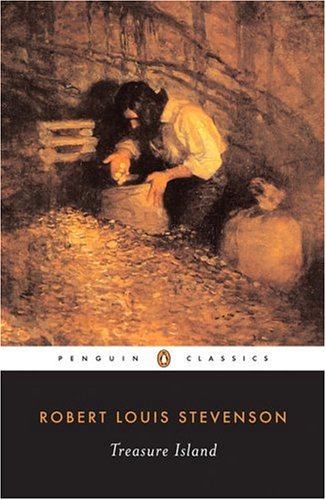
Treasure Island by Robert Louis Stevenson

Earlier in the year, just after the Christmas/New Year break, I read “Treasure Island”, largely out of curiosity to see how close the TV adaptation was to the original. In some respects it was very faithful – for example in the way Silver kills the seaman (Tom) who will not join the mutiny once they land on the island – but in others it made massive changes, the most obvious ones being the death of Trelawney and the loss/abandonment of the treasure. Stevenson tells us almost nothing about what Jim and Co do with the treasure once home – the narrative slams shut once back in the UK, with only a paragraph about how Ben Gunn loses his money in 19 days – but that leaves it to the reader to imagine the high life they lead. One important thing the TV adaptation did reinstate was Silver’s black wife, although they make her a “tart” – possibly editions and adaptations from my childhood edited out references to this character because mixed relationships were frowned upon – just shows how racist the 70s really were. The TV version was careful to avoid all the pirate clichés, but they are there in the book, timbers being shivered, pieces of eight, Jim lad, etc. I guess this is from where they became clichés.


This was a very easy read – the narrative rattles along, with the only passages that drag being the technical/nautical descriptions of sails being unfurled, anchors being weighed and the like. The point of view is well manipulated to keep the reader in the dark as to the location of the treasure, what has happened to the rest of the crew, Silver’s sinister intent, etc.


However, ultimately this remains a children’s/young teenagers’ adventure story, with little to say on the issues of the time, unlike, say, Stevenson’s much darker “Dr Jekyll and Mr Hyde”. I recognise that Treasure Island is, like all texts, open to broader interpretation. The island can be taken to represent (for example) an alternative England where anarchy rules, and the struggle between the pirates and the other crew members could be taken as a comment on the ferocious class struggle rocking late-Victorian England. Islands are a great source of metaphor. But once you have made those connections, what then? I am not convinced that they give you anywhere to go in terms of understanding what was going on in the world, nor reveal subconscious attitudes to class or gender.

Standard
19th Century literature, Book review, http://schemas.google.com/blogger/2008/kind#post, The Moonstone, Wilkie Collins

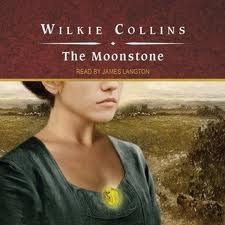
The Moonstone by Wilkie Collins, 1868

Books aren’t hailed as classics, and don’t stay in print for 150 years, without good reason. Sometimes the challenge a reader faces is to find that reason. The Moonstone is a good example of this challenge – without it coming so highly recommended by a wide cross section of authors and critics I highly doubt I would have persisted with this Wilkie Collins novel to the end, nor felt so disappointed when I reached that point.
 
Often described as the original detective story, published in 1868, the eponymous moonstone is a fabled Indian diamond. The diamond is stolen from a temple by a dissolute army officer, and eventually left as a bequest to his niece. On the night she receives it it is stolen, and the primary part of the narrative is an investigation into the theft.
 
What struck me as remarkable about the story is how so many things don’t happen. A servant commits suicide, and remarkably doesn’t re-emerge months later having faked her death with the aid of accomplices. Who would have seen that one coming? A wily old detective from London is recruited to investigate the theft, after bumbling local constables make a mess of the initial investigation, and he doesn’t solve the mystery. There is no neat, it all make sense solution to the mystery, which is only explained by a combination of people behaving in ways we have been explicitly assured they would not, and some remarkable coincidences of which most mystery writers would be ashamed. I am not telling you too much when I reveal that the theft itself is committed by one of the house guests – shock – acting under the influence of laudanum, which had been administered by a medical acquaintance in a bizarre and to be honest utterly unbelievable “prank”. As the number of house guests is very small, the pool of candidates doesn’t leave the reader guessing for too long.
 
So what is there in this novel that can justify its status? Let me try. Firstly, the bulk of the narrative is told as a first person record by two of the relatively peripheral characters – a servant at the country house, and a spinster relative of the family. This unusual technique gives the reader more of a fly on the wall perspective – they see a lot of the action without participating in it – but an equally flawed vision – there is much they either don’t see, or don’t understand. The reader is able to decode their misunderstandings and misjudgments fairly easily – this is not a complex narrative in the sense of having to work out what is going on.
 
The conventions of the country house crime were not entrenched in Collins’s time, and to an extent he establishes many of them here, although as I have said above only to a very limited sense – for example the locked room “mystery” at the end of the novel lasts for a few seconds until the ladder out of the ceiling is spotted!.
 
Other than these admittedly limited reasons I confess I am struggling to explain the mystery of why this novel is considered a classic.
 
Standard
19th Century literature, Book review, Bram Stoker, Dracula, horror, http://schemas.google.com/blogger/2008/kind#post

Dracula by Bram Stoker, 1897

Thrilling and Repulsive – an oxymoron perhaps, but one that neatly summarises the central theme of Dracula. The broad elements of the plot of Bram Stoker’s 1897 novel will be familiar to most if not all, but the text is unlikely to have been read by many outside those compelled to do so by college curricula, horror enthusiasts, or, like me, the Kindle-curious.

As a construct the text is highly complex – Stoker aspires to give the reader an up-to-the-minute account of events, but eschews the use of an omnipresent narrator – instead the story is told through a variety of diaries, notes, letters and newspaper articles. The diaries in particular are often presented as being hurriedly written shortly after the events being described. This is a really interesting and original technique – we see events through the eyes of the participants, although it is hard to imagine even the most obtuse of reader not realising what is going on – “He’s a Vampire!” – before the characters. They really need to have things spelt out for them by Van Helsing. Through this flawed and partial perspective, the narrative jumps around both in terms of location and time.


However imposing physically the Count may be, Dracula the character is in many ways a weak opponent – like Sauron or He Who Must Not be Named he doesn’t personally engage in the struggle with the rather Scooby-Doo like gang assembled to fight him, and is far too easily despatched when finally cornered. His inability to walk during the day, to be seen in mirrors, to rest outside his coffin filled with Transylvanian earth, combined with extreme allergies to garlic, crosses, holy water, and peanuts (I may have made the last one up) makes it hard to fear him. The only character he is able to conquer misses multiple opportunities to avoid him (eg closing her bedroom window at night – Doh!).


The cast of characters are noble, brave, and fearless in their pursuit of Dracula – but boy are they dumb! Jonathan Harker sees that Dracula has no reflection in a mirror in just the second chapter of the novel – but lets it pass without much concern or interest, and continues to treat his client as an eccentric European gentleman. Now I appreciate some of the vampire traditions had yet to be firmly entrenched in western consciousness, but how dense do you have to be not to spot that something supernatural is going on there? The long slow reveal of Dracula’s identify would be spoiled by too much emphasis or scrutiny of this episode, and that to Victorian readers the penny would take longer to drop, but still!.
There are some genuinely chilling moments in the novel. A small child is kidnapped and thrown to the three female vampires as a snack. The child’s mother is torn apart by wolves. A mental patient breeds and then eats insects – I am surprised he has not been included in the film adaptations of the text. The ghost ship pulling into Whitby harbour is equally effective.
Finally, and most strikingly, there is so much sex. This isn’t a new observation of course, and I know critics have seen descriptions of every form of sexual behaviour in this text, but the lasciviousness of the characters – compared to what we would normally expect in a late Victoria novel – is genuinely shocking. Although the sex act itself is not explicitly described, little else is left to the imagination. Innuendo stalks every chapter. When Harker first meets the three female vampires in the Count’s castle, he describes their encounter in highly and specifically sexual terms: one of them says “He is young and strong. There are kisses for all of us”. Harker then says “I lay quiet, looking out from under my eyelashes in an agony of delightful anticipation….The girl went on her knees and bent over me…There was a deliberate voluptuousness, which was both thrilling and repulsive.” (Chapter 3).  I think you have the heart of the issue there – sex in all its delicious variety was to the Victorians both thrilling and repulsive.  Or take this description of one of the fallen characters being “staked”: 
Arthur never faltered. He looked like a figure of Thor as his untrembling arm rose and fell, driving deeper and deeper the mercy-bearing stake, whilst the blood from the pierced heart welled and spurted up around it […]. And then the writhing and quivering of the body became less, and the teeth seemed to champ, and the face to quiver. Finally it lay still. The terrible task was over.”
Coitus interruptus indeed.

Standard
19th Century literature, Book review, http://schemas.google.com/blogger/2008/kind#post, Jules Verne, science fiction', The Mysterious Island

The Mysterious Island by Jules Verne

I have written previously about one of the probably unintended but positive consequences of the Kindle and its free books – namely that it has led me (and I doubt if it is just me) to read things I wouldn’t have dreamt of reading previously, and would probably have struggled to got my hands on even had I had the inclination to do so. This is a great example of that happening – I don’t remember even having read anything by Jules Verne before my Kindle ownership, despite being well aware of his prominence as the father of science fiction and the general outline of most of his major works eg Round the World in 80 days.

If you were to try to predict what you would find in a 19th century novel called the Mysterious Island I expect you would include dinosaurs/extinct creatures, long lost explorers rediscovered living surprisingly well, gold/lost treasure, and  volcanoes that destroy the island seconds after the last-minute rescue. (Or was that the plot of Alvin and the Chipmunks’ recent film ?) Some of these conventions are honoured here, but not at all in the way I expected.

The mysterious island is set in the uncharted waters of the Pacific, and the explorers are escapees from the American Civil War (which at the time of publication (1860’s) was just ending), blown off course in their escape balloon. Well it might happen. They go about mastering their environment with an extraordinary efficiency, helped by a particular genius with engineering and a sufficiency of natural materials wherever they look, such that by the end of their second year of captivity they are enjoying virtually every luxury afforded by modern life. Nothing seems too complex or technical to be beyond their grasp. This is the age when man was master of his environment, and where Robinson Crusoe made himself comfortable on his island, these guys turn it into a virtual metropolis, so much so that they don’t particularly want to leave.

So apart from the unnatural biodiversity of the island, what is the mystery? At first this is very lightly done – this is no Prospero’s Island, haunted by voices. But there are hints that there is more to this island than the castaways think, and these hints steadily accumulate so that by the time of the final “reveal” – and I won’t spoil it for you – the resolution is worth the wait, and it was definitely not one I would have predicted. In terms of echoes of modern productions, there is a strong hint here that the writers and producers of the TV series Lost must also have read this novel once upon a time – the unseen hand that guides their time on the island is a common thread between the two works.

Verne clearly was an enthusiastic amateur scientist, and spends a disproportionate amount of time walking the reader through detailed technical explanations of the islanders’ various innovations and inventions. Generally I have a rule against skimming sections of text – it is cheating really – but I made a few exceptions here, although far fewer than in “From the Earth to the Moon & Around the Moon” which is weighed down with some fairly obscure and quite possibly nonsensical analysis of the mathematics of space flight. In this novel, one of the earliest about space travel, some comic American gun enthusiasts fire a massive cannon with a manned capsule at the moon. The travellers survive the return journey – they don’t actually land on the moon, but “slingshot” round it in a way similar to Apollo 13 many years later – by landing in the ocean.

I am not sure if I will continue with Verne for now, or go in a different direction – perhaps some more non-fiction?


Standard