Book review, Pure Juliet, Stella Gibbons

Pure Juliet, by Stella Gibbons, 2016

Pure Juliet’ tells the story of Juliet Slater, a working class girl from London, who just happens to be a mathematical genius. It is one of an increasingly popular genre, the lost novel. Originally written by Stella Gibbons in the 1970’s, it was not published in her lifetime (she died in 1989) but was recently “discovered” by her family and has been marketed by the publishers with this narrative, rather than “the author didn’t think this was quite good enough yet but never got round to revising it” which is probably closer to the truth.pure-juliet

Cultural references set the first section of the novel, in which Juliet completes her A levels and leaves home to stay with an adoptive aunt, Miss Pennecuick, in her isolated country house in rural Hertfordshire, in the late 1970’s – punk rock, Friends of the Earth, and Star Wars are mentioned. Continue reading

Standard
Book review

On the Road, by Jack Kerouac, 1957

“What’ll we do? What’ll we do? Let’s move”.

“I just won’t sleep,” I decided. There were so many other interesting things to do.”

If you had to summarise this novel in two quotes, there you are!on-the-road

‘On the Road’ tells the breathless story of the adventures of Sal Paradise and Dean Moriarty, “two broken down heroes of the Western night”. Set in the years immediately after the Second World War, Sal and Dean, young men of no known occupation or visible means of support, criss-cross America restlessly by car, train and plane:

“Sal, we gotta go and never stop going ’till we get there.’

‘Where we going, man?’

‘I don’t know but we gotta go.” Continue reading

Standard
American literature, Book review, science fiction'

Fahrenheit 451, by Ray Bradbury, 1953

“A book is a loaded gun in the house next door…Who knows who might be the target of the well-read man?”

Bradbury’s seminal dystopian novel is one of the key texts of the McCarthyite era in post-war America. Bradbury describes a world in many ways very much like his own, but where firemen burn books, where the population are distracted from an understanding of their lack of freedom and the threat of nuclear war by the bread and circuses of wall-sized flat screen televisions, and in-ear “sea-shell thimbles”, and where suspects are hunted down by helicopter and summarily executed on live television. Continue reading

Standard
Book review

Supplementary: Clothing in ‘Vanity Fair’

Generally, Thackeray does not use clothing to illustrate character to any great extent in ‘Vanity Fair’. He will often tell us someone is wearing ‘smart’ or ‘worn’ or ‘faded’ clothes, without providing any further detail. But I noticed a couple of exceptions to this approach that caught my attention, one example relating to Amelia Sedley, and the other to her alter-ego, Becky Sharp. (Incidentally, it is interesting to me that Sharp is the name Becky is popularly known by, despite the fact that for most of the novel she is Becky Crawley – Sharp is obviously a much closer fit to her character, even though she can be obsequious with the best of them at times!)

The first example occurs when Amelia is getting married. Thackeray describes her thus:“The bride was dressed in a brown silk pelisse…and wore a straw bonnet with a pink ribbon; over the bonnet she had a veil of white Chantilly lace” pelisse

I had not come across the term pelisse before, but the internet tells me that “in early 19th-century Europe, (Vanity Fair is set in 1815 and the following decades) when military clothing was often used as inspiration for fashionable ladies’ garments, the term pelisse was applied to a woman’s long, fitted coat with set-in sleeves and the then-fashionable Empire waist. Although initially these Regency-era pelisses copied the Hussars’ fur and braid, they soon lost these initial associations, and in fact were often made entirely of silk and without fur at all. They did, however, tend to retain traces of their military inspiration with frog fastenings and braid trim.

Amelia is wearing – as her wedding dress – a brown silk coat of a military design. In the picture I have used here it looks a lot more feminine than it sounds; from the description alone you might think she was heading out on manoeuvres, rather than going to a wedding. The context of course is crucial – this wedding is being held in secret, in the face of opposition from the groom’s father, shortly before the groom and his best man (Major Dobbin) head off to face the French at Waterloo. It is, in other words, a military wedding, in which the participants must have many mixed feelings other than the pure joy normally associated with these occasions. A dark, uniform based costume seems in the circumstances more appropriate than a traditional wedding dress.

The accompanying “straw bonnet with a pink ribbon” and “veil of white Chantilly lace” are arguably more traditional items. The Wikipedia entry on Chantilly lace is, as entries on lace go, fascinating. It originated in Chantilly (duh), near Paris. Amelia is wearing French lace, even though her husband is about to go off and fight the French. This might be seen as being insensitive, but is consistent with the rest of the novel, in which there is not a trace of animosity amongst the adults against the French themselves – for example Becky has a French mother and teaches French – this is not a cause for comment or censure in the slightest. The fact that her mother was a dancer is on the other hand utterly scandalous. After Waterloo Paris resumes its place in the Grand Tour as if the war had never taken place. I think what is happening here is that the conflict was seen – on the northern side of the Channel at least – as not being Britain versus France, but Britain versus Napoleon, and the forces of revolution he represented.

Chantilly laces, Wikipedia goes on to tell us, were “generally black, which made them suitable for mourning wear. Little white Chantilly was ever made.” In wearing a lace more traditionally worn as mourning, the novel is foreshadowing the widow’s weeds that Amelia is to wear for so long after George dies at Waterloo. But there is more – in the gift that keeps on giving, Wikipedia also tells us that Chantilly “was a special favourite of…Marie Antoinette. When the French Revolution began…the lace-makers were seen as protégés of the royals, and after Mme du Barry and Marie Antoinette were guillotined in 1793, the lace-makers of Chantilly were themselves killed. Napoleon I sponsored revivals of Chantilly lace, most especially between the years 1804 and 1815.” This is a garment very specifically associated with the French aristocracy, revolution, and Napoleon. Not very diplomatic of Amelia, was it? Thackeray dresses Amelia with particular care in this scene, even if modern readers need to have recourse to the internet to decode it!

The second example I wanted to pick out occurs when Jos visits Becky in her down-at-heels apartment in Paris in chapter 65:

She had, by way of morning robe, a pink domino, a trifle faded and soiled, and marked here and there with pomaturn; but her arms shone out from the loose sleeves of the dress very white and fair, and it was tied round her little waist so as to not ill set off the trim little figure of the wearer.”

I took me some time to track down precisely what a domino was in this context. All the references online were to a domino being worn at a masquerade, or more simply as a form of fancy dress, often with a mask. One website explains:

“All the participants at a masquerade had to be masked and in disguise. Perhaps the most frequent sight at a masquerade was the “domino” costume. Venetian in origin, this disguise was very simple; it was comprised of a dark loose cloak that enveloped the body accompanied by a mask. These costumes were usually black, but occasionally varied to white and blue. The domino costume represented intrigue, adventure, conspiracy and mystery, four elements that were a distinct part of the masquerade atmosphere. The Domino costume was also often worn by both sexes.”

Intrigue, adventure, conspiracy and mystery – Becky’s favourite qualities. If ever there was a costume that fitted her personality it is one which represents these elements. The robe is one of the many costumes that Becky wears in the course of the novel – she is always performing, putting on an act, sometimes literally acting out a scene to impersonate and mock someone to others. The true Becky is rarely revealed – we get glimpses of her internal narration, but for most of the novel  she is playing a role, be it the injured wife, the love struck young woman, the bereft mother, and so on, always with an eye on the main chance. It is therefore hugely appropriate that she should wear – as casual morning wear – a performer’s costume, part of a disguise. The robe is faded and soiled and marked with hair oil – pomaturn (whose, I wonder? – I don’t think Becky wears hair oil) but despite this the narrator, seeing her largely through the eyes of Jos Sedley I think, cannot avoid noticing her attractive, petite arms and waist, and her trim little figure. By this stage in the novel there is little disguising the fact that Becky is a fallen woman – the scene later in this chapter were she hides her dinner and bottle of spirits under the bed-clothes to hide them from Jos, then has to try to avoid sitting on them, is comic but also a bit pathetic – and wears the worn, soiled costume of a performer fallen on hard times, which for once is exactly what she is.

What do you think – am I reading too much into these descriptions of Amelia and Becky, or is Thackeray a deceptively skillful author who can tell us a lot about a character using apparently incidental detail?


Standard
100 Best Novels Guardian list, 19th Century literature, Book review

Vanity Fair, by William Makepeace Thackeray, 1848

vanity-fair“Vanity Fair is a very vain, wicked, foolish place, full of all sorts of humbugs and falsenesses and pretensions.”

Thackeray’s ‘Vanity Fair’ draws its name from ‘The Pilgrim’s Progress’. It was published in nineteen monthly instalments, and as with many Victorian novels shows some evidence of padding – the scenes in continental Europe at the end of the novel in particular were quite obvious word-count filling.

Thackeray uses a distancing technique to allow him to present the story as a fair-ground puppet show. This allows him to present what would on some circumstances be seen as shocking or unrealistic behaviour – “it’s only a story” – but for almost all the novel the central characters are very real and present, and treated by the narrator as being genuine characters rather than archetypes. Continue reading

Standard
21st century literature, adventure story, Book review

Where my heart used to beat, by Sebastian Faulks, 2015

It wasn’t until I noticed this novel lurking in the Times’s ‘ten best-sellers in paperback’ list last week that I remembered I had read it. Such is the depth of impression it made, and I had to quickly remind myself what it was about – I had a vague memory of the war being involved – by reading some online reviews. They were not overly kind – the New York Times called it “biscuit bland” (a wonderful phrase which I will surely steal); the Washington Post an “an unmeshed assemblage of case histories”; the Irish Times a rather tedious piece of retro-sexism; the Guardian “dithery” (although the quote from this review which the publisher chooses to focus on is “combining as it does the cultural narrative of a complex century forsaken by God and certainty, a serious investigation into the vulnerability of the human mind and an old-fashioned – in the best sense – story of love and war, this is an ambitious, demanding and profoundly melancholy book”. I think “dithery” is more concise!)

Briefly, Robert Hendricks, doctor who specialises in psychiatry, aged 60ish, lives alone and clearly has had problems forming long term relationships. Out of the blue he is contacted by a stranger who knew his father in the First World War and is looking for a literary executor. Intrigued Robert travels to a small mysterious island, and begins a series of reminiscences which slowly unfold the story of his life. The text is unnecessarily complex, with tales within tales. The mysterious island turns out not to be mysterious at all, just small (large enough to have a town, and a mayor, but not large enough to appear on maps). Hendricks is an unengaging character, in his mid-sixties and seemingly irresistible to women. What is it about novels by men of a certain age where women keep throwing themselves at the central male character, stripping off at the drop of a hat and offering him no-strings sex – even the prostitute he engages in the first chapter can’t resist him, and despite his reluctance she is “intent on a repeat”. Such a nuisance when there are some more war diaries to be read.

The reviewers are universally agreed that this novel really takes flight when the inevitable sections on the second world war arrive. I can’t disagree – the portrait of the attempted break out at Anzio is well-written, but there is nothing particularly new here, and the scenes of squalor and fear fit uneasily in the romantic and literary mystery that comprises the rest of the novel, a mystery that I found dull, clumsily plotted and episodic.

“Throughout my life,” Hendricks tells us at one point, “I had thought that if I could get through this section of it, then the pattern of a destiny would reveal itself.” I know how he feels. Was this quote an example of Faulks going all-post-modern on us, anticipating the inevitable criticism of this meandering novel, or just a happy coincidence?

Just as a post-script, I did find one point of interest in the novel. It is set in the early 1980’s.Hendricks is 60ish, which means he was old enough to have fought in the second world war. It was only at that moment that I belatedly realised out that the older adults around me when I was growing up in the 70’s were of the right age to have fought in that war – and that now so many of them are gone. It is an arresting thought that 1980 was nearer in time to the end of the second world war than it is to today. Faulks chose this point in time carefully, and well.


Standard
100 Best Novels Guardian list, 20th century Literature, American literature, Book review

Babbitt, by Sinclair Lewis, 1922

‘Babbitt’, Sinclair Lewis’s satirical portrait of 1920’s America, was written only three years into the prohibition era, and published three years before that other, very different portrait of the USA of the time, ‘The Great Gatsby’. babbittThe term ‘babbitt’ was used in the US for some time (I am not sure if it is still current) to signify a person, especially a business or professional man, who “conforms unthinkingly to prevailing middle-class standards and norms”. The name itself is a cleverly constructed combination of ‘babble’, the meaningless babyish talk that Babbitt typically uses when in discussion with his friends, and ‘rabbit’, a small and vulnerable creature, the opposite of the alpha-male that he believes himself to be.

‘Babbitt’ tells the story of two years in the life of estate agent George Babbitt. The novel opens in 1920 when George is 46. He is an unthinking lower middle class businessman, married with three children, staunchly conservative in his views, and profoundly hypocritical in his behaviour. In conventional terms not much happens – he has doubts about some of his convictions, as his children grow up and begin to drift away from him, but after a brief flirtation with a more decadent and liberal group of friends he rapidly scuttles back to his safety zone, unharmed and none the wiser. His story is told by a third person narrator who largely reflects Babbitt’s thoughts and feelings, although the narrative voice occasionally steps apart from Babbitt to give the reader an alternative perspective. This different point of view is usually not really needed, because the narrator does such a good job of pointing out the contradictions inherent in Babbitt’s prejudices.

“All of them agreed that the working-classes must be kept in their place; and all of them perceived that American Democracy did not imply any equality of wealth, but did demand a wholesome sameness of thought, dress, painting, morals, and vocabulary.”

Hypocrites they may be, but some of Babbitt’s associates realise and accept that their respectable façade is dishonest. Early in the novel Jake Offutt, a politician and Henry T. Thompson, Babbitt’s father-in-law confer:

“Wonder how long we can keep it up, Hank? We’re safe as long as the good little boys like George Babbitt and all the nice respectable labor-leaders think you and me are rugged patriots. There’s swell pickings for an honest politician here Hank: a whole city working to provide cigars and fried chicken and dry martinis for us, and rallying to our banner with indignation, oh, fierce indignation, whenever some squealer like this fellow Seneca Doane comes along. Honest, Hank, a smart codger like me ought to be ashamed of himself if he didn’t milk cattle like them, when they come around mooing for it!”

As a satire on American post-war life, its small-mindedness and emptiness, its lack of genuine spirituality, its hypocrisy and prejudice, ‘Babbitt’ is effective, but perhaps a little heavy-handed. With some important exceptions, the principal characters of the novel, Babbitt’s friends and business acquaintances, are all varying reflections of Babbitt himself –stupid and prejudiced, despite considering themselves cultured and modern: There is a deeply unpleasant and sinister tone to some of their comments, such as this discussion in chapter 10:

“We ought to get together and show the black man, yes, and the yellow man, his place. Now I haven’t got one particle of race prejudice, I’m the first to be glad when a n***** succeeds, so long as he stays where he belongs and doesn’t try to usurp the rightful authority of the white man….And another thing we got to do is keep these damn foreigners out of the country. These Dagoes and Hunkies have got to learn that this is a white man’s country”

So perhaps some things haven’t changed that much?

Personally, while I enjoyed the mild sarcasm that Lewis deploys, I found the portrait of a classic mid-life crisis more interesting. When his friend Paul Riesling shoots his wife, this precipitates a moment where Babbitt comes to question the value and purpose of his life. He is unable to pinpoint the source of his dissatisfaction. There is a suggestion in the novel that Babbitt’s dissatisfaction with life derives from his unrecognised doubts about his sexuality. The first hints of this come when he is thinking about the film stars he has seen in his teenage daughter’s magazines, describing them as

blankly beautiful, suspiciously beautiful young men”.

We are told that he married without being in love with his wife, and that his sex life is very limited:

“She made him what is known as a Good Wife. She was loyal, industrious, and at rare times merry. She passed from a feeble disgust at their closer relations into what promised to be ardent affection, but it drooped into a bored routine.” (Chapter 6)

(By closer relations I don’t think Lewis means aunts and uncles). ‘Feeble disgust’ is a sad comment on their marital sex-life, and the choice of the verb “drooped” can’t be an accident! Later in their marriage, after his wife returns from an extended break with her sister out of State, Babbitt shrinks from the prospect of having reunion sex. Lewis coyly puts it thus:

“All the while he was dreading the moment when he would be alone with his wife, and she would patiently expect him to be ardent”. (Chapter 25)

Lack of interest in sex with his wife might be a symptom of Babbitt’s developing mid life crisis, but equally Lewis hints at a more specific cause:

“What did he want? Wealth? Social position? Travel? Servants? Yes, but only incidentally…But he did know that he wanted the presence of Paul Riesling, and from that he stumbled into the admission that he wanted the fairy girl in the flesh. If there had been a woman whom he loved he would have fled to her.” (Chapter 23)

In the US at this time the term fairy was used to describe a gay man. [1] Is this Babbitt’s unconscious speaking to him through his dreams, telling him to pursue his true nature? There is another hint of this in his earliest description of the fairy girl “She was so slim, so white, so eager! She cried that he was gay and valiant”. Indeed.

Wondering with this was a genuinely original insight, or whether this was a conventional modern reading of the novel, I asked Google. There is a paper from Richard Schwartz of the Department of English, Florida International University here which argues persuasively that ‘Babbitt’ is a portrait of latent homosexuality. I am not going to repeat the comprehensive arguments and evidence that Schwartz has put together, but if you are reluctant to click through to his paper consider these points that he has assembled:

“Babbitt “was an older brother to Paul Riesling, swift to defend him, admiring him with a proud and credulous love passing the love of women.” In Paul’s presence Babbitt “was awkward, he desired to be quiet and firm and deft.” At their club they eat apart from his regular group of dining companions, even though “At the Zenith Athletic Club, privacy was very bad form. But he wanted Paul to himself.” ”

There’s lots more. Incidentally, the phrase ‘love passing the love of women’ echoes that emphatic Victoria phrase, the “love that dare not speak its name” and is a quote from 2 Samuel 1.26 David’s Song for Saul and Jonathan in the New American Standard Bible.

When you read the novel from this perspective, Babbitt’s behaviour and his unresolved agonies about his life begin to make a lot more sense.

Sinclair Lewis was awarded the Nobel prize for literature in 1930, and ‘Babbitt’ was cited by the committee as being one of his main achievements. Time hasn’t been kind to this novel – there are better, funnier portraits of the period and type.

[1] <1895 “the peculiar society of inverts. Coffee-clatches, where the members dress themselves with aprons etc., and knit, gossip and crotchet; balls, where men adopt the ladies’ evening dress, are well known in Europe. ‘The Fairies’ of New York are said to be a similar secret organization. The avocation which inverts follow are frequently feminine in their nature. They are fond of the actor’s life, and particularly that of the comedian requiring the dressing in female attire, and the singing in imitation of a female voice, in which they often excel.”—‘American Journal of Psychology,’ VII. page 216

Standard
100 Best Novels Guardian list, 20th century Literature, American literature, Book review

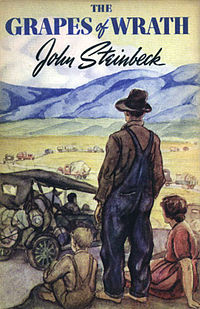
The Grapes of Wrath by John Steinbeck, 1939

‘The Grapes of Wrath’ opens with a portrait of the devastation caused by the dust bowl in 1930’s Oklahoma:

Every moving thing lifted the dust into the air…A walking man lifted a thin layer as high as his waist. An automobile boiled a cloud behind it.”grapes-of-wrath

Tom Joad has just been released on parole, after having served four years for manslaughter, killing a man with a shovel during a fight in which he had been stabbed. Tom finds his family home abandoned, and his extended family about to move to California, a journey estimated at around 2000 miles, including up and over the Rockies. He and a lapsed itinerant preacher join them, and thus begins the odyssey which is ‘The Grapes of Wrath’.

The novel draws much of its imagery and language from the bible, not least when the Joad family set off for the promised land joining a mass migration which followed in the footsteps of the original European settlers. In his documentary on the novel, Melvyn Bragg points out that the family of 12 on the Joad’s truck are

“as the 12 tribes of Israel seeking liberation. The truck itself is an ark; there is even a man named Noah on board.”

(The pedant in me wants to point out there were only eight people on the ark, and a heck of a lot of animals, but that might be counter-productive).

The Dust Bowl was caused by agricultural practices not suited to the Mid West environment, but Steinbeck treats it as a natural occurrence, a biblical plague. His condemnation of the banks that buy up the small share-cropper farms and evict the families is heartfelt, although his approach to farming technology – that tractors and combines are somehow alien machines that disconnect man from the soil and are inherently bad – is sentimental and unconvincing. However, the strength and impact of the prose is such that at the time the reader is carried along with the Joad’s distress at their (effective) eviction, and doesn’t challenge their view that they are doing the right thing.

“Funny thing how it is. If a man owns a little property, that property is him, it’s part of him, and it’s like him. If he owns property only so he can walk on it and handle it and be sad when it isn’t doing well, and feel fine when the rain falls on it, that property is him, and some way he’s bigger because he owns it. Even if he isn’t successful he’s big with his property. That is so.”

The rhythms and cadences of the language have the feeling of a revivalist sermon, all the more so when the speaker is Casy, the lapsed preacher who travels with the family. The ending phrase used here – “that is so” – has the impact of an “amen” or “this is the word of the Lord”. Steinbeck uses incomplete phrases to layer his descriptive passages:

“the main immigrant road … the path of people in flight, refugees from dust and the shrinking land, from the thunder of tractors and shrinking ownership”.

However, the Joad’s don’t feel sorry for themselves – they genuinely believe they are going to the land of milk and honey, and get quite angry when people they meet on route try to point out that not everything in California is as blessed as they expect it to be. The great continental migration from east to west is a fundamental defining part of the American narrative, which probably is one of the central reasons for this novel’s massive popularity in the US. The Joad’s journey echoes that great migration – although again the pedant in me can’t avoid noticing that in some ways it is much easier, as they have a truck to carry them, and gas stations along the way!

The journey is difficult and dangerous, but not completely a negative experience. Their lorry lasts the entire journey, including the crossing of the desert and the mountains; they meet kindness and friendship from other travellers, and they are very lucky to find a place a government camp, where Tom finds work on his first day. Later they get work picking cotton and a box-car to live in. However, the older family members find the journey very difficult, others bail out early, and soon the family has to face the hostile realities of life in California – there is very little work, and the settlers are resented bitterly by the locals, who feel threatened by the ‘Okies’.

This is an overtly political novel – driven by anger Steinbeck rages against the system that drives down wages, pits people against one another, and finds it more economical to leave fields bare than to feed people, crops to rot or be destroyed rather than harvest them and sell them at a loss:

“Here is a crime here that goes beyond denunciation. There is a sorrow here that weeping cannot symbolize. There is a failure here that topples all our success. The fertile earth, the straight tree rows, the sturdy trunks, and the ripe fruit. And children dying of pellagra must die because a profit cannot be taken from an orange. And coroners must fill in the certificate- died of malnutrition- because the food must rot, must be forced to rot. The people come with nets to fish for potatoes in the river, and the guards hold them back; they come in rattling cars to get the dumped oranges, but the kerosene is sprayed. And they stand still and watch the potatoes float by, listen to the screaming pigs being killed in a ditch and covered with quick-lime, watch the mountains of oranges slop down to a putrefying ooze; and in the eyes of the people there is the failure; and in the eyes of the hungry there is a growing wrath. In the souls of the people the grapes of wrath are filling and growing heavy, growing heavy for the vintage.”

Steinbeck outlines a clear political solution to the problem in the model, self-organising, self-policing community of Weedpatch, the government camp where the family settle for a while. Weedpatch is effectively a model Soviet commune, run by the people for the people, with leaders elected weekly and assets shared. Steinbeck’s novel is both a protest about the treatment of working people, and a warning about the inevitable results of that treatment.

And the great owners, who must lose their land in an upheaval, the great owners with access to history, with eyes to read history and to know the great fact: when property accumulates in too few hands it is taken away. And that companion fact: when a majority of the people are hungry and cold they will take by force what they need. And the little screaming fact that sounds through all history: repression works only to strengthen and knit the repressed. The great owners ignored the three cries of history. The land fell into fewer hands, the number of the dispossessed increased, and every effort of the great owners was directed at repression. The money was spent for arms, for gas to protect the great holdings, and spies were sent to catch the murmuring of revolt so that it might be stamped out. The changing economy was ignored, plans for the change ignored; and only means to destroy revolt were considered, while the causes of revolt went on.”

Tom, the novel’s central figure, slips away into the night at the end of the novel, a wanted man on the run. He is determined to take on the union organisation work of the murdered Casy. We are not told of his ultimate fate, but he leaves with these haunting words:

“I’ll be ever’where – wherever you look. Wherever they’s a fight so hungry people can eat, I’ll be there. Wherever they’s a cop beatin’ up a guy, I’ll be there. If Casy knowed, why, I’ll be in the way guys yell when they’re mad an’ – I’ll be in the way kids laugh when they’re hungry an’ they know supper’s ready. An’ when our folks eat the stuff they raise an’ live in the houses they build, why, I’ll be there.”

It would have been so nice to have been able to read ‘The Grapes of Wrath’ as a portrait of a time long past, in the way we now read Kingsley’s ‘The Water Babies’ or much Dickens’s social realism. But sadly one can’t – the problems of social deprivation and migrant labour are as acute today as they were in the 1930s. Hyperbole? Perhaps, although the statistics for the number of people dying in the attempt to cross from Mexico to the USA are still horrifying. But this is nothing compared the numbers of people trying to escape from poverty and conflict in North Africa and the Middle East, who die in their thousands in the attempt, and who are feared, stigmatised and abused in exactly the same way that Steinbeck’s characters are treated.

“In the West there was panic when migrants multiplied on the highways. Men of property were terrified for their property. Men who had never been hungry saw the eyes of the hungry. Men who had never wanted anything very much saw the flare of want in the eyes of the migrants. And the men of the towns and of the soft suburban country gathered to defend themselves; and the reassured themselves that they were good and the invaders bad, as a man must do before he fights, They said “These goddamned Okies are dirty and ignorant. They’re degenerate, sexual maniacs. The goddamned Okies are thieves. They’ll steal anything”.”

I know I’ve quoted a length from this novel. But I am not going to apologise for that – there is a poetry to Steinbeck’s prose, an almost hypnotic lushness, and it is really hard to find shorter sections that convey this adequately.

I am enough of a traditionalist to want to know what happened to the Joad’s, if they ever found the modestly comfortable life they were looking for, whether Al got the job in a garage he was so obviously suited for. But I can appreciate that Steinbeck wanted to leave some uncertainty about their future in a world where the future of America itself was becoming increasingly hard to predict.

Standard
100 Best Novels Guardian list, Book review

Zuleika Dobson, by Max Beerbohm, 1911

I finished this novel in something of a bad mood. It is a very bad book, and I resented the effort required to find any redeeming features. The fact that I found some in many ways made my mood worse! As I reflected on the text, I slowly came to accept that perhaps it wasn’t as bad as I originally thought. Don’t you hate it when that happens? Continue reading

Standard
Book review

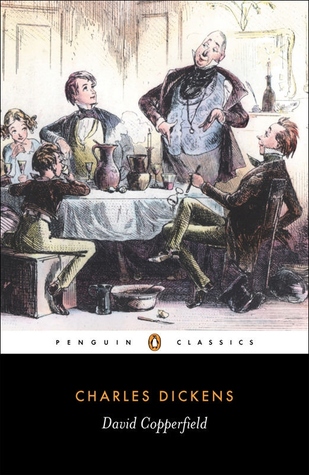
David Copperfield by Charles Dickens, 1850

Subtitled “The Personal History, Adventures, Experience and Observation of David Copperfield the Younger of Blunderstone Rookery (Which He Never Meant to Publish on Any Account)”

Originally published in nineteen monthly instalments, ‘David Copperfield’ takes the form of a personal narrative, with this evocative introduction:david-copperfirled

“Whether I shall turn out to be the hero of my own life, or whether that station will be held by anybody else, these pages must show. To begin my life with the beginning of my life, I record that I was born (as I have been informed and believe) on a Friday, at twelve o’clock at night. It was remarked that the clock began to strike, and I began to cry, simultaneously.”

The largely autobiographical plot follows the young David as he is orphaned, sent to school, and slowly makes his way in the world, eventually becoming a prosperous author.   Continue reading

Standard