Book review

Americanah, by Chimamanda Ngozi Adichie, 2013

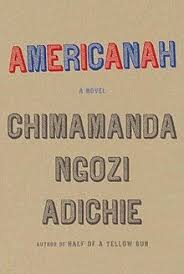
Americanah is Adichie’s third novel, following Purple Hibiscus in 2003 and Half a Yellow Sun in 2006. It’s a more personal novel than the earlier works, reflecting a maturity of her style and writing.
Americanah - Wikipedia

Although its reputation as a novel about race goes before it, Americanah is at its heart a love-story. It follows two central characters, Ifemulu and Obinze, who meet and fall in love with while growing up in Lagos. The portrait of life in Nigeria is unblinking – corruption is everywhere and affects everything. Many if not most middle-class Nigerians have just one ambition – to make enough money to be able to afford to leave the country, for either the UK or America. The non-linear structure of the novel means that much of it is told in the form of Ifemulu’s and Obinze’s reminiscences once Ifemulu has gone to America on a scholarship. Her experience of life in America is initially hard. She stays in Brooklyn with relatives for the first few months, and uses a fake identity card to try (largely unsuccessfully) to find work. Rejection after rejection make her wonder what she is doing wrong – is she too African? Slowly she comes to terms with American culture and the way of life, and in particular the prevailing attitudes to race. Before she came to America Ifemelu wasn’t really conscious of race – now she can’t avoid it. In her blog she later writes

“I came from a country where race was not an issue; I did not think of myself as black and I only became black when I came to America”.

Or putting it another way

“Dear Non-American Black, when you make the choice to come to America, you become black. Stop arguing. Stop saying I’m Jamaican or I’m Ghanaian. America doesn’t care.”

Her approach to the way she wears her hair – braided, ‘relaxed’ or naturally – comes to act as a metaphor for a central question of racial politics – do immigrants attempt to integrate into America culture, or do they retain links to their home countries, culture and ways of life? Initially she adopts an American accent in an attempt to fit in (and in particular to find a job) but eventually rejects that enforced Americanisation – the attempt to make her an Americanah – and goes back to using her natural accent and way of speaking.

She attempts to sustain her long distance relationship with Obinze, but when she is forced, through lack of money, to accept a sleazy job helping a tennis coach “relax”, she sees this as a betrayal of her relationship, and ghosts Obinze. This is a turning point for her in other ways as she finally obtains a well paying job and new relationships which she struggles to sustain.

Obinze’s parallel journey is to England. He also finds life in his new environment difficult and experiences many of the same problems Ifemulu faces. He lives with friends, struggles to find work, and has to use false identity papers. In desperation he pays for a marriage with an EU citizen which will allow him to stay in the UK, but on the day of his wedding he is arrested and deported. Racism in the UK is different from that in the US, but part of his daily experience nonetheless. Adichie catches some of the anti-immigrant sentiment that was to eventually lead to Brexit:

“He sat on the stained seat of the noisy train, opposite a woman reading the evening newspaper. Speak English at home, Blunkett tells immigrants’. He imagined the article she was reading. There were so many of them now published in the newspapers, and they echoed the radio and the television, even the chatter of some of the men in the warehouse. The wind blowing across the British Isles was odorous with fear of asylum seekers, infecting everybody with the panic of impending doom, and so articles were written and read, simply and stridently, as though the writers lived in a world in which the present was unconnected to the past, and they had never considered this to be the normal course of history: the influx into Britain of black and brown people from countries created by Britain. (258/9)

Back in the USA Ifemulu starts her a blog on the issue of race in America. The narrative includes several of her posts – informal and personal, allowing the author to reinforce points about race which may not have emerged fully in the main narrative. Her blog rapidly becomes very popular and she is able to use the earnings from it to give up her day job and buy an apartment. She is even invited to give talks at conferences and conventions on race in the USA.

She begins a new relationship with a Professor of history at Yale. Their relationship centres upon a mutual passion – their support for Barack Obama’s run for the US presidency. His campaign slogan – Hope – summarises how they feel about the prospect for race relations in America following his win. But the optimism fades quickly, and after a fight over a protest Blaine arranges, Ifemulu slowly comes to the realisation that her future lies back in Nigeria. This is the point the novel originally opens on, with her reaching out to Obinze after several years of silence, the previous narrative all being told in flashback to explain how they have reached this point. It is clear the mutual attraction is still there, and although Obinze, now rich from property deals, is married with a daughter, they resume their relationship as if they intervening years had not happened. The novel ends on a positive note for them. 

The largely positive responses to this novel are often qualified by two concerns – that the novel is sprawling, and that it is didactic. It could also be argued that the novel is a little too obviously aware that it is a novel about race. It includes a number of fourth wall breaches such as when Shan, Blaine’s irritatingly confident sister, ‘slightly drunk, slightly dramatic, and now sitting yoga-style on the floor’ proclaims:

“You can’t write an honest novel about race in this country. If you write about how people are really affected by race, it’ll be too obvious. Black writers who do literary fiction in this country, all three of them, not the ten thousand who write those bullshit ghetto books with the bright covers, have two choices: they can do precious or they can do pretentious. When you do neither, nobody knows what to do with you. So if you’re going to write about race, you have to make sure it’s so lyrical and subtle that the reader who doesn’t read between the lines won’t know it’s about race. You know, a Proustian meditation, all watery and fuzzy, that at the end leaves you feeling watery and fuzzy.” (335/6)

Americanah is unquestionably not watery and fuzzy. The rejection of bullshit ghetto books with bright covers possibly explains why both the hardback and paperback editions of the novel are presented in such a subdued way. As for the concern that the novel is sprawling, some readers will certainly have found it that way. For me it just kept on the right side of complexity, although I found the introduction of so many new characters even in the final pages of the novel a bit frustrating. It’s going to be interesting to see where Adichie goes next as a novelist.

Standard
Book review

“Red was the blood of the siblings massacred in the North, black was for mourning them, green was for the prosperity Biafra would have, and, finally, the half of a yellow sun stood for thoe glorious future.”

Ngozi Adichie’s ftirst novel, Purple Hibiscus, took as its focus a very personal, i0ntimate look at a troubled Nigerian family. The wider political context of a country “coming to terms with its imperial past” (as it has been described) is there, but it’s in the background, and the precise period of the setting is no5#0*t critical. Half a Yellow Sun is a much more political novel. It is set in the 1960’s following Nigeria’s independence from the UK, and features the tribal and political conflicts that followed, culminating in the Biafran war of 1967-1970.

Half of a Yellow Sun by Chimamanda Ngozi Adichie - Paperback - 01/15/2007 - from Greener Books Ltd (SKU: mon0000034080)

I confess I knew little about this period before reading this novel – the name Biafra was familiar, but I doubt I would have been able to find it on a map. Britain’s role in this conflict derives initially from its construction of Nigeria from a patchwork of different tribal kingdoms and states as a calculated tactic to produce a divided country, to its shameful support for the Nigerian side during the Civil War, including providing arms to the besieging Nigerian Army. I suppose it is hardly surprising that this is not a war that is taught in British schools!

Half a Yellow Sun is not, however, just a history book. The war is the setting and the inspiration for the novel, but the conflict is shown as a personal as well as national tragedy. The complex web of narratives are woven together using three principal narrators: Ugwu, a ‘houseboy’ (servant) to a prosperous university lecturer, his master’s partner, Olanna, and Richard Churchill, an English ex-patriate, boyfriend to Olanna’s twin sister. Thus Adichie captures the perspectives of the Nigerian working-class, the more prosperous middle-class, and an English ‘outsider’ point of view.

Flag of Biafra

The novel uses a non-linear time structure. It starts in the early 1960’s, post-independence years. Teenage Ugwu starts work for Odenigbo, the lecturer boyfriend of Olanna. Ugwu is a naive village boy bewildered by the opulence of Odenigbo’s home and furnishings. But he is bright and Odenigbo is patient, and he quickly learns his duties. Odenigbo hosts intellectual dinner parties in which the post-colonial future of the country is debated. He is sceptical about the concept of Nigeria itself:

“the only authentic identity for the African is the tribe…I am Nigerian because a white man created Nigeria and gave me that identity. I am black because the white man constructed black to be as different as possible from his white. But I was Igbo before the white man came.”

Most of the characters in the novel are also from the Igbo tribe, and it is largely the perspective of this group that is shown throughout the novel. Odenigbo articulates a compelling analysis of imperialism, although it is principally an intellectual, theoretical rather than a practical position:

“The real tragedy of our postcolonial world is not that the majority of people had no say in whether or not they wanted this new world; rather, it is that the majority have not been given the tools to negotiate this new world.”

Through Odenigbo we meet his partner, Olanna Ozobia, daughter of a prosperous and influential Nigerian businessman. Olanna and her twin sister Kainene are strong young women who have to work hard to retain their independence from their parents. Kainene is in a relationship with Richard Churchill, the novel’s third narrator. Richard is an English writer who studies tribal African art and teaches at the local university. Richard is a distanced observer of the events of the novel, only briefly a participant.

Four years later, conflict between the Northern Hausa people and the Eastern Igbo tribe is sparked by a political coup in which Hausa leaders are murdered. A counter-coup leads to massacres of many Igbo people living in the North. The new republic, Biafra, seceedes from Nigeria, ostensibly to create a safe nation for the Igbo people. Olanna, Odenigbo, their infant daughter and Ugwu are forced to flee as refugees. These chapters of the novel contains many cryptic references to a parallel conflict between Olanna and Kainene which has led to a painful separation, references which are only finally explained in the next part of the novel, which jumps back in time to shortly after the first section.

Eventually the secret of this pain is revealed. Odenigbo betrayed Olanna: manipulated by his deeply unpleasant mother he slept with her servant, Amala, who went on to have his baby. Olanna takes revenge by sleeping with Richard, who has been nursing a long-standing crush on her. Odenigbo and Olanna decide to adopt the new-born baby girl, while Richard and Kainene decide to stay together and try to repair their relationship. In anger Olanna also destroys Odenigbo’s manuscript of the book he was working for – throughout the novel books are destroyed, burnt, buried, and frantically repaired and replaced. This emphasises the importance of the conflict being memorialised, and of writing itself.

The final section of the novel is the most compelling and traumatic. I found myself only being able to read a few pages at a time, as the war bears down on the lives of the characters who have become important to the reader. Even though they are relatively prosperous, and therefore protected from some of the more severe deprivations of the war (Olanna and Kainene’s parents fly out to England for the duration), their situation slowly deteriorates. There is finally no escape from the brutality of the war, no ending even after the ceasefire.

Ugwu’s story arc is in some ways the most compelling. He starts as an ‘uncivilised’ village boy who shows great loyalty and love towards his employers. He continues to study throughout the novel and his voice slowly becomes more articulate and educated. Several sections of the novel end in extracts from books about Biafra, and although at first it is implied these are written by Richard Churchill it becomes apparent that they are most likely written by Ugwu, and that he eventually becomes a writer. He is a kind soul, but even he is corrupted by the war, and when he is conscripted he takes part in the gang-rape of a young woman. Despite this complicity in a war crime Adichie still portrays Ugwu more as a victim of the war than a participant or criminal.

This is a wonderful ambitious novel. In addition to the central portraits it contains a wide range of minor characters, all sketched vividly, and while some are archetypes they still come to life, such as Harrison, Richard’s ‘houseboy’, who takes pride in his Englishness and his ability to cook traditional English dishes from local ingredients, and who maintains certain standards of etiquette even in the depths of famine and war. Another important sketch is of Mohammed, a former boyfriend of Olanna. Mohammed is a Muslim from the Hausa tribe, and is therefore technically an enemy of the central Igbo characters, but he rescues her from tribal violence and epitomises the civility of the Hausa aristocracy, providing nuance to the portrait of the conflict.

Although the Nigerian-Biafran War has been written about before Half a Yellow Sun, this novel has an immediacy and relevance. Starvation of civilian populations as an extension of warfare wasn’t invented in Biafra, but it was taken to a cruel and new level. I am sure the war is seen in a different light by Nigerians compared to how it is perceived in the West, and this is an important step in redressing that balance.

While the legacy of colonialism is an important theme in the novel, it is not didactic. The reader doesn’t feel beaten around the head with the politics of the conflict, while at the same time it is entirely clear on the war’s origins in the creation of the nation of Nigeria, and the ongoing complicity of the West. This is a hugely rewarding complex novel which was rightly lauded by critics and with prizes, including the Orange Prize for Fiction (now called Baileys Women’s Prize for Fiction) 2007. I am glad to have finally read it, having seen it on various reading lists many times in the last few years. It marks a dramatic progression from what looks now like an immature first novel in Purple Hibiscus, a graduation to the top level of modern writers.

Half a Yellow Sun, by Chimamanda Ngozi Adichie, 2006

Aside
Book review

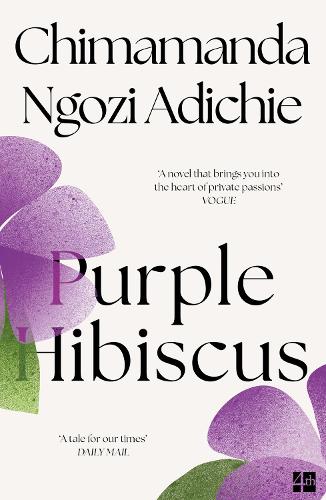
I honestly didn’t choose Purple Hibiscus deliberately as a companion piece to I Capture the Castle, (reviewed last week) but it works really well as such. It too is a coming of age novel, narrated by a teenage girl living in a ‘challenging’ family environment, and is often considered a young person’s novel. Over the course of the span of the novels both narrators falls in love and learn some difficult lessons about life.Purple Hibiscus by Chimamanda Ngozi Adichie | Waterstones

One can of course take these parallels too far. Purple Hibiscus was Chimamanda Ngozi Adichie’s first novel, published in 2003. It is set in Enugu in Nigeria where she was born and grew up and is a portrait of a young woman’s experiences in an extraordinarily strict Catholic family, dominated by a brutal father. At the same time it is also a wider commentary on the deterioration of civil society in Nigeria.

Kambili Achike is fifteen. She lives in terror of her father, who punishes any deviation from his rules with violence. Her mother is attacked so badly she twice miscarries. Her brother Jaja isn’t exempt from these attacks either, even though as the novel opens he is beginning to show signs of a preparedness to stand up to his father. Outwardly Mr Achike is a benevolent public figure and a devout Catholic, generous to his family and his community. But behind closed doors he is a monster. The scenes in which he tortures his family are distressing and explicit. 

A potential escape from this toxic and dangerous environment is offered by Kambili’s aunt Ifeoma, who offers to take her and her brother to a Catholic pilgrimage site, where a local girl claims to have witnessed visions of the Virgin Mary. Ifeoma appears aware of her brother’s brutality, but the novel implies that violent chastisement of one’s wife and children is an accepted or tolerated feature of Nigerian society. If so it is a symptom of a wider sickness in a society which is steadily breaking down – power supplies are interrupted, petrol is unobtainable, a newspaper editor employed by Kambili’s father is murdered by a postal bomb sent by state agents, and Ifeoma is sacked because she is insufficiently loyal to the incumbent regime.

Ifeoma’s household is very different from that Kambili and Jaja are used to. Her understanding and practise of Catholicism is more relaxed and less focused on sin and punishment. Her children, especially her teenagers, are encouraged to speak their minds and learn independence of thought. More generally Ifeoma’s parenting style is caring and supportive, a world away from  Kambili and Jaja’s home:

“It was what Aunty Ifeoma did to my cousins, I realized then, setting higher and higher jumps for them in the way she talked to them, in what she expected of them. She did it all the time believing they would scale the rod. And they did. It was different for Jaja and me. We did not scale the rod because we believed we could, we scaled it because we were terrified that we couldn’t.”

Kambili and Jaja begin to flourish in this environment. Later Kambili meets a young priest, Father Amadi, and becomes aware of a growing attraction for him. He seems to reciprocate her feelings, but neither of them act upon them.

Structurally the novel is a little weak. There are two extended spells where Kambili and her brother Jaja stay with their aunt – their tyrantical father would have been unlikely to agree to these visits, ceding his control over their every moment for a second occasion when the first included what he considered sinful behaviour. The ending felt a little rushed, with a series of incidents packed into a few pages when previously the pace had been relaxed, with everyday life with all its challenges being the main focus.

The novel also relies a lot on some slightly overworked symbolism, not least the purple hyacinth itself.

“Vibrant bushes of hibiscus reached out and touched one another as if they were exchanging their petals. The purple plants had started to push out sleepy buds, but most of  the flowers were still on the red ones. They seemed to bloom so fast, those red hibiscuses, considering how often Mama cut them to decorate the church altar and how often visitors plucked them as they walked past to their parked cars.”

The purple hibiscus are a special variety of the flower that will only prosper in Nigerian soil if cared for with love. The children in the novel are all equally delicate blooms that blossom if cared for.

These are minor reservations. The novel is a powerful, insightful portrait of life in post-colonial Nigeria, a society in flux and still coming to terms with its past. I think most readers will enjoy the novel principally because of its central character, Kambili. Because we hear her internal monologue for all of the novel it is easy to miss the fact that for much of the time she is virtually mute, terrified to say the wrong thing in front of her father, and lacking confidence to speak in front of school-friends or her cousins. She constantly monitors her thoughts to try and avoid anything considered sinful, and as a result she is more of an observer than a participant. Although she slowly finds her voice over the course of the narrative, her thoughts and reactions to even the most traumatic events are suppressed, leaving the reader to infer the full horror of her abuse. Because the only life she has lived is one of brutality she is unaware of the extreme nature of her father’s behaviour, which makes her mute acceptance of his violence all the more chilling.

I am interested to see how Adichie develops as a novelist. Half a Yellow Sun won awards and plaudits, as did the more recent Americanah, and I am looking forward to finding out the extent to which these were justified.


Purple Hibiscus, by Chimamanda Ngozi Adichie, 2003

Aside