
I honestly didn’t choose Purple Hibiscus deliberately as a companion piece to I Capture the Castle, (reviewed last week) but it works really well as such. It too is a coming of age novel, narrated by a teenage girl living in a ‘challenging’ family environment, and is often considered a young person’s novel. Over the course of the span of the novels both narrators falls in love and learn some difficult lessons about life.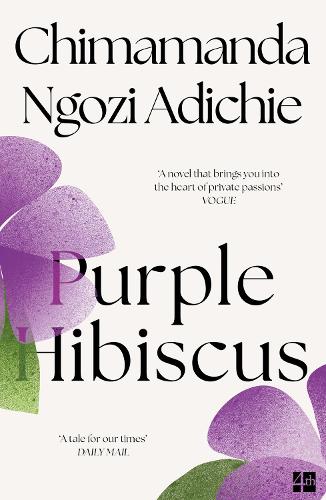
One can of course take these parallels too far. Purple Hibiscus was Chimamanda Ngozi Adichie’s first novel, published in 2003. It is set in Enugu in Nigeria where she was born and grew up and is a portrait of a young woman’s experiences in an extraordinarily strict Catholic family, dominated by a brutal father. At the same time it is also a wider commentary on the deterioration of civil society in Nigeria.
Kambili Achike is fifteen. She lives in terror of her father, who punishes any deviation from his rules with violence. Her mother is attacked so badly she twice miscarries. Her brother Jaja isn’t exempt from these attacks either, even though as the novel opens he is beginning to show signs of a preparedness to stand up to his father. Outwardly Mr Achike is a benevolent public figure and a devout Catholic, generous to his family and his community. But behind closed doors he is a monster. The scenes in which he tortures his family are distressing and explicit.
A potential escape from this toxic and dangerous environment is offered by Kambili’s aunt Ifeoma, who offers to take her and her brother to a Catholic pilgrimage site, where a local girl claims to have witnessed visions of the Virgin Mary. Ifeoma appears aware of her brother’s brutality, but the novel implies that violent chastisement of one’s wife and children is an accepted or tolerated feature of Nigerian society. If so it is a symptom of a wider sickness in a society which is steadily breaking down – power supplies are interrupted, petrol is unobtainable, a newspaper editor employed by Kambili’s father is murdered by a postal bomb sent by state agents, and Ifeoma is sacked because she is insufficiently loyal to the incumbent regime.
Ifeoma’s household is very different from that Kambili and Jaja are used to. Her understanding and practise of Catholicism is more relaxed and less focused on sin and punishment. Her children, especially her teenagers, are encouraged to speak their minds and learn independence of thought. More generally Ifeoma’s parenting style is caring and supportive, a world away from Kambili and Jaja’s home:
“It was what Aunty Ifeoma did to my cousins, I realized then, setting higher and higher jumps for them in the way she talked to them, in what she expected of them. She did it all the time believing they would scale the rod. And they did. It was different for Jaja and me. We did not scale the rod because we believed we could, we scaled it because we were terrified that we couldn’t.”
Kambili and Jaja begin to flourish in this environment. Later Kambili meets a young priest, Father Amadi, and becomes aware of a growing attraction for him. He seems to reciprocate her feelings, but neither of them act upon them.
Structurally the novel is a little weak. There are two extended spells where Kambili and her brother Jaja stay with their aunt – their tyrantical father would have been unlikely to agree to these visits, ceding his control over their every moment for a second occasion when the first included what he considered sinful behaviour. The ending felt a little rushed, with a series of incidents packed into a few pages when previously the pace had been relaxed, with everyday life with all its challenges being the main focus.
The novel also relies a lot on some slightly overworked symbolism, not least the purple hyacinth itself.
“Vibrant bushes of hibiscus reached out and touched one another as if they were exchanging their petals. The purple plants had started to push out sleepy buds, but most of the flowers were still on the red ones. They seemed to bloom so fast, those red hibiscuses, considering how often Mama cut them to decorate the church altar and how often visitors plucked them as they walked past to their parked cars.”
The purple hibiscus are a special variety of the flower that will only prosper in Nigerian soil if cared for with love. The children in the novel are all equally delicate blooms that blossom if cared for.
These are minor reservations. The novel is a powerful, insightful portrait of life in post-colonial Nigeria, a society in flux and still coming to terms with its past. I think most readers will enjoy the novel principally because of its central character, Kambili. Because we hear her internal monologue for all of the novel it is easy to miss the fact that for much of the time she is virtually mute, terrified to say the wrong thing in front of her father, and lacking confidence to speak in front of school-friends or her cousins. She constantly monitors her thoughts to try and avoid anything considered sinful, and as a result she is more of an observer than a participant. Although she slowly finds her voice over the course of the narrative, her thoughts and reactions to even the most traumatic events are suppressed, leaving the reader to infer the full horror of her abuse. Because the only life she has lived is one of brutality she is unaware of the extreme nature of her father’s behaviour, which makes her mute acceptance of his violence all the more chilling.
I am interested to see how Adichie develops as a novelist. Half a Yellow Sun won awards and plaudits, as did the more recent Americanah, and I am looking forward to finding out the extent to which these were justified.


Pingback: Book review: Half a Yellow Sun, by Chimamanda Ngozi Adichie, 2006 – The Reading Bug
Pingback: Book review: Americanah, by Chimamanda Ngozi Adichie, 2013 – The Reading Bug