
Americanah is Adichie’s third novel, following Purple Hibiscus in 2003 and Half a Yellow Sun in 2006. It’s a more personal novel than the earlier works, reflecting a maturity of her style and writing.
Although its reputation as a novel about race goes before it, Americanah is at its heart a love-story. It follows two central characters, Ifemulu and Obinze, who meet and fall in love with while growing up in Lagos. The portrait of life in Nigeria is unblinking – corruption is everywhere and affects everything. Many if not most middle-class Nigerians have just one ambition – to make enough money to be able to afford to leave the country, for either the UK or America. The non-linear structure of the novel means that much of it is told in the form of Ifemulu’s and Obinze’s reminiscences once Ifemulu has gone to America on a scholarship. Her experience of life in America is initially hard. She stays in Brooklyn with relatives for the first few months, and uses a fake identity card to try (largely unsuccessfully) to find work. Rejection after rejection make her wonder what she is doing wrong – is she too African? Slowly she comes to terms with American culture and the way of life, and in particular the prevailing attitudes to race. Before she came to America Ifemelu wasn’t really conscious of race – now she can’t avoid it. In her blog she later writes
“I came from a country where race was not an issue; I did not think of myself as black and I only became black when I came to America”.
Or putting it another way
“Dear Non-American Black, when you make the choice to come to America, you become black. Stop arguing. Stop saying I’m Jamaican or I’m Ghanaian. America doesn’t care.”
Her approach to the way she wears her hair – braided, ‘relaxed’ or naturally – comes to act as a metaphor for a central question of racial politics – do immigrants attempt to integrate into America culture, or do they retain links to their home countries, culture and ways of life? Initially she adopts an American accent in an attempt to fit in (and in particular to find a job) but eventually rejects that enforced Americanisation – the attempt to make her an Americanah – and goes back to using her natural accent and way of speaking.
She attempts to sustain her long distance relationship with Obinze, but when she is forced, through lack of money, to accept a sleazy job helping a tennis coach “relax”, she sees this as a betrayal of her relationship, and ghosts Obinze. This is a turning point for her in other ways as she finally obtains a well paying job and new relationships which she struggles to sustain.
Obinze’s parallel journey is to England. He also finds life in his new environment difficult and experiences many of the same problems Ifemulu faces. He lives with friends, struggles to find work, and has to use false identity papers. In desperation he pays for a marriage with an EU citizen which will allow him to stay in the UK, but on the day of his wedding he is arrested and deported. Racism in the UK is different from that in the US, but part of his daily experience nonetheless. Adichie catches some of the anti-immigrant sentiment that was to eventually lead to Brexit:
“He sat on the stained seat of the noisy train, opposite a woman reading the evening newspaper. Speak English at home, Blunkett tells immigrants’. He imagined the article she was reading. There were so many of them now published in the newspapers, and they echoed the radio and the television, even the chatter of some of the men in the warehouse. The wind blowing across the British Isles was odorous with fear of asylum seekers, infecting everybody with the panic of impending doom, and so articles were written and read, simply and stridently, as though the writers lived in a world in which the present was unconnected to the past, and they had never considered this to be the normal course of history: the influx into Britain of black and brown people from countries created by Britain. (258/9)
Back in the USA Ifemulu starts her a blog on the issue of race in America. The narrative includes several of her posts – informal and personal, allowing the author to reinforce points about race which may not have emerged fully in the main narrative. Her blog rapidly becomes very popular and she is able to use the earnings from it to give up her day job and buy an apartment. She is even invited to give talks at conferences and conventions on race in the USA.
She begins a new relationship with a Professor of history at Yale. Their relationship centres upon a mutual passion – their support for Barack Obama’s run for the US presidency. His campaign slogan – Hope – summarises how they feel about the prospect for race relations in America following his win. But the optimism fades quickly, and after a fight over a protest Blaine arranges, Ifemulu slowly comes to the realisation that her future lies back in Nigeria. This is the point the novel originally opens on, with her reaching out to Obinze after several years of silence, the previous narrative all being told in flashback to explain how they have reached this point. It is clear the mutual attraction is still there, and although Obinze, now rich from property deals, is married with a daughter, they resume their relationship as if they intervening years had not happened. The novel ends on a positive note for them.
The largely positive responses to this novel are often qualified by two concerns – that the novel is sprawling, and that it is didactic. It could also be argued that the novel is a little too obviously aware that it is a novel about race. It includes a number of fourth wall breaches such as when Shan, Blaine’s irritatingly confident sister, ‘slightly drunk, slightly dramatic, and now sitting yoga-style on the floor’ proclaims:
“You can’t write an honest novel about race in this country. If you write about how people are really affected by race, it’ll be too obvious. Black writers who do literary fiction in this country, all three of them, not the ten thousand who write those bullshit ghetto books with the bright covers, have two choices: they can do precious or they can do pretentious. When you do neither, nobody knows what to do with you. So if you’re going to write about race, you have to make sure it’s so lyrical and subtle that the reader who doesn’t read between the lines won’t know it’s about race. You know, a Proustian meditation, all watery and fuzzy, that at the end leaves you feeling watery and fuzzy.” (335/6)
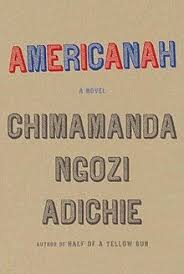
Americanah is unquestionably not watery and fuzzy. The rejection of bullshit ghetto books with bright covers possibly explains why both the hardback and paperback editions of the novel are presented in such a subdued way. As for the concern that the novel is sprawling, some readers will certainly have found it that way. For me it just kept on the right side of complexity, although I found the introduction of so many new characters even in the final pages of the novel a bit frustrating. It’s going to be interesting to see where Adichie goes next as a novelist.

