
Or to give the novel its full title, because the full titles of early novels are always worth recording: “The Farther Adventures of Robinson Crusoe; Being the Second and Last Part of His Life, And of the Strange Surprising Accounts of his Travels Round three Parts of the Globe”. 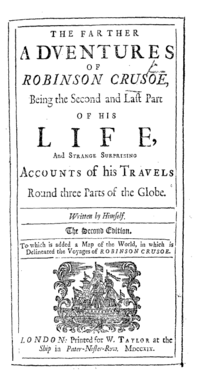
I enjoy literary curiosities and this novel definitely falls into that category. The original ‘Robinson Crusoe‘ was hugely popular, and this little-read sequel could be seen as a cynical cashing in, a ‘straight to video’ Robinson Crusoe 2, published just five short months after RC1. There is also an RC3 – ‘Serious Reflections During the Life and Surprising Adventures of Robinson Crusoe: With his Vision of the Angelick World‘ (1720) which for me is probably one Crusoe too many.
This novel opens with a quick summary of Crusoe’s life since his return from the island. He has bought a farm and had three children. But his wanderlust cannot be contained for long and he wants to return to his island. The death of his wife acts as a form of release and he sets off on another set of voyages, leaving his young family behind.
After an eventful Atlantic crossing, Crusoe and crew, including the ever-faithful Friday, return to Crusoe Island. They discover that the English sailors left on the island a decade earlier have been making trouble, and frankly were lucky to have been allowed to live. Crusoe pays tribute to the principled behaviour of the Spanish sailors who treat the untrustworthy Englishmen with respect and dignity. The capture of some local women, forced to act as “wives” to the European men, gives a glimpse of the barbarity with which the captives are treated, although Defoe presents this as typical adventurer behaviour. Acting as de facto sovereign of the island, Crusoe imposes a system of rule of law upon the islanders, and leaves for further adventures of a more varied type.
On the way to the mainland from Crusoe’s island, their ship is attacked. Friday is killed by three arrow shots during a brave attempt to negotiate. His death is mourned by Crusoe, although I found the almost casual way his death is described by the narrating Crusoe quite shocking, given Friday’s longstanding dedication to his master. Having disposed of Friday’s corpse in a burial at sea, Crusoe and companions set off on a series of adventures in first Brazil, then across the sea to Madagascar. Here one of the crew rapes a young native girl. The natives hang the crew member in punishment and in response the crew goes on a rampage, massacres the villagers and burns down their houses. Crusoe ineffectually opposes this behaviour and as a result is ejected from his ship and marooned.
This is not as serious a punishment as it would at first appear, as he is not without resources and not far from civilisation. He is eventually able to purchase a ship and organise a crew. It turns out however that this new ship has been stolen; fearing summary naval justice Crusoe and crew flee, eventually ending up in China. Following descriptions of various locations in China and the far east, Crusoe undertakes a very long overland expedition across Siberia and Russia back to western Europe, eventually arriving back in at London in 1705, having been away nearly eleven years.
What is the principal interest of this 300 year old novel? Is it more than a pub quiz answer in the Arts and Books round? To be honest, not really. There are some insights into the racist attitudes of travellers of this period, but no more so than in the original novel. There is a cut and paste feel to many of the travels – then we went here, then here, etc. Imperialism was clearly a brutal business, with native peoples being treated like commodities. The somewhat noble survivor figure that Crusoe becomes in the original novel, bringing civilisation to the primitive uncharted world, is diminished in this novel. Can I find anything to recommend it? The descriptions of travel in the far East and Siberia are possibly some of the earliest portraits of Western travel in this area, so if you have a specialist interest in this topic then these may be worth reading, but as a novel or adventure story it is clear why this tale is largely forgotten.


Very interesting. I’d never heard of a sequel before. How did you access a text – is it online somewhere? And, is it really by Defoe?
LikeLiked by 1 person
Yes, definitely by Defoe. I downloaded this onto my kindle, but also free online http://www.gutenberg.org/ebooks/561
LikeLiked by 2 people