
Let’s look first at that title, The Ballad of Peckham Rye. In what sense is the novel a ballad, a “poem or song narrating a story in short stanzas; a slow or romantic song”? In using this formulation Spark is light-heartedly comparing her story to a 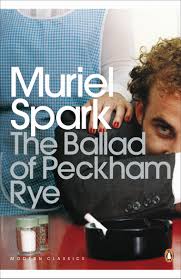 traditional love song, where hearts are broken, women are done wrong by their menfolk, and strangers come to town for a showdown with the law. Juxtaposing this idea with the suburban location of Peckham Rye, an area of London traditionally ripe for mockery, undercuts the essential silliness of the idea. Incidentally, why is South London treated as comedy gold in this way – c.f. Citizen Smith of the Tooting Popular Front or the Trotters of Nelson Mandela House? The online dictionary I consulted goes on to further define a ballad as “typically of unknown authorship, having been passed on orally from one generation to the next.” The story of the central event of this novel, the jilting of Dixie Morse at the altar, complies with this definition and becomes a piece of local folklore, told and retold by the Peckham residents long after the central characters have moved on.
The Ballad of Peckham Rye opens with the aforementioned jilting by Humphrey Place of his bride Dixie at the altar with the immortal phrase “No, to be quite frank, I won’t”. His decision is widely ascribed to his friendship with Dougal Douglas, the novel’s central character. Spark then goes back to the point when Dougal arrives, apparently from out of the blue, in Peckham. He is employed by textiles manufacturers Meadows, Meade & Grindley to “bridge the gap between industry and the arts”. It’s never really clear what this means or what his duties are, other than they involve lots of off-site research among the working people of Peckham. Dougal has the ability to strike up close friendships very quickly, and he soon becomes close to a range of characters including the tragic Merle Coverdale, stuck in an unhappy, mechanical affair with her boss, and the reluctant groom to be, (or not) Humphrey Place. Others are more suspicious of Dougal, not least Dixie, concerned about the impact he is having on fiance Humphrey, and electrician Trevor Lomas leader of a local gang of youths, who think he may be a spy.
There’s a strong flavour of Joe Orton to this novel. A very confident stranger arrives from nowhere and causes havoc in the lives of a settled community, encouraging the breaking of taboos. Dougal embarks upon what Wikipedia accurately calls a “mission of disruption” across Peckham. His spurious “human research” on the “moral character” of the people of the area allows him to avoid going into work, and to take a second non-job at a local textile manufacturers. In his spare time he even more bizarrely also works as a ghost writer for retired actress Maria Cheeseman. This juggling act can’t last, and when his landlady has a stroke and Ms Coverdale is murdered by her lover, the scene is set for the wedding rejection we know is coming. Humphrey rejects marriage to the money obsessed Dixie because Dougal has introduced him to the idea that there is more to life than work and domesticity. Dougal leaves Peckham as suddenly as he arrived, and we are told continues his career of chaos elsewhere.
Spark flirts with magical realism in this novel, but always backs away. For example it is suggested that the crook-backed Dougal has two lumps on his head where horns have been surgically removed. The ideal that he is a devil sent to cause chaos in Peckham is hinted at elsewhere – for example he refers to his inability to cross water, and describes himself as “one of the wicked spirits that wanders through the world for the ruin of souls” – but we never really take this seriously, unlike in works such as Sylvia Townsend Warner’s much earlier Lolly Willowes where the devil really does arrive in the English countryside.
The novel captures the poverty of expectations of early 1960’s suburban London, and the possibility that there is more out there somewhere. It’s not a significant piece of work, and is understandably over-shadowed by the magnificent Prime of Miss Jean Brodie. I suspect it is the kind of novel that would reveal more depths if re-read, but for now I am going to look for more elsewhere.

