
I don’t think you would be able to guess that Neverwhere is a novelisation of a television series – it has a dramatic range and scope ideally suited to the novel form, and must have been a challenge to film. It is rare for novelisations to be more than their original format, but here it is almost as if the novel was existing in concept all along, and it just took the development of the television series for it to come out.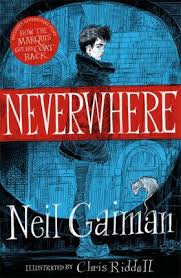
In the introduction to this edition, which was published to coincide with the publication of American Gods, Gaiman describes editing the text to make it more accessible to American readers – explaining that Oxford Street is a main shopping thoroughfare for example. I suspect he was wasting his time, because this is a novel firmly rooted in place, written by a writer with considerable and obvious affection for the London landmarks that appear in the book: Blackfriars, Baron’s Court, the Angel Islington and Old Bailey, among many others.
Three years in London had not changed Richard, although it had changed the way he perceived the city. Richard had originally imagined London as a gray city, even a black city, from pictures he had seen, and he was surprised to find it filled with color. It was a city of red brick and white stone, red buses and large black taxis, bright red mailboxes and green grassy parks and cemeteries. It was a city in which the very old and the awkwardly new jostled each other, not uncomfortably, but without respect; a city of shops and offices and restaurants and homes, of parks and churches, of ignored monuments and remarkably unpalatial palaces; a city of hundreds of districts with strange names – Crouch End, Chalk Farm, Earl’s Court, Marble Arch – and oddly distinct identities; a noisy, dirty, cheerful, troubled city, which fed on tourists, needed them as it despised them, in which the average speed of transportation through the city had not increased in three hundred years, following five hundred years of fitful road-widening and unskillful compromises between the needs of traffic, whether horse-drawn, or, more recently, motorized, and the need of pedestrians; a city inhabited by and teeming with people of every color and manner and kind.”
The novel’s springboard is the hidden issue of homelessness – how rough sleepers can live in cities such as London and be effectively invisible to the rest of the population. Gaiman takes this idea and has the homeless become residents of ‘London Under’ – a city existing in plain sight alongside London Above. I was reminded of China Meiville’s The City and the City which is based on a very similar concept. But Gaiman’s hidden world is magical, peopled by fantastical characters and where the normal rules of time and space do not apply. In this it is closer to the Rivers of London series which I believe it directly inspired.
Neverwhere’s central character is the Arthur Dent-like everyman beloved of fantasy writers. Richard Mayhew is a young businessman, who one day helps a mysterious young girl, Door, who appears before him, bleeding and weak, on a London street. Gaiman makes Richard a Scotsman exiled in London – he already feels a sense of alienation from his environment, so when his contact with the people of the Underworld makes him effectively invisible to other Londoners the process is complete. Door, only surviving member of a family of underworlders with the power to open any door, sends Richard to find the Marquis de Carabas who in turn can help her escape her pursuers. They hire a bodyguard, the Amazonian Hunter, and set off to find out why Door’s family was slain by the infamous assassins Croup and Vandemar, who are now on their trail. They criss-cross London Under in their quest, meeting a series of fantastical characters in extraordinary places. This is an action-packed adventure full of twists and turns and incident – it’s a great story.
I was a little uncertain as to Gaiman’s target audience with this novel. There is a horrific element to the novel’s casual and brutal violence, particularly that of Mr Croup and Mr Vandemar, the former all refinement and elegance, the latter the complete opposite, usually to be found munching on the remains of a puppy or a pigeon. Some characters die and don’t come back, and the happy ever after ending is not guaranteed. But while the peril in the novel is serious it is resolved quickly, and the one main character who is killed is resurrected with minimum suspense that it is not going to happen.
There’s a lot to enjoy in Neverwhere. The dialogue is outstanding, if fizzes with ideas, the aesthetic as evoked in Gaiman’s prose is wonderful, and the central relationship between Door and Richard is sweet, understated, and touching. There is a darkness to much of the humour (“Do you like cat?” she said. “Yes,” said Richard. “I quite like cats.” Anaesthesia looked relieved. “Thigh?” she asked, “or breast?” ) that is entirely unsentimental. Gaiman has promised a sequel, which would be fantastic although this novel stands up well on its own. Highly recommended if you enjoy fantasy.

