
In the mid-1990’s, in response to the question “Do you see yourself still writing Discworld books in ten years’ time?” Sir Terry gave a very definitive reply:
“No. Not even in five years time. Certainly not on a regular basis, anyway. There’s only so much I can do with it.”
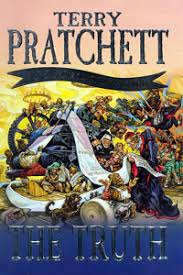
Published in 2000, The Truth was the 25th novel in the series, and came at a point when Sir Terry was clearly questioning whether that it had run its course. I believe it represents an important turning point for the series (just a personal theory): previous novels had shown hints of the series running out of steam. Taking established characters and putting them in novel situations can only take you so far. The Last Continent = Rincewind and the wizards in Australia; Carpe Jugulum = striking similarities to Lords and Ladies; The Fifth Elephant = the Watch in Uberwald. But in The Fifth Elephant Pratchett had also introduced the idea of the clacks, telegraphy, and with it the idea that technology had begun to arrive in the Discworld. The Truth picks up this idea and runs with it, introducing a new group of novels in the series, often grouped under the heading ‘Industrial revolution’, charting the arrival of technology in Discworld. It is more than possible that it was that idea that persuaded Sir Terry to keep writing the Discworld novels until he died. If that tentative theory is right, then let’s be grateful for great ideas.
William de Worde is a scribe (as if that name would allow him to be anything else!) He writes a monthly newsletter for leaders and senior figures outside Ankh-Morpork, which is produced for him in paper copy by an engraver, Mr Cripslock. William meets a group of dwarves who are starting a printing business. Printing technology, and in particular movable type, has been known for a while in Discworld, but has never been adopted in Ankh-Morpork. This is partly because there hasn’t been much need for it, but also because of the grip of the Guild of Engravers. (This situation, where a technology is known about but not widely adopted despite its obvious technical advantages, is not unheard of here in the round world. Examples that come to mind are the use of the wheel in Central and South America.
Almost by accident, William and the dwarves establish The Ankh-Morpork Times, and begin to publish daily editions, using Foul Ole Ron and friends as distributors. Their new venture is given impetus by a sensational story featuring the Patrician, Lord Vetenari, who is arrested for the attempted murder of his clerk, Drumknott. William’s nascent journalistic instincts tell him something is not quite right about the official account of the attack, and he begins to investigate, helped by his colleague Sacharissa Cripslock, daughter of his former and now out-of-work engraver, and by Otto, a recovering vampire and iconographer (the Discworld equivalent of photography).
The reader is aware that de Worde’s suspicions are justified. A conspiracy is underway by the ‘Committee to Unelect the Patrician’. These anonymous but influential figures have hired two assassins, the formidable Mr. Pin and Mr. Tulip, to frame the Patrician and replace him with a look-alike. Mr Pin and Mr Tulip are two of Pratchett’s finest villains. Mr Tulip is psychotically violent, strong enough to take down a troll. He consumes industrial quantities of drugs, although these are usually ersatz concoctions powdered mothballs mixed with icing sugar or similar. Mr Pin is the brains of the pair, the menacing presence who doesn’t need to be violent to terrify people (that’s Mr Tulip’s job).
The joy of The Truth lies in its insightful descriptions of the birth of journalism onto the blank page that is Ankh-Morpork. The exploration of the responsibilities of the press sounds like a worthy subject matter, but it is done, as is pretty much everything Pratchett wrote, with a joyfulness. William discovers the power of just asking questions and writing down people’s answers, even when that answer is “Don’t write that down! Nor that!”. The truth is more than just what William and the Times says it is, but the ordinary people of Ankh-Morpork equally seem happy to consume any nonsense that is published by the Times’s competitor, the Inquirer, simply on the basis that if it is written down it must be true. William works out in real time some important journalistic principles, such as not being intimidated into giving prior copy approval to anyone, even the police. He also discovers the power of being ‘clever’ with words – “He was appalled at the ease with which the truth so easily turned into something that was almost a lie, just by being positioned correctly” – an idea which could have had a personal significance for Sir Terry, a writer supremely clever with words.
There’s a very welcome freshness to The Truth. Partly this comes from the introduction of new characters – Mr Pin and Mr Tulip in particular are a terrible combination of the Krays and the killers in Pulp Fiction (there are even playful references to the “royale with cheese” discussion from the film, and the use of the term “going medieval on…him”). Seeing the Watch from another perspective – they are important characters in the novel, but secondary to the Times’ team – also serves to give new energy to the novel. And while movable type is not really new technology as such, it is new to Ankh-Morpork, and I found the reference to the power of science to change the world strangely moving:
“Kings and lords come and go and leave nothing but statues in a desert, while a couple of young men tinkering in a workshop change the way the world works.”


Pingback: Book review: Monstrous Regiment (Discworld 31) by Sir Terry Pratchett, 2003 – The Reading Bug
Pingback: Book review: Raising Steam (Discworld 40), by Sir Terry Pratchett, 2013 – The Reading Bug