
Beryl Bainbridge has been on my ‘must read more by this author’ list for a long time, particularly since I enjoyed her ‘An Awfully Big Adventure‘ back in 2018. It’s taken me until now to act on that resolution, and only then because I came across her Master Georgie, which was shortlisted for the 1998 Booker Prize, in a charity shop at a bargain price.
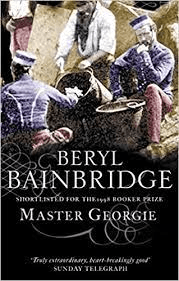
The novel is told in six brief chapters, which Bainbridge describes as ‘plates’, introducing the photography theme which provides a structure for the novel. The opening plate/chapter is told by Myrtle, a Victorian foundling who has been taken in (and is later adopted) by the Hardy family who are from Liverpool. Any echoes of another orphan child found in Liverpool and taken in by a family (Heathcliff?) seem coincidental. Myrtle is obsessively devoted to Master Georgie, the son of the household. Set in 1846 this introductory chapter tells the events of the day of Mr Hardy senior’s ignominious death of a heart attack in a brothel, and how his body is smuggled back into the family home in a cart (previously used to present a Punch and Judy show) to try to avoid any scandal.
Four years later we next hear from Pompey Jones, an Artful Dodger-like character who having helped with the removal of Mr Hardy’s body from the brothel to his bed has become another part of the extended Hardy household. Pompey is working with Master Georgie, now the master of the household. on his experiments with amateur photography. George is now married and a surgeon. There are also hints in Pompey’s narrative that his relationship with George has a sexual component.
Another time skip takes the novel to the outbreak of the Crimean War in 1854 Sevastopol. For reasons that are unclear (to me on a first read, I may have missed something by way of explanation) George having signed on as an army doctor, has been followed into the conflict by Myrtle, his brother in law Dr Potter, and their families. Pompey is also there as an assistant to a war photographer travelling in the trusty and multi-purpose Punch and Judy cart. This chapter is narrated by Dr Potter, and having checked it seems his explanation for travelling into the heart of a war-zone is that he needs to be there as an ‘observer’ which seems unconvincing at best.
The conflict gradually heats up and comes to dominate the narrative, ending in the bloody battle of Inkerman. These are the strongest scenes of the novel in which the horror of the conflict is captured in gory detail. Death, which has dominated all the sections of the book, almost overwhelms it.
One of the things that stood out from An Awfully Big Adventure was the author’s clever manipulation of point of view narration to slowly build the narrative. It’s the jigsaw building method of story-telling, where the final picture only emerges as the pieces are assembled by the different perspectives. Bainbridge uses the same technique here, although to much lesser effect. The narrators leave it to the reader to fill in many gaps in the narrative, but it is fairly easy to piece these together and work out the relationships between the characters with a little care and attention. When the final picture is assembled in An Awfully Big Adventure it is with a sense of revelation, something that is lacking here. Constructing the novel around the six photographs, one taken in each ‘plate’ was probably a clever idea, but it runs the risk of being over-pleased with the conceit without adding much to the narrative. Each chapter is a snapshot of events rather than part of a coherent narrative, and while piecing the connections between each ‘plate’ is a comfortable enough task for the reader, it didn’t feel as rewarding as I think the author may have intended.
Master Georgie is a lesser novel in other ways. Myrtle has the potential to be a central character, but her portrait is horribly one-dimensional. Apart from her slave-like devotion to Master George, to the extent of having his children and then giving them up to his wife to raise as her own, her character has no depth whatsoever. All she does is follow George around like a puppy dog. This is such a waste of a potentially interesting character – it would have been interesting to have seen her gradually come to realise that he didn’t deserve her devotion for instance, or for her to have found something to do other than hang around on the off-chance he might need her. Dr Potter is also problematic (although to a lesser extent). The amateur Victorian geologist is something of a cliché in the first place, but his role in the novel is unclear other than to provide a contrasting voice to the other narrators. Why does he follow George to war? I understand there was an element of war tourism in the Crimea, but Potter isn’t there for that. For the initial stage of the journey he is accompanied by his wife and children, as is George, even though it is clear that a serious conflict is brewing. It just makes no sense why they would all recklessly head off to the Crimea in the way they do. George seeks out the conflict because he believes he can help as a doctor, and possibly as some form of redemption for previous weaknesses or to prove himself (the novel’s title infantilises him, suggesting he needs to do some growing up), but the presence of the others is inexplicable.
Master Georgie has the beginnings of a great novel about the Crimean War, using that conflict to reflect on Victorian society, class and personal relationships. The structure of the novel, based around the six photographs, is cleverly designed. There are glimpses of what might have been, but only glimpses. It had an incomplete or draft feel to it. I have no issue with the reader being asked to do the heavy-lifting and sketch in the missing details of relationships between characters, for example, but here even when that work is done we are left with a picture with too many missing pieces.


I agree with your conclusions – the novel, structured around six photographs, seems too much like a series of snapshots itself with two of the three characters severely underdeveloped and the third something of a caricature and a rather tiresome one at that. As for the focus of their attentions, Master Georgie, he seems to disappear entirely. It has many vivid moments but the central relationships are too coyly and obliquely handled to be compelling, at least to this particular reader!
LikeLiked by 1 person