
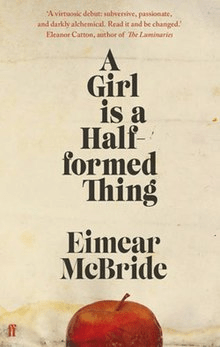
A Girl is a Half-Formed Thing, by Eimear McBride, 2013
I read Eimear McBride’s extraordinary first novel, “A Girl Is a Half-Formed Thing” in summer 2022, but have struggled over several different drafts to do it justice in the form of a review. It is in some respects a traditional family story – of a young Irish woman whose life takes a dark turn when she is raped by her uncle. She is thirteen when this happens, and despite the narrator not describing it as a sexual assault she clearly does not give consent to what happens (appallingly the Guardian’s 2013 review of the novel talks about this as being a sexual ‘encounter’; the New Yorker review uses the term ‘sexual relationship’, seemingly ignoring her age and their family relationship). This response has echoes of the way Lolita is sometimes referred to as a teenage seductress or other, similar terms, when she is simply a child sex abuse survivor. Just because the character doesn’t see herself as a victim it doesn’t mean she isn’t one.
Within this conventional framework, the novel is daringly original. All the characters are unnamed, and the narrative takes place in an Ireland devoid of dates and obvious historical context. But this is a minor issue compared to the narration. The novel is told by the “half-formed” girl of the title, and begins when she is two years old. It is presented in a barely recognisable version of the English language, taking stream of consciousness to a new level. It is intense and fractured, full of invented words and phrases and old words used in new ways. I initially assumed this was the author’s (successful) attempt to mimic the disordered thought patterns of a young child, and that the text would soon (as she grew older) settle down into more familiar patterns and structures. Oh no! If anything the disorder increases as the narrator grows up and experiences the world in more complex ways. It is usually possible, with care, to work out what is happening at any particular point. This example, chosen at random, is fairly easy to follow:
“We were moving off now. From each other. As cannot be. Helped. I didn’t want it from that time on. You know. All that. When you said sit with me on the school bus. I said no. That inside world had caught alight and what I wanted. To be left alone. To look at it. To swing the torch into every corner of what he’d we’d done. Know it and wonder what does it mean. I learned to turn it off, the world that was not my own. Stop up my ears and everything. Who are you? You and me were never this. This boy and girl that do not speak. But somehow I’ve left you behind and you’re just looking on.”
Almost conventional, no? Some complete sentences, and a vague says of who is saying what, to whom. But when the narrator is agitated, drunk or upset, or when her identity is breaking down, the best the reader can hope for is to just derive a general sense of the narrative. Any detailed deconstruction of whose speech is being reported and who is doing what is almost impossible:
“Puk blodd over me frum. In the next but. Let me iar. Soon I’n dead I’m sre. Loose. Ver the aIrWays. Here. mY nose my mOuth I. VOMit. Clear. CleaR. He stopS up gETs. Stands uP. Look. And I breath. ANd I breath my.”
Far too the narrative features episodes of distressing sexual violence, which I won’t quote here but needs a trigger warning for virtually all readers I would have thought. McBride is unflinching in her descriptions of her character’s search for degradation as a form of self-harm. This can make the novel a difficult read especially when combined with the complex narration, and arguably there’s just one too many instance of brutal sex with a random stranger. But experimental literature is by definition transgressive – maybe one day this will seem quite conventional?

