
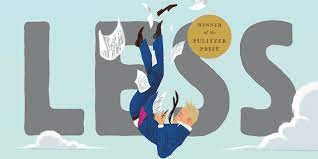
Less by Andrew Sean Greer, 2017
Arthur Less, a middle-aged novelist, just coming out of a long term relationship with a younger man who is now getting married, can’t face the idea of attending the wedding. To avoid having to decline an invitation he accepts an improbable series of invitations to different events around the world, just as an excuse to be out of the country on the fateful day. The improbability of all these invitations just lying around waiting to be accepted is something the reader will have to accept. Although initially intended to just skip the wedding, Less’s adventure builds into an around the world odyssey of speaking engagements, conferences, interviews and residencies. And that’s pretty much it – we follow him on this journey and he gets into the inevitable ‘scrapes’ and misunderstandings, too many sleeping pills, mistaken identity (we are led to believe that Less is a common name in the book-writing game) and incidental romantic encounters.
The first leg of Less’s odyssey is in New York, where he chairs an event for a successful and overrated science fiction writer. Then on to Mexico, where he takes part in a panel discussion about his former lover’s work – as a younger man Less was in a long-term relationship with a much older and far more respected writer. In Italy an earlier novel of his is a candidate for an obscure literary award which he improbably wins. Then on to Germany, where he teaches a writing course entitled Read Like a Vampire, Write Like Frankenstein and has a brief fling with a much younger student. Here Greer subtly introduces the thought that the previously omniscient narrator, who has revealed Less’s intimate thoughts and feelings, might be a character within the novel, or the author breaking the fourth wall. The stages of Less’s journey continue breathlessly – Paris, Morocco, Japan and India, each illustrated with local colour and touches of humour, but there is little time to breathe before we are off again.
Much of Less is essentially meta-fiction (at the risk of being patronising, I have always found it easiest to understand the use of the term ‘meta’ in virtually any context by substituting the word ‘about’. So meta-fiction is fiction about fiction). Or to put it another way this is a novel about being a novelist. Less the character is struggling to have his latest novel published. His publisher finds it simply too depressing.
“It was about a middle-aged gay man walking around San Francisco. And, you know, his … his sorrows … ”
As of course this novel might be were it to show Less struggling with his heartbreak. But he manages to persuade his publisher to accept his novel by inverting every bad or depressing thing that happens to his central character into a positive. And that’s precisely what happens to Less himself – he bumbles his way around the world and things work out well for him at each step of his journey. The gods of travel look after him to ensure he finds his way to his next destination on time however drunk or jet-lagged he may be. And the novel ends with a happy ever after that never really looked on the cards.
I found it hard to engage with Less. He is a bit anodyne, a bit Prufrockian:
“Name a day, name an hour, in which Arthur Less was not afraid. Of ordering a cocktail, taking a taxi, teaching a class, writing a book. Afraid of these and almost everything else in the world. Strange, though; because he is afraid of everything, nothing is harder than anything else. Taking a trip around the world is no more terrifying than buying a stick of gum. The daily dose of courage.”
We know from the outset this is going to be a voyage of self-discovery with a happy ever after ending, but I found the episodic structure too predictable. I wondered at one point whether the chapters had been written as columns for a magazine (as with the original version of Bridget Jones’s Diary for instance, or Armistead Maupin’s Tales of the City, which is an obvious influence on this text) but apparently not. Nevertheless it has that feel – no time to develop a character because we only have a few days to spend with them, so they never get beyond a brief sketch.
But while the novel’s plot and structure disappoints, Less was an enjoyable read – Less’s mishaps are comical, and Greer’s superb command of imagery and skill in constructing a sentence always kept me reading. On almost very page there is a brilliant simile or metaphor – it is virtually impossible to choose one or two that could represent the whole, but what about
“Bougainvillea bloomed on their porch like a discarded prom dress“;
or how’s this for the sensation of drinking exotic beer:
“…and they were having some new kind of beer that tasted like aspirin and smelled like magnolias and cost more than a hamburger.”?
The more I think about it the more I believe that Greer is a gifted writer who has yet to find (in this novel at least) a suitable vehicle for his skills. On this evidence I am sure it will happen.

