
“At the beginning of August a band in scarlet uniforms began to play in the municipal gardens. To Boris, watching them through binoculars from the top of a tree, they appeared like bloodstained weevils that we shortly to bring about the collapse of summer.”
A Girl in the Head is out of print and has been since the 1980’s, which is surprising given that Farrell is a Booker Prize winner (for The Siege of Krishnapur) and that at least one of his other works – The Singapore Grip – was televised. It has only eight reviews on Goodreads and even fewer on Amazon – it is fair to say it has sunk with barely a trace. I think it is due a reappraisal.
Occasionally you will read a novel that keeps setting off little ‘pings’ in your head, memories and reminders of the work of other writers. A Girl in the Head is one such book – I was constantly being reminded of other works from the period. The novel is told by Boris Slattery, an impoverished Polish aristocrat (or so he tells us, but he is a fantasist and there are lots of reasons for doubting his version of events) living in the decaying English seaside town of Maidenhair Bay. Boris is vain, self-deluding, often ridiculous, and morally compromised. He drifts through a collapsing marriage while fantasising about younger women, particularly the Swedish schoolgirl Inez who gives the novel its title. The events of the novel span one summer and follow Boris as he bumbles his way through life. He is a traditional anti-hero – achieving little, thinking highly of himself, and getting into ‘scrapes’ such as being trapped in the tree-top mentioned above. Most of all he is driven by sexual fantasies that never quite come to fruition.
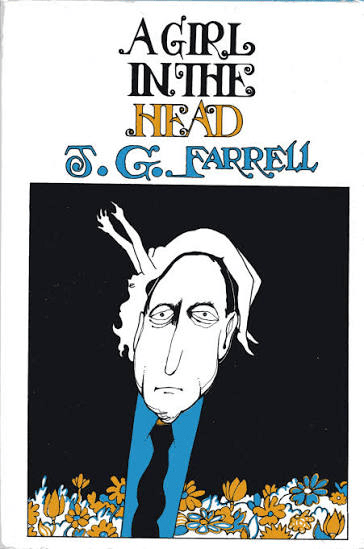
The novel has two alternating narrators – Boris himself, and an omniscient narrator writing in the third person. It soon becomes apparent that in fact this omniscient narrator is simply Boris writing about himself, narrating his actions as if he were observing them. This serves to distance him from his actions and their consequences. His internal monologue reveals him to be delusional and vain – he thinks all women are sexually attracted to him. In one disturbing scene he has reluctant, clumsy and unenjoyable sex with an under-age girl in a boat-house on the sea-front, hurrying to completion before they are disturbed. While this scene is presented as consensual and comedic, it is troubling – Boris is much older than this girl but sees himself almost as the victim of the encounter rather than its perpetrator.
Other scenes reminded me of Anthony Burgess’s anti-hero, the poet Enderby, in the sense that Boris is often confronted with his own incompetence and frustrations. Here, for example, he tries to get rid of a dog that has attached itself to him:
“Since the first (and only) time I had tickled his year he had become utterly devoted to me. Though I detest dogs it was virtually impossible to get rid of him. I made one or two vain attempts, it is true. I made him sit down and ran away from from him. Without success. I even tried making him sit still in the middle of the road whenever I heard a car coming. On one occasion, huddled nervously on the crown of the road and under strict orders not to move, he even vanished beneath the thundering wheels of a passing lorry.
Boris thinks this anecdote is amusing, not that he shares it with anyone but the reader, but a moment’s consideration reveals it to be quite horrific. Other scenes reminded me of the absurdism of Beckett. One member of Boris’s household is a cantankerous grandmother, who enjoys being read the headlines from the local newspaper, the more lurid and graphic the better:
“‘Here’s one for you Granny’ declared Maurice in ringing tones. ‘Shropshire bride disembowelled by gypsy’,
‘Serves him right’ muttered Granny Dongeon, ‘the little fool’.
‘Police having been using dogs and helicopters to help them with their enquiries’.
‘They didn’t have helicopters when you were a girl did they Granny?’
‘People knew how to behave when I was a girl’ Granny Dongeon said crossly. ‘Disembowelling a gypsy. I never heard of such a thing’.
The narrative follows Boris as he wanders around Maidenhair Bay, lusting after young women, Inez in particular. Inez is far more interested in Alessandro, another house-guest for the summer. When Uncle Cecil comes to stay for an extended visit, Boris’s wife absurdly decides that the solution to the shortage of beds is to have the two teenagers share a bed! Peeping through the hole in his floor Boris watches as Inez clumsily tries to seduce Alessandro, who is more interested in riding horses than girls, it seems.
Farrell’s debt to Nabokov and Lolita is obvious. While there are some differences – Boris’s fantasies are largely unacted upon – both Boris and Humbert Humbert are predators and delusional about their behaviour. Arguably Humbert is a monster while Boris is just a fool, but I can’t help wondering whether perhaps the real difference between them is one of opportunity.
For me the strongest echo throughout the novel was with the writing of Kingsley Amis. A standard Amis plot line from this period sees an older male protagonist lust after younger women. In the course of his attempted seduction the protagonist gets into various ‘scrapes’ and somehow manages to bumble and bluster his way out of them. (I appreciate I am using slang here but these terms – bumble, scrapes, etc – sum up the attitudes of the time). In the 1960’s these attitudes were seen as more comical than problematic, but thankfully times have changed and Boris (and his peers) now stand exposed as dirty old men.
A Girl in the Head occupies an awkward place in Farrell’s bibliography. Published three years before Troubles, it has generally been treated as an interesting experiment, overshadowed by the later, more successful novels that established his reputation. I said in opening it deserves a reappraisal. It is uneven and flawed, but I have to confess I would like to know how things turned eventually out for Boris.

