
The Only Story by Julian Barnes, 2018
“Most of us have only one story to tell. I don’t mean that only one thing happens to us in our lives: there are countless events, which we turn into countless stories. But there’s only one that matters, only one finally worth telling.”
The Only Story is that of the doomed romance between 19-year-old Sussex University undergraduate Paul Roberts and Susan McLeod, a 48-year-old married woman with two grown-up daughters. Paul meets Susan at the local tennis club, where they are partnered in a doubles tournament. From that moment on they quickly become close friends, and then much more. Paul narrates their story from the vantage of decades later, a lifetime really, looking back with the wisdom of years which of course is denied a 19-year old. Susan is trapped in a loveless (and sexless) marriage to a bully of a husband with whom she has very little in common. Despite the inevitable scandal this causes at the tennis club and elsewhere, Paul and Susan become lovers. They conduct their affair largely in the open, hoping that its improbability will protect them.
Generation gap love stories follow a predictable pattern. If the woman is the older partner then the romance is bitter-sweet, educational, and doomed. If the man is the older partner then the romance is abusive, predatory and well, yes, also obviously doomed. Paul and Susan’s relationship follows these familiar tram-lines. There is always a maternal aspect to the way Susan speaks to and behaves towards Paul, an attitude that he apparently does not find problematic – he seems to like having someone tell him what to do. The older Paul narrating the story tells the reader early on that this is not going to be a happy-ever-after story, which frankly we would probably have worked out ourselves. What was not predictable was the nature of the unhappy ending. Because their relationship survives much longer than one would expect, in large part because Susan has the financial resources to support them both once she leaves her husband. She is able to buy a house for them in London, (the setting is the 1960’s, when this would not have been quite so absurdly improbable) while Paul embarks on the long process of qualifying as a solicitor. If this level of financial independence is hard to credit then Barnes ignores the issue. Financial difficulties are simply not part of this story.
Their relationship remains happy, even as Susan slips into a new version of the bored domesticity that characterised her life with her husband. As she sees Paul embark on his adult life she turns to drink, and slowly becomes an alcoholic. For years Paul struggles to cope and to find her help, but eventually he cannot manage any more and he moves out. Susan, now hollowed-out by her addiction, is cared for by one of her daughters and when years later Paul visits her in a nursing home she does not recognise him.
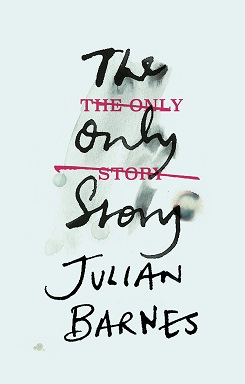
It has to be said this novel has an appallingly dull front cover (right). The deliberate smudging – presumably to represent the narrator’s tears? – is so cliché. But it is somehow fitting for a banal novel that has very little to say. Age has not given Paul any important insights into his relationship with Susan (there is never any hint that it might have been abusive or inappropriate, or even that it could have worked out differently) and he looks back on it with no real regrets and no understanding of the impact of the affair on the other people involved, their families. The simplistic way he thought about the relationship at 19 basically remains the way he sees it in later life. For him it is the only story worth telling in his life and it sours all future possible relationships (which in itself should have been a sign of something wrong). What passes for insights into love and relationships are really little more than a dreary collection of hallmark inscriptions:
Would you rather love the more and suffer the more, or love the less and suffer the less?
“You’re still in it. You’ll always be in it. No, not literally. But in your heart. Nothing ever ends, not if it’s gone that deep. You’ll always be walking wounded.”
“first love always happens in the overwhelming first person. How can it not? Also, in the overwhelming present tense.” #
“I do believe now that when two lovers meet, there is already so much pre-history that only certain outcomes are possible.”
A more interesting telling of the story would have been to give voices to the other participants. Would Gordon, Susan’s abusive and violent husband, have had a different perspective? I suspect he tolerated Paul’s presence in his family home through gritted teeth and was well aware of the threat he posed. Susan’s daughters, or Paul’s parents, would have seen things differently, not the grand romance that all 19-year olds think their first love affair is, but something far more sordid and unattractive. Instead we have to accept Paul’s banal unfiltered version of events. I haven’t read much else by Barnes, only his Booker winning The Sense of an Ending (2011), and the even earlier Arthur and George (2005). Neither novel lodged itself firmly in my memory, but looking back it seems that The Sense of an Ending has some distinct similarities with The Only Story, principally the narrative structure of looking back over decades to an important event in the past. Perhaps, for Barnes, this really is the only story?


I had reservations about this novel too, especially the narrative technique and flatness of delivery. But there are a few redeeming features.
LikeLiked by 1 person
When I find myself struggling to find redeeming features for a problematic novel, I sometimes get to the point of basically giving up – recognising the positives might be there if you look hard enough for them, but thinking that do so would be perverse when the elephant in the room is that the novel is not very good. I don’t think Barnes is a bad writer, just that I haven’t found novels by him that I enjoy yet.
LikeLiked by 1 person