
James by Percival Everett, 2024
It is a simple coincidence that I followed a reimagining of Hamlet (in Tom Stoppard’s Rosencrantz and Guildenstern are Dead) with Percival Everett’s 2024 novel, James, which reimagines Mark Twain’s Adventures of Huckleberry Finn from the perspective of the enslaved Jim.
Before reading James I reread my review of Huck Finn to remind myself of my reactions to that novel. One of the observations I made in that review (back in 2016) was that “All the black people in the novel are portrayed as caricatures – they speak an exaggerated form of English, rendered phonetically thus: “But it’s awluz jis’ so; people dat’s sot, stays sot; dey won’t look into noth’n’en fine it out f’r deyselves, en when you fine it out en tell um ’bout it, dey doan’ b’lieve you.” They are all also hugely superstitious, frightened of ghosts and witches, and are extremely easy to tease or fool, with a child-like innocence or naivety. Huck and Tom have no hesitation in exploiting this gullibility for their own amusement.”
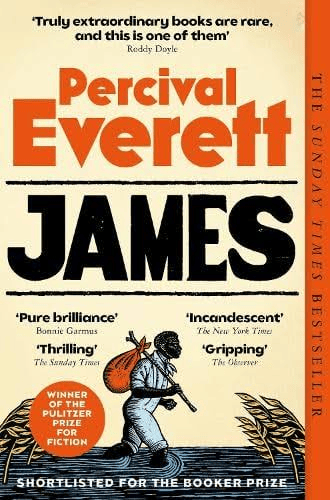
This is explained in James which shifts radically from Twain’s original text to reveal that Jim is intelligent and literate. He and the other enslaved characters use the “dumbed-down” slave dialect quoted above as a survival mechanism to keep white people feeling comfortable and superior about their status. Stupid, childlike slaves do not represent a threat to the slave owners. The same applies to the superstition about witches and ghosts – the enslaved encourage white people to believe they are slow-witted and superstitious in order to make them feel superior and therefore less likely to resort to violence. So Jim has two voices – the intelligent measured voice he uses when with other enslaved people he trusts and his slavery dialect, deliberately full of grammatical mistakes and clumsy constructions. This dichotomy is also reflected in his two names – Jim the enslaved man, and James, his true personality.
The novel begins in Hannibal, Missouri, in 1861, the year the American Civil War broke out. When Jim’s wife, Sadie, overhears that their enslaver plans to sell Jim to a new owner in New Orleans, Jim flees to hide out on the nearby Jackson’s Island. There, he meets Huckleberry Finn, who has faked his own death to escape his abusive father. The pair team up and begin a treacherous raft journey down the Mississippi. As they navigate the river, Jim deals with the challenges of the river journey, including a near-fatal rattlesnake bite. While feverish, he hallucinates intellectual, fierce debates with Enlightenment philosophers like Voltaire, Jean-Jacques Rousseau, and John Locke. Eventually Jim is separated from Huck and sold into a blackface minstrel troupe. Here, Everett opens a discussion of the social construction of race through a discussion of the concept of “passing” and racial performance. Within the troupe, Jim meets Norman, a light-skinned Black man who is successfully passing as white in his daily life to secure his safety and freedom. However, to perform in the minstrel show, the white-passing Norman must apply burnt cork to his face to “play Black” for white audiences. Jim is forced to do the same. Everett dissects how white supremacy relies on an artificial concept of race. While passing allows Norman access to physical safety, it forces an ongoing alienation from his true identity. At the same time James never fully trusts Norman, recognising that his ability to ‘pass’ as white gives him an advantage Jim will never have.
In Twain’s original Huckleberry Finn, Jim’s story ends with his ‘owner’, Miss Watson, freeing him in her will because she feels guilty about her previous plans to sell him. Tom Sawyer knows Jim is already legally free but callously conceals the truth so he can orchestrate a convoluted, theatrical escape plot. Huck thinks he is breaking the law to help a runaway slave, only to discover his elaborate efforts were unnecessary because Jim was already a free man. In James, the novel’s ending is very different. James knows that a black man is never fully free in the Southern slaving owning states, where a piece of paper is worthwhile against slavers’ guns, dogs and whips. So he takes the question of his liberty, and that of his family, into his own hands.
Novels about the enslavement of black people in America have to walk a fine line in terms of being honest about the abuse of the enslaved without descending into gratuitous descriptions of the visceral horror that was daily life. The brutality of life for the enslaved is not something writers can sugar-coat (unlike Twain of course) but simply portraying horror, abuse and degradation for the sake of it would make difficult reading. Octavia Butler’s Kindred manages this difficult balancing act by viewing slavery through a twentieth century time traveller’s lens. James ennobles the enslaved with an intelligence to outwit their masters and a bravery to face the daily horrors of their lives. Everett does not turn away from the darkness of slavery, but neither does he allow it to overwhelm the narrative. Although James uses Huck Finn as its starting point, it shows us a very different version of the American South on the brink of civil war. I’ve read that Huck Finn is taught to all American schoolchildren – it would be great if they could all be encouraged to read James as well as a corrective to the warped views of the American nineteenth century.


I feel you’re a little harsh on Huck Finn the novel, having taught it several times here in English schools. It’s very much of its time and does a radical job for its time, particularly if you compare it with something like Uncle Tom’s Cabin. The moment where Huck realises his cruelty in having played a trick on Jim, where he finally realises that Jim is actually a human being with feelings like himself, is a true epiphany, I’ve always thought. And I also very much enjoyed James as a counterbalance. Question: which of the two novels will people be reading in a century’s time?
LikeLiked by 1 person
I am sure you are right in terms of the harshness of my Huck Finn review. In mitigation I would say it was 10 years ago and I am sure I would be kinder if revisiting it now. In terms as to which book will be read in 100 years, I am not sure James really works without HF, so in an ideal world both would ‘survive’, but if it is only one it would have to be the original.
LikeLike