Category Archives: 20th century Literature
Of Mice and Men by John Steinbeck
Firstly, we are encouraged throughout the story to think of Lennie as an animal – all of the imagery used to describe him focuses on this aspect of his appearance and behaviour. When we first see him he is described as “dragging his feet a little, the way a bear drags his paws” (page 19); later he is said to be “as strong as a bull” (43); and later still he “came as silently as a creeping bear” (140). Bears and bulls are of course dangerous, and frequently killed by man.
The story is set in a world in which it is legitimate for man to destroy animals – for example to avoid unnecessary suffering. We are given two examples if this in the text – the killing of Candy’s dog, and the killing of four of Slim’s puppies. The putting down of Candy’s dog is particularly poignant and telling – Candy is told it is the right thing to do, and the reasons are compelling, but at the same time we can clearly see that it is not a straightforward decision. He is told to shoot the dog in the back of the head, which prefigures Lennie’s death. And of course it is Candy’s gun which is used to kill Lennie, underlining the connection between the two deaths, if such emphasis were needed. So Lennie is little more than an animal, and it is acceptable to put animals down when their owners feel it is appropriate to do so, therefore….
But Lennie isn’t an animal, and killing him is not legitimate.
Lennie is brain-damaged and disabled, and whatever his crimes did not deserved to be put down like a dumb beast. Across the Atlantic, the Nazis were treating disabled people in pretty much the same way as George does Lennie, weighing their value in the balance and killing those found too much of a burden.
So why, when George kills Lennie, do so many readers see it as nothing less than an act of love, more than a mercy killing, a gift, sending Lennie to the promised land he has no prospect of inheriting on earth? Steinbeck spends the whole book leading us to this point, painting the choices George makes as unavoidable. We are told of their near escape from their previous town, when Lennie scares a young woman, sparking a manhunt. We are told of Lennie’s troubled childhood and George’s charity in taking him on. We see Lennie’s propensity for killing animals accidentally. And George loves Lennie, cares for him as best he can, and doesn’t want him to suffer the painful death Curley threatens.
Towards the End of the Morning by Michael Frayn
Read in a Faber and Faber 2005 edition. This is one of Frayn’s early (1967) novels about life in the newspaper industry pre-Wapping. It is an affectionate portrait, which some well observed scenes, but overall it is the slight kind of novel that can slide over your eyes without ever entering your brain. You really get no sense of the highly skilled writer Frayn was to become. The story, such as it is, follows two men in one of the backwaters of an unnamed Fleet Street newspaper, pointlessly churning out unread copy to fill gaps in the paper. Churning is a poor choice of verb actually, because we rarely see them doing any work before going to the pub, and their colleague sleeps extensively, then dies, at his desk, without anyone noticing for some time. His replacement is a charmless character who is never really fleshed out at all. The men are unlovable buffoons, tolerated with a deep sigh by their womenfolk. They have various mildly amusing situations before the novel peters out inconclusively. The comic scenes, such as the freebie holiday one of the newspapermen goes on, are over-extended, and I found them tiresome and unfunny. This has all been done so much better by for example, Kingsley Amis.
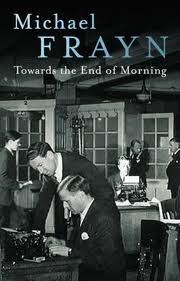
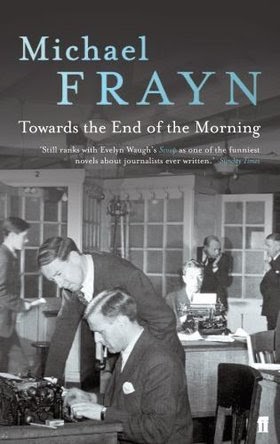
Frayn writes in his introduction that “No-one, for some reason, can remember the title I gave it” (the novel). This short essay, written presumably for the re-issue of the novel in 2000 on the back of some of his more successful, contemporary work, is arguably a more interesting portrait of the lost world of Fleet Street than the novel itself. But the reason the title is forgotten is the forgetability of the novel itself. If evidence of this were needed, look at these two book covers:
Spot the difference? The title of the novel!!
Frayn is one of our most interesting writers and probably doesn’t get the recognition he deserves. His craft is infinitely stronger these days, and while I thought Spies was flawed, it is still a great book. Hopefully I will get round to writing about it soon.
A Handful of Dust by Evelyn Waugh, 1934
First published in 1934, and read in a gorgeous Penguin Modern Classic Edition.
Waugh is the great chronicler of mid-war upper class British life, and this is one of his bleakest, blackest novels. This savage, bitter comedy charts the end of a aristocratic marriage. The world the characters inhabit is not the comic, chaotic swirl of events seen in for example Vile Bodies, in which characters are not far from caricatures. Although all Waugh’s novel contain an element of bile, the taste here is particularly bitter – one would imagine the writer had experienced a relationship breakdown or divorce. There is a moment about half way through the novel when tragedy strikes. Even though I had read it before it still struck me with a visceral force, such is the quality of the writing and characterisation.
The title of the novel, in case you weren’t able to place it, is from the Waste Land:
When I was taught Eliot at A level I was told I would find, or simply found, the Waste Land impenetrable, but looking back and re-reading it now I find lines like those above chillingly straightforward, even if they are open to many different readings. Here, a handful of dust can either be anything mundane – i.e. fear can be found in the everyday or ordinary, or the phrase can suggest the burial ritual, dust to dust.
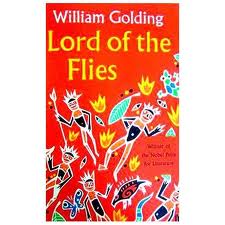
Lord of the Flies by William Golding, 1954
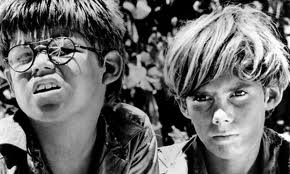
Unless you have not been paying attention for the last 60 years, the plot of Lord of the Flies will be familiar – a group of schoolboys crash land on a tropical island during an unsuccessful evacuation from a nuclear conflict. Without adults or the trappings of civilisation, order quickly breaks down, the little savages emerge, and things go badly for the vulnerable characters, until at the last minute order is restored by the arrival of the British navy.
, referenced several times both explicitly and implicitly in the novel, suggests that this is a corrective account of how boys would cope if stranded. But that I think misses the point. The adult world beyond the confines of the island is not a mature civilisation but an equally barbaric place where people are killed on an industrial scale. Instead of war-paint the adults wear uniforms, instead of sharpened sticks carry machine guns. The island is a microcosm of the wider world, not some sort of bizarre social experiment where, stripped of constraint, boys run wild. The Heart of Darkness, explicitly referenced in the novel’s closing lines (“Ralph wept for the end of innocence, the darkness of man’s heart”) is within man, not just boys.
Sons and Lovers – D.H.Lawrence
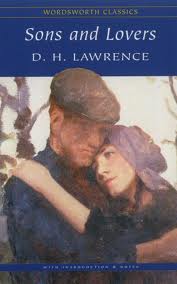
Lawrence famously was the first novelist to write openly and honestly about sexual relationships between men and women. This is a relatively early work however, and there is still much hesitation in his approach. While people have sexual urges, and subsequently sex, it is described largely through suggestion or inference, the literary equivalent of trains going into tunnels. People are deeply moved, feel their hot blood rising, and objects often stand in as representations of their erotic feelings. For example there is an extraordinary scene where Miriam, one of the lovers of the title, turns her attention to some daffodils thus: “To her (Miriam) flowers appealed with such strength she felt she must make them a part of herself. When she bent and breathed a flower it was as if she and the flower were loving one another. Paul hated her for it.” (Page 155). Not too much room for ambiguity to my jaded 21st century eyes there. “Miriam went on her knees before one cluster, took a wild looking daffodil between her hands, turned up its face of gold to her, and bowed down, caressing it with her mouth and cheeks and brow. He stood aside with his hands in his pockets, watching her…..fondling them lavishly all the while” (page 198). Which I am sure was nice. Her approach to flowers, which decorate the book like a church in August, is summarised earlier:
People constantly behave in an extremely sexual way while continuing to avoid sex itself eg:
“She (Miriam again) took her finger from her mouth with a little pop, and looked up at him almost challenging. But still her soul was naked in her great dark eyes, and there was the same yearning appeal upon her.” (page 169).
Or later
“He (Paul) picked up a stick and began to stab the earth with it….He thrust, thrust, thrust at the ground with the pointed stick, digging up little clods of earth as if he were in a fever of irritation.” (page 200). One last example, when Paul is reading the bible to Miriam:
“She sat back on the sofa away from him, and yet feeling herself the very instrument his hand grasped. It gave her great pleasure.”
When the sex does finally arrive, which I can understand to a pre-Great War audience must surely have been shocking, not to mention titillating, it is usually presenting as the exercise of male lust against passive female acceptance. He conjures an extraordinary phrase to describe “married love” on this basis: “Being the sons of mothers whose husbands had blundered rather brutally through their feminine sanctities”.
If I were to do a word count I am guessing one of the words that would crop up most frequently in this novel is “hate”. An example is cited above, where Paul, the principal son of the title, hates his girlfriend for liking flowers just a bit too much. But people hate others and things at the drop of a hat, and for apparently little or no reason. We can thus conclude that these are people who are moved to deep emotions signified by their quivering breasts and moody silences. Stella Gibbons parodies this all wonderfully in Cold Comfort farm of course, especially through the character of Cousin Judith, and Seth and his mollocking. And delightfully there is also a Miriam in CCF who bears the fruit of too much blundering through her feminine sanctities.
The handling of the Oedipal relationship between Paul and his mother, Gertrude to remind us of Hamlet’s problems with women no doubt, reminded me of Seth’s comments to Flora that he won’t let women eat him:
“She wants to absorb him. She wants to draw him out and absorb him till there is nothing left of him, even for himself. He will never be a man on his own feet – she will suck him up”. (As Larkin almost said, they suck you up, your mum and dad). (Page 173)
Westwood – Stella Gibbons
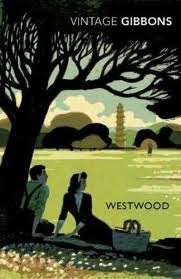
“If Cold Comfort Farm is Stella Gibbon’s Pride and Prejudice, then Westwood is her Persuasion,” says Lynne Truss, in her introduction. The observation is acute. It is intended as a positive comment, but I am not sure it does Gibbons or Westwood any favours – Persuasion is a book it is hard to love, the characters being largely unengaging and unsympathetic, all the more so when contrasted with the earlier work which inspires such devotion. Once the first bright flare of Cold Comfort farm had faded away, what was Gibbons to do – keep silent like Harper Lee, or earn a modest living churning out uninspired and uninspiring stories that have dated horribly and never hint at the heights of achievement CCF achieved. There is some amusement in spotting traces of the DNA of Mr Mybug in the characterisation of Gerard Challis, the pompous and horny playwright gleefully exposed to his family as a “cad”, but the principal character, Margaret Steggles, is just the kind of self absorbed young woman whom Flora would have kindly said “yes dear” to and then got away from as quickly as possible. Her dilemma – of being a young, clever, but plain young women in a world where men are in short supply, and likely to continue thus, is one women of the time would be identified with, but today makes us just sigh with relief. Some reviewers have claimed that the description of a post blitz London provides some interest – Westwood was published in 1946, and the story takes place in London just after the Blitz; – but this is not enough to support the interest of a 21st century reader. I quite understand the idea of mining the Gibbons back-catalogue – Vintage must have done quite well out of it, and have done the job respectfully, assembling some nicely designed editions with thoughtful introductions. But I can’t resist the thought that once the flurry of interest has died away these books will fade back out of print until the next rediscovery.
Christmas at Cold Comfort Farm, by Stella Gibbons, 1940
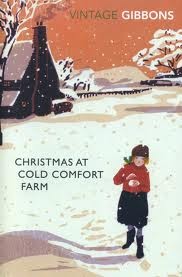
OK, last entry on Cold Comfort for now,although to be fair it has been an obsession for more years than I care to remember, and this writing has a certain cathartic/therapeutic role. “Christmas” it needs to be said straight away is a short story – not even that really, more a portrait. It runs to less than 20 pages in the Vintage edition recently published, and bless them for doing so. I can forgive the fact they do little to publicise the fact that this is not a novel, but a collection of stories, only one of which is about Cold Comfort.
The original novel was published in 1932; this short story dates from 1940, and Conference, which I wrote about earlier in the month dates to 1959, astonishingly late given the subjects being satirised. But I have written enough about Conference, save to say that the glimpse we have of Elfine, out riding with her sons, is worth the book on its own. Back to Christmas. Gibbons rediscovers her light comic touch here, and the vision of a Cold Comfort unredeemed by Flora’s reformation, anarchic and dark, is to be treasured. Adam Lambsbreath delivers presents to the clan, disturbing Seth with a “friend” and being shot at by Amos with the goat-gun in the process, and then Christmas dinner degenerates into predictable anarchy. Elfine escapes with Dick on horseback, and the farm settles back into its long wait for Flora, Aunt Ada flapping weakly at anyone in range of the Milk Producers Weekly Bulletin and Cowkeepers Guide. One word – brilliant.Cold Comfort Farm – a classic
![]() |
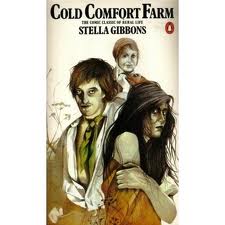
| (this cover illustration is wrong is so many different ways, but is from the first edition I owned) |