20th century Literature, Book review

Starlight – Stella Gibbons

This is a curious novel. It follows two impoverished sisters, Gladys and Annie, living in a run down part of North London. Their landlord sells their home to a “rackman” – a phrase many people will be unfamiliar with, but used here to describe an unscrupulous landlord likely to drive up rents, harass tenants, and ignore the fabric of their properties. If you are interested in the original Rachman this makes an interesting read – http://en.wikipedia.org/wiki/Peter_Rachman.

While the new landlord does indeed appear to be closely modelled on the original, instead of turning the sisters out into the street he installs his ailing but apparently much loved wife in the neighbouring house. She has an au pair, a German refugee, Erika, and a daughter, Peggy. Peggy’s parallel unhappy love story has all the hall marks of a short story worked into the longer narrative (nothing wrong with that by the way – Raymond Chandler did much the same thing to stunning effect in some of his novels). The sisters, drawn with some affection but no illusions as to their frailities (Glad is a gossipy fool, Annie a nervous hypochondriac), turn to the local clergy for assistance. The vicar and his curate are another pair in this story of couples, again drawn with affection but unblinkingly, their flaws and weaknesses shown without hesitation. The eccentric lodger living in the attic appears in the narrative occasionally adding a further element of mystery to the story.

As a novel Starlight has its limitations. We slowly come to like the central characters, more or less, are happy for them when their lives improve, and take pleasure in their small victories and enjoyments. The wider cast is equally well drawn, but are closer to caricature. The novel has some awkward moments which to me indicated some clumsiness in drafting – people behaving in ways that do not feel natural or convincing, such as the landlord Pearson being knocked down by the 60 year old vicar, or the (spoiler) motiveless murder of the old man from the attic.

It is probably as a period piece that this novel holds the most interest, a portrait of a time when one generation of English people were still looking back to the war, and the later generation warming up to the 1960s. We aren’t told when the action of the novel occurs, and Gibbons uses this imprecision to show the different perspectives of her characters. One of the older characters refers in a slip of the tongue to drawing the curtains as “doing the blackout”; the older characters shop as if they were still subsisting on rations (in a way they are), and live in world where houses are still uninhabitable from damage from the Blitz. The younger ones go to a dance featuring the long-haired “Spacemen”, locating the novel’s events right up to the time of publication (1967), more than 20 years after the end of the war. Erika brings this gap being a refugee from a continent seemingly only just recovering from the war. The narrator, and the author, firmly sides with the older generation, having little sympathy for longer than collar length hair, drawing links between this debauchery and mindless street fighting and murder.
What makes the novel genuinely weird is the plot line about possession. Yes, demonic, head turning, green eyed possession, eventually cast out by crucifix wielding, holy water splashing clergymen. I’ve exaggerated for comic effect slightly here, but only a little. It is a decidedly odd element to introduce, and despite its centrality to the climax of the novel actually adds little to the overall impact of the story.
I bow to no-one in my admiration of the genius of Stella Gibbons, which peeps through here in many elements of this novel, but overall I can’t deny that this is really for the completists amongst us. Many thanks nonetheless to Vintage for republishing these long lost novels.

Standard
20th century Literature, Book review, Patrick Suskind, Perfume

Perfume: The Story of a Murderer by Patrick Suskind

This blog was originally going to be about that small sub-set of books that I found offensive, but re-reading parts of this particular novel reminded me just how objectionable I found it, and how puzzled I was that I seemed to be the only person who has a problem with it.

Google any combination of the words “Perfume” “Suskind” and “misogyny” or “feminism” and you won’t find anything. And yet I am genuinely puzzled that feminists did not feel outraged by this novel. So what is my problem?

Let’s start with the Wikipedia entry for it, which says  
Perfume: The Story of a Murderer is a 1985 literary historical cross-genre novel (originally published in German as Das Parfum) by German writer Patrick Süskind. The novel explores the sense of smell and its relationship with the emotional meaning that scents may carry. Above all it is a story of identity, communication and the morality of the human spirit.”

So a story of a murderer – the clue is in the title – isn’t about a lunatic murdering virgins and abusing their bodies to distill scent from them, but is about nice, fluffy things like identity, communication, and the human spirit. Is it really?

Imagine an advertisement for a film. It promises to feature the casual murder of 20 virgins – and the emphasis of their sexual status is Suskind’s, not mine – followed by an orgy and scenes of cannibalism. The bodies of the murder victims are abused by the murderer in some fetishistic way to distill “perfume”. What kind of film would you expect – an exploitative torture porn video nasty, or something literary and sophisticated.

I appreciate the case for the defence will be that I shouldn’t take this too literally – despite Suskind’s determined focus on making each scene as real as possible by his focus on the senses throughout the novel – and that this is magical realism, where the brutal slaughter of young women is a metaphor for…. – what exactly? This case is laid out, for example, in the dozens of laudatory reviews on Amazon, for example this one:

“I came to this book expecting to find a crime novel, or a thriller, about a serial killer. Instead I found a beautifully written and deeply researched novel about a young Frenchman with an unusual sense of smell and a unique gift for the art of the perfumier. In fact, the murders of young girls, so emphasised in the film, take second place to the marvellous descriptions of how perfume is made, and the way in which Grenouille gradually infiltrates the profession, becoming a master perfumier due to his prodigious gifts

The murders of girls takes second place to the descriptions of how perfume is made? Really? I don’t give a stuff about the technical detail as to how perfume is made, but I am pretty sure it doesn’t involve murdering virgins. grenouille may have been a skilled perfumier, and I am sure Hitler could whip up a nice cheese omelette, but talk about missing the point.

To be as clear as possible, it is not the literary treatment of murder that I find objectionable – that would preclude me from appreciating large sections of world literature, including Shakespeare (Titus Andronicus, anyone?). Murder can be used to shock, to amuse, or to make any other number of points. It can even be handled in a way that is hard to stomach (for example, American Psycho). But the idea that women’s bodies contain within them an essence that can be found as long as you kill enough of them, and that this is some way legitimises their killing, I found nauseating.

I am aware I have not made the case for the prosecution compellingly here – it is hard to define the offensive, even when it is staring you in the face. Equally I accept no-one else seems to have a problem with this novel and its treatment of women. But I found it nasty, brutal, and disturbing. If that was Suskind’s intention, fine, but why is everyone else pretending this is a high minded dissertation on identity and the like?

Standard
20th century Literature, Book review, Pale Fire, Vladimir Nabokov

Pale Fire by Vladimir Nabokov, 1962

“Pale Fire” is a complex, multi-layered post modernist novel – but for goodness sake don’t let that put you off! At the heart of this novel is an extraordinary romp – and that’s not a word you expect to see used to describe a modern novel.

The structure of the novel is worth spending a minute or two outlining. It opens with a 999 line poem, which is followed by what appears to be at first a detailed critical analysis of the poem. The critic uses appropriate technical language and phrases and the reader is not alerted to there being anything out of the ordinary in this set up. This appearance slowly begins to unravel. The first hint that all is not as it seems occurs when the critic is disturbed by some noise outside, and this intrusion appears in his notes. The situation quickly spirals from here, as we come to understand that the writer – Charles Kinbote, academic and friend of the now deceased poet John Shade, is in fact delusional. He is the ultimate unreliable narrator, and nothing he tells us can be taken at face value. Sometimes slips in his facade reveal a different perspective, but any “revealed truth” has to be treated with equal care. This is not a world in which the true state of affairs is within our grasp; we are just shown different levels of illusion.

Kinbote’s footnotes to the poem steadily lead the reader to understand that he took a teaching job in the United States and cultivated an acquaintance with Shade, imposing his company despite the resistance of Shade’s wife. Over time, he tells Shade the fantastic story of King Charles the Beloved of Zembla and his escape into exile. We are invited (by Kinbote) to infer that he is telling his own story, and that he wants Shade to turn this narrative into his poem; a suggestion Shade stubbornly resists.

The real delight of the novel is this Zemblan fantasy. It is outrageously kitsch, almost unquotable in that every sentence is at once ridiculous, over-written, camp, and hilarious. The king’s escape from imprisonment, his disguises and near misses, is all related breathlessly, kept superbly in tone. A parallel narrative relating the journey of Shade’s accidental assassin across Europe to the US is of a piece of this comic operetta style, closer to some of the tone of cheap gangster or spy stories.

In constructing this inner narrative we are invited to see the world outside it as real – similar to the way McEwan uses the alternative ending of “Atonement” to bring into focus the “real” ending. In this “real” world Kinbote is a disturbed academic, Gradus the assassin an escaped lunatic or criminal trying to kill the judge from whom Kinbote rents his house, and Shade is who we are told he is, the one constant through all the layered narratives. But there are many warning signs that tell us that however flawed and ridiculous Kinbote’s stories may be, the world from which he relates them is equally artificial. There is no safe ground to which the reader can anchor themselves, no fixed point of reliable perspective. The “real” world is equally flawed and ridiculous, albeit in a different, less comic, way.

On one level, the simplest reading of this novel is a satire on academia, and in particular the hangers on that surround famous writers, noting down their every comment for future inclusion in memoirs, chronicling the mundane details of the famous one’s life, and attempting to gain their place in the margins of the picture frame of posterity. No doubt this was in part Nabokov’s point, reflecting on some of the response to the publication of “Lolita”, but on its own this is a fairly mundane reading. But this is a fairly limited reading.

An alternative approach is to see the novel as a mystery story, in which we are invited to unpick the accidental revelation of the real events of the novel from Kinbote’s confused perspective. This is a seductive reading, as the reader is always led carefully into “guessing” what really happened a few pages before Kinbote confirms it. A good example of this is his identity – we work out that he believes he is Charles the Beloved well before the mask slips and he refers to Charles as “I” rather than “He”. But this guessing game is, once the reader realises that Kinbote is telling his own story, far too easy. Guessing games are sometimes fun, but they aren’t great literature.

Which leaves the complex, multi-layered narrative which is open to multiple, all equally valid readings. Which in turn makes this a classic modernist novel.

There are no rules about how or when to enjoy a novel, and the escapist fantasy of the King of Zembla, which wouldn’t feel out of place in a Gilbert and Sullivan operetta, is still for me the funniest, most enjoyable part of this novel.

Standard
20th century Literature, American literature, Book review, F Scott Fitzgerald, The Great Gatsby

The Great Gatsby by F Scott Fitzgerald – 1925

What is this? – not “this” the Great Gatsby, but this, the words I am writing? It is not a review – despite the heading of this blog you can’t really review a book published 90 years ago, not one which has attracted the wealth and weight of critical comment that much loved novels such as this have? At the same time a plot summary would be redundant, and random impressions need some kind of structure to make them worth reading. I think the best I am going to get to is “some interesting things I noticed about the novel that may not have been written about elsewhere, but probably have”.


I mention above that this novel is much loved – adored would be closer. On a first reading it is hard to see why – the central character is a deeply flawed former criminal, and is involved in the death of a young woman. But he sacrifices himself for the woman he loves without flinching, knowing that his life without her love is worthless. It is in that sacrifice that he finds redemption from his previous life of crime.

The Jazz Age setting is obviously seductive, conspicuous consumption meeting post Great-War hedonism and the early days of prohibition in a perfect storm of parties, frivolousness, and excess. The narrator, Nick Carraway is a tabla rasa who observes the events of the novel without meaningful judgment or any significant involvement – he seems as hollow as many of those he observes. He suggests that he has scorn for the nouveau riche and borderline criminal people orbiting around Gatsby, but is happy to join them, and condones Tom’s unfaithfulness to Daisy by his silence.

The novel is rich, almost burdened, with symbolism. The glasses that loom over the petrol station, a key scene for the very visual settings Fitzgerald uses, are explicitly compared to Nick’s neutral gaze. I am aware as well that the name Carraway suggests the very small (if pungent) seed of the same name – he is as unsubstantial and of little significance. As a narrator he is reasonably reliable, and does not hide or obscure events, but equally his personal role is not really important – he is only there to observe.

Probably the most mundane, but unavoidable, reading of this novel is that it represents a judgment on the Jazz Age and all its excess. Mundane because once you have drawn the conclusion that rich people aren’t that nice one doesn’t really have anywhere to go with it. Gatsby is usually exempted from this judgment, despite his background and criminal career making him in many ways its exemplar. His time in the war has taught him the cheapness of human life, although perhaps he did not value his own anyway, having lost Daisy to Tom, which is why his sacrifice, when it comes, seems so easily done.

I wanted to mention one irritation, which seems churlish given the overall strength of the novel, but stood out for me anyway. Prior to the motor accident that precipitates Gatsby’s demise there is a lot of “business” about who takes what car. This is a plot device to ensure Gatsby is mistakenly blamed for the accident. It appeared clumsily done to me – it was obvious there was some reason for the “take my car” ” no take mine” nonsense that didn’t really make much sense at the time. I may be being unfair to Fitzgerald, who I am sure wouldn’t mind that much anyway! Doubly unfair because the plotting may have been tight and I might have just missed the point, or simply because in the overall context of the novel a writer should be allowed to get away with little bits of business to engineer the end he is looking for.

I think this novel, given its place in the pantheon of world literature, probably deserves another reading, which given its relative brevity isn’t asking that much. For now its success is for me, elusive.


Standard
20th century Literature

Stiff Upper Lip Jeeves – P G Wodehouse

The novels of P G Wodehouse are so easy to dislike one really has to struggle to overcome the stench of monied stupidity rising off them. Rich people running around getting into “scrapes” (how easily the slang infects one’s language) in highly contrived “comic” situations, which are all resolved by the intervention of the gentleman’s gentleman. Incidentally there is no subversion here – in portraying the working class servant as brighter than the upper classes he serves, Wodehouse is flattering to deceive – Jeeves is still a poodle even if he can do tricks.

There is a temptation to treat these novels – and having read one you have pretty much read them all – as self parodies, clever because they are so dumb, cool because they are clichéd. But they are production line stuff, knocked-off-in-a-weekend pieces of nonsense. Wodehouse makes little or no attempt to vary the diet (see summary plot below taken from Wikipedia to save you the trouble of reading the book, or any other of Wodehouse’s for that matter.)

I know the story of Wodehouse’s internment in the second World War has been gone over in detail elsewhere, and I don’t intend to go over old ground here. One of my favourite authors from this period, George Orwell, was a strong Wodehouse supporter, and that would normally be good enough for me. But I am sorry, there is no doubt in my mind that it is just not good enough to say Wodehouse was uninterested in politics, or simply naïve and foolish – he had a responsibility as an author to not be such a fool, and there is plenty of evidence in his novels to suggest a man of considerable intelligence and political awareness, if not interest. It can hardly have been surprising to anyone that the author who described the English upper classes at decadent play was able to take the rise of the Nazis so casually. Wodehouse may not have been a Nazi himself, but in his portrait of Spode, the Moselyesque English fascist, he clearly makes the mistake of not taking them seriously enough – not everything can be laughed away.
Bertie Wooster returns to Totleigh Towers, the site of an earlier ordeal that nearly landed him in prison and, worse still, in bonds of marriage to Madeline Bassett, the syrupy daughter of the house who believes the stars are God’s daisy chain. Only Gussie Fink-Nottle, Bertie’s childhood friend and Madeline’s on-again off-again fiancé, stands between our hero and the dreaded state of matrimony. No surprise, then, that matrimonial disaster looms for our hero when Madeline, inspired by the life of Percy Bysshe Shelley, orders Gussie to abandon his beloved steak and kidney pie and take up a vegetarian diet. Add the intrigues of Miss Stiffy Byng to win her fiancé the Reverend Stinker Pinker a vicarage, the rivalry of collectors Sir Watkyn Bassett and Bertie’s Uncle Tom over an objet d’art, and the irresistible culinary attractions of American Emerald Stoker, and you have trouble of the sort only Jeeves can mend.”

Standard
20th century Literature, Anthony Burgess, Book review

The Complete Enderby by Anthony Burgess

Read in the Kindle edition
Julius Xavier Enderby, poet, is one of my all-time favourite literary characters.

Book 1 – Inside Mr Enderby, published under the pseudonym Joseph Kell in 1963. We first meet Enderby through the eyes of a group of time travelling school children, on an educational trip to visit some of the poets of yesteryear. There are echoes of Joyce Grenfell in the teachers admonitions to the students not to misbehave, which of course they do. Enderby lives alone, in squalor. His bathroom is his sanctum, where he composes his poetry, filing much of it in the bath which he shares with a family, indeed generations, of mice. He lives a narrow, routine existence, troubled by the outside world as little as possible. But people just won’t leave him alone.

Nasty neighbours and a nosy landlady are a nuisance, but his problems really start when he wins a literary prize, which he accepts in person at an event in London – or rather doesn’t accept, his speech getting away from him somewhat. After that he loses control of his life. Vesta Bainbridge, women’s editor of “Fem”, takes him in hand, and begins the arduous task of transforming him into husband material. She succeeds to the extent of getting him in a fit state for their marriage but the change is temporary, and he manages to escape from her (on their honeymoon in catholic Rome) as she rapidly transforms herself into his dead step-mother. At some point, apparently angered by his betrayal, his muse, always conceived as a literal companion, deserts him. Seeing no future without poetry, Enderby attempts suicide. He attempt fails, and we leave him in a rest home undergoing a cure to rid him of his infantile obsession with poetry and its trappings.

Book 2, Outside Enderby. The psychiatric transformation of our hero is no more effective nor long lasting than Vesta’s attempt, and with the return of his muse, Enderby is about to leave his job as a barman when fate once more intervenes. The bar where he works is being used as a venue for a pop group – the lead singer of which has plagiarised some of his poetry, left behind in his flight from Vesta’s home. The singer is shot by a bitter former band member, but Enderby is framed, and flees. Taking a holiday flight to Tangiers, narrowly escaping the clutches of a matronly astrologer on the way, he tracks down Rawcliffe, a failed former poet who had plagiarised his extended poem, the Pet Beast, turning it into a schlock horror film script. Rawcliffe, who is in all the anthologies, is dying, and Enderby cares for him in his last days, instead of killing him as intended. Enderby inherits Rawcliffe’s bar, and settles down into a comfortable life of exile. But the happy ending is denied him, because at the end of the novel he is visited – literally – by a personification of his muse, who is a cruel mistress, and who appears to intend to desert him, once again.

It appears that Burgess planned books one and two as a single volume, and only published them separately when a serious illness threatened to be (indeed was diagnosed as) terminal. But having created this character it seems Burgess couldn’t really leave him alone.

Book 3, A Clockwork Testament, or the End of Enderby, finds Enderby lecturing in creative writing and minor Elizabethan drama in New York. He is more of a fish out of water than ever, finding much in New York and his students to frustrate and anger him. This is a lighter revival of Enderby, putting him in comic situations in which his frustrations with the modern world are never far from the surface. Enderby makes no compromises for his new situations, and is blunt to the point of being offensive towards his black students, particularly in his liberal use of the N-word – what would have read as challenging and daring in the 1970s comes across as simply offensive in 2012, not that Burgess would have given a stuff. But this is true of many treatments of this issue, and we should be wary about imposing 21st century values on 1970s Britain, or any other period for that matter. Which I suppose is his point.

The discussion about the potentially corrupting influence of art, as exemplified by the popular response to the vulgarised film treatment of “The Wreck of the Deutschland” dominates much of the novel. This is Burgess’s response to the media storm generated by the film of Clockwork Orange, hence the otherwise inexplicable title of the third novel in the series, in case the point were to be missed (which of course it is now much easier to do, with Kubrick’s film available to watch on terrestrial television, and pretty tame stuff compared to, for example, the Saw movies.)

The fourth and last Enderby novel, Enderby’s Dark Lady, or No End to Enderby, in which Burgess imagines what might have happened to our hero if he had not taken the post in New York. Here he is offered a role scripting a musical representation of the life of Shakespeare, variously entitled Will! Or An Ass for an Actor in a very different part of America, rural Indiana. Here he is as much a fish out of water as anywhere else, and comes in for a lot of stick from the cast, crew, financial backers, and the community generally. He becomes besotted with the female lead, April Elgar, a gorgeous African American actor, who befriends him and who allows Burgess plenty of opportunities to demonstrate his scholarship and knowledge about Shakespeare’s dark lady of the sonnets.
The musical is of course chaotic, and on the opening night Enderby has to take the part of Will, which he does triumphantly (after his own fashion) – ad-libbing, breaking the fourth wall, ignoring an intervention from a US Equity equivalent representative who tries to stop the show, ending in a dance of the beginning of the world on stage with April. Instead of the usual time travelling tourists, Burgess book-ends the story with more erudition about Will and Elizabethan theatre – a story about spying and the theatre in Shakespeare’s time to open, including a theory on Shakespeare’s involvement in the development of the St James’ edition of the bible which I have never taken the time to follow up but if taken at face value appears very convincing, and ending with a science fiction tale about a time traveller going to an alternative 1590’s London to meet Shakespeare. The trip doesn’t end well, but this stand alone story is a far more interesting treatment of the parallel worlds theory than “The Long Earth”.

Why is Enderby such an endearing, successful character? He meets many of the criteria you would look for in a sit-com character – good hearted but hopelessly adrift in the modern world, always falling unwittingly into comic situations, and at the same time puzzlingly attractive to various maternal and not so maternal women. For Enderby poetry is the all-consuming mistress that he cannot allow himself to be distracted from. The comedy switches from quite low brow, scatological stuff to highbrow meditations on Elizabethan theatre and Shakespearean scholarship.

Burgess’s style, throughout the quartet, is one of the major enjoyments of the novels. He plays with language freely, at times showing off, but rarely distracting from the overall fun of the piece. Here’s an example from Book 2. Enderby is serving drinks in a bar when he meets an old acquaintance, whose breath, he notices, smells of onions:

“Then, instead of expensive mouthwash, he had breathed on Hogg-Enderby, bafflingly (for no banquet would serve, because of the known redolence of onions, onions) onions.  “Onions” said Hogg.”

I can just imagine Burgess’s pleasure at meeting the no doubt self imposed challenge of repeating “onions” four times consecutively without interruption nor syntactic trickery.

I’ve read these novels for pleasure several times since discovering Inside Enderby many years ago, and apart from the easily offended they should be a joy for all readers. I cannot recommend them highly enough.

Standard
20th century Literature, Book review, Evelyn Waugh, Vile Bodies

Vile Bodies by Evelyn Waugh

Let’s start with the title. About ten years ago a film was made of this novel, but due to wrangles with the Waugh estate the film was called “Bright Young Things” not “Vile Bodies”. (This is from memory, unverified by Wikipedia). The name change mattered, because the irony of the phrase “Bright Young Things”” is easy to miss (or dismiss), whereas there is no missing the bitterness and bleakness of the original title. And make no mistake, this is a bitter, and unblinking bleak portrait of the mid-war, middle class world Waugh inhabited, where the humour underscores the emptiness of people’s lives rather than detracting from it.
This is satire at its crystalline, brilliant, best. The plot, such as it is, follows the misfortunes of Adam Symes and his assortment of friends, relatives and acquaintances. But the series of disjointed incidents portrayed is simply a vehicle for Waugh to shine a light on the shallow, broken society of mid-war Britain. There are several deaths, too many for them to be shrugged off, including an accident with a chandelier, a suicide, and Agatha Runcible’s descent into madness and thence death arising from a motor racing accident. (The choice of name here, from a nonsense word coined by Lear, points out the nonsensical nature of the lives of many of the characters. All of these deaths are passed over very lightly, almost in passing; Simon Balcairn’s suicide in particular is quite chilling – he gasses himself, and in putting his head in the oven he at first holds his breath, realises this is missing the point, then chokes, collapses and dies. 
It would be all too easy to take this as simply a light hearted portrait of the rich and stupid at play. There is some playfulness in the novel – for example in the way Symes creates characters and themes for his gossip column, which are then picked up and copied by fashionable London. But the novel is a much more damning critique of British mid war society than this. Waugh seems full of bile towards his subjects, constantly snatching any prospect of happiness or financial stability from them. The Bright Young Things portrayed are not happy or fulfilled – their relentless parties and jaunts are just a desperate attempt to district themselves from the emptiness of their lives. The final “Happy Ending” chapter, in which Chastity’s broken life casts her up in a war zone as part of the detritus of some devastating future conflict, is a chilling summary of where the country is heading – to death, dissolution, and decay. Instead of having partying young people on the front cover, a better illustration would be Munch’s “Scream”.
 
Standard
20th century Literature, Book review, Coming Up for Air, George Orwell

Coming Up for Air by George Orwell, 1939

Apart from 1984 and Animal Farm, Orwell is best known for his journalism. And rightly so – his earlier novels have the feel of a writer learning his craft, not in terms of crafting a sentence, but in terms of developing a plot, story, and characters.
In this later novel (1939) George Bowling is a fat, forty something insurance salesman, trapped in a loveless marriage and yearning for the freedom of his bucolic boyhood of Edwardian England. The nostalgia is suffocating – I was reminded irresistibly of Peter Kay in some of the riffs on how boiled sweets were better before the War. The first person narrator insists he is not deliberately romanticising his past, and acknowledges there were many things wrong with pre-War England, but the overall impression is that the modern world is rotten with commercialism, population growth, and a lack of freedom. There are some vivid images to illustrate this, not least a sausage that tastes of fish. All highly clichéd – all of our boyhood summers were sunnier, all our food tasted more of itself, everything was less hurried and less threatening. As boys of course we could take pleasure from simple things that as older men we are bored with.
But Bowling’s ennui is much more deep rooted that this. He loathes his wife, barely tolerates his kids, and can find no pleasure in every day life. He is trapped, and looming over everything else is the threat of war. He is not particularly frightened of the coming war, but what he dreads even more is the post-war world, which he expects will be totalitarian. Here there are some strong echoes of 1984, with the boot stamping on the human face, forever, being foreshadowed by Bowling’s visions of post war society.


Orwell was a socialist, a member of the left wing Independent Labour Party, and had recently risked his life in the Spanish Civil War. But none of this political perspective appears in this novel. While Bowling fears the future, there is no suggestion anywhere that there is anything he or anyone else can do to control or affect it. There are some Communist and a trotyskist characters who make a very brief appearance in the novel, but they are dismissed as “People’s Front of Judea” figures. The Labour Party figure in the same scene is passed over without any suggestion that he, or what he represents ie working people getting together and trying to improve things is in any way a solution to the problems he identifies in society. There is an apolitical pessimism that sits strangely with what we know about Orwell’s politics – does this reflect some kind of personal despair with the way of the world – a giving up almost?

Orwell mines his journalism heavily in this novel, which adds to the suggestion that it was something written to generate funds rather than a work of inspiration. All through I kept getting echoes of other things he had written elsewhere (eg Bowling’s thoughts on urban myths, swans breaking your legs, etc). The novel spends about half of the narrative reminiscing on Bowling’s boyhood, and after a quick scene of domestic unhappiness he goes to try to rediscover his childhood haunts, and is inevitably disappointed.
All this is formulaic stuff. The plot device at the end of the novel, in which Bowling hears a radio SOS (do they still have them now?) and thinks it is for him, when it is not, followed swiftly by the accidental bombing of Little Binfield, a not so subtle pre-figuring of the war to come, is clumsy in the extreme. I must say however that my memories of some of the scenes, as well as the overall storyline of the novel, stayed with me strongly over 30+ years from first reading, so there must be more to it than I have given credit thus far.

If you want to be an Orwell completist, try this – it won’t divert you for long. But for coherent political analysis stick to the journalism.


Standard
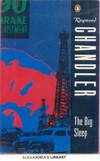
20th century Literature, American literature, Crime, Detective, Detective fiction, Raymond Chandler, The Big Sleep

The Big Sleep by Raymond Chandler, 1939

Chandler is one of my favourite writers – top 5 at least, and pretty much everything he published is consistently readable. As such I don’t really have a favourite novel of his but if forced to choose it would probably be “The Big Sleep”. This is Chandler at his sublime best. Philip Marlowe, his iconic hard boiled detective, a loner, is the quintessential private eye, the model on which so many detectives down the ages have been based upon. We see the action through his detached, sardonic perspective, although even then many things we are left to work out for ourselves.

The principal attraction of these novels – “The Lady in the Lake”, “Farewell my Lovely”, “The Long Goodbye”, “The Little Sister” – all classics – is not the plotting, tight though this is, but the prose – Chandler had an ability to craft a phrase like few others. Take this opening from “The Big Sleep” for example, probably one of the best ever written:

“It was about eleven o’clock in the morning, mid October, with the sun not shining and a look of hard wet rain in the clearness of the foothills. I was wearing my powder-blue suit, with dark blue shirt, tie and display handkerchief, black brogues, black wool socks with dark little clocks on them. I was neat, clean, shaved and sober, and I didn’t care who knew it. I was everything the well-dressed private detective ought to be. I was calling on four million dollars.”
Doesn’t that make you want to stop and go and read the book itself? Go on, I won’t be offended. The dark little clocks are a great touch.

The plot is extremely complex, not that it matters. Marlowe is employed by the ailing General Sternwood to investigate a small blackmail problem. In doing so Marlowe gets involved with pornographic book lending (which in today’s world is almost cute), gambling, boot-legging, gangsters, and several murders. The story flies along at such pace that you don’t actually spot the join – the book was originally two shorter stories, welded together to make the novel. This is done with such craftsmanship that you don’t notice unless you are looking for it – and even then it doesn’t matter a jot. (End of chapter 19 if you are interested – everything is tied up neatly at that point with only the missing persons investigation, which Marlowe isn’t really supposed to be conducting, outstanding).

If you haven’t read Chandler before you are in for a treat. This is as good a place to start as any – it’s his first Marlowe novel. In Philip Marlowe we have one of the great literary characters – as well realised and fully rounded as any I can think of. Some Christians exhort people to ask “What would Jesus would do?”. With all possible respect to these individuals, I often wonder whether “What would Marlowe do?” would offer better advice. That won’t mean too much if you haven’t read the books, so you know what to do now, don’t you?
Standard
20th century Literature

Lucky Jim – Kingsley Amis

I am conscious that I have written a run of pretty negative reviews in recent weeks, so to redress the balance and cheer myself up a little I have just re-read an old favourite, Kingsley Amis’s 1954 novel “Lucky Jim”.
 
Jim Dixon is a lowly academic at a provincial Midlands university. He hates his job, his boss, his “digs” (ie lodgings), his colleagues – he doesn’t even like his girlfriend very much. The novel follows his struggle to impress his boss sufficiently to avoid getting the push, which involves having a pointless piece of research published, delivering an end of term lecture on “Merrie England”, and generally brown-nosing his boss and his boss’s family for all he is worth. (“Educating Rita” nicked the drunken end of term speech by the way). Because every instinct within him objects to this he does a poor job of it, and only avoids being dismissed through his titular luck in being offered a much more desirable job out of academia.
 
The comedy derives from Jim’s inability to express his rage and frustration. His interior monologue expresses this anger effectively enough, but externally he has to keep up a pretence. This conflict leads him to self sabotage – most dramatically at a weekend stay at his boss’s house when he gets drunk and starts a small fire in his bedroom (see quotes below).
 
The expression “laugh out loud” is used far too often in the context of books – I see the phrase on the blurbs of books quite regularly – but I can honestly say in all my journeys to work and back I have never heard anyone burst out loud with laughter when reading a book. But “Lucky Jim” genuinely, hand on heart, makes me laugh, out loud. Out of context quotes probably lose much of their impact, but I still find the description of Jim’s drunken escapades at Welch’s house really funny; his description of getting, being, and recovering from being, drunk are completely spot on.
 

Here’s some of the scene with Jim slowly realising just how drunk he is:

It wasn’t as nice in the bathroom as it had been in the bedroom. Though it was a cool night for summer he found he felt hot and was sweating. He stood for some time in front of the wash basin, trying to discover some more about how he felt. His body seemed swollen below the chest, and uneven in density. The stuff coming from the light seemed less like light than a very thin but cloudy phosphorescent gas; it gave a creamy hum” (Chapter 5)


And this is the hangover description, one of the best I have ever read, which opens chapter 6:

Dixon was alive again. Consciousness was upon him before he could get out of the way; not for him the slow gracious wandering from the halls of sleep, but a summary, forcible ejection. He lay sprawled, too wicked to move, spewed up like a broken spider crab on the tarry shingle of the morning. The light did him harm, but not as much as looking at things did; he resolved, having done it once, never to move his eyeballs again….His mouth had been used as a latrine by some small creature of the night, and then as its mausoleum. During the night, too, he’d somehow been on a cross-country run and then been expertly beaten up by secret police. He felt bad.”


Note incidentally that this isn’t just funny, but it is clever and well written too – the creamy hum quote for instance is a great example of a “I know what you mean” kind of imagery.

Lucky Jim has a strong period feel. This is very clearly recovering post-war Britain, with the war and rationing fresh in everyone’s minds. References to the war are scattered through the novel like a background noise. The contrast between Dixon as a representative of a new generation, wanting to break free of the shackles of pre-War Britain, and his many opponents, is a precursor of the coming rebellions of the 1960s. I appreciate Dixon isn’t a political figure, and would resist being co-opted into any rejection of traditional values – Amis was deeply conservative, not to say misogynist. Much of Dixon’s anger comes from his sexual frustration – his girlfriend Maureen places strict boundaries on their relationship. But we don’t read Lucky Jim because of its social commentary.

 
Despite this period feel I was delighted at the extent to which the novel had not dated. Normally humour doesn’t age well – try watching Fawlty Towers today; what was once side splitting now hardly raises a smile. But “Lucky Jim” speaks to some timeless themes – frustration with authority and the eternal internal struggle between doing what is right and doing what one wants.
 
Amis in later years degenerated into a bit of a self parody, and never met the heights of Lucky Jim again. That’s not to say his other novels are not worth reading – I found “The Green Man” for example quite compelling when I read it many years ago, and he won the Booker in 1986 for the Old Devils – but his grumpiness eventually became just a bit too insistent. But if you haven’t read it before, or even if you have, give yourself a treat with this gem.
 
Standard