100 Best Novels Guardian list, 20th century Literature, Book review, D H Lawrence, The rainbow

The Rainbow by D H Lawrence, 1915

‘The Rainbow’ is an extraordinarily dense, complex novel. It follows three generations of the Brangwen family in rural Nottinghamshire, and contains some remarkable writing. Originally published in 1915 it is incredibly modernist in tone. But it also has, for me, some serious stylistic weaknesses. Of course this will be heresy for any Lawrence adherents, and I recognise it is a matter of personal taste.zzzzzzzzzzzzzzzzzzzzzzzzzzzzzzzzzzzzzzzzzzzzzzzzzzzzzzzzzzzzzzzzzzzzzzzzzzzzzzzzzzzzzzzzzzzzz
The novel spans a period from the mid-nineteenth century to just after the Boer War at the end of the century. It portrays the relationships of the family set against the background of the industrial revolution. Tom Brangwen, one of several brothers, falls in love with a Polish widow, Lydia. The conflict in Poland from which Lydia is a refugee is mentioned only in passing, and with the later reference to the Boer war is one of the few real world events that intrudes into the lives of the characters. Lydia’s daughter by her first husband, Anna, forms the focus of the second third of the novel. She marries Will Brangwen, a cousin by marriage, and goes on to have a very large family. The last section of the novel follows Will and Anna’s daughter, Ursula, and her relationships with a female teacher (in what today would be an illegal relationship, because Ursula was still a pupil at the time), and then a Polish soldier.

The novel is infused with Christian sentiment and symbolism, and this is expressed most clearly in the novel’s closing lines, from which it also draws its title:

“She saw in the rainbow the earth’s new architecture, the old, brittle corruption of houses and factories swept away, the world built up in a living fabric of Truth, fitting to the over-arching heaven.”

This is a version of Blake’s new Jerusalem, in England’s increasingly dark and unpleasant land, scarred by the impacts of industrialisation.

The portrayal of sex is probably the aspect of his writing for which Lawrence is most well-known. Here he attempts to address the challenge of how to write about sex without using explicit language. Euphemisms are deployed extensively – I particularly liked the phrase “underneath yearnings” (106) and “they loved each other to transport again, passionately and fully” (112). Imagery, particularly of flowers, animals and different forms of heat, flames, and burning is also used throughout the novel to portray sex and sexuality.

Suddenly, with an incredibly quick, delicate movement, he put his arms around her and drew her to him. It was quick, cleanly done, like a bird that swoops and sinks closer, closer. He was kissing her throat. She turned and looked at him. Her eyes were dark and flowing with fire. His eyes were hard and bright with a fierce purpose and gladness, like a hawk’s. She felt him flying into the dark spaces of her flames, like a brand, like a gleaming hawk”. (Notice the change of tense there by the way – from “he put” to “he was”.)

“Feeling herself lying open, like a flower unsheathed in the sun, insistent and potent with demand…The warmth flowed through her, she felt herself opening, unfolding, asking, as a flower opens in full request under the sun.…When she opened and turned to him…she was as new as a flower that unsheathes itself and stands always ready, waiting, receptive.”  (34)

Later, when Ursula is considering having sex with Skrebensky, Lawrence’s use of the flower as a metaphor for female sexuality becomes more explicit –

“Here she would open her female flower like a flame, in this dimness that was more passionate than light”.

Male sexuality is more directly treated, although again symbolism often takes the place of direct description:

“She went down with him into the warmish cellar, where already in the darkness the little yellow knobs of rhubarb were coming. He held the lantern down to the dark earth. She saw the tiny knob-end of the rhubarb thrusting upwards upon the thick red stem, thrusting itself like a knob of flame through the soft soil.”

Lawrence’s attempts to write about female sexuality are certainly bold. His portrayal of a lesbian relationship in particular would undoubtedly have been shocking to a contemporary audience. Despite his efforts (to write about sex without using explicit language) ‘The Rainbow’ was on publication judged obscene, and banned. It is still to this day shocking that copies of the novel were burned by the authorities in 1915 in scenes that pre-figured the Nazi book burnings of the 1930’s. It is likely that the anti-war sentiments expressed in the novel by Ursula were a contributory factor in the decision to ban the book – airing anti-war arguments in 1915 was a brave move by any standards.

Flowers and flower imagery dominate throughout the novel – daffodils, primroses, snowdrops, bluebells, harebells, jasmine, yellow crocuses, peaflowers, geraniums, Christmas roses, and on and on in profusion. When he gets it right there is a luxuriance to Lawrence’s writing that is almost intoxicating:

“The dim blue-and-gold of a hot, sweet autumn saw the close of the corn harvest. To Ursula it was as if the world had opened its softest pure flower, its chicory flower, its meadow saffron. The sky was blue, and sweet, the yellow leaves down the lane seemed like free, wandering flowers as they chittered round the feet, making a keen, poignant, almost unbearable music to her heart. And the scents of autumn were like a summer madness to her. She fled away from the little, purple-red button chrysanthemums like a frightened dryad, the bright yellow little chrysanthemums smelled so strong, her feet seemed to dither in a drunken dance.” (208)

So what are the negatives? Firstly, there is Lawrence’s propensity for hyperbole. For my taste, ‘The Rainbow’ is massively over-written. Characters hate one another with a passionate intensity, then moments later love one another with an eternal unfulfilled longing. Everything is expressed in sudden absolutes that change just as easily.

A shiver, a sickness of new birth passed over her, the flame leaped up him, under his skin. She wanted it, this new life from him, with him, yet she must defend herself against it, for it was a destruction” (23)

After a while this gets tiring and tedious. Or as Lawrence would say, his heart achingly rejected it with a passionate urgency that seemed to overwhelm his soul – he hated it and loved it and hated it. And so on.

Secondly, not since the ‘Deathly Hallows’ have I read a book more desperately in need of a good editor. Lawrence uses repetition relentlessly, like a sledge hammer. Nothing is said well enough that it cannot benefit from a second or third repetition. Examples are spread across every page, but for instance see this from pages 180/181:

“In spite of herself the tears surged higher, in spite of her they surged higher. In spite of her, her face broke. …she did not forget, she did not forget, she never forgot”.

As I have written elsewhere, each instance of repetition can in isolation be justified – here the character is repeating these phrases to herself to try to persuade herself not to cry, and once having cried, to remember the wrong done to her. But the cumulative impact of this repetition is oppressive.

Lawrence is an important writer, and his inclusion on the Guardian’s 100 best novels list is certainly justified. But I wish he had had a good editor.
Standard
100 Best Novels Guardian list, 20th century Literature, American literature, Book review, Ernest Hemingway, Fiesta, The Sun Also Rises

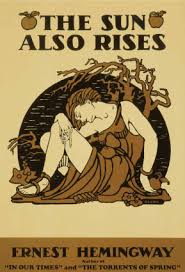
Fiesta: The Sun Also Rises, by Ernest Hemingway, 1926

The name of this novel has a complex history – at one stage it was going to be called, among other things, ‘The Lost Generation’ – and this alternative title, together with the epigraph from Ecclesiastes, beginning “One generation passeth away, and another generation cometh” provide some useful guides to interpreting this novel. yyyyyyyyyyyyyyyyyyyyyyyyyyyyyyyy

Set in the 1920’s in Paris and Spain, the events of the novel are shown from the viewpoint of the central character, Jake Barnes. Barnes recounts what happens in the moment, but he never explains – only context and snatches of conversation provide clues to the characters’ backstories. We can gather, for example, that Barnes was a combatant in the First World War, and that during that conflict he received a wound, physical or psychological, which made him impotent. Barnes is besotted with Lady Brett Ashley, a young woman who is part of the hard-drinking crowd who haunt the bars and clubs of Paris. No-one seems to work – Barnes is ostensibly a reporter for an American paper, but we hardly ever see him do any reporting, and he takes several weeks off without repercussions.

It is reasonable to infer that Barnes’ impotence, combined with his lust for Brett, would torture him, but only glimpses of this are offered to the reader. He compensates for his feelings by assisting Brett in conducting her affairs – for a woman of the 1920’s she is very liberated, and quite guilt free and open about her relationships. In a rare moment of introspection Barnes chastises himself, saying

“Send a girl off with one man. Introduce her to another to go off with him. Now go and bring her back. And sign the wire with love. That was it all right.”

The second section of the novel moves to Spain, and a fishing expedition is followed by the fiesta of the title in Pamplona, including the bull run and some of the scenes of bull-fighting for which Hemingway is probably best known. With Barnes’s connivance, Brett seduces the 19 year-old matador, and in a jealous rage one of her recent former lovers beats him (and Barnes) up. The novel ends shortly after the fiesta, with Barnes and Brett spending time together in Madrid, and wondering how their relationship might have developed had he not been afflicted:

“Oh Jake,” Brett said, “We could have had such a damned good time together.”
Ahead was a mounted policeman in khaki directing traffic. He raised his baton. The car slowed suddenly, pressing Brett against me. Yes,” I said. “Isn’t it pretty to think so?

(The mounted policeman’s raised baton proving a somewhat unnecessary piece of symbolism there I think. )

As an evocation of the fascination of bull-fighting, the scenes towards the end of this novel are unparalleled. If one is already disgusted by bull-fighting there will be nothing here to change ones mind. The portrayal of the hedonism of  Barnes and his group of friends, representatives of a lost generation, reminded me of an expatriate version of ‘Vile Bodies’. Another text worth comparing this novel to is of course Fitzgerald’s ‘The Great Gatsby’. which in a different setting has similar themes. The reader is invited to see this group of characters as resilient survivors of the fracturing of society which is slowly healing, as the sun also rises. xxxxxxxx

But. There are some issues with the novel that I wanted to explore. The first is the use of repetition. At times it is quite oppressive. I know drunk people – and many of the characters are pretty much permanently drunk – repeat themselves a lot. But it’s not much fun to read. Here’s a random example:

“Brett put her hand on my arm. 

“Don’t get drunk, Jake’ she said. ‘You don’t have to’. 

‘How do you know?’

‘Don’t’, she said. ‘You’ll be all right’. 

‘I’m not getting drunk’  I said. ‘I’m just drinking a little wine. I like to drink wine’. 

‘Don’t get drunk’, she said. ‘Jake, don’t get drunk’. 

In context, each repetition is justified and legitimate – here the effect is to emphasise both the drunkenness of the pair, and the lack of real communication between them. But the cumulative effect is somewhat wearing.

Secondly there is Hemingway’s famously sparse style. In Hemingway the quick brown fox never jumps over the lazy dog – the fox jumps over the dog. In theory this should make the novel very simple to read – but avoiding over elaborate description is one thing, and stripping the prose to its bare bones whereby one thing happens, then another thing happens, and so on, combining to deadening effect, is another. As a result although it is only just over 200 pages long this novel took me several days to complete.

Third, Barnes’s group of expatriate friends are an unpleasant bunch. They are openly anti-semitic, and the novel contains several derogatory references to homosexuality. These of course were much more acceptable attitudes than they are today, but the casual use of the n-word in a text only 90 years old isn’t reflected in the novels of many of Hemingway’s contemporaries.

Finally, the elephant in the room (metaphor deliberately mis-chosen) is the topic – bull-fighting. Hemingway glamorises the killing of animals for sport, and while this once may have seemed acceptable, today it leaves a bad taste.

As a postscript, and to be completely honest something of a boast, I spotted a fleeting reference to Marlowe’s ‘The Jew of Malta’ here. On page 66 of the Vintage edition, (which by the way contains an extraordinarily self-indulgent introduction by Colm Toibin which is all about Colm Toibin, and barely mentions the novel it is introducing), Barnes mentions a friend who is a taxidermist. Bill, another friend, replies

“That was in another country…and besides all the animals were dead”. The full quote from Marlowe is:

“Thou hast committed fornication: but that was in another country, and besides, the wench is dead.”

This so far as I can tell isolated example of wit from Bill is of course a reference to Brett.

Standard
100 Best Novels Guardian list, 20th century Literature, Book review, Booker prize nominee, Irish literature

Amongst Women by John McGahern, 1991

Michael Moran, the patriarch at the heart of this novel, is a depressing misanthropic monster. He abuses his children, terrorises his wife, and attempts (ultimately unsuccessfully) to control every aspect of their lives, all the while ensuring that his interests and comforts are catered for:

“Anything easy and pleasant aroused deep suspicion and people enjoying themselves were usually less inclined to pay attention to others” (61) (others here being Moran himself.)

Amongst womenWhen Moran dies at the end of the novel his family finally experience a sense of relief from his omnipresent oppression. This relief is possibly a false dawn, as his influence continues to linger:
“as they left him under the yew, it was as if each of them in their different ways had become Daddy.”

The novel is set in rural Ireland in the 1950’s or 60’s. The exact date is not specified, but can be inferred from the changes in society affecting Ireland, as well as the ages of the characters in relation to some of the historic events mentioned, specifically  the Irish war of independence. The Moran family in addition to Michael, the father, includes his three daughters, two sons, and their stepmother. We are never told about their mother, who is never referred to or hinted at. Given the veneration by Irish Catholics for the role of mothers in the family, this is surprising.

The novel opens with Moran being cared for by his daughters, who have put their busy lives in Dublin and London on hold. To cheer him up, a thankless task if ever there was one, they decide to recreate ‘Monaghan Day’, a family celebration when Moran’s friend McQuaid used to visit and they would reminisce about the war. Without McQuaid to participate there seems little point in this, and it is really just an excuse for the narrator to tell us in flashback some of Moran’s back story. We are told that he fought as an officer in the Irish Republican Army, and in the Irish Civil War that followed (we are not told on which side Moran fought in the Civil War, but can infer that he was a loyalist). Moran is bitter about the direction Ireland has taken post-independence, and petulantly refuses his soldier’s pension. The main narrative focus of the novel is the teenage years and early twenties of the children, as they grow up and leave home. Moran’s violent outbursts towards his family and his control freakery, often exercised through obsessive repetitions of prayers, gradually drive them all away, although they all, except Luke the eldest, regularly return thereafter to the family home. They are pathetically grateful for any acts or signs of tenderness from their father.

This is all well done – the portrait of an abusive, dysfunctional Irish family is convincing. But is it enjoyable? Hardly. It tells us little we do not already know about this society, which even when this novel was written was fading into the past. It was a time of widespread and institutionalised physical and sexual abuse, unpredictable violence, and the tyranny of men over women. McGahern seems ambivalent about this period, and about his central character, perhaps from a sense of nostalgia about his own past. While well written the novel contains too much repetition for my taste – endless scenes of family prayers and haymaking – and much of the heavy-handed symbolism was sign-posted clumsily. It came as more of a relief than anything else when Moran was finally laid to rest.

Standard
100 Best Novels Guardian list, 20th century Literature, Book review

Lolly Willowes by Sylvia Townsend Warner, 1926

Virago Modern Classics have done the reader no favours in managing expectations by publishing this in a twee edition illustrated with a strangely distorted ginger cat, and a quote from John Updike, author of yesterday’s reviewed novel, describing this as “witty, eerie, tender”. (How many times have you said to yourself, “You know what I need to read right now is a funny but scary but romantic novel”?)

The eponymous Lolly, a childish transliteration of Laura, is a prosperous young woman. The first third of the novel follows her very conventional background and birth, and in a fractured time scheme that must have felt very modern in the 1920’s takes the reader up to Lolly’s 47th year. Her family have long since attempted to marry her off – one suitor is dismissed with a joke about werewolves. The company of men -as potential husbands anyway – leaves her cold. She prefers wandering the more obscure parts of London looking for herbs to turn into medicines. One day she has an epiphany, and decides to break free from the patriarchal forces that have been suffocating her, and go and live alone in a small village in the middle of nowhere. Here she begins to breathe at last, but her peace is short-lived, because a visit from her nephew Titus quickly comes to feel like an invasion.

And this is where the novel takes an unexpected turn. Having been quite naturalistic for three quarters of the story, Townsend Warner introduces the occult. More specifically Lolly becomes a witch, and shortly thereafter meets Satan. This development isn’t quite as sudden as I have suggested – looking back over the text there are clues that the village of Great Mop is not the rural backwater it seems on the surface – but it is a strange turn of events nonetheless. Satan is a genial chap, whose idea of supreme evil extends as far as stinging Titus with wasps, and making his milk go off. Titus flees Great Mop, happily engaged as it happens, and the novel ends with Lolly looking forward to a long career of witchcraft, presumably fairly relaxed about the eternal damnation that will follow shortly thereafter.

The allegorical intent of the novel is not hard to decode. As is often the case, sex is at the root of it all. ‘Lolly Willowes’ is at once a manifesto for the liberation of women from patriarchy, with witchcraft being the symbolic representation of the rejection of control of women by men, but also a more subtle plea for the right of women to control their own sexuality. Lolly begins to discover her long dormant feelings when she moves to the countryside and starts to commune with nature:

“In February came a spell of fine weather. She spent whole days sitting in the woods, where the wood-pigeons moaned for pleasure on the boughs. Sometimes two cock birds would tumble together in mid air, shrieking and buffeting with their wings, and then would fly back to the quivering boughs and nurse the air into peace again. All around her the sap was rising up. She laid her cheek against a tree and shut her eyes to listen. She expected to hear the tree drumming like a telegraph pole. (page 110/111)

Admittedly there are phallic symbols aplenty here, but look at the verbs – moaning, tumbling, shrieking, buffeting, quivering, rising, drumming – this is an extraordinarily physical experience for someone just sitting still.

The novel’s climax is a witches’ Sabbath, which threatens to end in a Bacchanalian orgy – “They whirled faster and faster, fused together like two suns that whirl and blaze in a single destruction … contact made her tingle from head to foot…like a torch she was handed on from one to another…partners came and went, figures and conformations were in a continual flux…sometimes the dancers were coupled” (159/160). This scene is followed by a more reflective conversation between Lolly and a very gentlemanly Satan, dressed as a gamekeeper, her very own Mellors. Lolly explains her conversion to witchcraft in a quite sad, melancholy speech, only some of which I can offer here:

“One doesn’t become a witch to run around being harmful, or to run around being helpful either, a district visitor on a broomstick. It’s to escape all that – to have a life of one’s own, not an existence doled out to by others….That’s why we become witches: to show our scorn of pretending life’s a safe business, to satisfy our passion for adventure… When I think of witches I seem to see all over England, all over Europe, women living and growing old, as common as blackberries, and as unregarded. I see them, wives and sisters of respectable men…there they are, child-rearing, house-keeping, hanging washed dishclothes on currant bushes, and for diversion each others silly conversation, and listening to men talking together in the way that men talk and women listen”.
There definitely is a poignancy and tenderness to this unexpected ending to what starts as such a conventional novel. Once I had taken time to comes to terms with the subversion of my expectations about the direction and tone of the novel, I liked it!
Standard
100 Best Novels Guardian list, 20th century Literature, American literature, Book review, Uncategorized

Rabbit Redux – John Updike – 1971

The Penguin Modern Classics editions of Updike’s Rabbit quartet (Run, Redux, Rich, and at Rest) contain an afterword by the author which in some ways makes the reviewer redundant, offering insight into the composition of the novels to which few could hope to achieve. Of course, I am going to have a try.

Harry ‘Rabbit’ Angstrom is a middle aged, blue-collar AmericZZZZZZZZZZZZZZZZZZZZZZZZZZZZZZZZZZZan. His wife is sleeping with a work colleague, and soon leaves Rabbit and his teenage son Nelson. Harry is in a dead end job as a print-setter, which even in 1969, the novel’s setting, was clearly becoming obsolete. The reproductions of Harry’s set type which appear in the novel are cruelly riddled with errors, suggesting he isn’t even any good at his job. While the narrative point of view is largely Harry’s/Rabbit’s, we do not gain much insight into his feelings. He seems to take his wife’s betrayal in his stride, although it obviously hits him harder than he realises, as is shown later in the novel when his behaviour begins to get more erratic. Invited out by a work colleague, a black man who Harry would normally not associate, Harry picks up Jill, a wealthy 18 year old young woman fleeing suburban Connecticut. Although more like his lost daughter than a replacement wife, she moves in with him and Nelson. Later her  ‘friend’ Skeeter, a radical Vietnam veteran follows her and also moves in, causing scandal in the neighbourhood.  While Harry and Nelson are out visiting friends the house suffers an arson attack, and Jill is killed. Finally, in the aptly named Safe Haven motel, Harry reconciles with his wife, after a fashion, and they fall asleep together.
The period setting of the novel provides an important backdrop to its events. Neil Armstrong and Buzz Aldrin land on the moon – Harry watches the landing on a fuzzy black and white television in his mother’s bedroom. Race riots break out across America, and the war in Vietnam continues to divide the country. Harry is defiantly conservative in the face of several protest voices, not least Skeeter, who challenges him on issues of race and the war.

It has to be said that Harry is not a pleasant character. He is unashamedly racist, sexually exploits the clearly vulnerable Jill, who is half his age,  and takes pleasure from hurting her during sex. He beats his wife when he finds out she has been unfaithful, and is a poor father. He has many other faults which I am not going to spell out here – suffice to say he is a hard hero to like.

It’s equally hard to avoid the simple reading of this novel that has Harry as an extended metaphor for America. Updike specifically invites this comparison in his afterword – “The character of Harry Angstrom was, for me, a way in – a ticket to the America all around me.” Skeeter’s “invasion” of Harry’s home, hard to understand otherwise, is representative of the rise of black power in America, the intrusion of what Harry/Updike sees as an alien race. His values – paternity, patriotism, fidelity – are under attack from all around. In other words this is a deeply conservative novel in which Harry struggles to at first resist, then come to terms with the changes sweeping America in the late 60’s. He is a victim throughout the novel, weakly accepting what happens to him, not challenging his wife’s lover when he confronts him, taking redundancy without complaint, even spinelessly accepting Skeeter’s moving into his house and sleeping with Jill – he doesn’t like it, but he can do nothing about it. He has a sharp tongue towards his family and friends, but is a profoundly weak man. The reader feels sorry for Harry, perhaps, but that’s the extent of it.

Reading the second novel in a quartet is not the best way to approach a writer’s output (I started the Harry Potter series by reading The Goblet of Fire, stupidly) but I am torn on whether I want to read more about Rabbit. What might bring me back, one day, is Updike’s undoubted way with a sentence:

“How sad, how strange, we make companions out of air and hurt them, so they will defy us, completing creation”.

Standard
100 Best Novels Guardian list, 20th century Literature, Book review

The Heat of the Day –Elizabeth Bowen – 1948

Elizabeth Bowen’s ‘The Heat of the Day’ has strong echoes of Graham Greene’s ‘The End of the Affair’. It is set in London during the second world war, where tHeathe threat of sudden death from the Blitz leads to people to live their lives with a sense of urgency. Bowen’s evocation of life in London during this period is one of the strongest features of this otherwise flawed novel:
“The night behind and the night to come met across every noon in an arch of strain”. (10)

“Now down a shaft of anticipating silence the bomb swung whistling”. (114)

“Overhead, an enemy plane had been dragging, drumming slowly round in the pool of night, drawing up bursts of gunfire–nosing, pausing, turning, fascinated to the point for its intent. The barrage banged, coughed, retched; in here the lights in the mirrors rocked. Now down a shaft of anticipating silence the bomb swung whistling. With the shock of detonation, still to be heard, four walls of in here yawped in then bellied out; bottles danced on glass; a distortion ran through the view. The detonation dulled off into the cataracting roar of a split building: direct hit, somewhere else.”

Bowen’s language, and in particular her sentence construction, is interesting. At first you wonder whether English is her first language, given how unnatural some sentences sound:

“The restaurant at which they met most often was this morning, he was sorry to tell her, closed.”(115)

Would not that sentence have flowed more naturally with the words “was” and “closed” together, for example

“The restaurant at which they met most often was closed this morning, he was sorry to tell her” or

“The restaurant at which they met most often, he was sorry to tell her, was closed.” Or even

“He was sorry to tell her that the restaurant at which they met most often was closed”

But it is a fair assumption that writers do things like this for a reason. In this case I am sure that the impact this slightly awkward sentence construction had on me, which was to read the sentence twice or more, was deliberate. This technique is intended to keep the reader focussed, preventing them from reading passively. I have a vivid memory of Kingsley Amis doing this in a novel of his which I haven’t read for a long time, but must revisit, ‘The Green Man’. Anthony Burgess does the same thing in one of his Enderby novels when he brilliantly constructs a sentence in which the word “onions” is repeated four times, but which remains syntactically correct. Coming back to ‘The Heat of the Day’ for a moment, Bowen also conveys the hesitancy of her character with this technique.

Probably the weakest, least interesting aspect of the novel is the contrived, unconvincing, plot. Stella Rodney, a middle-aged woman who works for the government, is propositioned by Harrison, a shadowy figure who seems to be in love with her. Harrison tells Stella that her boyfriend/lover, Robert Kelway is spying for Germans. He promises not to report Robert if she becomes his lover. This sordid proposition forms the core of the narrative – Stella cannot decide whether to take Harrison seriously or not, so extraordinary is his proposal. While she thinks it over, we are told in flashback of the first time she met Harrison, at the funeral of a relative who has left his substantial property in Ireland to her son, Roderick, who is now in the Army. Eventually, after a trip to the estate in Ireland, Stella asks Robert about Harrison’s accusations – he of course denies the accusation, and then proposes to her. However, we later find out that the accusation is true – Robert is a German spy, even though he was wounded at Dunkirk. He confesses all to Stella, and in an attempt to escape from her flat falls from the roof and is killed – the novel deliberately leaves it ambiguous as to whether this is an accident or suicide. The novel then quickly draws to a close with an overview of the next few years of the war and a fast forward summary of the lives of the main characters. The subplot involving a working class girl, Louie, is horribly patronizing – I was not sure if Louie was intended as comic relief in contrast to the well bred Mrs Rodney, but the tone of these scenes was unconvincing.

Bowen is a good stylist (for example, this sentence jumped out at me ““Vegetables of the politer kind packed the curves of crescent and the points of stars” (125)), although occasionally her writing is overblown. But the plot is weak – the reasons for Kelway spying for the Germans are unconvincing, and his behaviour when he is exposed – going to his family home for a long and pointless (and possibly intended as comic?) discussion about its sale is bizarre. The elusive Harrison is equally unconvincing. His interest in a relationship with Stella, for which he is prepared to turn a blind eye to Robert’s spying, surely another form of treason, is pursued in a very lacklustre way – having raised the question with her he then leaves her alone for several weeks to mull it over. Bowen seems to recognise this weakness when she writes:

“By the rules of fiction, with which life to be credible must comply, he was as a character “impossible” – each time they met, for instance, he showed no shred or trace of having been continuous since they last met.”

The Vintage classic edition I read this in quotes the Los Angeles Times as describing this novel as “intelligent noir” and that it “fills the reader’s heart with dread”. I thought it was entirely lacking in suspense or menace, but the fact that this is the best quote they could find about the novel probably tells its own story.

Standard
100 Best Novels Guardian list, 20th century Literature, American literature, Book review, Saul Bellow, The Adventures of Augie March

The Adventures of Augie March by Saul Bellow, 1953

To be honest, everyone comes across a book from time to time that they struggle to complete, indeed to get started with. The plot never really seems to start, the characters are undefined and un-engaging, and keeping track of who is who and what has happened doesn’t really seem worth the effort. But one persists, out of stubbornness more than any expectation that all of a sudden the novel will transform into something more compelling. For me this is a relatively rare occurrence, but Bellow’s ‘The Adventures of Augie March’ was unfortunately one such book.

The novel follows the first few decades of the life of the eponymous hero growing up in Chicago in the 1920’s and 30’s. The title deliberately echoes the Mark Twain Tom Sawyer/Huck Finn novels of 80 years or so earlier. While Twain’s narratives were, superficially at least, quite innocent, Augie March is brought up in a very different world.

So why was this book such a challenge, to the extent that I actually felt a sense of relief when I finished? I identified a number of reasons. Firstly, Bellow’s sentence construction is often awkward, almost as if English were not his first language. To offer just two simple examples:

By dumb concentration and notice-wooing struggle. The only way I could conceive, in my blood-loaded, picturesque amorousness“. (138)
“Thus Mrs Renling in her strenuous wand hacked-up way, and the whiteness that came from her compression into her intense purposes.(151)”

The intention, presumably, is to convey the fragmented nature of Augie’s internal narration. This works effectively at first, but after a while becomes wearing.

Secondly, the novel has no real plot. We follow Augie as he wanders aimlessly from job to job and relationship to relationship. Each situation involves the introduction of a large cast of characters – even on the penultimate page, more than 500 in, Bellow is still introducing new characters. Events are structured chronologically, but the episodic nature of the narrative means it doesn’t flow – I did this, then I did this, then I did something else.

Thirdly, Augie is not an engaging character. He is devoid of any insight into his own motivation – he just wanders through life. His personal attachments to other people are superficial – even his family members are discarded when he loses interest in them. His mother is left in a home for the blind, and he rarely visits her, and his disabled brother is dumped in an institution and he only visits him once in a period of several years. His love life is complicated and unconvincing.

If this was just a series of scenes of urban life in pre-war Chicago, the novel would have had a degree of integrity. But at one point Bellow seems to bore of this theme, and he takes Augie to Mexico to train an eagle to capture lizards. Yes, apparently the best way to catch lizards isn’t to trap theme, but to train an eagle to catch them. As a plot device this would be out of place in a Marx brothers film, but it gets worse, because out in Mexico Augie meets Leon Trotsky, on the run from Stalin’s secret police. Despite the major world events that occur over the span of the novel, from the end of Prohibition and the Great Depression, Augie barely notices them. Even though he has met Trotsky, his later assassination and death don’t merit a mention. The Second World War only intrudes as an interruption to Augie’s plans to finally settle down and marry.

So to summarise: no plot, boring characters, clumsy writing – yet Bellow won the Nobel prize for literature! I’m quite happy to admit I must be missing something. I’m going to guess it’s one or more of the following:

1. ‘The Adventures’ conforms strictly to the traditions of the picaresque novel, defined in the Encyclopaedia Britannica as:

a first-person narrative, relating the adventures of a rogue or low-born adventurer as he drifts from place to place and from one social milieu to another in his effort to survive. In its episodic structure the picaresque novel resembles the long, rambling romances of medieval chivalry, to which it provided the first realistic counterpart. Unlike the idealistic knight-errant hero, however, the picaro is a cynical and amoral rascal who, if given half a chance, would rather live by his wits than by honourable work. The picaro wanders about and has adventures among people from all social classes and professions, often just barely escaping punishment for his own lying, cheating, and stealing. He is a caste-less outsider who feels inwardly unrestrained by prevailing social codes and mores, and he conforms outwardly to them only when it serves his own ends. The picaro’s narrative becomes in effect an ironic or satirical survey of the hypocrisies and corruptions of society, while also offering the reader a rich mine of observations concerning people in low or humble walks of life.”

See what I mean?  Augie is an Everyman through whose eyes the reader can see his world, but his passage through it leaves few traces. So is ‘the Adventures’ a modern day American version of the classic picaresque novels such as ‘Don Quixote’? I think that is a sustainable interpretation, but I am not convinced.

2. ‘The Adventures’ also contains numerous classical references. These left me wondering if there were possibly parallels between Augie’s adventures and those of the classical characters he refers to, as happens in ‘Ulysses’. In the end I just didn’t care enough to try and find out.

3. The range and scope of the novel made me wonder whether this was Bellow’s application for the ‘Great American Novel’ competition. This scepticism wasn’t helped by the quote from Martin Amis on the back cover claiming “‘The Adventures of Augie March’ is the Great American Novel. Search no more.” There are some explicit references to other candidates in that competition, now closed of course. Does this description of Augie’s brother Simon’s spending habits ring any bells?:

‘From the barbershop we’d go to Field’s to by him a dozen or so shirts, imported Italian underclothes or slacks or shoes, all things of which he already had a surplus; he showed me drawers, closets, shelves full, and still kept buying’ (224)

I noted down several quotes from this novel during the week or so that it took to complete, but the one I should have listened to was Bellow’s advice, in Augie’s voice:

“I never blamed myself for throwing aside such things as didn’t let themselves be read with fervor, for they left nothing with me anyhow” (206)

This novel didn’t let itself be read with fervour, and even though I didn’t throw it aside, no-one could surely have blamed me if I had.

Standard
20th century Literature, A Month in the Country, Book review, J L Carr, novella, Penguin Modern Classics

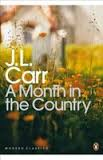
A Month in the Country by J.L.Carr, 1980

‘A Month in the Country‘ is an exquisite novella, short-listed on publication for the Booker prize back in 1980 at a time when they weren’t so awkward about word-count (this runs to barely 80 pages), and turned into a film with Kenneth Branagh and Colin Firth which has its own, fascinating story. Carr only published a handful of short novels in his life, and is a wrongly neglected novelist – so much so that I am going to put him on my alternative ‘Best novels written in English’ list.

‘A Month in the Country‘ is narrated by Tom Birkin, and tells of the summer (the pedant in me can’t resist pointing out that the events of the novel take place over the course of the whole summer, not just one month – would ‘A Summer in the Country’ have been a worse title?) of 1920. Back from the horrors of the First World War, Birkin has been commissioned to restore a mural, his rather specialist profession, as part of the whimsical legacy of a local landowner, Miss Adelaide Hebron. He spends his days on the scaffolding within the church, slowly uncovering and restoring the mural depicting Judgment day. His nights are spent in the belfry. The slow, quiet work is in some ways a therapeutic part of his recovery from a bad case of shell shock. He is accompanied by a succession of local figures who come to visit and check on his progress, interested in the curiosity of a visitor to the sleepy Yorkshire village of Oxgodby. He also has a companion of sorts in Charles Moon, employed as part of the same legacy to try to find the grave of one of Miss Hebron’s ancestors, buried outside the churchyard according to legend.

This is one of those deceptive novels where on the surface little happens, but when you look back there is in fact a huge amount of incident, romance, drama, and superbly rich characterisation. Carr captures the wonder of an English summer with wonderful economy – you can almost hear the bees lazily buzzing as Birkin cycles to church, or chats to Moon over another cup of tea.

Ah, those days…for many years afterwards their happiness haunted me. Sometimes, listening to music, I drift back and nothing has changed. The long end of summer. Day after day of warm weather, voices calling as night came on and lighted windows pricked the darkness and, at day-break, the murmur of corn and the warm smell of fields ripe for harvest. And being young.

The healing process Birkin goes through as he restores the mural in the eaves of the church has another parallel in the healing the country experiences from the war. Moon, camping in the field next to the church in a dugout reminiscent of the trenches, has his own healing processes to go through. He has quickly identified the location of the grave he has been commissioned to find, but strings out his time in Oxgodby exploring the site of a Saxon basilica. Birkin is slowly engaged in the life of the local community, umpiring cricket matches and even taking a service at a nearby chapel. All the while his understated romance with the vicar’s wife is blooming – even though there is little to the relationship beyond a few chaste glances and words. He understands that her marriage is, like his own, mistaken and unhappy, and the climax of the novel is reached when he has the opportunity to reveal his feelings, certain they will be reciprocated. The moment agonisingly passes, and once gone cannot be recaptured.

I’ve not really even started to unravel the complexity and beauty of this exceptionally well-written, delicately drawn novel. I have never read anything that captures so well the sense of loss:

“We can ask and ask but we can’t have again what once seemed ours for ever – the way things looked, that church alone in the fields, a bed on a belfry floor, a remembered voice, the touch of a hand, a loved face. They’ve gone and you can only wait for the pain to pass. All this happened so long ago. And I never returned, never wrote, never met anyone who might have given me news of Oxgodby. So, in memory, it stays as I left it, a sealed room furnished by the past, airless, still, ink long dry on a put-down pen. But this was something I knew nothing of as I closed the gate and set off across the meadow.”

Wonderful.

Standard
100 Best Novels Guardian list, 20th century Literature, American literature, http://schemas.google.com/blogger/2008/kind#post, Philip Roth, Portnoy's Complaint

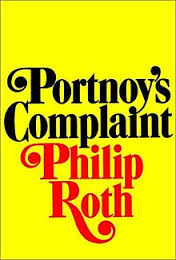
Portnoy’s Complaint by Philip Roth, 1969

Portnoy’s complaint is both a noun and a verb – the book is another first person narrative describing the author’s childhood and later life, an autobiography with only the flimsiest attempt at disguise as a novel. Alexander Portnoy complains to his psychiatrist – at quite some length – about his domineering mother, his father crippled by chronic constipation, and the impact this has on his later ability to develop serious relationships with women. This is both his lament and his condition.

Of his mother he writes memorably:

“She was so deeply embedded in my consciousness that for the first year of school I seem to have believed that each of my teachers was my mother in disguise. As soon as the last bell sounded I would rush off for home, wondering as I ran if I could possibly make it to our apartment before she succeeded in transforming herself. Invariably she was already in the kitchen by the time I arrived, and setting out the milk and cookies. Instead of causing me to give up my delusions, however, the feat merely intensified my respect for her powers

As a young boy his relationship with his mother is simply dysfunctional, but when he hits puberty it becomes positively Oedipal. The chapter on the masturbation frenzy he embarks on at this point is a famously sustained portrayal of adolescence, and is quite filthy in some respects. It is hardly surprising given Portnoy’s frankness about every aspects of his sexual life and fantasies that the book caused a considerable controversy on publication. Even today it has the power to shock.

As with most first person narratives, the reader is automatically sympathetic to the narrator – we see the world through their eyes, hear their explanations for their conduct, get their side of the story. With such monstrously controlling parents it is hardly surprising that Portnoy rebels, pursuing relationships with non-Jewish girls. He is unarguably a misogynist. He gives his girlfriends unpleasant, objectifying nicknames – the Pumpkin, the Pilgrim, the Monkey – and abandons the latter when she is feeling suicidal. He feels guilty about this, but not guilty enough to do anything about it. Of course he blames his mother for his inability to form grown up relationships with perfectly pleasant young women, (he cites one reason why he leaves ‘The Monkey’ as her calligraphy!) but his inability to accept any personal responsibility for this begins to chafe after a while – “a Jewish man with his parents alive is half the time a helpless infant” – and you want to tell him to stop whining and grow up.

The novel takes a darker turn in the final chapters when Portnoy goes to Israel. He has a casual sexual encounter with a female soldier, but is impotent. Later in the final pages he meets up with a hitchhiker, and tries to rape her. It is quite satisfying to see her kick his ass. His misogyny seems unrestrained when the travels to Israel, possibly because of his distance from his mother.

In the end, Portnoy is his own, most astute critic. He pleads:

Spring me from this role I play of the smothered son in the Jewish joke! Because it’s beginning to pall a little at thirty-three!”

Standard
100 Best Novels Guardian list, 20th century Literature, At Swim-Two-Birds, Book review, Flann O'Brien, Irish literature

At Swim-Two-Birds, by Flann O’Brien – 1939

At Swim-Two-Birds‘ is quite unlike any other novel I have ever read. On the whole that is a good thing, but it also means that it can be a challenging, almost impossible read. Let’s start with a plot summary, which I have borrowed direct from Wikipedia:

At Swim-Two-Birds presents itself as a first-person story by an unnamed Irish student of literature. The student sets three apparently quite separate stories in motion. The first concerns the Pooka MacPhellimey, “a member of the devil class”. The second is about a young man named John Furriskey, who turns out to be a fictional character created by another of the student’s creations, Dermot Trellis, a cynical writer of Westerns. The third consists of the student’s adaptations of Irish legends, mostly concerning Finn Mac Cool and Mad King Sweeney.

In the autobiographical frame story, the student recounts details of his life. He lives with his uncle, who works as a clerk in the Guinness Brewery in Dublin. The uncle is a complacent and self-consciously respectable bachelor who suspects that the student does very little studying. This seems to be the case, as by his own account the student spends more time drinking stout with his college friends, lying in bed and working on his book, than he does going to class.

The stories that the student is writing become intertwined with each other. John Furriskey befriends two of Trellis’s other characters, Lamont and Shanahan. They become resentful of Trellis’s control over their destinies, and manage to drug him so that he will spend more time asleep, giving them the freedom to lead quiet domestic lives rather than be ruled by the lurid plots of his novels. Meanwhile, Trellis creates Sheila Lamont (Antony Lamont’s sister) in order that Furriskey might seduce and betray her, but “blinded by her beauty” Trellis assaults her himself. Sheila gives birth to a child named Orlick, who is born as a polite and articulate young man with a gift for writing fiction. The entire group of Trellis’s characters, by now including Finn, Sweeney, the urbane Pooka and an invisible and quarrelsome Good Fairy , convenes in Trellis’s Red Swan Hotel where they devise a way to overthrow their author. Encouraged by the others, Orlick starts writing a novel about his father in which Trellis is tried by his own creations, found guilty and viciously tortured. Just as Orlick’s novel is about to climax with Trellis’ death, the college student passes his exams and At Swim-Two-Birds ends.

The reason why I have exceptionally quoted this plot summary at such length is to give you some idea of the labyrinthine complexity of the plot. I struggled with following the action of the narrative until I came across this summary (after extensive research, of course) and used it as a crib sheet to help me follow things. I have no idea what this says about me as a reader, but I recommend it as an approach for anyone else who struggles as I did. Of course the other point that jumps off the page from this precis is the bizarre, post-modernist nature of the text. Characters writing their own endings and launching attacks on their authors is something no-one (that I know of) had done before O’Brien, certainly not in novel format, and it still remains outside the normal realms of fiction, belonging more to comedy or comic books.

The third reason why the novel presents challenges to the reader brought up on traditional narrative is the innovative use of found texts. I’ve not been able to establish precisely which parts of the novel were copied from other texts in ‘At Swim-Two-Birds’, other than the letter from a tipster recommending a sure fire winner, but I suspect the section providing random ‘useful’ facts during Trellis’s trial, the summary of the events of the poem ‘The Shipwreck’ (pages 201-211) and the long list of ‘flowers and plants rarely mentioned in ordinary conversation’ on page 192 are examples. The latter two instances are dropped into the text almost entirely at random with little or no contextual reason for their use. The use of complex Irish names and place names added yet another layer of difficulty for this reader, and if you think I am exaggerating the point, try this:

“Sweet to me your voice, said Caolcrodha Mac Morna, brother to sweet-worded sweet-toothed Goll from Sliabh Riabhach and Brosnacha Bladhma, relate then the attributes that are to Finn’s people.”

Most of the humour in the novel derives from O’Brien’s surreal approach to his subject matter, such as it is. The closest thing I can compare it to is listening to a drunk telling you a long and unstructured story, where no-one behaves rationally, and where he keeps forgetting what he was telling you. Occasionally glimmers of sense can be perceived, but this never lasts long and we are soon back in old Ireland, with the Pooka speculating on whether his wife is a kangaroo, or whether the invisible fairy in his pocket is planning to set it on fire.

This certainly all adds up to an unusual, even unique novel.

Standard