100 Best Novels Guardian list, 20th century Literature, American literature, Book review, Catcher in the Rye, J D Salinger, The Catcher in the Rye

The Catcher in the Rye by J D Salinger, 1951

Three things I didn’t notice about ‘Catcher in the Rye’ when I first read it as a teenager:
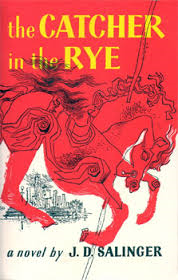
a) Holden Caulfield, the novel’s 16 year old narrator, is seriously rich. He attends a private boarding school in New Jersey, from which he has just been expelled. His family live in an apartment building close to Central Park which is large enough (the apartment, not the park) for them to have a live-in house-maid. During the 48 hours or so of the novel’s span he spends money like water, on hotels, cabs everywhere, drinks, and a prostitute. How could I have missed this first time round, seeing him as a fairly normal, typicla teenager. I think the simple reason is that we see the events of the novel through Holden’s eyes, and he is not aware of how privileged and prosperous he is – for him, it is normal to be able to afford all these things.

b) Holden hates pretty much everything. Actors. Hotels. Phonys. People who repeat themselves. Inexpensive looking suitcases. People who repeat themselves.

I hate living in New York and all. Taxicabs, and Madison Avenue buses, with the drivers and all always yelling at you to get out at the rear door, and being introduced to phony guys that call the Lunts angels, and going up and down in elevators when you just want to go outside, and guys fitting your pants all the time at Brooks, and people always….” (page 141)

Holden’s anger is random – he snarls at anything that crosses his path, but at exactly the same time tries to befriend anyone he can.

c) Holden is quite obviously clinically depressed. He is unable to sleep, he cries for no particular reason, he is unable to concentrate, and he is full of inarticulate rage against the world. Holden may have become, as described by Wikipedia, as “an icon for teenage rebellion and angst”, but that’s really a case of projection – Holden doesn’t really rebel against anything; he is just extraordinarily lonely and upset. He desperately tries to make connections with anyone who will talk to him, from taxi drivers to Salvation Army nuns, (not that the Salvation Army has nuns) and ten year-olds in the park.

By the end of the novel, Holden is hospitalised. He talks in the introduction about becoming “run-down” and coming “here” without saying explicitly where here is. However, on the final page, he mentions “how I got sick” and “this one psychoanalyst guy they have here”.

So, we have someone who is prosperous and in a loving family, with no material wants. He hates virtually everything he comes across, however trivial or inoffensive they might be. He is depressed. How can that be a simply case of teenage angst, something he will grow out of? For me, rereading ‘Catcher’ it is quite obvious that Holden has not recovered from the death of his brother a few years earlier. It is reasonable to assume that showing grief would have been frowned upon by his Waspish family. There’s no reference to any counselling or other support – instead he is simply sent away to boarding school, separating him from his remaining siblings. He still mourns for his brother, thinks about him a lot, and refers to him in the present tense in his internal monologue, but doesn’t speak about him to anyone, not even his little sister Phoebe.

‘Catcher’ is a novel much loved by teenage readers. Holden seems to speak to them in a way like few other characters in literature. He was, arguably, the first authentic teenager in literature. Coming back to the novel several decades later the authenticity of that voice is lost. In trying to establish whether this reaction was simply personal to me, or something wider, I scrolled through some Amazon (UK) reviews of the novel. One comment from a perceptive reviewer jumped out at me:

Reading it – and To Kill A Mockingbird, which is the only book that regularly beats it in polls – has been a formative influence for generations of American adolescents, to the point at which nostalgia for that time of life may impose a filter between the older reader and any objective assessment. Even so, it’s striking how many find that it can’t be reread later in life with the same admiration.”

That struck a chord – the novel is often read at a point in the life of readers when they can identify with Holden, not because of his wealth, his illness, or his loss, but because he is a teenager angry with the world. As a more mature reader we see the novel’s faults, the absence of any plot and the various implausibilities in terms of Holden’s age, an immature 16 who still gets served in bars and clubs.  We also see Holden as the distressed young man he is rather than a voice of rebellion. It is, of course, one of the strengths of the novel that is can appeal to different types of readers in very different ways.
Standard
20th century Literature, Book review, G K Chesterton, The Man Who Was Thursday

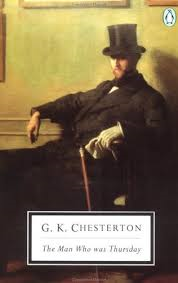
The Man who was Thursday by G K Chesterton, 1908

What a great title for a novel. Set in the early years of the 20th century, ‘The Man who was Thursday’ is subtitled ‘A Nightmare’, which gives a clue to the novel’s eventual denouement. Gabriel Syme, a newly recruited, not to say unusual police detective, infiltrates a gang of anarchists, and within hours has secured a place on their European Council. The council has seven members, each with a code name derived from the days of the week. The purpose of these code names is not immediately apparent, as each is also known by their actual names, and the council operates openly ‘in plain sight’, on the basis that this is the best form of disguise. A fairly breathless adventure ensues in which each council member is steadily exposed by Syme as fellow police officers.

I was already aware of the novel’s plot big ‘twist’, so I can’t be sure at what point I would have worked it out. I doubt it would have taken long. Each member has their own ‘reveal’ scene, although the surprise fades quickly, and the “Oh, by the way, I’m a policeman not an anarchist as well” scene quickly becomes the routine.


Chesterton challenges the reader to work out whether this is a naturalistic detective novel or not. The surreal elements are introduced quite early on – the back-street pub Syme is taken to by Gregory, keen to demonstrate the authenticity of his belief in anarchy, leads into a mysterious underground den of London anarchists, packed with weaponry and bombs. Anarchists were considered a real threat in early 20th century Europe, it being more of a catch-all term for revolutionary than it is today, and so even though the world Syme is introduced into has fantastical elements, it is unclear at first whether the reader is expected to treat them as simply part of an adventure story. Chesterton exploits this ambiguity throughout the novel – he constantly introduces mysterious, seemingly supernatural aspects into the narrative, only to quickly provide a naturalistic explanation. Syme duels with one of his council members, cutting him several times with an open blade, but does not draw blood. It is quickly revealed that this is because he is wearing a number of prosthetics, not least a false nose, which he removes to reveal – cure fanfare – yet another London policeman. Syme is earlier followed through London at breakneck speed by an old man who can hardly walk – and yes, the old man is revealed soon thereafter as an athletic policeman in disguise.

The nightmarish intensity of the novel accelerates as it draws to a climax, in some quite astonishingly surreal scenes. Naturalism is abandoned as Sunday, the leader of the Council, leads his gang, now all revealed as policemen, on a chase through the streets of London, partly on an elephant, partly by hot air balloon, throwing surreal comic notes into their path (“Fly at once. The truth about your trouser stretchers is known. – A FRIEND”) as he goes – into the countryside. The chase ends in a masked fancy dress ball. Christian allegory takes centre stage, and the somewhat bemused reader leans that Sunday’s disguise mirrors that of the novel itself – it never was a detective story, but a dream, a nightmare, all along.

I am sure I am not alone in finding this novel strangely discomforting. Chesterton wrote detective fiction – the Father Brown stories – and so the expectation that ‘Thursday’ would be more of the same, a reworking of Conrad’s ‘The Secret Agent’ with a lighter tone, is completely subverted by the revelation that the novel is a well-disguised religious allegory all along. The joke is a clever one, although whether it is clever enough for me to want to pursue Chesterton further is one I have yet to decide. The best I can say for now following a few days reflection on having finished the novel is that my disappointment at not having read the detective novel I expected has abated, and I have reappraised ‘The Man who was Thursday’. It may not be a great detective story, but it is quite an intelligent novel, and while religious allegories are something I can quickly have too much of, it is still good for me to have my expectations subverted once in a while.


Standard
100 Best Novels Guardian list, 20th century Literature, American literature, Book review, Housekeeping, Marilynne Robinson

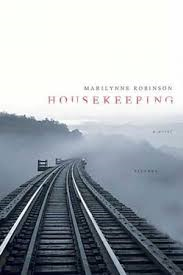
Housekeeping by Marilynne Robinson, 1980

Among the various reasons for keeping this blog, the one I keep coming back to is to help me remember. I doubt if it is just me who forgets the detail of a novel, then the main events and protagonists, and finally come to doubt whether I have even read it at all. Which is why it is important that I write carefully about Marilynne Robinson’s ‘Housekeeping’, because otherwise there is not a chance in hell of me remembering it in a few months time.

The novel is narrated by Ruthie, and tells of the events of her childhood. Orphaned by the suicide of her mother she is brought up with her sister Lucille by their grandmother, then two elderly great-aunts, and finally by her aunt Sylvie. It is never stated directly, but it is fairly evident that Sylvie is mentally disturbed – she neglects the children, fills the house with rubbish and cats, and can often be found staring out into space. Housekeeping, the semi-ironic title, is not something that occurs to her, and even in the broader sense she struggles to keep a house for the girls, the younger of whom escapes to live with a teacher as soon as she is able. Finally, after Ruthie’s neglect becomes inescapable, and it appears likely she is going to be taken into care. To avoid this she and Sylvie run away, and at the novel’s close we are told they continue to live the rootless life of transients.

‘Housekeeping’ is one of those novels where the sense of place is vital. The isolated American town of Fingerbone (admittedly a fine name for a town) is settled next to a large lake, crossed by a railway bridge. From said bridge and into said lake a train crashed, carrying with it Ruthie’s grandfather, setting in chain the events that lead to this story, and providing a backdrop for the narrative itself. Think ‘Twin Peaks’ without the murder or (some of) the craziness. It always seems to be bitterly cold down in Fingerbone, and the chill and damp coming off the lake exudes from the pages.

Robinson left it almost another twenty-five years after publishing ‘Housekeeping’ to publish another novel, but it cannot have been because of the reception of this her first, prize-winning attempt. In his Guardian review Robert McCrum goes to far to say, surely in an act of wild over-exaggeration, that Robinson introduces a “new, timeless, and utterly distinctive voice into the magical polyphony of the American novel”. While she can certainly craft an image – for example  “watching gulls fly like sparks up the face of clouds that dragged rain the lenght of the lake” this restraint and economy is often absent. At times the writing is extraordinarily over-written, as here:

To crave and to have are as like as a thing and its shadow. For when does a berry break upon the tongue as sweetly as when one longs to taste it, and when is the taste refracted into so many hues and savors of ripeness and earth, and when do our senses know any thing so utterly as when we lack it? And here again is a foreshadowing–-the world will be made whole. For to wish for a hand on one’s hair is all but to feel it. So whatever we may lose, very craving gives it back to us again.”

Does it really? Or is this the triumph of style over substance, attractive to literature prize-juries but simply not that interesting?

Standard
100 Best Novels Guardian list, 20th century Literature, Book review, children's literature, Kenneth Graeme, Wind in the Willows

The Wind in the Willows – Kenneth Graeme – 1908

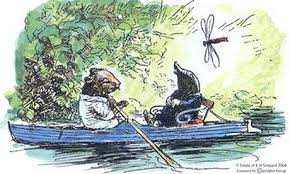
It is an incredibly long time since I last read ‘The Wind in the Willows’, and I returned to it with some nervousness – would it have retained its wit and charm? Unsurprisingly, it is one of those novels which contains depths unnoticed in earlier reads. It is simply wonderful, and if you have a couple of hours spare there are few ways of spending them that would be more rewarding than on the riverbank with Ratty, Mole, Toad, and Badger.

In an interesting article in the Guardian books column back in 2009, ‘Wild Waters are upon us’, Rosemary Hill observed that ‘The Wind in the Willows’ was written within a few years of Beatrix Potter’s ‘The Tale of Peter Rabbit’, E.Nesbit’s ‘The Railway Children’, and J.M.Barrie’s ‘Peter Pan’. Together she argues, very persuasively, these children’s stories came to define the Edwardian Era, “as an idyllic last summer bathed in golden sunshine“, in contrast to the developments in the real world, “a decade of social discontent and growing international tension, when the cracks in the British Empire began to show“. This novel captures brilliant a world of largely suburban contentment – the animals co-exist quite comfortably with the human world, all except perhaps Mr Toad, and their occupations – mainly messing about on boats – are those of middle class people with time on their hands. If ‘Willows’ creates a lost Edwardian idyll, rather than portraying it, the novel is however quite clear that this world is under threat, from development, urbanisation, and not least the dreaded car. The car must have been a rare and slightly frightening sight in 1908, but the way Graeme captures the petrol-head obsession of Toad has close parallels to the car worship of today.

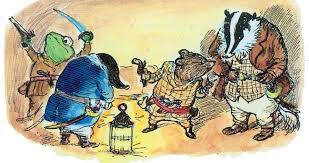
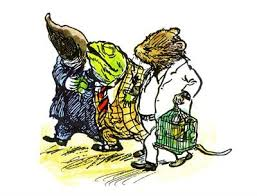
Graeme’s wonderful conceit in ‘Willows’ was to anthropomorphise his characters, but in a very fluid way. At times they are real animals, and in the edition I read on the kindle the illustrations show them as lifelike, to scale creatures. At other times they are human scale. They have human character traits, but also at other times behave like the animals they are, subject to instincts and urges which nevertheless find an echo in the reader. The cast of characters is hugely strong and well defined; we all know a Ratty, Mole, or Badger, let alone a Toad. The supporting cast of characters is equally well sketched in, so we feel great affection for Otter, for example, or his son, Portly. The Chief Weasel only gets a few lines but that was enough for A.A. Milne to give him a much larger part in the stage version, ‘Toad of Toad Hall’. The narrative is also told with a striking economy – there are only two pages between Toad’s escape from his friends at Toad Hall, and the magistrate passing sentence, “twelve months for the theft…, three years for the furious driving, which is lenient, and fifteen years for the cheek“.


Part of my nervousness about returning to ‘Willows’ lay in the way the Wild Wood and its inhabitants are handled. It is ‘other’ – and can be read as anything alien to the comfortable life of Ratty and company, even if it is home to Badger. At one point the narrator describes it as “low and threatening, like a black reef in some still southern sea“. The alliteration is marvellous, but the point is made – the wild-wooders are like foreigners, tribal natives, dark and threatening. It is like the areas on maps marked ‘here be dragons’.  The insurrection of the wild-wooders, numerous and disrespectful to their betters, and at times actually threatening, seemed to me to be a perfect model for the class struggles of the period. The working class are organising and asking why they have to live lives of poverty and drudge, while the middle classes mess around in boats, doing very little. Their revolution, when it comes, is quickly squashed, and it is made clear they have learnt their place, tugging on their forelocks when the squires of the manor pass by. This of course was wishful thinking – the class problems of 20th century Britain were not as easily resolved as a clip around the ear. However I think the handling of this paradigm does throw a light on the complacent attitude of many to the rise of the organised working class in the early years of the 20th century.

I was equally nervous about the “Piper at the Gates of Dawn’ chapter, that strange, surreal story where Ratty and Mole go searching for Otter’s lost son, Portly, and meet him safe in the arms of Pan. Yes, Pan. Mole sees “the backward sweep of the curved horns, gleaming in the growing daylight; saw the stern, hooked nose between the kindly eyes that were looking down on them humorously, while the bearded mouth broke into a half-smile at the corners; saw the rippling muscles on the arms that lay across the broad chest, the long supple hand still holding the pan pipes only just fallen away from the parted lips; saw the splendid curves of the shaggy limbs disposed in majestic ease on the sward“. Pan saves Portly and returns him to his friends, then wipes their memories, Men in Black fashion. It’s still a really strange, slightly homo-erotic chapter. I can only assume Graeme was trying to introduce the idea that the animals have their own spirituality, their own God, but this must have opened up some really difficult lines of thought for God-fearing Edwardians only just coming to terms with Darwinism and their links with the animal kingdom.

The thing that struck me for the first time on this reading was in relation to the treatment of Toad by his friends when they decide they cannot stand by and see him wreck his life by his addiction to fast cars. The way this is described is almost identical to a modern intervention into the life of a drug addict. His friends sit him down and clearly explain the problem. They describe the waste of money on his addiction, the “regrettable incidents with the police“, and the “weeks in hospital, being ordered about by female nurses“. When he rejects their help they restrain him, keep him under close watch – “he must never be left an instant unguarded. We shall have to take it in turns to be with him, till the poison has worked itself out of his system”. (page 61). Toad has “violent paroxysms” makes “uncouth and ghastly noises“, and lies “prostrate amidst the ruins of chairs” – is not this a wonderfully accurate description of someone going ‘cold turkey’.

Finally, to end on a joke, which made me laugh out loud. Toad is in the most liberal dungeon in the country, chatting to the kindly daughter of the warder. She is trying to explain her escape plan, and says:

“I have an aunt who is a washerwoman”,

to which Toad graciously and affably replies

“There, there, …never mind; think no more about it. I have several aunts who ought to be washerwomen”.

Could Bertie Wooster have said it better?

Standard
20th century Literature, American literature, Book review, Vonnegut

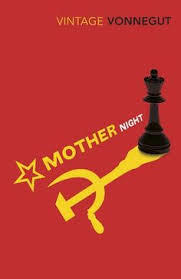
Mother Knight – Kurt Vonnegut – 1966

Released a few years before ‘Slaughterhouse 5’, ‘Mother Knight’ is probably best seen as a companion piece to that work. In some ways a more conventional narrative, it tells in diary form the story of Howard W. Campbell Jr, an American, who moved to Germany in 1923 as a child, and became a well-known playwright. Married to a German woman, he is approached by an American shortly before the second world war starts, and asked to stay in Germany and become a spy for the Americans. This he does, reluctantly, because in order to maintain his cover he has to become an enthusiastic propagandist for the Nazis. As he observes “we are what we pretend to be, so we must be careful about what we pretend to be” – pretending to be a Nazi for so long corrupts his soul, and he finds it hard to argue with or oppose the Americans he meets later in life who hate him, as a symbol and public face of the Nazis.

I don’t know if there was a real-life American equivalent of Campbell, but the obvious English parallel is with William Joyce, Lord Haw-Haw, who must surely have provided some inspiration for the novel, even if unlike Campbell, Joyce remained an unrepentant Nazi.

The reader is left in doubt throughout the novel whether his defence – that he was acting as a spy – is genuine. He presents no evidence in support of it, and the suggestion that he was conveying messages in his broadcasts through coughs and hesitations is implausible, to say the least. However, the final dénouement reveals his story – his defence – was actually true all along. By then it is too late for Campbell, having lost everything he values he passes his own sentence on himself.

Vonnegut is novelist of ideas – he throws them around casually, sometimes following them through, but often discarding them. This makes ‘Mother Knight’ a surprisingly easy and enjoyable read – the cast of characters was entertaining, including some cutting portraits of American Nazis, and the shifts of mood from comedy to black farce worked well. It’s also quite a brave novel – it addresses serious themes and topics such as the holocaust, the rise of fascism, and nationalism. The central character is perhaps hard to like – as narrator of his own story we should normally be sympathetic to him – we understand his motivation, even when what he does is questionable. Campbell never attempts to justify his actions in the war, but he is not prepare to accept some of the lazy condemnation thrown at him which has parallels with the way opponents of the Nazis were treated (the stealing of the light bulbs for example). Just to illustrate the point, there is a brief discussion of nationalism which quite bravely in post-McCarthy America rejects the whole concept of being proud of one’s country:

“You hate America, don’t you?’
That would be as silly as loving it,’ I said. ‘It’s impossible for me to get emotional about it, because real estate doesn’t interest me. It’s no doubt a great flaw in my personality, but I can’t think in terms of boundaries. Those imaginary lines are as unreal to me as elves and pixies. I can’t believe that they mark the end or the beginning of anything of real concern to a human soul. Virtues and vices, pleasures and pains cross boundaries at will.”

You can see Vonnegut warming up for ‘Slaughterhouse 5’ here, although without some of the surrealist components of the later novel. I also caught some echoes of ‘Lolita’ as well – both novels being the posthumous prison diary of someone reviled by society. I will definitely be returning to Vonnegut – he writes well, entertainingly, is refreshing unstuffy and unpretentious, but at the same time deals with serious themes. Recommended.

Standard
100 Best Novels Guardian list, 20th century Literature, Graham Greene' The End of the Affair

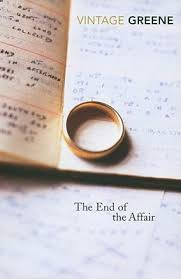
The End of the Affair – Graham Greene – 1951

I am ashamed to admit that this is the first Greene novel I have read; I fear it may be the last, at least for now. ‘The End of the Affair’ tells the story of an adulterous affair between Maurice Bendrix, an author on the cusp of, if not fame, popularity, and the wife of a neighbour and friend, Sarah Miles. Bendrix’s narrates the story in flashback, returning to the present often and thereby constructing a complex time scheme that only coheres at the end of the novel. The affair lasts for four years, the first four years of the Second World War. The war is largely background noise to the events of the novel, although it does intrude at one point when a V2 bomb, strangely called here a ‘robot’ lands very close to Bendrix’s house, knocking him out. Thinking him dead, Sarah prays for him to be saved, promising god that if he does survive she will reward him (that is, god) by leaving Bendrix and being faithful to her husband.

Bendrix survives, in fact is largely unhurt, and true to her perverse bargain with god, Sarah leaves him. Leaves is a misleading term, in that she has never actually left her husband, who working late at the Ministry and already living a sexless life, doesn’t notice the affair. She finds the separation painful, so perversely pursues other affairs – the deal with god was very specific apparently – but eventually relents and decides to resume the relationship. The reader is invited to see the hand of god in the various bits of fairly clumsy sit-com style incidents that prevent this resolution being carried out, and Sarah finally succumbs to the irresistible charms of the Catholic Church, before catching a cold and dying. Colds are pretty ferociously dangerous in romantic novels; in fact it would be nice some time soon to read a novel where the resolution is not provided by someone conveniently dying, even if the death as here is signposted a long way in advance, and comes as nothing of a surprise. Cuckolder and cuckolded commiserate one another after Sarah’s death, and eventually become an odd couple of their own, pottering down to the pub each night to drown their sorrows.

Much of the novel is dominated by a discussion of religion, and more specifically Catholicism. God intervenes in the life of the characters, and while they resist fiercely, they eventually accept his gifts. Even though Bendrix ends the novel by rejecting the roman god, he does so more through stubbornness and anger than any lack of belief. Frankly, this is largely tedious, unconvincing preaching – of course god can appear in the lives of characters if the author simply invents “coincidences” to persuade them of his existence. Rosencrantz and Guildernstern in Stoppard’s play about their deaths show infinitely more faith in the power of coincidence, denying the existence of an external power, even when that power is the author himself. All it takes here, by comparison, are some simple coincidences before Bendrix begins to start doubting his agnosticism, ending with a suggestion reminiscent of the conversion at the end of “Brideshead” that he too has accepted the inevitable (even if this suggestion comes at the very beginning of the novel: “If I had believed then in a God”.)

In an insightful introduction in this Vintage edition, Monica Ali surgically pinpoints many of the faults in the novel – the poor characterisation in particular, and the failure of the religious conversion scenes. I agree, but I think she is too kind on Greene. We are invited to see Bendrix as a tragic anti-hero – he is the victim of his own sad story – but if you remove his point of view from the events of the novel and look a little more objectively, he is really a nasty piece of work. He cuckolds Miles, simply at first to get some material for his novel. He has sex with Sarah in her own house while Miles is upstairs, and later has sex with her in a ditch, overlooked by a farmer on a tractor who passes “at the moment of crisis”. Nothing gets in the way of his determination to sleep with Sarah – at one point he even is grateful for the war for the opportunities it provides: “War had helped us in a good many ways” (page 45). He is casually arrogant about his writing and his attractiveness to women, and treats his lover appallingly, employing a private detective, the gormless hat-tipping Parkis, to steal her diary.

Greene’s reputation as one of England’s foremost post-war novelists cannot be evaluated on the strength of a single novel, but this is not a strong exhibit for the defence. ‘The End of the Affair’ is a confident, well constructed novel full of strong descriptions and turns of phrase, but I suspect it won’t linger long in the memory. It has not aged well – I appreciate that 1951 was a long time ago, but there is a bit of a dated, Edwardian feel to this tale – the characters still have maids to answer the door. Perhaps I need to take a look at ‘Brighton Rock’ or ‘Our Man in Havana’ after a suitable period of reflection?

Standard
100 Best Novels Guardian list, 20th century Literature, Book review, Elizabeth Taylor, Elizabeth taylor. Mrs Palfrey at the Claremont, Mrs Palfrey at the Claremont

Mrs Palfrey at the Claremont by Elizabeth Taylor, 1971

I confess I had never heard of Elizabeth Taylor before her appearance in the Guardian best 100 novels in English list. One of the hope-for benefits of working through this list was the discovery of some hidden gems, a writer whose back catalogue would open up to exploration. Having now read the clumsily titled and thinly written ‘Mrs Palfrey at the Claremont’ I know why she is so unknown – her inclusion on this list is puzzling, when you consider the authors such as Tolkien and Rowling who missed the cut. There’s nothing wrong with ‘Mrs Palfrey’ as a novel, and if you try hard you can find some features of interest – but little that will occupy you for long.

Laura Palfrey who in Taylor’s somewhat spiteful description ““would have made a distinguished-looking man and, sometimes, wearing evening dress, looked like some famous general in drag”, is recently widowed. She arrives at the Claremont hotel in London, one rainy Sunday in January. The novel immediately strikes a false note – the taxi driver is unfamiliar with the hotel. Taylor is telling the reader that the hotel is obscure and forgotten, like Mrs Palfrey herself, but she surely under-estimates London cabbies? After years as a colonial ex-patriot wife she faces the fact of her isolation, and the inevitability of decline and death.
There is a strangely dated air to both the Claremont and the novel itself. Although published in 1971 the setting is firmly in the sixties, with references to the Beatles and hair-length being a cause for disproportionate anger in the elderly. At one point, a young man refers to his girlfriend as a “bird”. (Quite genuinely, for a split second I took this as a reference to him having bought himself a parrot or canary, so dated is this slang). In fact, although the setting is the 60’s this novel could easily have been published several decades earlier with only minor edits. Mrs Palfrey’s back story is strangely blank – while we know her husband was in a colonial role in Burma, that would have ended in the late 1940’s; we aren’t told when or how he died, where Mrs Palfrey lived after that, or much about her strange decision to move away from her daughter in Scotland to the most expensive city in the country, rather than the more sedate and welcoming south coast, for example.
The Claremont becomes in the words of the Guardian’s reviewer “a genteel antechamber to oblivion”. Mrs Palfrey and her fellow long term inhabitants are waiting for death, bored silly, whiling their time away with banal occupations – patience, short walks, crosswords – waiting for the next meal or the next infrequent visitor. This is more a retirement home than a hotel. Even great writers struggle to generate interest from a story of bored people with nothing to do, and while Taylor captures the sense of ennui well, it’s not enough to keep the reader engaged.
As a substitute for incident or plot, Taylor introduces Ludovic (Ludo) Myers a struggling writer. Ludo rescues Mrs Palfrey after a geriatric fall, and becomes, through a series of misunderstandings, her substitute grandson. Ludo has fallen straight out of the pages of ‘New Grub Street’ – he is trying to write a novel, keeps warm by working during the day in Harrods Banking Hall, (not the British Library, just for variety), subsists on tinned goods, and only puts his fire on a single bar when he is feeling extravagant. His friendship with Mrs Palfrey is the only thing that enlivens her days, but there is little of substance to it and it quickly fades.
Taylor is felt by some to be an undiscovered genius, a novelist spoken of in the same breath as Jane Austen. The comedy in the novel is ineffably slight – if you find old people being pompous and falling over funny then this is for you, but I found the novel’s ending, when Mrs Palfrey has another fall, and dies alone, unremembered, something of a release.
Standard
100 Best Novels Guardian list, 1984, 20th century Literature, Book review, dystopian fiction, George Orwell

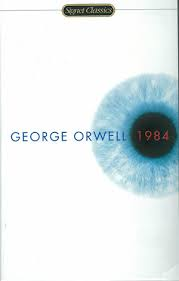
1984 by George Orwell, 1949

When I re-read a novel (as here) for the umpteenth time, I always look carefully for things I have forgotten or overlooked the last time. It’s surprising what you miss – I wrote about this here a while back. The first thing that struck me about ‘1984’ is what a brilliant opening it has. Not just the extraordinary first line – “It was a bright cold day in April, and the clocks were striking thirteen” – but the opening chapter. Orwell packs so much into these few pages it positively fizzes – Big Brother, the anti-sex league, the two minute hate, the Ministry of Truth, doublethink and newspeak. It’s such a detailed and comprehensive evocative of the new world we are plunged into that it is shocking.

Orwell was the first writer who spoke to me personally through his works, and I absorbed all his novels, even those he wrote simply for financial reasons, and would have been happy to have seen pulped, as well as his journalism, letters, and anything else available. So making a dispassionate judgment about 1984 is impossible, and I am not even going to try. Orwell’s fierce intellect shines from every line – this has to be the most quotable novel ever written, particularly when you think that it was not written as a series of epigrams (unlike, say ‘Dorian Gray’) but as a dystopian horror story. The concepts that Orwell develops in this novel have become part of our popular and political culture – ‘Big Brother’ for example, as a short-hand phrase to describe the over-intrusion of the state into our private lives, (as well of course as a reality TV gameshow). 1984 is a passionate warning cry against the evils of totalitarianism.

But, and there is always a but, post-war ration starved Britain had already rejected the hopelessness of ‘1984’. In electing a Labour Government with a mandate for radical change, they had decided that they didn’t have to settle for the permanent rule of the party, and that things didn’t always have to be dreary and hard. The proles had rejected the lie of the ruling class that things can never get any better. Orwell seems to have completely missed that sense of optimism. Winston Smith believes that if there is hope, it is with the proles, the working class. But the proles of 1984 are so easily distracted by pulp fiction, machine produced porn, and a fake lottery that there is never any prospect of them organising and gaining a class consciousness which would allow them to “rise from slumber, in unquenchable number”. By 1949 the Attlee Government was clearly struggling – was that really the time to warn of the risks of a Soviet takeover of Western Europe?

I can’t find the faintest trace of hope in 1984. Some readers claim the post-script essay on the introduction and development of Newspeak suggests IngSoc did not last, but that seems clutching at straws. By the end of the main novel, Winston is broken, looking forward to the bullet in the back of his head as a mercy. There is no suggestion that the future holds anything but the stamping of a boot on a face, forever.

Eton-educated George, or should that be Eric, was always a stranger in the slightly smelly, uncomfortable world of the working class. His sense of alienation from the working class – even, one could argue, his submerged class hatred – is vivid in 1984. They are an utterly alien species, with goldfish like memories, no class consciousness, and representing nothing of value. Winston is amazed at their stoicism, as well as their ability to reproduce so prolifically – Orwell shares similar sentiments in, for example, ‘The Road to Wigan Pier’. If the proles are the only hope, then there is no hope. I appreciate I am criticising ‘1984’ for not being a socialist manifesto, when of course it was never intended as such. But it handed a potent weapon to the critics of socialism, and all Orwell’s subsequent comments about the intention of his writing had little impact on the perception that he was a trenchant critic of English Socialism. Which is a pity, because there are few writers in the twentieth century who wrote as interestingly or as well as Orwell on social issues.

Standard
100 Best Novels Guardian list, 20th century Literature, Book review, H G Wells, HG Wells, humour, The History of Mr Polly

The History of Mr Polly by H G Wells, 1910

Most Victorian novels were about prosperous people. Yes, they sometimes had money worries, but they weren’t urban working class. Dickens changed all that, and people from all parts of the class spectrum became suitable subjects. However, the petit bourgeoise, the shop keeping class, technically bosses in that they were self employed, but dirt poor nonetheless, were largely ignored. That changed with the Grossmiths’ ‘Diary of a Nobody‘ in 1892, and ‘The History of Mr Polly‘ is an early entry in this ‘little man and his troubles’ or ‘white collar’ genre.

Mr Polly‘ opens with him sitting on a stile, grumbling. He hates his life. He doesn’t love or particularly even like his wife, he finds his job as a shopkeeper dull and unfulfilling, and he mourns the absence of any romance or culture in his life. He also suffers horribly from chronic indigestion, representative of his dissatisfaction with life. The first half of the novel is a flash-back from this point, chronicling how he has always felt this way, more or less, and how he reaches this nadir. He settles on suicide as the only logical escape and having made that decision implements his plan quite calmly. Inevitably he botches the job and in the process burns half his street down. Ironically this provides him, in the form of insurance money, an escape route and he runs away. The final section of the novel sees him settled as a handyman at a country pub, living a bucolic but largely culture-free lifestyle that seems to suit him. This life is threatened by uncle Jim, the nephew of the landlady, a thug who menaces her for money. Polly discovers the hero inside himself, stands up to Uncle Jim, and in comic bumbling fashion defeats him.

Polly is quite an engaging anti-hero. He reminded me of Anthony Burgess’s Enderby, one of my comic legends. He has a kind heart, and does his best to avoid causing harm. he takes the hardships in life as they come and looks for pleasure in small things. He has a way of mangling the language which is intended as humorous, and which just about manages to raise a smile. Despite his ineptitude in most things, somehow he manages to come out on top. Some of the set-piece scenes in the novel, such as his father’s funeral, where remote relatives descend on the wake and have a great day insulting one another, are enjoyable. If one looks hard for more serious themes, such as any traces of Wells’ Fabianism, they can be found, but the novel is not openly political. The main ‘message’ of Mr Polly’s history is that one should be true to oneself:

when a man has once broken through the paper walls of everyday circumstance, those unsubstantial walls that hold so many of us securely prisoned from the cradle to the grave, he has made a discovery. If the world does not please you, you can change it. Determine to alter it at any price, and you can change it altogether. You may change it to something sinister and angry, to something appalling, but it may be you will change it to something brighter, something more agreeable, and at the worst something much more interesting. There is only one sort of man who is absolutely to blame for his own misery, and that is the man who finds life dull and dreary”

Mr Polly didn’t have such a terrible life. While slowly going bust in his shop, he didn’t suffer the privations many people experienced, and enjoyed many of the comforts of his Edwardian idyll – an idyll that was to be lost forever just a few years after this novel was published.

Standard
100 Best Novels Guardian list, 20th century Literature, Book review, humour, Joy in the Morning, P G Wodehouse

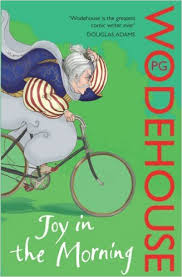
Joy in the Morning by P G Wodehouse, 1946

I had a fairly strong reaction when I last read some Wodehouse, and I suspect my record of the event is intemperate. Having calmed down I returned to ‘Joy in the Morning’ determined to be fair minded. In that same spirit of fairness I ought to acknowledge that Wodehouse has some heavy-weight admirers whose opinion I have rarely had occasion to doubt. Douglas Adams no less is quoted on the cover of this Arrow (2008) edition saying “Wodehouse is the greatest comic writer ever”, and Stephen Fry is on the frontispiece describing Wodehouse as the “funniest and finest writer”. High praise indeed.

Written in the early 1940’s during Wodehouse’s internment in France and Germany during the second world war, this novel tells in Bertie Wooster’s first person narrative the story of his adventures at his uncle’s country home in Steeple Bumpleigh, or in Wooster’s words “the super-sticky affair of Nobby Hopwood, Stilton Cheesewright, Florence Craye, my uncle Percy… is one of those imbroglios that Bertie Wooster believes his biographers will refer to as “The Steeple Bumpleigh Horror”.  The Guardian’s recent review described the novel as “both an elegy and an encore” – an elegy for a lost Edwardian Britain, and an encore because this is very familiar ground – Wodehouse recycled this very limited set of characters and situations endlessly. “


‘Joy in the Morning’ (and in my head I keep mixing this title up with ‘Morning Glory’ which is something entirely different) is a ‘greatest hits’ selection of comedic situations: the imposed engagement; a blazing country cottage; a nocturnal confrontation; a fancy-dress ball. The novel also contains an element of self-justification for Wodehouse’s involvement in what some considered war crimes, namely broadcasting on German radio from Berlin. “I doubt,” says Bertie, speaking of the writer Boko Fittleworth, “if you can ever trust an author not to make an ass of himself.”


Despite my best intentions I did find myself laughing out loud at some passages. Wooster is such an idiot. But overall the novel is not a success. It is over-long and predictable. Wodehouse claimed to work tirelessly on his plots, and farce well done does require tight plotting in order to be plausible, but the plotting here is a mess. It depends on people behaving in ways that are more than just ridiculous but utterly unbelievable: schoolboys burning houses down, successful businessmen agreeing to conduct private meetings at a fancy dress ball, policemen leaving their uniforms on the riverbank while taking a dip in the river, and so on. The resulting comic situations lose a lot of their impact when they are set up so clumsily – we know Wooster is going to lose an important birthday gift brooch, that Jeeves is going to come up with a cunning plan to rescue the situation, that the imposed engagement will fade away by the end


Wodehouse may have been a collaborator, and may have romanticised a lost Britain that depended on a rigid class system that virtually enslaved the working class to preserve the privilege of a small minority, but he could turn a phrase, for example “There was a sound in the background like a distant sheep coughing gently on a mountainside. Jeeves sailing into action.”


Wodehouse is adept at using the gap between Wooster’s weaknesses, his village idiot view of the world and reality, to comic effect; many of them are having an affectionate nod towards Shakespeare:


 “It was one of those cases where you approve the broad, general principle of an idea but can’t help being in a bit of a twitter at the prospect of putting it into practical effect. I explained this to Jeeves, and he said much the same thing had bothered Hamlet.”


“She came leaping towards me, like Lady Macbeth coming to get first-hand news from the guest-room.”


“You can’t go by what a girl says, when she’s giving you the devil for making a chump of yourself. It’s like Shakespeare. Sounds well, but doesn’t mean anything.”


The bromance between Wooster and Jeeves is as strong as ever, and even in this strangely sexless world, in which all a chap ever wants is to avoid being ensnared by an eligible young woman (what possible reason could Wooster have for not wanting to get married or be involved with any of the women who circle around him?) is quite touching. Jeeves and Wooster are only going to be apart for a few hours, but still say a tearful goodbye:


 “We part, then, for the nonce, do we?’

‘I fear so, sir.’

‘You take the high road, and self taking the low road, as it were?’

‘Yes, sir.’

‘I shall miss you, Jeeves.’

‘Thank you, sir.’
‘Who was that chap who was always beefing about gazelles?’
‘The poet Moore, sir. He complained that he had never nursed a dear gazelle, to glad him with its soft black eye, but when it came to know him well, it was sure to die.’
‘It’s the same with me. I am a gazelle short. You don’t mind me alluding to you as a gazelle, Jeeves?’
‘Not at all, sir.”

Standard