21st century literature, Anthony Horowitz, Conan Doyle, Crime, Holmes, Holmes and Watson, House of Silk, Sherlock

Book review: House of Silk by Anthony Horowitz

I would have thought that pastiches of the Sherlock Holmes oeuvre, of which this claims to be the first authorised by the Conan Doyle estate, would be one of the easiest to pull together. Each of the stories follows a fairly rigid pattern, and there are a series of boxes for any author to tick – Holmes with violin, tick, cocaine addiction referenced but not indulged, tick, London fog, rattling coach drives, cheeky Cockney urchins , Mrs Hudson making tea, Mycroft being inscrutable, and of course the dazzling deductions based on flimsy evidence (but never guesses, oh no). And with Dr Watson you have the most affable and gentle of narrators, always comfortably behind the pace, leaving the reader a sense of superiority – we can work out which is the Holmes in disguise character before he does, how the locked room is escaped from, etc. Horowitz sinks into the comfort of these clichés with an almost audible sigh, and the reader is granted 400 pages of predictable, unchallenging nonsense.


Another Conan Doyle tradition that Horowitz follows religiously is the tendency to not bother too much with plausibility. Raymond Chandler in the Simple Art of Murder famously described the Holmes stories as “mostly an attitude and a few dozen lines of unforgettable dialogue” and elsewhere, although I can’t find it now after at least five minutes on Google, picks apart the plot of The Hound of the Baskervilles, pointing out just how many absurdities and improbabilities the plot contains. Horowitz maintains this tradition with a plot that depends utterly on people being in the right place at the right time – for example Holmes’s escape from prison depends on him bumping into a prison doctor who he knows from a previous case, not to mention the bizarre behaviour of the Irish gangster who marries a man to exact revenge upon him, which as a plan has a number of flaws in it (ie a dependence on him being gay and thus not want sex with you, but prepared to marry you nonetheless!)
There is some updated knowingness here – we meet Moriarty, but he doesn’t play a part in the plot – and the concern for the underclass (for example the street children Holmes uses as his eyes and ears in back streets) missing in the Conan Doyle. Watson’s narration is set many years in the future, after Holmes’s death, which as a device adds nothing to the novel. As a deviation from the Conan Doyle tradition of having a near contemporaneous narration this seems a strange one to choose.
Nevertheless, Horowitz does a competent job throughout, without at any stage dazzling or impressing – the nearest he comes is during the unveiling of the villain at the close, which as described above doesn’t stand up to much if any scrutiny. In the back of my mind throughout the read was the way the recent TV series had grasped all of these conventions but not proven shackled by them, managing to remain true to the spirit of the original but reinventing Holmes for a modern generation. The House of Silk suffers significantly by comparison


.

Standard
21st century literature, Alan Hollinghurst, Book review, Booker Prizewinner, gay literature, The Line of Beauty

The Line of Beauty by Alan Hollinghurst

Continuing in my attempt to catch up with the best part of a life time of not reading Booker prize winners, I recently finished, not without a fair amount of persistence, Alan Hollinghurst’s “The Line of Beauty”. Hollinghurst is a slow writer – he has only written half a dozen novels in total – and the only other work of his I have read is the “Swimming Pool Library” which feels like decades ago.

This novel is a leisurely portrait of the life of a rather pampered young man in mid 1980s London, when Thatcherism was at its most rampant and Aids was beginning to have a dramatic impact on the lives of gay men.

Nick Guest leaves Oxford and lodges with the family of one of his undergraduate friends, Toby. Toby’s father Gerald is a Conservative MP. Nick is a Guest in more ways than one – welcomed as a lodger, his homosexuality is acknowledged by the family but largely on a “don’t ask, don’t tell” basis. Their’s is a social liberalism that has some clearly defined limits.

Nick begins his sex life with a romance with a black Local Government worker, but his affection for Toby remains undimmed. In parallel the political life of the family father develops, culminating in a visit from Mrs Thatcher which is vividly realised – I wonder if this was all Hollinghurst’s imagination, or whether he was present at something similar. Nick them moves on to a clandestine relationship with another Oxford friend, who keeps up a front of heterosexuality, and introduces Nick to a cocaine dependency.

The third phase of the novel sees things all fall apart. Aids takes Nick’s first boyfriend, then his second, and again in parallel Gerald’s political career falters over a financial and then sexual scandal, something the conservative party seemed to specialise in in the 1980s. Finally Nick is thrown out of the lodgings he has enjoyed for far too long, and takes an Aids test which he expects to be positive.

As a portrait of gay privileged life in the 1980s this is probably the definitive work, for what it is worth. But the novel had other attractions for me. Hollinghurst is particularly good at the detailed nuances of social interaction – words and gestures are accurately dissected for their meaning. This isn’t just the fact with the wealthy – the visit to the black, evangelical family of his first lover, Leo, where his sexuality is quite literally the love that dare no speak its name, is captured perfectly in all its ambivalence.

i didn’t fall in love with this book – the central character is far too unlikeable and unsympathetic, almost narcissistic – and it didn’t make me want to turn to more of Hollinghurst’s works. The Booker short list for 2004 was weak by comparison with some years, although this novel did beat David Mitchell’s Cloud Atlas, which by comparison was far more innovative and readable. But I was left admiring Hollinghurst’s craftsmanship, which is more than I can say for many of the other novels that have won the Booker subsequently.

Standard
21st century literature, Ark, Book review, Stephen Baxter

Ark by Stephen Baxter

“Ark” is the sequel to Baxter’s “Flood”, reviewed here a few days ago. This is a real doorstep of a book, as science fiction often is, which picks up the story several years before “Flood” ends. The central theme – a space rocket takes survivors to another world to avoid the apocalyptic flooding of earth – had already been heavily trailled in “Flood”, and Baxter covers some familiar ground in opening, presumably for the benefit of readers who hadn’t read the previous novel. (Incidentally, JK Rowling was a master of this – she always got the “what you missed” section out of the way early in the Potter novels, with considerable economy – although towards the end of the series she stopped bothering, on the grounds if you didn’t know Harry was a wizard etc then you had been living in a hole in the ground for the last five years. Anyway, back to “Ark”).

“Ark” has a very similar construction to “Flood” – short chapters following a large group of characters, with a few individuals at the core; occasional significant time jumps; a tendency to somewhat casually kill people off and usher in new generations quite regularly.  In fact this is probably best seen as a mirror novel of “Flood” with the only significant different being the terrain – space instead of earth and water.

Baxter indulges himself with a leisurely account of the early days of the flooded earth space programme, constantly threatened by the rising water and the human tide which accompanies it. The group of Candidates being trained to undertake the flight are examined closely, although I felt that the time jumps and the sudden deaths made it harder to care about any of them. Zane, the most vulnerable, was unconvincing – someone with his vulnerabilities and weaknesses would be unlikely to have passed the various vetting processes.

I think we all know without spending too much time considering the issue that long months and years in deep space would be terribly boring, and it is a challenge to the author to make them seem less so. He can fast forward decades in a page but we still return to the same setting with the same crew (give or take) and the same set of issues.

After ten years the crew reach Earth 2, which despite its flora and fauna and evidence of advanced intelligence is considered by most to be uninhabitable – leading to a three way split between them – some try to settle Earth 2, others decide to return to Earth, hoping that the waters had receded (they hadn’t!) and a third group vote to push on another unimaginable 30 years to a possible Earth 3. I would have liked to hear more about what happened on Earth 2, but this group is not mentioned again. The group that returns to Earth find Ark 2, an unlikely underwater settlement, but the main focus is on the group that travels on to Earth 3, giving us a lot more of the same. Planet fall, when it comes, is almost as much a relief for the reader as it must have been for the passengers.

I have no evidence for this, as usual, but my hunch is that what really interests Baxter is the speculative science behind inter-stellar travel, colonisation of new planets, etc, and the plot and characters in this novel as simply window-dressing around this core. Which isn’t really good enough is it?

Standard
21st century literature, Book review, Ian McEwan, Spy stories, Sweet Tooth

Sweet Tooth by Ian McEwan

Read in the Jonathan Cape hardback first edition.

Serena begins a relationship with the writer, Tom Haley, she is “running”, without telling him she is a “spy”. This provokes a strong reaction from one of her colleagues. Much of the novel is spent reaching this point, filling in Serena’s early love affairs, including one with a professor at her university who in later turns out, to little surprise, was leaking information to the Russians earlier in the Cold War.
Serena reads Haley’s short stories, and we are given detailed synopses of them, including extensive quotes. This gives us the stories within stories which gives the novel a complex structure. Eventually the details of the MI5 funding come out in the press, no doubt leaked by this jealous colleague, and the relationship reaches at crisis.  In the final chapter there is a revelation which reframes the rest of the narrative in a very similar way to the disclosure at the end of Atonement, and prompts the reader to look at the novel in a completely different light. This technique could be irritating – it’s not really necessary – but the successes of the novel elsewhere outweigh this distraction.
The central character appears to be an open, slightly delusional, slightly dishonest, and not very likeable character, and prior to the final chapter revelation I (and I think most readers) thought this was simply a flawed narrator of the kind we are very familiar with in much contemporary fiction. The fact that McEwan has gone further than this doesn’t I think take us anywhere particularly new – one kind of flawed perspective in a narrator is very similar to another; it is not as if we get any closer or indeed further away from “the truth”.
A couple of other moans before I try to get to why I read this novel in little over 24 hours. First, the period detail which McEwan tries so hard at getting right. The problem with this is that his trying is just too apparent – for example telling us the price of a pint of beer in 1974 (13p). Period detail needs to be accurate and appropriate, but not flaunted. Second, the plot developments, other than the final twist, and too obvious – the Cambridge don who turns out to be a spy is just a bit of a cliche, and can be seen a mile off; like-wise the boyfriend who is not just that much into sex with his hot girlfriend, who shockingly turns out to be gay. And so on. Lastly, the Monty Hall problem, which McEwan doesn’t spend too much time on, thankfully, has already been done in Mark Haddon’s “The Curious Incident” and comes across as tired here.
So why did I keep reading with such interest? McEwan’s prose style is mature and well crafted – there is rarely a false note with the language (as opposed to the plot). The central character is a bit wet and dim, always a few pages behind the reader and her associates, but is generally likeable and pleasant. Some of the period and geographic detail also struck a personal chord, and many of the other writers referenced were familiar. In itself that’s not enough to account for the interest, so I think what I am going to do is let the novel settle in my mind for a bit, maybe read some reviews and reread a few chapters, and come back to it in a few weeks.
Standard
21st century literature, Book review, Flood, Stephen Baxter

Flood by Stephen Baxter

Working on the basis that anyone Terry Pratchett decides to work with must be pretty damn good, I decided to give Stephen Baxter another try after “The Long Earth” (see review last month). “Flood” appeared to stand out from the other recommendations for reasons I haven’t decided upon. The name really tells you most of what you need to know about the premise of the book – the world floods in genuinely biblical proportions. The novel opens in the very near future with the release of a small group of hostages from their captives in Spain, a release facilitated by the Gates/Jobs/Branson like boss of one of the hostages. FloodFrom this point the waters begin to rise, and never stop, and we follow the lives of the hostages as they try to adapt, along with the rest of the world.

You can probably pencil in most of the main events along the way – the gradual breakdown of society, the development of enclaves of the rich, the move to a floating society – didn’t Kevin Costner cover this in Waterworld? There is little to keep you reading beyond the inevitable and unending succession of watery disasters. I didn’t identify with any of the principal characters, and I got the impression Baxter didn’t either, so lightly did he ink them in and so casually did he kill them off. The episodic nature of the description of the flood is reinforced by regular time jumps – several years pass between chapters, and if this is an attempt to avoid any boredom with the inevitability of the progression of the flood then it doesn’t work.

As a highly regarded science fiction writer the very least I would have expected from Baxter is some coherent science, but that is probably the most disappointing part of the novel – the attempts to explain the causes of the flood are pretty risible. There are some successful things about this novel – the description of a generation growing up never having known land for example worked well for me – this is a small consolation to what is otherwise another hugely disappointing work. I am going to persist however and have ordered the sequel “Ark” as something stubborn within me wants to know where Baxter is going with this.

Standard
21st century literature, Book review, Booker Prizewinner, Hilary Mantel, Wolf Hall

Wolf Hall by Hilary Mantel 2009

Wolf Hall won the Booker prize in 2009, and its sequel, Bringing up the Bodies, is the Bookies’ favourite for the 2012 prize. If it weren’t for this accolade I very much doubt if I would have read it, not being an historical fiction fan, and I certainly would not have persisted to the end of the 650 pages.
This is very much the “anti-Booker” – instead of the usual slim volume of sensitively crafted, flawed memories, this is a detailed recreation of the life of Thomas Cromwell. As always the best and first question to ask is “Why?” – which Mantel helpfully answers in a short Q&A published at the end of this Fourth Estate paperback edition. Mantel found Cromwell a mysterious figure, and decided to give him a voice. This she does very well – his portrait is well rounded and convincing. He comes over as a sympathetic figure, caught up in turbulent times, trying his best to follow his conscience whilst at the same time to survive and prosper.

Mantel draws heavily from the historical record, which is of course legitimate – Shakespeare did very much the same – and we get a detailed insight into the key characters from this crucial period in English history. There is, as you will have guessed, a faily big “but” coming. In fact, several. Where to begin?

First, everything takes such a long time to happen, and while we wait for Henry to divorce Katherine and marry Anne Boleyn the material used to fill the gaps is not interesting enough to carry the reader along – I confess I took a two week break half way through reading this, and only returned out of a sense of duty or stubborness.

Second, the author’s much criticised use of the male singular personal pronoun is deeply irritating. Usually, but not always, “he” is used to refer to Cromwell. The idea no doubt is to pull the reader closer into identifying with him, but it generates huge confusion virtually on every page, which is compounded by large blocks of dialogue and the use of the present tense. You can usually work out in the end who is being referred to, and devices to make the reader pause and think are often no bad thing, but here the main impact is one of irritation.

This confusion is made worse by the huge cast of characters, many with the same name, who are often lightly sketched. I gave up bothering to try to work out who was who, who was related by birth or marriage to who, and so on – the investment of effort and time wasn’t proportionate to the reward.

Finally, the title is simply a teaser for the second book in the series, (I am assuming it is a series – there are a lot of wives to go), Wolf Hall being the home of the Seymours. It is an evocative metaphor for the dog eat dog world Henry created amongst his court, but it is a bit of a cheat.

In the end, do we care enough about the central character to justify the 650 pages? I didn’t I’m afraid, and unless you are a big historical fiction fan (think Philippa Gregory or Alison Weir) I would not recommend this.

Standard
21st century literature, science fiction', Terry Pratchett, The Long Earth

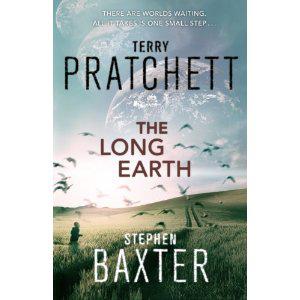
The Long Earth by Terry Pratchett and Stephen Baxter

Occasionally a new series is announced on television. The director is someone well known, the lead actors are famous, the production has obviously (from the trailers) had a lot of money spent on it. So you tune in with high expectations…. but end up a bit underwhelmed – the whole is less than the sum of the parts. Somewhere the story has been lost.

The premise of the novel is simple but well realised. The idea of multiple parallel universes has been around for a long time, but Pratchett/Baxter’s idea is to ask – “What if we could travel easily to and from these worlds?” This is the “Long Earth” of the title. The challenge these writers faced was to take this idea and overlay it with a story, without letting the conceit overwhelm the narrative. Broadly speaking I don’t think they achieved this. They explore a lot of the issues that the Long Earth presents – how would migration to these new worlds affect the old earth, what about those who are unable to travel, (stepping), what would the new worlds be like – almost like an intellectual exercise. New species and civilisations are discovered, but the heart of the novel is a journey to the far reaches of the Long Earth to discover a new form of intelligent life, that may or may not represent a threat to the rest of civilisation.

There are a huge number of threads left hanging at the end of the novel – the mysterious Black corporation, for example, is mentioned in passing as some kind of global MegaCorp, but this goes nowhere. Joshua the main character is built up as a messiah-like figure and there are references to “the Silence” that aren’t properly explored or explained. Equally there is little of the typical Pratchett whimsy – the organic matter that drives the stepping devices is a potato (why?), and we are told about but do not meet a religious cult that believes all of existence is a practical joke. There are also some obvious traces of Pratchett in the character of Lobsang, a hyper-intelligent robot that passes the Turing test and claims to be the reincarnated spirit of a Tibetan priest. But the lightness of touch which usually characterises Pratchett’s writing is largely missing. In its stead are long passages describing the journey West through the long earth. (Incidentally, the journey West is a deliberate and explicit echo of the journey across the Wild West of the USA, without the red indians/native americans.

Pratchett started a story based on the idea of the Long Earth and stepping between worlds, in the 1980’s, and abandoned it, presumably because he wasn’t able to craft a story out of it. DiscWorld might have got in the way a bit as well. Bringing in a sci-fi writer (Baxter is often described as a “hard sci-fi” writer – I can only guess this means he doesn’t normally include any fantasy element in his work) to help finish the work was misconceived – Pratchett already had the sci-fi component of his story, what he needed was a strong plot to bring to life the world he had created.

Despite a literal big bang, the book actually ends with a bit of a whimper, and it is made obvious that we are being invited to participate in a series of novels – the Long Earth perhaps becoming the new DiscWorld, with characters such as the police officer we meet but who has very little to do in this novel becoming more central, having their own plot lines, etc. If that inference is correct it is a fine ambition, and I am sure I will keep reading – for now.

Standard
21st century literature, Book review, Booker Prizewinner, John Banville, The Sea

The Sea – John Banville


Read in a Picador 2006 edition. Winner of the 2005 Booker prize.
A generic Booker prize winner is emerging from my reading of recent weeks. The short novel is narrated by an older character looking back on a formative incident from their youth – an incident that is not revealed until well into the novel. This incident has profoundly affected the later life of the main characters, but like the sun cannot be looked at directly, and has to be revealed slowly and through hints and subtle references. Other than this climactic event there is little plot development, and all the characters are seen through the prism of this incident. The typical 21st century Booker favourite is heavy on atmosphere and imagery, but light on some of the more traditional components of the novel such as story.
The Sea could almost have been written as a “How to win the Booker prize” exercise, ticking so many of these boxes. This does it a disservice however, because within the generic Booker candidate is a much stronger novel struggling to get out.
The plot is easily summarised: Max Morden, (a pun on “maximum modern”?) recently widowed, having lost his wife after a long illness, goes to drink himself quietly into oblivion in a seaside boarding house from his youth, where, many years earlier, “something happened” – the traditional formative experience. Max narrates the novel in a stream of consciousness which flits from one time period to another. Slowly the childhood summer where he met the Grace family is unfolded. While clearly distressed at the loss of his wife, the narrator is still able to craft elaborate metaphorical descriptions of the Grace family and their seaside summer.
In what way does this childhood experience make the man, as we are led to conclude? Why does being witness to a traumatic childhood experience, combining sex and death (and while this is a spoiler, apologies, the real surprise would have been if his childhood had not been marked by an experience combining sex and death, wouldn’t it?) make Max the man he becomes? Does it affect his ability to form adult relationships, make a career, or otherwise live his life? Apparently not – there is no real hint that his average career and average life has been affected by the incidents of this extraordinarily long summer.
The fallibility of memory is often a strong theme of these novels, but is played straight here. Max misremembers, adjusts his focus, admits to fallibility, but on other occasions when the authorial voice is stronger has a stroner grasp of time and place. While he recognises these memories may be fallible or flawed, this doesn’t detain him long – nothing comes of the gap between memory and reality.
The reviews quoted on the cover and back of this novel focus heavily on Banville’s use of language. He has a particular flair for imagery which while not directly associated with the thing being described, does have the effect of making the reader pause and reflect. At times this tips over into plain over-writing, such as when a farmyard is described thus – “Big shallow muslin-draped pans of milk lost in their own silence” (53). This doesn’t really mean anything, but has the effect, if you are like me, take another pass at the sentence. Most of the time though the imagery works well; seabirds dive like “torn scraps of rag” (64), a waiter approaches “tentative as a fox cub” (65); a car engine cools “still clicking its tongue to itself in fussy complaint” (79). I particularly liked the narrator’s description of lying in bed next to his wife like “toppled statues of ourselves” (99)
Banville (or is it Morden?) tiptoes on the border with nonsense so frequently that is not surprising that occasionally he oversteps – such as when “being alone with Myles was like being in a room which someone had just violently left” (83); or when Chloe’s teeth are described as having “a faint tinge to the enamel of her incisors that was green indeed, but a delicate damp grey-green, like the damp light under trees after rain, or the dull-apple shade of the underside of leaves reflected in still water” (138).
I have a sneaking suspicion that this is actually a great novel – or more specifically that Banville has the potential to write a great novel. The writing here is allusive, (I got lots of echoes of Eliot which I haven’t traced yet) complex, very clever, and improves with time – rereading for this blog very shortly after the first reading was a surprisingly pleasant experience, not having to worry about the distracting nonsense of the big reveal, and being able to just enjoy the writing instead. Absolutely this is a flawed novel, but would it be too patronising of me to say it shows great promise?
Standard
21st century literature, Book review, Waiting for Sunrise, William Boyd

Waiting for Sunrise by William Boyd

Be careful what you wish for – I was bemoaning the absence of a novel with a structure or plot, and this is what the bookshop’s shelves presented me with.
 
I normally start these entries with a plot summary to provide me with some means to remember the book by in months and years to come, as well as being at heart a traditionalist. This novel is itself deeply traditional – with one exception – it reads almost as a pastiche. Briefly, it follows the adventures of Lysander Rief, an improbably named actor who is in 1913 Vienna for psychiatric treatment of a sexual problem. This problem melts away when he meets another ex-pat, an English artist, Hettie Bull, who swiftly and artfully seduces him under the nose of her Austrian lover. Like most of the other problems in the novel this psychological issue is transient and easily solved – nothing much stands in our hero’s way. Hugely improbably Hettie later accuses him of rape when their affair leads to a pregnancy. Rather than being a serious threat to our hero this is simply a way to disguise their affair from her sculptor common-law husband. Despite the charge being transparently fabricated, Lysander escapes Vienna in a comic disguise with the help of some shadowy embassy officials. It is hard to take this or any other peril he faces seriously when all problems fade away so easily.
 
This is the start of his wartime career as a spy, and where the Buchan pastiche really gets going. The embassy officials contact Lysander back in the UK. He has joined up on the declaration of war but been posted to an internment camp in Wales. On the pretence of collecting payment for the legal and bail bill incurred in Vienna they persuade him to travel back to Europe to track down a spy. He brutally tortures the relevant information out of an embassy official who dies of a heart attack shortly thereafter – we can never be entirely sure if this is as a result of the torture, but quite possibly. Another comedy disguise allows escape back to the UK, despite his being shot in transit by a fellow spy as the result of a misunderstanding. All this promises mystery and suspense that never quite materialises, but the recovered code points to a mole in a UK Government War Ministry, which Lysander, once quickly recovered from his wounds, infiltrates. Uncovering the mole is a business-like affair, quickly done, and the book shudders to a halt with the spy’s eventual perfunctory revelation and dispatch. There is no twist in the tale or denouement beyond the resolution we had been shown 100 pages earlier.
 
Throughout the novel false trails are laid none of which go anywhere. Mysterious characters are sketched in and then fade away and are forgotten. The front line of the war is visited briefly in the manner of a tourist, and the solution to the various puzzles thrown in Lysander’s way can all be resolved without much effort. This all adds up to an author on auto-pilot.
 
I mentioned earlier one instance where this novel differs from its Edwardian predecessors, and that is in its frank treatment of sex. Lysander effortlessly sleeps his way though the book, with none of the women immune to his charms. The treatment of women in this novel has not been picked up on by any of the reviewers I have read, but to me it was ridiculous – he only has to snap his fingers for corsets to be unbuckled and stays removed, an Edwardian James Bond.  
 
If fiction which is unchallenging and instantly forgettable – and I found myself having to check on the novel’s bland title – is to your taste then I would have thought an original, such as Riddle of the Sands or 39 Steps would be much more rewarding fare.
 
 
Standard
21st century literature, Booker Prizewinner

Supplementary: The Sense of an Ending (2) – Julian Barnes

I wanted to add a few comments to my notes on Julian Barnes’s “A Sense of an Ending”. I have spotted what I think is a significant flaw at the heart of the novel, although to be fair it is one that is not apparent on a casual read. 

The novel’s primary theme is the imperfection of memory, which the narrator describes more eloquently as “some approximate memories which time has deformed into certainty” (page 4), and “that certainty produced at the point where the imprefections of memory meet the inadequacies of documentation” (page 17). To illustrate this the letter Tony writes to Adrian and Veronica is exhibit A. In Tony’s memory this letter is unremarkable:

“as far as I remember,I told him pretty much what I thought of their joint moral scruples. I also advised him to be prudent” (page 42) 

– all fairly restrained, dignified stuff. The actual letter is far more robust, and is positioned by the narrator as being the cause of all the subsequent problems in their various relationships.

But this doesn’t work, because when Tony describes his recollection of the letter he is already aware of what he wrote, he has seen the original – unless we are being invited to understand that the narration of part one is divided from part two by the reading of Mrs Page’s will.

While possible that is unconvincing – why would Tony record the events of part one unless to provide background to part two? So he already knows his language was harsher than he describes it in his softened page 42 version. This is important to the understanding of Barnes’s central theme, that memory is fallible, but that documentary evidence can often teach us how flawed our memory is. Here the documentary evidence is to hand, but Tony still presents us with the pre-documentary version.

I appreciate that I need to set this out more clearly, but for now I think my central point is that the points Barnes are discussing are not fully thought through.

Standard