100 Best Novels Guardian list, Book review, Classics, Conan Doyle, Detective fiction, Holmes, Holmes and Watson, http://schemas.google.com/blogger/2008/kind#post, Sherlock

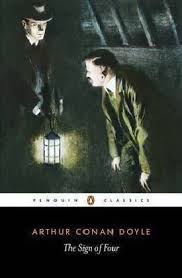
The Sign of the Four – Conan Doyle – 1890

Or, if you prefer, ‘The Sign of Four’, which is I think the better known version of this novel’s title. There is quite a significant difference between the former – meaning a sign which collectively represents four people – and the latter, which means simply 4. But as the sign itself plays no real part in the plot, other than contributing to the overall effect of mystery, the point is moot. (Just as a further irrelevant aside, in later short stories Watson refers to the case as The Sign of Four).

A quick plot summary might be a good place to start. This is an early Holmes story, where many of the familiar tropes of the sequence are just being established. Here we see the first incarnation of Holmes’ famous, if nonsensical, epithet “when you have eliminated the impossible, whatever remains, however improbable, must be the truth”. (140) We see Holmes, bored, and taking cocaine – a 7% solution – which he also offers to Watson. The method whereby Holmes is able to make fantastically accurate deductions about people from minor aspects of their appearance and behaviour is used at the opening of the novel, serving little purpose other than entertainment to relieve the boredom, and is disregarded once the crime is under investigation. And of course there are the Baker Street irregulars, the blundering police, and the mastery of disguise. All the elements are here, early on in his career.

The crime itself is, as usual with Holmes and Watson, obscure, yet easily solved. Indian treasure, pillaged from Agra during the First War of Independence, is hidden in a house in the London suburbs. One of the gang cheated out of his share of the prize returns to steal it, and in the course of the burglary someone is murdered. The villains hide on a boat on the Thames, but are chased down and captured. During the chase the treasure is thrown overboard and lost. In a lightly done parallel plot Watson falls in love with, woos, and becomes engaged to be married to the client who brings them the mystery – Watson is quite a fast worker!

Holmes’s powers are not taxed greatly. The murderer leaves footprints at the scene, and a trail of tar from the scene to their hideaway. The murderer’s accomplice has previously been seen shadowing the victim’s father, and leaves marks of his wooden leg outside the window. There is little attempt at concealment or deception. Holmes is slightly delayed in capturing the villains by their cunning ruse of hiding their boat in a boatshed, which it takes a particular genius to discover. It’s all done and dusted in less than a hundred pages, with plenty of time for some light drug taking and observational parlour tricks.

How does one explain the enduring appeal of the Holmes stories? Victorian England couldn’t get enough of the curmudgeonly consulting detective, forcing Conan Doyle to bring him back after the Reichenbach Falls attempt to kill him off. It can’t be the thinly constructed plots. While Holmes and Watson (and Mrs Hudson) may have survived as characters, the novels and stories themselves are little read, and usually discarded in any adaptation. Holmes represents the victory of rationalism and reason against the forces of nature and the threatening world outside our borders. It is hardly surprising that the villains in Holmes’ adventures are invariably foreigners, threatening our great British institutions. Tonga, the Andaman islander with the feet of a child, is described in purely animalistic terms. When first spotted on the boat, he is “a dark mass which looked like a Newfoundland dog”. (178) Closer up he seems to Watson to be a “savage, distorted creature. He was wrapped in some sort of a dark ulster or blanket, which left only his face exposed, but that face was enough to give a man a sleepless night. Never have I seen features so deeply marked with all bestiality and cruelty. His small eyes glowed and burned with a sombre light, and his thick lips were writhed back from his teeth, which grinned and chattered at us with half-animal fury” (178) Only half-animal Watson? Holmes can defeat any puzzle, any challenge, with the application of logic and knowledge. The world can be tamed. The fact that this is all smoke and mirrors, and that the final resolution usually depends on a pistol or noose rather than a logic puzzle, is passed over quickly.

If you have read any of my previous attempts at close textual analysis you might want to try the game yourself. Here are two passages from ‘The Sign of the Four’ which jumped out at me. The first describes Mary Morstan, Holmes’s client and Watson’s love interest, seen from Watson’s perspective:

“She was seated by the open window, dressed in some sort of white diaphanous material, with a little touch of scarlet at the neck and waist. The soft light of a shaded lamp fell upon her as she leaned back in the basket chair, played over her sweet, grave face, and tinting with a dull metallic sparkle the rich coils of her luxuriant hair. One white arm and hand drooped over the side of the chair, and her whole pose and figure spoke of an absorbing melancholy. At the sound of my footfall she sprang to her feet, however, and a bright flush of surprise and of pleasure coloured her pale cheeks.”

The colours are interesting – virginal white, diaphanous like a wedding dress perhaps, but with some touches of scarlet at the neck and waist, suggesting something more carnal? None of these details are accidental, from the observation that she is sitting in a basketchair, (baskets usually being used for possessions) to the fact that her “white arm” is drooping over the side of the chair. Why the whiteness of her arm needs to be emphasised here, given we have already established her ethnicity and dress, is worth asking, and what is suggested by the fact her arm droops rather than rests?

In the second scene I have picked out, Holmes and Watson are watching the boat yard, and while they do so they spot some workmen coming from work: Holmes says:

’See how the folk swarm over yonder in the gas-light’
‘They are coming from work in the yard’
‘Dirty looking rascals, but I suppose everyone has some little immortal spark concealed about him. You would not think it, to look at them. There is no a priori about it. A strange enigma is man’” (177).

This reverie is interrupted by the signal that the suspects are leaving.

The verb choice “swarm” is telling here, even though describing working men in these terms was not unusual – they are alien, threatening. But Holmes comes close to doubting their humanity. What does this tell us about the portrayal of class in late Victorian literature?
Standard
100 Best Novels Guardian list, Book review, Classics, http://schemas.google.com/blogger/2008/kind#post

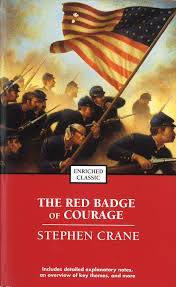
The Red Badge of Courage – Stephen Crane – 1889

I am not sure whether this is really a novel in the traditional sense of the word. It’s very short – about 125 pages – and there is very little plot or characterisation. The events of the novel, (a term I will retain for convenience’ sake), take place over a couple of days during the course of a battle in the American Civil War. They are shown largely from the perspective of a raw recruit, who initially is terrified, and runs away, but once he gains his “red badge of courage” (i.e. a wound) he finds new reserves of bravery, and takes an active part in the remainder of the battle.

The novel was written over 25 years after the end of the war. You would in the normal course of events have expected the novel to be part of the healing process, the rebuilding of the nation – if not, why write it in the first place? The soldiers on both sides of the battle are shown as human and fallible – they show fear, lie, gossip, cuss, and die. They do heroic things and cowardly things side by side, they have a healthy contempt for their leaders, (although the narrator allows the reader to see that the officers are reasonably good at their jobs, even if that includes being cold-blooded about potential casualties) and rarely have anything other than the sketchiest of ideas what is going on in the confusion of the battle. The politics of the war are ignored completely, including the most obvious issue of slavery, which is not mentioned. This arguably gives the novel some verisimilitude, but the reality was the given both armies were volunteer forces, soldiers would have had some idea of why they were fighting, and may have cause to mention it from time to time. Ignoring slavery allows the novel to appeal to both North and South, but is still a puzzling omission given the novel is written entirely from a Unionist (northern) perspective.

Crane uses some interesting techniques to give atmosphere and credibility to his novel, making it in some ways similar to a survivor’s account of the battle. He uses short chapters, making the narrative move quickly. The principal character – Henry Fleming – is almost always referred to as “the youth”, giving him an everyman status, and the other characters are usually referred to in a similar way – the tall soldier, the loud soldier, etc. – to depersonalise them. The soldiers’ heavily accented language is recorded phonetically to give the narrative a sense of authenticity. The point of view stays closely with the youth, and we see what he sees, feel what he feels. The novel’s language focusses on colour, giving an almost impressionist feel to the descriptive passages that form the core of the narrative.

Given the absence of plot or characterisation, it is hard to understand why this is considered a great American novel, or one of the definitive novels of the American Civil War. It seems a calculated attempt to show the war not as a series of great set piece battles where the field of combat was bestrode by might men doing might deeds, but as peopled by real, flawed, people, pushed on by fear of death and failure. I can only speculate, but I suspect the answer is somewhere in this mix. The Civil War was, and remains, America’s bloodiest conflict. The scale of the national trauma was hard for Europeans to imagine, particularly given that America had only been an independent country for less than a hundred years. Civil wars must be much harder to recover from as a country than wars fought against a common enemy. Once the war is over you have to somehow carry on living and accepting the defeated enemy, which remains part of your country. So showing that the war wasn’t a struggle of good versus evil was probably part of that healing process. I read this novel in a Wordsworth edition, which includes two other short stories by Crane. The first, The Veteran, published in 1893, shows Fleming, the protagonist of the Red Badge, much later in life, and acts as  a useful coda to the Red Badge. As a survivor of the war he is a greatly respected member of his community, but he refuses to romanticise his experiences:

“Could you see the whites of their eyes?” said the man who was seated on a soapbox.
“Nothing of the kind” replied old Henry warmly, “Just a lot of flitting figures, and I let go at where they ‘peared to be the thickest. Bang”
“Mr Fleming” said the grocer – his deferential voice expressed somehow the old man’s exact social weight – “Mr Fleming, you never was much frightened in them battles, was you?”.
The veteran looked down and grinned…”Well I guess I was, he answered finally”. Pretty well scared, sometimes”. (121)

He even has the courage, in old age, to admit his cowardice in his first battle, despite his tarnishing his image in the eyes of his grandson. So the civil war wasn’t a romantic struggle, it was at best a necessary evil.
Standard
100 Best Novels Guardian list, Book review, Classics, http://schemas.google.com/blogger/2008/kind#post, humour, Jerome K Jerome, Three men and a boat

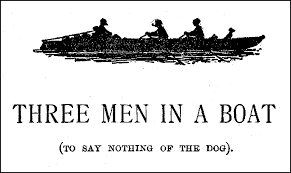
Three Men in a Boat (not to mention the dog) – Jerome K Jerome – 1889

Mildly amusing. Whimsical. Harmless  These are the words that come to mind when I reflect on the experience of reading this Victorian “classic”. For some reason, while many comic novels age appallingly, Three Men in a Boat seems bullet-proof against the passage of time. It is feather-light – there is no plot to speak of, very few events, no characterisation, or only the barest. The title sums up pretty much all you need to know about the novel – three middle class single men of indeterminate age or occupation take a short trip in a rowing boat up the Thames. It rains. They fall in occasionally. The narrator tells several stories of similar incidents on similar trips. These stories all follow the same pattern – the principal character is hugely over-confident in his own abilities – to sail, hang a picture, pack a bag, navigate a maze etc. – and retains this over-confidence in the face of every failure.

I am clearly missing something, because many online reviewers describe this novel as “laugh out loud”, and it has never been out of print. The lead review in Amazon goes to far as to say “If you don’t love this book, and don’t weep laughing whilst reading it, then there’s something wrong with you”. I can’t recall ever weep laughing at any novel, let alone one with so flimsy an appeal. There is admittedly a whimsical charm to the whole enterprise, and the appeal to a late Victorian bygone era where the outside world rarely intrudes is clear. There are however a few points in the novel where this approach is discarded, and these jar badly. Mostly these are the scenic descriptions which were the novel’s original premise, (it was commissioned as a travel book) and they do not fit at all with the tone of the rest. But there is also a casually gratuitous use of a racial slur – the n-word – which may have been acceptable in the 1880’s but is hateful now. Possibly even worse, there is a description of a suicide. I can only assume Jerome included this distressing scene – a woman falls pregnant without being married, and, shunned by her family and friends, she finally ends it all by drowning herself in the Thames, to be discovered by our three men – as a contrast to the nonsense about frying pans and banjos. Victorians were famously mawkish and sentimental, so presumably this also seen as justification for this scene, but to a contemporary reader it is deeply uncomfortable.
So in a way I feel that, as does happen sometimes, I have failed. Failed to unlock this novel, to find a way of reading it that gives it some value, the value others clearly believe it to have. Which is of course nagging me. I was tempted to try to read this as social commentary, a reflection on late Victorian England, a period of change of course as technology gathered pace and the lower classes began to find their voice. The three men are clumsy buffoons, but there are closer to Grossmith’s Mr Pooter, or indeed Wells’ Mr Polly, than Wodehouse’s much later creations. This is a confident, relaxed country, peopled by citizens not afraid to assert their challenge to order – the boatmen for example are very clear that fencing off backwaters on the Thames is reprehensible, and signs denying picnickers the right to rest on land adjoining the river are to be ignored – no great respect for property rights are shown. But in all honesty this remains thin stuff, nostalgic and comfortable compared to much of the challenging literature being written elsewhere around this time. So for now I admit defeat – there must be a reason why this novel remains so popular, but what that is I cannot tell.
 
Standard
100 Best Novels Guardian list, 20th century Literature, Book review, Classics, http://schemas.google.com/blogger/2008/kind#post

Supplementary: A Passage to India – E.M.Forster (1924) (2)

This blog entry follows on from the previous review of A Passage to India, and focuses on the novel’s opening paragraph. This kind of detailed, deep dive analysis of text is a different approach to the reviews I have been writing over the last couple of weeks.

“Except for the Marabar caves – and they are 20 miles off – the city of Chandrapore presents nothing extraordinary.

This is an unusual opening. Novels usually tell us that the scene they are about to describe will be interesting, not “nothing extraordinary”. The term “presents” is a hint that there will be a difference between the outward appearance of the city, and what is to be found behind the façade. Obviously, the reference to the caves is a hint that these are to play a key part in the novel’s events, and come back to mind when the trip to the caves in being planned, and underway. Overall the tone here, deliberate I suspect, is of a sneering Victorian tour guide, summarising the merits or otherwise of this backwater for the benefit of our incoming tourists, Mrs Moore and Miss Quested.

Edged rather than washed by the river Ganges, it trails for a couple of miles along the bank, scarcely distinguishable from the rubbish it deposits so freely.

Here the description strikes an even more unusual note. Firstly, what is the difference between edged and washed, a distinction the narrator takes care to point out. The simple answer is dirt – the river runs past the city, regardless of verb choice, but does not flood, and therefore the city remains filthy. This description is reinforced by the verb choice “trails” – the city lacks energy, spreading itself pointlessly along the banks of the river. It – the city – must be relatively small if it only runs ( a more traditional verb choice) for two miles, but it is “scarcely distinguishable from the rubbish it deposits”. Hold up – the narrator tells us that he cannot tell the difference between the city and the rubbish it produces. It is a rubbish tip. In any other context this would be dismissed as ridiculous hyperbole – no city in the world, however polluted, is indistinguishable from a rubbish tip. This is more than hyperbole – it is abuse.

There are no bathing steps on the river front as the Ganges happens not to be holy here;

Another sentence that is easy to pass by, but once more, hold up. The Ganges is the holy river of Hinduism, and that holiness doesn’t switch on and off as the river passes through the landscape. Forster must surely have known that. So what is he doing saying this? Is the reader being invited to question the narrator’s veracity (this early in the novel)? Is Forster assuming lazily that his readers will allow this to pass, being ignorant of other faiths? This is part of the “nothing to see here” lacklustre description of the city, but I find this approach puzzling – if Forster wanted to imagine a non-descript city in the middle of India, why set it on the banks of one of the greatest rivers in the world? And then proceed to ignore this setting for 300 or more pages?

indeed there is no river front,

What? For an innocuous piece of description this is the third time in two sentence that I have to ask that question. No river front? Ignoring the fact that a few lines earlier we have been told that the city trails along the river bank (I appreciate that there is a subtle difference between a river bank and front), why would a city be built on the bank of (to repeat myself) one of the greatest rivers in the world, and then effectively turn its back on it? Surely one of the reasons the river is worshipped as a God is because of its life-giving properties. The citizens of Chandrapore would need access to the river for water, for washing, for cremations, for leisure – the idea that they would ignore this incredible resource beggars belief. By now this narrator is losing credibility. This is not a realistic portrait that is being painted, which alerts the reader to the fact that there is more to Chandrapore than we are being led to expect.

and bazaars shut out the wide and shifting panorama of the stream. The streets are mean, the temples ineffective, and though a few fine houses exist they are hidden away in gardens or down alleys whose filth deters all but the invited guest.

Here we have filth again. The narrator/Forster’s sense of disgust with this city is palpable. One has to ask, in what sense are the temples “ineffective”. Presumably architectural, although there may be a small comment on the spiritual ineffectiveness of these foreign religions.

Chandrapore was never large or beautiful but 200 years ago it lay on the road between Upper India, then imperial, and the sea, and the fine houses date from that period. The zest for decoration stopped in the 18th century, nor was it ever democratic. There is no painting and scarcely any carving in the bazaars.

Confirmation, if it were needed, that this is a tour guide, or an effective parody of one. The emphasis on the absence of tourist goods in the bazaar and the imperial history of the town put the reader in the role of armchair traveller, learning about the city by proxy, but guided by a very unreliable mentor.

The very wood seems made of mud, the inhabitants of mud moving.

What wood? The wood of the carvings which scarcely can be found? Or something else – this is ambiguous, but leads to the next thought – the people of Chandrapore are “inhabitants of mud”. Literally of course this means ‘people living in mud – that is, the mud-like wood” – but the very clear reference is to ‘people of mud’ – that is mud-people. This is an old racist taunt which JK Rowling references in her use of the term “mud-blood” as a deeply offensive term, as indeed it is.

So abased, so monotonous, is everything that meets the eye, that when the Ganges comes down it might be expected to wash the excrescence back into the soil.

We return to the Ganges. I take the phrase “come down” to mean flood or burst its banks. Excrescence is a powerful word, expressing a sense of disgust, and the speaker here seems to anticipate a flood almost wishfully, looking to see a cleansing of the filth that appals him so much, back into the soil – note back into, not just into, again referencing the idea that the people of India have arisen from the soil, are people of mud.

Houses do fall, people are drowned and left rotting, but the general outline of the town persists, swelling here, shrinking there, like some low but indestructible form of life.

As throughout this paragraph, there is ambiguity here. The tour guide voice has been abandoned for something much more expansive. It is not clear whether “houses do fall” (as opposed to ‘houses fall’) refers to what happens when the Ganges comes down, or as something that periodically happens in any event. People are drowned and left rotting is also ambiguous – if people drown their bodies would normally be washed drown stream, or eaten by crocodiles. This phrase could mean either ‘people are drowned, and then their bodies are left to rot’ or ‘some people drown, and others die in the streets where their bodies are left to rot’. The ambiguity doesn’t rest there – people are drowned actively, rather than drown passively – is this something done to them, or something that happens. Leaving bodies to rot is unlikely to be something that actually happened in India other than in a major disaster, but the narrator gives the impression it is a common occurrence.

Here as throughout ‘A Passage to India’, the narrative voice shifts subtly, and can never be trusted. In an apparently innocuous scene-setting paragraph, numerous under-currents lead the reader to understand that India may seem harmless, but if you scratch the surface you will find it threatening, distressing, and dangerous. Miss Quested is about to find that out.

Standard
Alice in Wonderland, Book review, http://schemas.google.com/blogger/2008/kind#post, Lewis carroll

Alice’s Adventures in Wonderland – Lewis Carroll – 1865

Why read “Alice”? Isn’t it a children’s book? And haven’t you already absorbed every detail of it, through cultural osmosis. After all, every scene is iconic, every character very well known, (the white rabbit, the mad hatter, the Cheshire Cat, and so on) – even many of the phrases – “off with his head”, “Curiouser and curiouser”, “I’m late” etc. – have entered the language. Is there anything left to be learnt?

A little. For every book that falls into this category – very well known, but very little read – reading the novel, in this case for the first time, in other cases for the first time for decades – is a very interesting experience. What characters and scenes have entered the cultural lexicon, and which missed the cut? In Alice an extraordinary proportion of the scenes have made it. Reading the novel was like revisiting familiar childhood scenes. There were very few chapters or scenes that were not well known, and that had survived the transition from book to popular knowledge largely intact – the Mad Hatter and the March Hare are exactly as random and bizarre as you think they are going to be, the Cheshire Cat and the Caterpillar are slightly creepy, and the Mock Turtle sadly irritating.
The Internet will tell you that Alice is a satirical portrayal of Victorian England, with disguised portrayals of political and other prominent, and that the nonsense comments of the characters either are coded commentary on the events of the day, or simply a portrait of the topsy-turvy nature of society – “We are all mad here”. Critics have been able to divine critiques on the Monarchy, colonialism, evolution, politics both left and right and many others in Alice – how fruitful these attempts at decoding the text have been is debateable. Alice is a wonderful children’s book, where the dream-like transitions from one bizarre situation to another, capture perfectly a child’s flexible perspective on the world. I suspect it is that aspect of the novel, rather than its “hidden” meanings, that have made it so popular, and why the characters have been so resilient, when other Victorian children’s literature – The Water Babies for example – have faded from the popular imagination.  

One other point – the book is very short, can be read in a couple of hours, and is free on the Kindle, which is where I read it – so why not try it? The Kindle edition, although free, does not have any of the wonderful illustrations that form such a large part of the book’s impact. Mervyn Peake illustrated the book for one edition, which is worth getting your hands on if you can – if not take a look at his extraordinarily powerful drawings on the web.
Standard
http://schemas.google.com/blogger/2008/kind#post

Comment: More on Book lists

Last month the Guardian published another of the “100 best novels written in English” lists that appear from time to time. Quite why they did so, other than to generate more traffic for their website, escapes me. The suspicion that this is no more than clickbait intensifies when you consider the detail of the list – some really strange choices such as the omission of “Pride and Prejudice” and “Brideshead Revisited”, to mention just two, as well as the inclusion of some obscure novels such as “Mrs Palfrey at the Claremont” by Elizabeth Taylor, “Zulieka Dobson” by Max Beerbohm, and “Hadrian the Seventh”, by Frederick Rolfe, none of which I had heard of before. To be fair to Robert McCrum, who complied the list, he has accepted the arbitrary nature of many of his choices. Some of the online comments on the list are pretty hilarious by the way – for example the observation that
 
“This list is about maintaining the cultural elite’s stranglehold on what is to be regarded as acceptable reading matter. It’s a list of 100 cultural hoops that the socially aspiring are expected to jump through in order to have a chance of joining their ‘intellectual betters’.”
It’s fair to say it is a reasonably conservative list, but what other kind of “Best 100 novels in English” are there?

I have read roughly 30 from this lis. That seems a bit low, but it is an honest figure, and I have avoided counting books that I am not sure about, such as “Robinson Crusoe” or “Alice in Wonderland”. Of the 30 I have blogged here about 10 of the novels. I am toying with the idea of working my way through the list once my recent focus on the Great War has died down. For anyone who is unable to work their way to the Guardian website, here’s the list, in chronological order, with books read in italics, and books blogged about in bold.

1. The Pilgrim’s Progress by John Bunyan (1678)


2. Robinson Crusoe by Daniel Defoe (1719)


3. Gulliver’s Travels by Jonathan Swift (1726)


4. Clarissa by Samuel Richardson (1748)


5. Tom Jones by Henry Fielding (1749)


6. The Life and Opinions of Tristram Shandy, Gentleman by Laurence Sterne (1759)


7. Emma by Jane Austen (1816)


8. Frankenstein by Mary Shelley (1818)


9. Nightmare Abbey – Thomas Love Peacock (1818)


10. The Narrative of Arthur Gordon Pym of Nantucket by Edgar Allan Poe (1838)


11. Sybil by Benjamin Disraeli (1845)


12. Jane Eyre by Charlotte Brontë (1847)


13. Wuthering Heights by Emily Brontë (1847)


14. Vanity Fair by William Thackeray (1848)


15. David Copperfield by Charles Dickens (1850)


16. The Scarlet Letter by Nathaniel Hawthorne (1850)


17. Moby-Dick by Herman Melville (1851)


18. Alice’s Adventures in Wonderland by Lewis Carroll (1865)


19. The Moonstone by Wilkie Collins (1868)


20. Little Women by Louisa May Alcott (1868-9)


21. Middlemarch by George Eliot (1871-2)


22. The Way We Live Now by Anthony Trollope (1875)


23. The Adventures of Huckleberry Finn by Mark Twain (1884/5)


24. Kidnapped by Robert Louis Stevenson (1886)


25. Three Men in a Boat by Jerome K Jerome (1889)


26. The Sign of Four by Arthur Conan Doyle (1890)


27. The Picture of Dorian Gray by Oscar Wilde (1891)


28. New Grub Street by George Gissing (1891)


29. Jude the Obscure by Thomas Hardy (1895)


30. The Red Badge of Courage by Stephen Crane (1895)


31. Dracula by Bram Stoker (1897)


32. Heart of Darkness by Joseph Conrad (1899)


33. Sister Carrie by Theodore Dreiser (1900)


34. Kim by Rudyard Kipling (1901)


35. The Call of the Wild by Jack London (1903)


36. The Golden Bowl by Henry James (1904)


37. Hadrian the Seventh by Frederick Rolfe (1904)


38. The Wind in the Willows by Kenneth Grahame (1908)


39. The History of Mr Polly by HG Wells (1910)


40. Zuleika Dobson by Max Beerbohm (1911)


41. The Good Soldier by Ford Madox Ford (1915)


42. The Thirty-Nine Steps by John Buchan (1915)


 43. The Rainbow by DH Lawrence (1915)


 44. Of Human Bondage by W Somerset Maugham (1915)


  45. The Age of Innocence by Edith Wharton (1920)


 46. Ulysses by James Joyce (1922)


 47. Babbitt by Sinclair Lewis (1922)


 48. A Passage to India by EM Forster (1924)


 49. Gentlemen Prefer Blondes by Anita Loos (1925)


 50. Mrs Dalloway by Virginia Woolf (1925)


51. The Great Gatsby by F Scott Fitzgerald (1925)


52. Lolly Willowes by Sylvia Townsend Warner (1926)


 53. The Sun Also Rises by Ernest Hemingway (1926)


 54. The Maltese Falcon by Dashiell Hammett (1929)


 55. As I Lay Dying by William Faulkner (1930)


 56. Brave New World by Aldous Huxley (1932)


 57. Cold Comfort Farm by Stella Gibbons (1932)


 58. Nineteen Nineteen by John Dos Passos (1932)


 59. Tropic of Cancer by Henry Miller (1934)


 60. Scoop by Evelyn Waugh (1938)


61. Murphy by Samuel Beckett (1938)


62. The Big Sleep by Raymond Chandler (1939)


 63. Party Going by Henry Green (1939)


64. At Swim-Two-Birds by Flann O’Brien (1939)


 65. The Grapes of Wrath by John Steinbeck (1939)


66. Joy in the Morning by PG Wodehouse (1946)


67. All the King’s Men by Robert Penn Warren (1946)


 68. Under the Volcano by Malcolm Lowry (1947)


 69. The Heat of the Day by Elizabeth Bowen (1948)


 70. Nineteen Eighty-Four by George Orwell (1949)


 71. The End of the Affair by Graham Greene (1951)


 72. The Catcher in the Rye by JD Salinger (1951)


 73. The Adventures of Augie March by Saul Bellow (1953)


 74. Lord of the Flies by William Golding (1954)


75. Lolita by Vladimir Nabokov (1955)


76. On the Road by Jack Kerouac (1957)


 77. Voss by Patrick White (1957)


78. To Kill a Mockingbird by Harper Lee (1960)


 79. The Prime of Miss Jean Brodie by Muriel Spark (1960)


 80. Catch-22 by Joseph Heller (1961)


 81. The Golden Notebook by Doris Lessing (1962)


 82. A Clockwork Orange by Anthony Burgess (1962)


 83. A Single Man by Christopher Isherwood (1964)


84. In Cold Blood by Truman Capote (1966)


 85. The Bell Jar by Sylvia Plath (1966)


 86. Portnoy’s Complaint by Philip Roth (1969)


 87. Mrs Palfrey at the Claremont by Elizabeth Taylor (1971)


 88. Rabbit Redux by John Updike (1971)


 89. Song of Solomon by Toni Morrison (1977)


 90. A Bend in the River by VS Naipaul (1979)


 91. Midnight’s Children by Salman Rushdie (1981)


92. Housekeeping by Marilynne Robinson (1981)


93. Money: A Suicide Note by Martin Amis (1984)


 94. An Artist of the Floating World by Kazuo Ishiguro (1986)


 95. The Beginning of Spring by Penelope Fitzgerald (1988)


 96. Breathing Lessons by Anne Tyler (1988)


 97. Amongst Women by John McGahern (1990)


 98. Underworld by Don DeLillo (1997)


 99. Disgrace by JM Coetzee (1999)


 100. True History of the Kelly Gang by Peter Carey (2000)


Standard
20th century Literature, Book review, http://schemas.google.com/blogger/2008/kind#post, Italo Calvino, The Path to the Spiders' nest

The Path to the Spiders’ nest by Italo Calvino

Another Eton mess. Sorry, cheap joke. This short novel by Calvino, his first, was written in 1946, almost immediately after the end of the Italian partisan war. It follows a young (adolescent?) boy, Pin, who gets involved almost by accident in the partisan campaign. Pin is wise beyond his years in some respects, an orphan (we presume, although this is not confirmed) brought up by his prostitute sister, but innocent and naïve in other ways, always searching for companionship and love. This edition of the novel includes an introduction, written later in the 1960’s, in which Calvino apologises for the story’s failings, including its “neo-realism”, and its sentimental ending.

Most of the action of the novel is shown through Pin’s eyes. He has a limited understanding of what he sees, and it is the gap between his relative innocence and the world going on with its business around him, that offers some the amusement of the novel. Don’t get me wrong – this is not a novel of compic misunderstandings. While Pin is an innocent abroad, trying to survive among short-fused partisans living in the hills above the unnamed city, he is also very “street-wise”. At the same time he is also short-sighted – he steals a German soldier’s gun without giving any consideration to the likely consequences, for himself or his sister.

Although Pin carries most of the narrative focus of the novel, there is one chapter where the point of view switches to one of the partisan fighters – this chapter, and the switch in particular, jars and disrupts the overall flow of the narrative, simply to give a brief lecture on the politics of resistance. The novel also includes some heavy handed symbolism. A pet hawk has its neck wrung, which I wrongly thought might foretell Pin’s eventual demise. The hawk is a more flexible metaphor for innocence and liberty, killed in the bloody war it gets caught up in (you can see why I thought this might have meant Pin, who also carries a lot of symbolic weight on his young shoulders.) 

The introduction to the novel is in some ways more interesting than the novel itself. Calvino directly addresses the reader, and is very frank about the novel’s genesis and its weaknesses. He avoids the obvious explanation/excuse – he was a young writer just setting out to learnt his craft – and gives a series of false starts, interrupting himself and restarting each time with “This was my first novel…” Through this iterative process he comes to an acceptance that this novel is a very minor part of Italy’s literature of the war. He points out some interesting parallels – for example with Treasure Island. Treasure Island is a very simple children’s novel, with memorable but two-dimensional characters (with, arguably, the exception of the charismatic but evil Long John Silver) and has a young boy as its narrator, caught up in an adventure out of his control. So is this novel also a children’s story? And does that explain why it appears on the Eton list? Probably. Roald Dahl’s autobiographical “Boy” is often taught in state schools for the same reason – tell a child a tale about another child having adventures, and it will capture their attention in a way that other stories by the same author may not. This is one of the secrets behind the success of Harry Potter of course. It confirms my suspicion that the Eton list is not an aspirational piece of showing off, but more in the way of a light, unadventurous summer reading list that a bright 16 year old could probably run through in a couple of months.


And as for this novel? Well it won’t occupy you for long, and its weaknesses are capably pointed out by the author himself (although I would recommend you read the preface after the novel). It is an interesting tale of the partisan war in Italy, but other than that it is little more than a curiosity.
Standard
19th Century literature, Book review, Bronte, Bronte Sisters, Charlotte Bronte, http://schemas.google.com/blogger/2008/kind#post, The Professor

The Professor by Charlotte Bronte (2)

Written in 1846, although not published during her lifetime, The Professor is a largely autobiographical account of Charlotte’s two years teaching in Belgium. Her attempt to narrate the story through a male character is at best a mixed success. There is, as with Villette, a degree of wish fulfillment, as the romance is successfully concluded with marriage, a child, and a comfortable country cottage. Reader, I married him. If this was all The Professor had to offer then its obscurity would be understandable, however well drawn the romance is. However, there are other elements that draw the attention.

One of the minor characters is Mr Hunsden (if he is given a first name, I missed it), an acquaintance and latterly friend of Mr Crimsworth, the eponymous professor. Despite being relatively prosperous, Hunsden is undoubtedly a radical. He describes England in terms which would surely have been shocking to Victorian England in its Imperious pomp

“A little, corrupt, venal, lord-and-king-cursed nation, full of mucky pride… and helpless pauperism; rotten with abuses, worm-eaten with prejudices. ….Come to England and see ….examine the footprints of our august aristocracy; see how they walk in blood, crushing hearts as they go. Just put your head in at English cottage doors; get a glimpse of famine crouched torpid in black hearthstones, of Disease lying bare on beds without coverlets, of Infamy wantoning viciously with Ignorance, though indeed Luxury is her favourite paramour, and princely halls are dearer to her than thatched hovels”. 175
This is purple but very effective prose which Dickens and other observers of Victorian England’s darker side would hesitate to use. The speech is dismissed by Frances Henri, the Swiss teacher and fiance of the Professor to whom it is addressed, and the theme is largely dropped.
In contrast the novel also has a vigorous anti-Catholic element. Frances is the spokesperson for this point of view:
“I know nothing of the arcana of the Roman Catholic religion, and I am not a bigot in matters of theology, but I suspect the root of all this precocious impurity, so obvious, so general in Popish countries, is to be found in the discipline, if not the docutrines, of the Church of Rome. …These girls belonged to what are called the respectable ranks of society. They had all been carefully brought up, yet was the mass of the mentally depraved.” (page 71)
“ I long to live once more among Protestants. They are more honest than Catholics. A Romish school is a building with porous walls, a hollow floor, a false ceiling. Every room in this house Monsieur has eye holes and ear holes, and what the house is the inhabitants are – very treacherous.” (page 106/7)
It is easy to forget in liberal, 21st century Britain how virulent anti-Catholicism was in this country for centuries – only 60 years earlier London had been torn apart by the Gordon riots (http://en.wikipedia.org/wiki/Gordon_Riots) – Frances’s anti-Catholicism can presumably be read as a simple reflection of Charlotte’s own feelings.
Finally, there is room in the novel for Charlotte’s defence of her occupation as a novelist. She clearly felt the prejudice against women writers deeply, as she puts these words in the mouths of another female character:
“It appears to me that ambition, literary ambition especially, is not a feeling to be cherished in the mind of a woman. Would not Mlle Henri be much safer and happier if taught to believe that in the quiet discharge of scial duties consists her real vocation, than if stimulated to aspire after applause and publicity? She may never marry, scanty as are her resources, obscure as are her connections, uncertain as is her health (for I think her consumptive).” (page 111) How many times must she have heard these sentiments, or suspected them. The final parenthesis – “for I think her consumptive” is sadly chilling.
Standard
Book review, Bronte, Bronte Sisters, Charlotte Bronte, Descriptions of sex in literature, http://schemas.google.com/blogger/2008/kind#post, The Professor

Supplementary: The Professor by Charlotte Bronte – inadvertent smuttiness?

Here’s a fun game for anyone finding 19th century romantic literature just a little too slow – “spot the subconscious sexual metaphor”.

These novels invariably put young men and women in the prime of their lives in close proximity, and despite every attempt to restrain their sexual impulses, it just can’t help bursting through. Usually nature is the chosen vessel in which to convey their instincts, with tree buds bursting into blossom, waterfalls spouting, and so on, but I don’t think one needs to be too smutty minded to see this effect happening elsewhere. “The Professor” provides some excellent examples. The scenario is this: William Crimsworth is teaching English to Belgian schoolgirls in Brussels. There he meets a young woman Frances Henri – we are told she is 19 – , and eventually after some complications falls for her charms. He visits her archetypal ‘umble abode, and she lights a fire to warm the place. He is worried she is using up her limited supplies of firewood and coal, and wishes he could be in a position to help her:

“I am glad it is not yet winter, thought I, but in two months more come the winds and rains of November. Would to God that before then I could earn the right and the power to shovel coals into that grate ad libitum” (page 132). At his pleasure indeed.

Later he describes the moment he declares his affection for her, and instead of this being a stumbling, formal declaration in the manner of Mr Darcy and his peers, he grabs her and sits her on his knee:

 
“The frost of the master’s manner might melt; I felt the thaw coming fast, whether I would or not. ….There are impulses we can control, but there are others which control us, because they attain us with a tiger leap, and are our masters ere we have seen them”. (page 165).

The use of the term “our masters” is particularly significant here as Crimsworth is always described as Frances’s master, even after they are married. This is an arguably less-Freudian use of language – instead of the sexual metaphors jumping unbidden into the author’s head, this second example seems more deliberate. For a Victorian female novelist to write this frankly about sexual desire – a tiger leap – and to acknowledge the sexual frisson between husband and wife is unusual, if not unique. The initial submissiveness of their relationship matures into a flirtation which is preserved by Frances’s enjoyment of chastistement. William says at one point “I fear the choice of chastisement must have been injudicious, for instead of correcting the fault, it seemed to encourage its renewal”. (188)


Standard
21st century literature, http://schemas.google.com/blogger/2008/kind#post, Miscellany

Comment: Shades of Grey

A guest blog today:

Now upon reading that title, I bet you thought of either the erotic books or the simply disturbing film. I bet none of you thought of anything else. And you know what? I hate those books – the film too I guess. They have left a mark not only on British culture, but on the minds of anyone who had the curiosity to follow the media’s hype over the damned thing.

Before you ask, no, I have not read them. I guess that may be bad given that I am writing an article criticising them, but the detailed content is not what I want to focus on. This book has a mountain-load of critics commenting on how the series is unrealistic and disrespectful in its representation of men, women, relationships and the key word “consent”; but that again is not my focus.

My repugnance towards the book is personal, mostly concerned with the title. Anything that now has “50”, “shades”, or “grey” related to it has a permanent association with this smut. For example, one of my favourite sayings, ‘Black and white and all between are all but shades of grey’ which I think is brilliant visual imagery to demonstrate how everyone is equal and should be treated with respect, is now ruined. If I were to ever again say this, it would be greeted with an awkward silence and a few childish giggles, as instead of thinking about the message of the quote (Is it a quote or a saying?), they’re thinking about a multimillionaire with a whip. Similarly, there is a superb book, based on a similar idea of proving equality set in a dystopian world with a class system ranked and distinguished by colours, called ‘Shades of Grey’. The author is the superb Jasper Fforde, whose ‘Thursday Next’ series I thoroughly recommend to any English Literature student – it is a very amusing commentary on classical literature whilst being completely supernatural and unique – check out “The Eyre Affair”. Yet now the title to poor Mr Fforde’s book is often misinterpreted by any book-store browser and rejected – or picked up by someone expecting similar ‘scenes to Fifty, who also reject, though possibly with a greater sense of disappointment.

The title has created a stigma attached to these words which interrupt and ruin the messages of other significant features of our culture That’s why I hate the damned books. The film too.
Standard