http://schemas.google.com/blogger/2008/kind#post, Jasper Fforde, Thursday Next

One of our Thursdays is Missing – Jasper Fforde

The law of diminishing returns is setting in for this series. Fforde keeps delivering his linguistic pyrotechnics, clever plot twists, and his imaginative recasting of the world of fiction. And yet I can’t deny my interest is waning, and as a result I fear I will end up focussing on minor flaws which in early books in the series – and the seventh is coming out later in the year – were more easily over-looked.

This admittedly jaundiced view is not helped by the choice of the “written” Thursday Next as the main protagonist – the real Thursday Next being missing, as the title suggests. Even writing that, and considering trying to draw a distinction between two different flavours of literary character being used here emphasises just how nonsensical that would be. The power of fiction is such that when we identify with a character, and that character is replaced, even if the replacement is a carbon copy of the original, we feel the loss. In any event the primary Thursday in this novel is not a carbon copy of the original, and we are constantly reminded of the fact – she is a more timid, reserved, version. Because the action of the book takes place almost exclusively within BookWorld, we are deprived of most if not all of the characters that have grown over the series. 

One other gripe – there are some jumps in the narrative, almost as if some paragraphs or pages are missing. One example where a puzzle is set – Thursday has to work it out to escape from an island of fan-fiction – and we are not given the answer. I understand this is because Fforde set his fans a series of puzzles on his website, which is where the answer to this and the other narrative discongruities can be found (such as who gives Thursday her Jurisfiction badge?) In the edition I read there was no signposting of this which meant that the book read as rushed and incomplete. Disappointing, but I don’t don’t I will be coming back for more with TN7.

P.S. Just one more moan – why the silly book titles? I was going to say puns, but there’s no punning going on, just the simple insertion of one word for the original. Doing this to a Jeffrey Archer was bad enough, but One of our Dinosaurs is Missing – really?
Standard
http://schemas.google.com/blogger/2008/kind#post

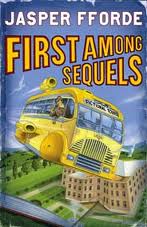
First Among Sequels – Jasper Fforde

First Among Sequels is (I think, but I may have lost count) the fifth in the Thursday Next series. Halfway through this novel it would be fair to say I was disappointed. Not a lot had happened, and most of the text was a reiteration of the ideas of the earlier books in the series. While several years have elapsed since Something Rotten, Thursday has acquired several children, and is no longer a literary policewoman, despite all this ostensible change, everything felt very familiar.

Then about halfway the book seemed to wake up, sit upright, and give itself a good shake. In fact Fforde seems to have spotted what was happening himself, because he introduces a couple of very clever ways of stopping lazy reading – that is where the reader doesn’t really engage with the text, pays only partial attention, and doesn’t mind too much about the detail – like when taking a train ride you have been on many times before you don’t look out of the window. Spoiler alert – don’t read further if you don’t want to know how he does this. The first of these techniques is that one of Thursday’s children doesn’t exist – she is a mindworm implanted by Aeornis Hades, a mind controlling villain from an earlier book. Thursday is convinced she exists, and when told she doesn’t has only moments of lucidity before relapsing into the illusion again. It explains why the child is so under-written, and the reader realises with a jolt that they had not been paying enough attention to realise what had been happening. Later on this lesson is reinforced with a subtle, unflagged and very clever change of narrational point of view. I don’t mind admitting it had me tracking back a chapter or so to spot what I had missed at first.


This is confident playful writing by a writer at the top of his game. Fforde creates a deliciously dark villain in Thursday Next 1-4, and although she is killed off “textually” at the end of the novel, as we always knew she must be, I would not be at all surprised to see her return. In reading First Among Sequels I was reminded of some of the better episodes of Doctor Who, where time travelling allows just about anything to happen, including dead characters to reappear. There’s a wealth of other really funny and interesting ideas, plus an appearance of one of my favourite characters in literature, to make this a really worthwhile and valueable addition to the series. Fforde is in complete control of his material, despite sometimes juggling with concepts which in lesser hands would be simply silly (e.g. the recipe for unscrambled eggs), but definitely pulls it off.

Standard
http://schemas.google.com/blogger/2008/kind#post, Zombie

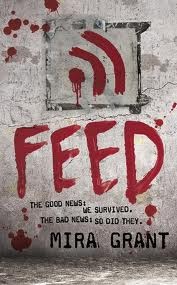
Feed – Mira Grant

By this week’s guest blogger, SRJ:

It is clear this book was written for a purpose, a message of some sort, because it is a zombie book – yet I feel zombies were not the focus. For a 550 page book there are surprisingly few zombie encounters; in fact I was relieved when the Eakly attack happened, since I was starting to wonder whether the zombies would actually feature again.
 
So if the focus isn’t zombies, what is? Is it the relationship between Shaun and Georgia? Is it the journey they make from beta journalists to alpha to national plot uncoverers? Or is it about the “truth” Georgia so vehemently pursues? If so then I feel the book did not mirror this enough; after all, we never find out who is really behind the big plan, nor their true reasons for it. We only find out about one man involved, who confesses practically nothing. We never even see or find out about the attackers.
 
I feel that the book spent too much time with background zombie-related things such as the blood tests rather than actual zombies to be one of those books that focus on action and excitement like most zombie books. So it must make a point somewhere, but it wasn’t clear enough. I might do a separate piece because I have some thoughts on the blood tests (watch this space!).
 

Nevertheless, it was a good book; I enjoyed the zombie attacks where they happened, and the story itself was enthralling. Maybe we find out more details of the plot in the sequel, but somehow it won’t be the same with the book ending the way it did.

Standard
http://schemas.google.com/blogger/2008/kind#post, Miscellany, Shakespeare

Meaning

My last post looked in detail at Act 1 scene 1 of Hamlet, the battlements scene. I tried to show how the dramatist conveys a lot of detail about the scene, about the feelings and thoughts of the characters, with an extraordinary economy, and how in particular he builds a feeling of suspense and dread.

But I wanted to make a clear distinction between this kind of analysis, and the futile attempts you often see to decode from text “What the author really means”. This school of thought looks at literature as one big guessing game, where the author hides their intent or meaning within the lines of their book (or play, or poem) and the reader’s job is to work through the various clues to piece together what the author is really saying. Sometimes the codes are “easy” to crack – so Godot = God, simple as that. All Beckett meant to say was we are all going to die, but God doesn’t exist, and that makes him feel a bit sad. Sometimes the interpretation can be more complicated, and can only be done by reference to the author’s other work, personal life, diaries or love affairs.

I am not denying (of course) that authors use symbolism – but these are usually a bit more complex than object A symbolises object or abstract value B. The “find the real meaning” reading of literature is seductive – we all enjoy playing the game, and authors sometimes encourage us to do so. But it is ultimately wrong headed for several reasons:
– It is simplistic, reducing the analysis of literature to a parlour game
– It is boring – once you have worked out that the symbol equals X, what next?
– It is limiting – why should the author have sole authority over what his or her text means? Why can’t meaning change over time and with context. What Othello or The Merchant of Venice “meant” in 1600 is unlikely to be immutable. What I think of the opening lines of Act 1 Scene 1 of Hamlet has as much or as little validity as what anyone else thinks, so long as I can justify my reading.

Books aren’t simple machines for the conveyance of information. They don’t just provide the conduit for thought from the author to the reader. Once written they are free and live or die independently from the authorial intent, whatever that was. A simple example to illustrate the point – the word “fire” changes its meaning depending on its context – the word said as an instruction to a execution squad will have a completely different impact to the word said in alarm when smoke is spotted. Is it always that simple to spot the difference? – of course not.

Can you take this too far? Can an apparently straightforward text such as Animal Farm, with an ostensibly clear set of symbolic meanings, come to be about something other than the Russian Revolution? Well that’s completely up to us, the readers. If we find it interesting and useful to read this as a morality tale about, say, the Pol Pot regime in Cambodia or the ethnic cleansing in the former Yugoslavia, why not? Drama in particular has the room to breathe that novels sometimes lack – staging, editing and production can turn a 17th century play about ancient Rome into a 21st Century political thriller.

So if the purpose of literary criticism or analysis is not to play “find the real meaning”, what is it for? Well, just because we abandon as pointless an attempt to understand what the author meant, doesn’t mean all texts are meaningless, or all readings are equally valid. Some are simply more interesting and worthwhile than others. We search for meaning, but we understand that the process is not a simple exchange from brain of author to brain of reader. The exchange is informed and changed by context and interpretation. Meaning changes. The first cave paintings might mean to us “Ancient man understood and valued his environment” but who knows, 10,000 years ago they might have been instruction manuals!

I understand and acknowledge that I am only scratching the surface of a highly complex set of issues here, and whether I return to the subject to tease a bit more understanding from it depends on how the mood takes me.

Standard
19th Century literature, Book review, http://schemas.google.com/blogger/2008/kind#post, Jude the Obscure, Thomas Hardy

Jude the Obscure by Thomas Hardy, 1895

My campaign of self improvement and of reading books I should have read a long time ago continues. I have steered clear of Hardy previously largely due to prejudice – his poetry, which formed part of one of my school courses many years ago, felt sentimental and dull, and those of his novels that I had seen adapted for television or cinema were uninspiring pastoral pieces.


Having said that, I had read that Jude had been his last novel followed by a long silence filled only with the previously mentioned poetry. So I knew there was something which had scandalised some elements of late Victorian society, and my interest was pricked. Hardy deals with sexuality in a way that is immensely frustrating to the modern reader – the characters in the novel don’t seem to behave in a way recognisable to us, torn as they are between the strict conventions of the period and their own natural impulses. No one has what we would consider a healthy, “normal” attitude towards sex, and I found the scene where Sue forces herself to share a bed with her husband despite her profound disgust for what that implies – so strong that in one scene she junps out of her bedroom window to avoid him – quite disturbing. In some ways even the recognition of these issues, and especially of sex outside of wedlock, was shocking, and would not have featured in novels from just a few decades earlier in the century – no matter how impulsive and headstrong Heathcliff is (for example) he never oversteps this boundary. As such this novel is a bridge between the 19th century novels in which there is little or no suggestion of human sexuality – it was just taboo – and the more frank works of, say, Lawrence a few years later.


Having said that, I suspect that it was not the handling of sexuality that would have been really shocking to the Victorian reader – very little is explicit after all – but the deaths of the children towards the end of the novel, and the characters reactions to them, which really horrifies.


Other than the interest the novel carries in its treatment of these issues, what other features of the novel can recommend it? The description of country life in late Victorian England is well sketched, and the principal character’s frustrations with the lack of academic opportunities is of passing interest. Well, not really.


I was hoping that this introduction to Hardy’s novels would help me overcome my prejudice and inspire me to explore the rest of his works. Sadly that plan didn’t work – Jude was just too dull – but I haven’t given up on him yet!

Standard
100 Best Novels Guardian list, 19th Century literature, Book review, http://schemas.google.com/blogger/2008/kind#post, Robert Louis Stevenson, Treasure Island

Treasure Island by Robert Louis Stevenson

Earlier in the year, just after the Christmas/New Year break, I read “Treasure Island”, largely out of curiosity to see how close the TV adaptation was to the original. In some respects it was very faithful – for example in the way Silver kills the seaman (Tom) who will not join the mutiny once they land on the island – but in others it made massive changes, the most obvious ones being the death of Trelawney and the loss/abandonment of the treasure. Stevenson tells us almost nothing about what Jim and Co do with the treasure once home – the narrative slams shut once back in the UK, with only a paragraph about how Ben Gunn loses his money in 19 days – but that leaves it to the reader to imagine the high life they lead. One important thing the TV adaptation did reinstate was Silver’s black wife, although they make her a “tart” – possibly editions and adaptations from my childhood edited out references to this character because mixed relationships were frowned upon – just shows how racist the 70s really were. The TV version was careful to avoid all the pirate clichés, but they are there in the book, timbers being shivered, pieces of eight, Jim lad, etc. I guess this is from where they became clichés.


This was a very easy read – the narrative rattles along, with the only passages that drag being the technical/nautical descriptions of sails being unfurled, anchors being weighed and the like. The point of view is well manipulated to keep the reader in the dark as to the location of the treasure, what has happened to the rest of the crew, Silver’s sinister intent, etc.


However, ultimately this remains a children’s/young teenagers’ adventure story, with little to say on the issues of the time, unlike, say, Stevenson’s much darker “Dr Jekyll and Mr Hyde”. I recognise that Treasure Island is, like all texts, open to broader interpretation. The island can be taken to represent (for example) an alternative England where anarchy rules, and the struggle between the pirates and the other crew members could be taken as a comment on the ferocious class struggle rocking late-Victorian England. Islands are a great source of metaphor. But once you have made those connections, what then? I am not convinced that they give you anywhere to go in terms of understanding what was going on in the world, nor reveal subconscious attitudes to class or gender.

Standard
19th Century literature, Book review, http://schemas.google.com/blogger/2008/kind#post, The Moonstone, Wilkie Collins

The Moonstone by Wilkie Collins, 1868

Books aren’t hailed as classics, and don’t stay in print for 150 years, without good reason. Sometimes the challenge a reader faces is to find that reason. The Moonstone is a good example of this challenge – without it coming so highly recommended by a wide cross section of authors and critics I highly doubt I would have persisted with this Wilkie Collins novel to the end, nor felt so disappointed when I reached that point.
 
Often described as the original detective story, published in 1868, the eponymous moonstone is a fabled Indian diamond. The diamond is stolen from a temple by a dissolute army officer, and eventually left as a bequest to his niece. On the night she receives it it is stolen, and the primary part of the narrative is an investigation into the theft.
 
What struck me as remarkable about the story is how so many things don’t happen. A servant commits suicide, and remarkably doesn’t re-emerge months later having faked her death with the aid of accomplices. Who would have seen that one coming? A wily old detective from London is recruited to investigate the theft, after bumbling local constables make a mess of the initial investigation, and he doesn’t solve the mystery. There is no neat, it all make sense solution to the mystery, which is only explained by a combination of people behaving in ways we have been explicitly assured they would not, and some remarkable coincidences of which most mystery writers would be ashamed. I am not telling you too much when I reveal that the theft itself is committed by one of the house guests – shock – acting under the influence of laudanum, which had been administered by a medical acquaintance in a bizarre and to be honest utterly unbelievable “prank”. As the number of house guests is very small, the pool of candidates doesn’t leave the reader guessing for too long.
 
So what is there in this novel that can justify its status? Let me try. Firstly, the bulk of the narrative is told as a first person record by two of the relatively peripheral characters – a servant at the country house, and a spinster relative of the family. This unusual technique gives the reader more of a fly on the wall perspective – they see a lot of the action without participating in it – but an equally flawed vision – there is much they either don’t see, or don’t understand. The reader is able to decode their misunderstandings and misjudgments fairly easily – this is not a complex narrative in the sense of having to work out what is going on.
 
The conventions of the country house crime were not entrenched in Collins’s time, and to an extent he establishes many of them here, although as I have said above only to a very limited sense – for example the locked room “mystery” at the end of the novel lasts for a few seconds until the ladder out of the ceiling is spotted!.
 
Other than these admittedly limited reasons I confess I am struggling to explain the mystery of why this novel is considered a classic.
 
Standard
19th Century literature, Book review, Bram Stoker, Dracula, horror, http://schemas.google.com/blogger/2008/kind#post

Dracula by Bram Stoker, 1897

Thrilling and Repulsive – an oxymoron perhaps, but one that neatly summarises the central theme of Dracula. The broad elements of the plot of Bram Stoker’s 1897 novel will be familiar to most if not all, but the text is unlikely to have been read by many outside those compelled to do so by college curricula, horror enthusiasts, or, like me, the Kindle-curious.

As a construct the text is highly complex – Stoker aspires to give the reader an up-to-the-minute account of events, but eschews the use of an omnipresent narrator – instead the story is told through a variety of diaries, notes, letters and newspaper articles. The diaries in particular are often presented as being hurriedly written shortly after the events being described. This is a really interesting and original technique – we see events through the eyes of the participants, although it is hard to imagine even the most obtuse of reader not realising what is going on – “He’s a Vampire!” – before the characters. They really need to have things spelt out for them by Van Helsing. Through this flawed and partial perspective, the narrative jumps around both in terms of location and time.


However imposing physically the Count may be, Dracula the character is in many ways a weak opponent – like Sauron or He Who Must Not be Named he doesn’t personally engage in the struggle with the rather Scooby-Doo like gang assembled to fight him, and is far too easily despatched when finally cornered. His inability to walk during the day, to be seen in mirrors, to rest outside his coffin filled with Transylvanian earth, combined with extreme allergies to garlic, crosses, holy water, and peanuts (I may have made the last one up) makes it hard to fear him. The only character he is able to conquer misses multiple opportunities to avoid him (eg closing her bedroom window at night – Doh!).


The cast of characters are noble, brave, and fearless in their pursuit of Dracula – but boy are they dumb! Jonathan Harker sees that Dracula has no reflection in a mirror in just the second chapter of the novel – but lets it pass without much concern or interest, and continues to treat his client as an eccentric European gentleman. Now I appreciate some of the vampire traditions had yet to be firmly entrenched in western consciousness, but how dense do you have to be not to spot that something supernatural is going on there? The long slow reveal of Dracula’s identify would be spoiled by too much emphasis or scrutiny of this episode, and that to Victorian readers the penny would take longer to drop, but still!.
There are some genuinely chilling moments in the novel. A small child is kidnapped and thrown to the three female vampires as a snack. The child’s mother is torn apart by wolves. A mental patient breeds and then eats insects – I am surprised he has not been included in the film adaptations of the text. The ghost ship pulling into Whitby harbour is equally effective.
Finally, and most strikingly, there is so much sex. This isn’t a new observation of course, and I know critics have seen descriptions of every form of sexual behaviour in this text, but the lasciviousness of the characters – compared to what we would normally expect in a late Victoria novel – is genuinely shocking. Although the sex act itself is not explicitly described, little else is left to the imagination. Innuendo stalks every chapter. When Harker first meets the three female vampires in the Count’s castle, he describes their encounter in highly and specifically sexual terms: one of them says “He is young and strong. There are kisses for all of us”. Harker then says “I lay quiet, looking out from under my eyelashes in an agony of delightful anticipation….The girl went on her knees and bent over me…There was a deliberate voluptuousness, which was both thrilling and repulsive.” (Chapter 3).  I think you have the heart of the issue there – sex in all its delicious variety was to the Victorians both thrilling and repulsive.  Or take this description of one of the fallen characters being “staked”: 
Arthur never faltered. He looked like a figure of Thor as his untrembling arm rose and fell, driving deeper and deeper the mercy-bearing stake, whilst the blood from the pierced heart welled and spurted up around it […]. And then the writhing and quivering of the body became less, and the teeth seemed to champ, and the face to quiver. Finally it lay still. The terrible task was over.”
Coitus interruptus indeed.

Standard
Book review, http://schemas.google.com/blogger/2008/kind#post, humour, Jasper Fforde, Something Rotten, Thursday Next

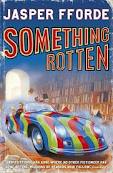
Something Rotten by Jasper Fforde

Something Rotten is the fourth in Jasper Fforde’s “Thursday Next” series. I am a big fan of Fforde – he has a comic inventiveness mixed with erudition that is rare in today’s literature. He is hard to categorise – comic fiction certainly, but that is only the start of it. In Thursday Next he has created an original character that you genuinely care about (if not identify with) and her separation from and eventual reunion with her husband is quite touching. So why was I left a bit underwhelmed at the end of this book?

I am pretty sure it is not because his standards are slipping. There are some negative features of a series of novels that are unavoidable – for example we know the principal character will almost certainly survive, no matter what – in this case a bullet to the head is shrugged off in a couple of chapters – so there is little if any tension about the final outcome. As we know what is going to happen, the only interest rests in how we get there, not where we are going. That’s not to say that there aren’t challenges ahead for Thursday in the rest of the series I am sure.
I think the heart of the problem is in the way I have been reading these books – that is, altogether, without any significant breaks. Imagine if you read all of the Harry Potter series in one go, not over the ten or so years they were published. The impact would have been completely different. The suspense would be seriously diminished, the changes in style and pace would be much more obvious, plot discrepancies would jump out at you, and the point at which Rowling’s editors gave up – at the end of “Prisoner” – would be stark. Even knowing that there were seven books in the series, and that it has a definition conclusion, would make the experience different to reading each as it was published (or in my case joining the party at 4 and working back, hurriedly). That experience would be hard but not impossible to create, but I think explains some of my staleness with Fforde. So the simple prescription is a break from this series – the only remaining question is – Where next?
Standard
19th Century literature, Book review, http://schemas.google.com/blogger/2008/kind#post, Jules Verne, science fiction', The Mysterious Island

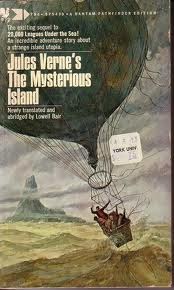
The Mysterious Island by Jules Verne

I have written previously about one of the probably unintended but positive consequences of the Kindle and its free books – namely that it has led me (and I doubt if it is just me) to read things I wouldn’t have dreamt of reading previously, and would probably have struggled to got my hands on even had I had the inclination to do so. This is a great example of that happening – I don’t remember even having read anything by Jules Verne before my Kindle ownership, despite being well aware of his prominence as the father of science fiction and the general outline of most of his major works eg Round the World in 80 days.

If you were to try to predict what you would find in a 19th century novel called the Mysterious Island I expect you would include dinosaurs/extinct creatures, long lost explorers rediscovered living surprisingly well, gold/lost treasure, and  volcanoes that destroy the island seconds after the last-minute rescue. (Or was that the plot of Alvin and the Chipmunks’ recent film ?) Some of these conventions are honoured here, but not at all in the way I expected.

The mysterious island is set in the uncharted waters of the Pacific, and the explorers are escapees from the American Civil War (which at the time of publication (1860’s) was just ending), blown off course in their escape balloon. Well it might happen. They go about mastering their environment with an extraordinary efficiency, helped by a particular genius with engineering and a sufficiency of natural materials wherever they look, such that by the end of their second year of captivity they are enjoying virtually every luxury afforded by modern life. Nothing seems too complex or technical to be beyond their grasp. This is the age when man was master of his environment, and where Robinson Crusoe made himself comfortable on his island, these guys turn it into a virtual metropolis, so much so that they don’t particularly want to leave.

So apart from the unnatural biodiversity of the island, what is the mystery? At first this is very lightly done – this is no Prospero’s Island, haunted by voices. But there are hints that there is more to this island than the castaways think, and these hints steadily accumulate so that by the time of the final “reveal” – and I won’t spoil it for you – the resolution is worth the wait, and it was definitely not one I would have predicted. In terms of echoes of modern productions, there is a strong hint here that the writers and producers of the TV series Lost must also have read this novel once upon a time – the unseen hand that guides their time on the island is a common thread between the two works.

Verne clearly was an enthusiastic amateur scientist, and spends a disproportionate amount of time walking the reader through detailed technical explanations of the islanders’ various innovations and inventions. Generally I have a rule against skimming sections of text – it is cheating really – but I made a few exceptions here, although far fewer than in “From the Earth to the Moon & Around the Moon” which is weighed down with some fairly obscure and quite possibly nonsensical analysis of the mathematics of space flight. In this novel, one of the earliest about space travel, some comic American gun enthusiasts fire a massive cannon with a manned capsule at the moon. The travellers survive the return journey – they don’t actually land on the moon, but “slingshot” round it in a way similar to Apollo 13 many years later – by landing in the ocean.

I am not sure if I will continue with Verne for now, or go in a different direction – perhaps some more non-fiction?


Standard