
As I have mentioned elsewhere, I am currently reading Michael Slater’s very detailed biography of Charles Dickens. One of my main ‘take-aways’ from the work thus far is that Dickens was so much more than a novelist, even if that is what he is predominantly remembered for today. He wrote an extraordinary volume of work, and no genre was beyond his reach – plays, poetry, short stories, journalism, writing for children, travelogues, and essays, as well as an amazing number of letters. This has encouraged me to explore some of his work outside his novels, which led me to The Chimes.
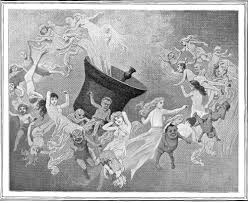
Following the success of A Christmas Carol (1843) Dickens wrote four further annual Christmas stories. The Chimes: A Goblin Story of Some Bells that Rang an Old Year Out and a New Year In, (1844) is the second in the series (The Cricket on the Hearth (1845), The Battle of Life (1846), and The Haunted Man and the Ghost’s Bargain (1848) complete the list).
The book was written during Dickens’s year-long visit to Italy. Its title is from Faust’s line in Henry 4th part 2 “We have heard the chimes at midnight, Master Shallow!” in which he reminisces about their adventures in their youth. There’s a tone of regret for days past in the line which forms a backdrop to the story. As with virtually all Dickens’s work there is also a campaigning purpose to the text, of sorts, as we shall see.
The story opens on New Year’s Eve. Trotty Veck, an ageing messenger (this is before the days of postmen) is cold and hungry, but cannot leave his post until he has earned something for his family. His work is casual and unpredictable – the gig economy is nothing new. He shelters in the shadow of the local church and his day is measured out by the sounding of the church bells, the chimes. His daughter Meg brings him some food, and announces that she and her fiancé Richard have decided to wait no longer and are to marry the next day. Their happiness is disrupted by the intrusion of the appalling Alderman Cute and his friends who make Meg and Richard feel that being poor they have no right to marry.
Trotty carries a letter for Cute to Sir Joseph Bowley MP. Bowley is spending the last hours of the year settling any debts to ensure a clean start to the new year, and advises Trotty to do the same. When the MP hears that he owes rent and other debts he berates him, showing no understanding of the position of the working poor. Again, sounds familiar? Trotty however tends to agree with him, indoctrinated as he is into thinking that the behaviour of the poor is the problem rather than their condition and circumstances. On his way home Trotty meets Will Fern, an impoverished agricultural worker, and his orphaned niece, Lilian. He kindly takes them home with him and shares what little food he has, in a genuine act of charity.
The midnight chimes are no occasion for celebration in this starving household. Instead they call to Trotty, who in a dreamlike state goes to the church and climbs the belltower. There he sees the spirits of the bells and their goblin attendants. This is an hallucinatory vision from something out of Dante or Bosch: these goblins are not bankers (a la Rowling) nor engineers (a la Pratchett) but menacing, supernatural figures who chastise Trotty for his lack of faith in mankind. It slowly becomes apparent that Trotty is now dead, having fallen from the belltower years before. The reader is left to wonder whether this vision is part of his eternal torture, or, as with A Christmas Carol, more in the way of a warning?
In a series of visions very similar to those shown by the Ghost of Christmas Yet to Come, Trotty is shown how the lives of his family play out in the future. Despite their best efforts to make a good life, Richard becomes an alcoholic, Will is unable to earn a living because of his earlier criminal convictions, which lock him into a cycle of imprisonment and brief release, and, in the absence of a loving family around her, Lilian becomes a prostitute. Meg is driven to the murder of her child and suicide, but is rescued at the last minute by Trotty’s ghostly intervention.
The story ends with Trotty waking up as the bells ring in the New Year. All he has seen has been a vision of a possible future, one which is not pre-ordained. Another future, in which Meg and Richard marry and in which his family and friends prosper is open to him, although how he will achieve that future without changes within wider society is unclear. The Chimes seems to suggest Trotty and his family, indeed his class, are masters of their own destiny; the goblins and the spirits of the chimes focus on his sins of condemning the fallen and poor:
‘Who turns his back upon the fallen and disfigured of his kind; abandons them as vile; and does not trace and track with pitying eyes the unfenced precipice by which they fell from good—grasping in their fall some tufts and shreds of that lost soil, and clinging to them still when bruised and dying in the gulf below; does wrong to Heaven and man, to time and to eternity. And you have done that wrong!’
Has he, or is it more Cute and Bowley, representatives of the judiciary and the legislature, that have failed the fallen and disfigured?
It’s hardly surprising that a story of such sinister ambiguity has not prospered compared to its predecessor. Although highly popular in its time – five different productions of The Chimes were on stage within weeks of publication and it sold 20,000 copies in the first three months – the story’s goblins are no longer part of our cultural landscape and have no Christmassy connotations whatsoever. The reader will be happy that Trotty and his family have survived another year, but their problems are as deep-rooted as ever and there’s no suggestion that Alderman Cute or Bowley MP are going to help them any more than they have previously – if help is going to come it needs to come from Trotty and family themselves. The fact that Trotty helps William Fern escape prosecution and offers him shelter offers some hope that by working together they can avoid the worst that Cute and Bowley can throw at them, but this is scant consolation in lives marked by cold, hunger and want.
I am not sure this is more than a curiosity rather than a representative of Dickens’ shorter form of writing – I will need to read more of that to make a call on that – but it’s not a story I could honestly recommend as being either heart-warming or particularly chilling. It has its moment, but the whole is less than the sum of the parts. At least Dickens wasn’t on auto-pilot here, just serving up generic Christmas related stories of poor people over-coming the odds – he genuinely tries to do something very different, although I suspect it may not have seemed as strange to mid-nineteenth century readers as it does to us today.

