
Any novel set in modern South Africa is going to be about apartheid. There’s obviously no way of avoiding the subject, but the author needs to find a way of addressing it that is original, to find a new way of telling the same story. The Promise is an interesting addition to the collection of novels that try to talk about the experience of the end of apartheid. It might say more about my reading choices than anything else, but most of these stories tend to be told from the white/Afrikaans perspective.
The Promise is told predominantly from the perspective of the Swart family, landowners and farmers just outside Pretoria. I say predominantly but one of the distinguishing features of this novel is the extraordinarily fluid narrative voice. It moves from character to character and scene to scene remarkably quickly, and there is often a beat where the reader re-orientates themselves to the new point of view. While it is usually made clear quickly who’s eyes we are now seeing the world from, that moment of uncertainty is disorientating. As a technique this is really effective in keeping the reader focussed on the word on the page – this is not a novel you can coast through, not without getting thoroughly confused anyway! It is broken into four sections, each set around ten years apart and focussed on the death of a family member.
Amor is the youngest daughter of the Swart family, and the closest the novel comes to a central figure. She is the still centre of the novel around which the other characters revolve. She witnesses her mother, on her death-bed, ask her father to promise to give the family servant, Salome, ownership of the run-down house she occupies on the family farm. The promise is given but insignificant to him and he quickly forgets it. When reminded by Amor he can barely recall having done so (although he never denies it) but it is clear he has no intention of doing keeping his promise. The worth of his promises is underlined when he assures Amor she will not have to return to the hostel she has been living in during her mother’s sickness, another promise that is quickly broken.
As successive family members die, Amor returns to the family farm to remind the surviving members of her father’s promise. Each time the issue is raised it is waved away as a nuisance. It’s hard not to translate this situation to the wider political context, with the farm representing the country and the promise being a political commitment to restore ownership of the land to the black community. During the course of the novel the apartheid regime comes to an end, the Truth and Reconciliation Committee completes its work, and Nelson Mandela is freed and becomes President. But the white community as represented in the novel retains its privileges and its prejudices, and the changes going on in the outside world seem to leave the Swart’s unaffected.
Of course the word ‘promise’ can also mean potential, and this novel is also about the wasted potential of the younger generation of the family. As a young woman, Amor promises to be beautiful, but that promise is (it is suggested) wasted, as she rejects her family, breaks contact with them other than to attend periodic funerals, and refuses to accept any income from the farm under the terms of a family will. This money collects in a trust account and she intends it to eventually go to Salome.
Anton, Amor’s older brother, undergoes a steady mental breakdown through the course of the novel. This breakdown is precipitated when, during his army service, he shoots and kills a woman protestor on the same day his mother dies. He believes he is in some way responsible for his mother’s death. It is that which troubles him, not the death of the black woman herself. He slowly descends into alcoholism, and while doing so tries to write a novel, which eventually Amor comes to read. She describes it like this:
“There are interjections from the author in the margins too. Is this a family saga or a farm novel? one says. And another. Weather is indifferent to history! And also, Is this comedy or tragedy? ..The phases of the man’s life, separated by intervals of roughly ten years, will map out his development into full maturity, from promise through defeat to return and ripening, in tandem with the seasons.” (277/278)
It is quite common for authors to anticipate and address critics comments within the novel itself, but I am not sure if I can remember someone doing it quite so openly. The Promise is both a family saga and a farm novel (another genre that is new to me!), and while the rest of this description parallels without quite matching the novel in which it appears, it seemed to me a very unsubtle way of reminding the reader that this is just a novel not a record of a real family’s lives. This breaking of the fourth wall happens at several points throughout the novel. At one point the narrator’s restless focus switches to a homeless man, almost as if by accident. After he is arrested for vagrancy, fined and discharged, the narrator observes:
He has a long walk ahead of him, back to the church that he regards as home, but there’s no reason to accompany him and, come to think of it, there never was. Why is he obscuring our view, this unwashed, raggedy man, demanding sympathy, using a name that doesn’t belong to him, how did he waste our time with his stories? He’s very insistent on being noticed, how self-centred of him, what an egotist he is. Pay him no further mind. (203/204)
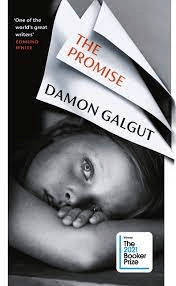
The Promise reminded me of the 2007 Booker winner, Anne Enright’s The Gathering. Both are constructed around families returning to the family home for a funeral, both of course won the Booker, and both front covers feature photographs of young girls staring directly down the camera. The Promise is the stronger, more interesting of the two, and I can see why it won last year’s Booker (from what seems quite a weak shortlist). Eventually it fizzles out, stopping rather than ending, and I was left wishing for a novel about apartheid that for once isn’t written from the white people’s perspective. Galgut could have given the black characters in this novel more than just a handful of lines, and portrayed them as more than victims or walk-on characters. Perhaps it’s not his place to write about the black South African experience of apartheid, (it’s not like he portrays apartheid as a good thing! or his racist characters in a positive way) just that the attempts at redemption by Amor (she goes to work as a nurse in ward for Aids victims) seem pathetic by comparison with the scale of the crime that was apartheid.

