It’s really nice to now be able to give an early Booker prize-winning novel a positive review, after having severely panned John Berger’s G., followed by the indifferent Something to Answer for.
Because Troubles was wonderful. (OK, strictly speaking Troubles isn’t an ‘early’ Booker prize winner. It won the Lost Booker Prize in 2010, when the absence of a book published in 1970 in the series, caused by a change in the qualification rules, became too difficult for people who don’t like interrupted sequences to bear. But it was published in 1970, which in my book counts as early.)
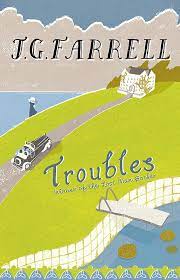
Troubles tells the story of the final years of a once grand Irish hotel, the Majestic, during the years of the Irish War of Independence (1919–1921). It is the first instalment in what is sometimes described as Farrell’s ‘Empire Trilogy’, preceding The Siege of Krishnapur and The SIngapore Grip, although I am not sure the term ‘trilogy’ is appropriate for three novels that are only loosely connected. It was widely praised when first published, and rightly so.
The novel opens in 1919, when, after surviving the horrors of the First World War, although not without some psychological wounds, Major Brendan Archer travels to Ireland to try and discover whether he is engaged to Angela Spencer, a young woman who he met while on leave in England, and who wrote to him thereafter describing herself as his fiancé. (“He remembered declaring that he would come back to her, but not very much else.”) Angela’s Anglo-Irish family owns the ramshackle and ironically named Majestic Hotel. The hotel is enormous, with hundreds of rooms and just about every facility you can imagine, from swimming pools to squash courts and ballrooms, all of which are derelict and out-of-order. (One of the more surreal aspects of the novel is the way the hotel seems to expand in scale all the time, with new floors, cellars, grounds etc constantly being revealed.) The hotel is falling apart. It barely functions as a hotel with only a handful of guests. Herds of cats have taken over the upper stories. The term “herding cats” is used in this novel to describe the difficulty of getting a large group of cats to do what you want them to do – it is possibly the origin of the phrase, although all online references refer to later origins:
“It is impossible to control a herd of cats; each one makes up its own mind where it wants to go.”
The Majestic quickly becomes the dominant character of the novel, a symbol of both Empire and Ireland. While it is a hotel, it might be easier to think of it as a castle. That way the novel’s place in the tradition of gothic novels makes a lot more sense. What is unusual if not unique about Troubles is that there is no attempt to underplay or disguise the use of symbolism. The hotel may as well have been called ‘The Empire’ or ‘The Symbol’! Most novels which use symbolism as central features of the narrative are far less direct – the reader is left to do some of the work, and the symbol is more elusive than a shameless X = Y. Any close correlation between the symbol and the symbolised often leads to the narrative becoming a parable. (I am thinking for example of Animal Farm). Troubles is the only novel I can think of where there is no attempt to separate the symbol from its signifier. The novelist places the equation front and centre and constantly draws explicit parallels between the two components. A good example of this is the cats with orange fur and green eyes which breed in vast numbers, over-run the upper floors of the hotel and die violently at the hands of the Major and Edward Spencer, the hotel’s Anglo-Irish owner. A reader would have to be particularly dim-witted to not notice the (uncomplimentary) parallels between the cats and Ireland’s Catholic population. If any such reader were to be in need of further help interpreting the novel, Farrell intersperses the narrative with a series of increasingly dark news articles about the Troubles and the decay and breakdown of colonial order throughout the Empire.
I’ve already mentioned the slightly surreal nature of the narrative. This is a hotel where the Addams Family would have felt at home:
In the foyer at the foot of the vast flowing staircase there stood a statue of Venus; a dark shading of dust had collected on her head and shoulders and on the upper slopes of marble breasts and buttocks. The Major screwed up his eyes in a weary, nervous manner and looked round at the shabby magnificence of the foyer, at the dusty gilt cherubs, red plush sofas and grimy mirrors.
“Where can everyone be?” he wondered. Nobody appeared, so he sat down on one of the sofas with his suitcase between his knees. A fine cloud of dust rose around him.
After a while he got to his feet and found a bell … The sound echoed over the dusty tiled floor and down gloomy carpeted corridors and away through open double-leafed doors into lounges and bars and smoking rooms and upwards into spiral after spiral of the broad staircase (from which a number of brass stair-rods had disappeared, causing the carpet to bulge dangerously in places) until it reached the maids’ quarters and rang in the vault high above his head … from this vault there was suspended on an immensely long chain, back down the middle of the many spirals from one floor to another to within a few inches of his head, a great glass chandelier studded with dead electric bulbs … all was silent again except for the steady tick-tock of an ancient pendulum clock over the reception desk showing the wrong time.
The plants in the Palm Court begin to take on a life of their own and tear apart the hotel. Animal deaths abound – cats are shot and have their heads smashed against the wall, a peacock is throttled for its feathers, and the piglets are slaughtered by ‘Shinners’ (Sinn Fein supporters). Murphy, a sinister servant lurks in the darker corridors, muttering to himself, while the hotel’s owner, Edward Spenser, plans to conduct medical experiments on him. The old ladies who constitute the hotel’s few surviving guests play whist and act as a chorus to the action of the novel, while Edward’s elderly mother seems to live in a cupboard, emerging once a day for dinner clutching an unloaded revolver. It’s quite mad! I read that it has been filmed once, but I would love to see a series made of it, Downton Abbey on acid. There’s enough material for several series in fact.
There are a couple of scenes that over-step the mark. In one, a soldier tries to rape one of the teenage Spenser twins, who is unconscious having drunk too much. He fails because she is wearing multiple layers of under-garments:
“It’s not at all easy to undress someone who is unconscious – and Charity was wearing a great many layers of clothes. Fortunately Matthews was deft and experienced at removing ladies’ garments”
The scene is played as dark humour; in the neighbouring bedroom her twin is with another soldier who is desperate to avoid sex because of what appears to be his latent homosexuality, possibly scarred by an unpleasant experience in a brothel in France:
“He had only to close his eyes to see glittering-ringed fingers parting thick white curtains of fat to invite him into some appalling darkness”.
The other scene which has not aged well is in which Padraig, a friend of the family, is encouraged by the twins to dress up in women’s clothing, and thereafter habitually dresses a woman. His change in appearance is accepted and even welcomed by the hotel’s residents, but towards the end of the novel he is thrown into the hotel’s abandoned swimming pool (fortunately still filled) by some rowdy soldiers. Again this is written largely as a comic scene, but the homophobic/transphobic bullying is uncomfortable reading to a modern reader.
It is a coincidence that I read this novel immediately before Something to Answer for, which addresses the end of the next phase of colonialism. Troubles makes a great companion piece to the Newby novel, sharing a similar structure – a colonial possession seen through the eyes of an Englishman abroad as the period of English rule draws to an end. But while Something is unstructured and a mess, Troubles is a carefully controlled dark farce. It’s one of the best, most original novels I have read in a long time. it could so easily have descended into chaos but manages to balance all the elements with considerable skill. The romantic elements – the Major develops an unrequited love for a local woman who flirts with him but avoids any further attempts at intimacy – are probably the least successful, and the dramatic ending is revealed in the opening pages and are therefore devoid of any suspense. But the success of the novel is in the portrait of the decaying, mad hotel and its inhabitants, as the try to avoid the inevitable and almost succeed.