
I decided to end 2020 with a final Booker Prize winner, Anna Burns’ Milkman, which won the prize in 2018. It won from what seems a fairly weak long and shortlist, missing many of the big-hitters in English fiction in recent years, although I would freely admit to not having read any of the short-listed novels, nor indeed anything by any of the short-listed authors.
Set in Northern Ireland during the peak of what was euphemistically called “the Troubles” – that is to say the bitter sectarian violence that dominated daily life for much of the population of Northern Ireland in this period – Milkman is a first person narrative describing a few traumatic weeks in the life of the unnamed narrator.
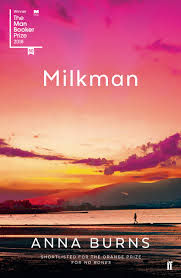
This narrator is an eighteen year old woman who lives in the heart of the Catholic community in a large town in Northern Ireland. It (along with everything else) is never named, but i think it is safe to assume it is based on Belfast. She is in a relationship of sorts with her “maybe boyfriend” although she tries to keep this relationship secret from her mother and siblings. She has a large family – as it seems do all her friends and neighbours – who are all referred to by their relationships rather than their names – third brother-in-law, oldest sister, etc. Friends and neighbours are also nameless and referred to by their occupation or some other defining feature. This is a world of euphemisms and coded references where proper nouns are forbidden – so the Protestant community is “the other side”, the Irish Republic is “the country down there” and Britain is “the country over the water”.
The Troubles form a backdrop to our protagonist’s daily life, but she does her best to navigate some form of normality despite the rigid code of conduct imposed by her community. This means that some types of rule-breaking are allowed – for example she sleeps over with her maybe-boyfriend without apparently attracting the censure of the community – but other activities such as going to hospital for medical treatment (it might allow the authorities an opportunity to force you into becoming an informer, or worse throw suspicion on you that you are an informer) even when seriously unwell are forbidden.
The narrator’s attempts to get on with her life are disrupted when she meets the Milkman. He does not deliver milk or any other dairy products, and the source of this soubriquet is unclear. He is much older than her and already married. Milkmen are usually perceived as a welcome presence, and a positive part of the daily life of a community. However this milkman however is anything but. He is a senior member of the Provisional IRA (again never mentioned directly) and as such he has certain privileges in this society, one of which appears to be the right to pick a consort of his choosing, irrespective of her wishes in the matter. The narrator is alarmed at being singled out in this way, and doesn’t know how to react. A robust rejection would be dangerous, for her maybe-boyfriend if no-one else, but she has no interest in this creepy figure. She doesn’t know who to turn to for help:
“At the time, age eighteen, having been brought up in a hair-trigger society where the ground rules were – if no physically violent touch was being laid upon you, and no outright verbal insults were being levelled at you, and no taunting looks in the vicinity either, then nothing was happening, so how could you be under attack from something that wasn’t there? At eighteen I had no proper understanding of the ways that constituted encroachment.”
She goes jogging with one of her many brothers-in-law, walks to her evening classes, socialises with maybe-boyfriend, but all the while is conscious of the menacing presence of the Milkman. Her relationship with maybe-boyfriend suffers under this strain, until she discovers his secret relationship with his friend, chef. Chef is bullied for his interest in cooking, which is widely perceived as indicating he is gay – although he is able to put his chef knives to use when the time comes.
The claustrophobic atmosphere of the city, where the authorities lurk behind every bush, snapping pictures of people going about their lives, is profoundly oppressive, and distorts all normal relationships. People accept punishment beatings and shootings as normal, and choose unhappy relationships to avoid the disappointment when happy relationships fail, as they surely must. The control of the terrorist groups and their supporters is however tenuous – freedom seems to be seeping out all over the place, from the children and their embrace of ballroom dancing (when written in this context I know that must appear implausible, but the author does a much better job of making it seem convincing) to romantic relationships being restored, including maybe-boyfriend and his long-standing romantic feelings for chef.
This wasn’t an easy novel to read – the refusal to use any proper nouns combined with the dense paragraphs and complex family relationships made it hard to push through at times. Conveying how language is breaking down with using fractured sentences is difficult, leaving the reader with paragraphs like this:
“Still,’ he said. ‘Ach,’ I said. ‘Ach nothing,’ he said. ‘Ach sure,’ I said. ‘Ach sure what?’ he said. ‘Ach sure, if that’s how you feel.’ ‘Ach sure, of course that’s how I feel.’ ‘Ach all right then.’ ‘Ach,’ he said. ‘Ach,’ I said. ‘Ach,’ he said. ‘Ach,’ I said. ‘Ach.’
But despite this Milkman made a strong impression on me. There are many surprising, almost charming elements, such as the narrator’s young sisters, who are exceedingly intelligent and curious, and blossom in the most difficult of circumstances. Love also finds a way – the narrator’s mother rekindles a childhood romance with the real milkman, her brother runs away with a former girlfriend, and chef and maybe-boyfriend edge towards declaring their feelings for one another. Initially the small-mindedness of the tight-knit community initially seems invincible – no dissent is allowed, and anyone who behaves unconventionally is considered “beyond the pale”, including the narrator. But this begrudging, limited tolerance of unconventional behaviour, such as the “issue women”, a feminist group, and the real milkman himself, who refuses to allow the IRA to bury weapons in his garden, are the seeds for a wider resistance. From such a grim premise Milkman turned out to be surprisingly optimistic.

