
‘Love in a Cold Climate’, a companion volume to ‘The Pursuit of Love’, tells the story of an extended family of aristocrats’ lives and loves between the wars. It was published in 1949, when the world it describes was already becoming a distant memory. The large armies of domestic servants – it is said, only half-jokingly, that the Montdore’s have a valet whose sole job is to fold the newspapers in the library – were already hard to sustain in the 1930’s. But if you are looking for any nostalgia in this novel for a privileged way of life soon to disappear, then look elsewhere, because while Mitford’s characters may be dancing on the edge of extinction, they are blithely unaware of the fact, and the forces massing to bring them down are only hinted at. The great depression might mean fewer balls, but for some characters we might as well still be in the nineteenth century.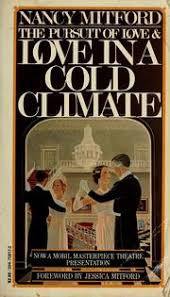
This is not a plot-led narrative – it is more an ensemble piece in which eccentric characters comically go about their business trying to find a way to get through to the next meal. This for example is a typical day for one of the principal characters:
“I had an early luncheon at home…After lunch? Hair. Washed and set. …Then tea with Daddy at the House, rest after tea, dinner.. and bed”.
The story is narrated by Fanny, a distant cousin of Polly, who observes the adventures of Mitford’s cast of characters in a non-judgmental way, always on the borders of the action but never really participating, the still heart of a novel of quickly changing affiliations:
“Sooner or later everybody in that set becomes the lover of everybody else, so that when they change their lovers it is more like a cabinet reshuffle than a new government”
What plot there is is provided by Polly, only daughter of Lord and Lady Montdore, who shocks everyone by marrying her recently widowed uncle by marriage, ‘Boy’ Dougdale. Her outraged parents disinherit her, and she goes to live abroad, leaving the legacy of her parent’s fabulous riches to a distant cousin, Cedric. Cedric appears in the second half of the novel, exploding into the narrative in a shower of outrageousness. He must be one of the earliest openly gay characters in literature, and makes no attempt to disguise his sexuality. Although he is described in homophobic terms – “queer”, “a terrible creature from Sodom” and “ an awful effeminate pansy” – most characters are happy to overlook his overt sexuality, such as when he picks up and gives a ‘job’ to a lorry driver.
While some characters are homophobic, the novel’s attitude to sex and sexuality is surprisingly progressive for the 1940’s. Sex is discussed openly and characters make very little if any attempt to hide their affairs. However, Boy Dougdale’s predilection for young girls jars horribly even when it is treated as a joke. He is known as the Lecherous Lecturer amongst Fanny’s cousins for his inappropriate behaviour towards young girls.
“(He) took Linda up on the roof and did all sorts of blissful things to her; at least, she could easily see how they would be blissful with anybody except the Lecturer”
In the novel’s conclusion, Mitford ruthlessly ties up any loose ends. Polly and Boy return from exile, Polly’s baby dies, (Lady Sonia comments “I expect it was just as well, children are such an awful expense, nowadays”) Cedric and Boy fall in love and Polly moves on to another affair. Despite these darker elements, the novel generally places more emphasis on the comic than the serious. If Wodehouse represents one extreme of the country house novel, where nothing more serious ever happens than a missing prize pig, and Waugh the other extreme where the shadows of the war can never be escaped, ‘Love in a Cold Climate’ falls somewhere in between but doesn’t suffer from the comparison.
P.S A couple of points of details – if you have read ‘Love’ did you spot these?
In Chapter 4, Fanny describes two paintings in her guest bedroom, “Caravaggio’s ‘The Gamesters’ and ‘A Courtesan’ by Raphael”. There are no such paintings – Raphael almost exclusively painted religious scenes and figures, and his paintings are now worth tens if not hundreds of millions of pounds; Caravaggio did paint ‘The Cardsharps’ and ‘A Courtesan’ but not ‘The Gamesters’. (The Courtesan’ has a fascinating back-story – the woman in the portrait at one time appears to have had a pimp, whom Caravaggio stabbed to death. This painting was destroyed in Berlin at the end of the Second World War). Why is Mitford putting such unlikely paintings in the guest bedrooms in the Montdore’s country house, Hampton? Partly to demonstrate their ridiculous wealth, but the titles also underline the fact that morality is a flexible quality in this house, where gamblers and prostitutes decorate bedroom walls.
In the opening paragraphs of Chapter 6 there is a short line of dialogue about the recent burglary: “Yes it is a shame. I’m in a terrible do about my bracelet of lucky charms – no value to anybody else really – too, too sick making. Just when I had managed to get a bit of hangman’s rope – Mr’s Thompson too – did I tell you? Roly will never win the National now, poor sweet”. This line of dialogue is not attributed to any specific character – it is part of the overall reaction to the burglary of Montdore House. The speaker has been collecting lucky charms, not the small objects attached to a bracelet that some people wear to this day, but the actual objects itself. We know this because she refers to the notorious execution of Edith Thompson in 1923 (seven years before the time in which ‘Love’ is set) for the ‘common purpose’ murder of her husband. Thompson, one of only 18 women to be executed in the UK in the twentieth century, was exonerated by her alleged co-conspirator, and had no physical part in her husband’s murder. Her execution appears to have been botched, and the Home Secretary’s refusal to grant clemency despite a massive petition in her favour was obviously hugely controversial. The brutal coldbloodness of someone, to collect a memento of this women’s death and use it a a lucky charm, speaks of their utter callousness.
In the later sections of the novel, when Fanny is married and living in Oxford, she innocently attracts the attention of some of her husband’s students. On one occasion Cedric visits and sees one of these students, a “spotty child”, who Fanny describes as a “Young Shelley” (i.e. a budding poet); Cedric responds bitingly that he is more like “the Young Woodley”. This is a reference to a play (1925) and film (1930) of the same name, in which a student becomes attracted to his headmaster’s wife. Cedric is jokingly suggesting that there is more to Fanny’s friendship with the anonymous young student than meets the eye, and that Fanny is as bad as the rest of the characters in the novel. There’s no indication this is anything other than a joke, but Fanny reveals very little of her life, so we can’t be sure.


That’s interesting about the novel’s attitudes to sex- it’s pretty unusual for books of that time! Sounds like an interesting book and I’m curious about the characters in it. Great review!
LikeLiked by 1 person
Pingback: Book review: Keep the Aspidistra Flying, by George Orwell, 1936 | The Reading Bug