
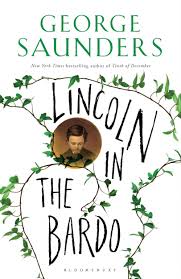
When Lincoln in the Bardo won the 2017 Booker prize, much of the media coverage focused on the apparent ‘difficulty of the novel’, probably encouraged by Saunders’s interviews on the topic. In fact the novel is wonderfully accessible, once the reader has adapted to the slightly unusual narrative technique.
The novel has many different narrators – by one count over 160 – and it cuts quickly between these different voices. On the page it is presented like this:
An exceedingly tall and unkempt fellow was making his way toward us through the darkness.
hans vollman
This was highly irregular. It was after hours; the front gate would be locked.
the reverend everly thomas
The boy had been delivered only that day. That is to say, the man had most likely been here –
roger bevins iii
Quite recently.
hans vollman
As you can see, the author has helpfully indicated which character is speaking, which is normally fine – I found myself quickly adapting to this technique, which seems a commonsense way of avoiding the “he said, she said” reporting of conversation which can be dull. Often it is not particularly important which character is narrating, because the three above act largely as a kind of chorus to the action, finishing one another’s sentences, as here, but when it matters it is simple enough to check. Less frequent narrators are usually given distinctive voices, speech patterns, or language. Note incidentally that it is virtually impossible to describe this approach without using the language of the spoken word – voice, speech, speaking, etc. This is because these sections of the novel are effectively a script. If the text was written this way it would not be a cause for comment or seen in any way as difficult:
Hans Vollman: “An exceedingly tall and unkempt fellow was making his way toward us through the darkness.”
The reverend Everly Thomas: “This was highly irregular. It was after hours; the front gate would be locked.”
Roger Bevins III: “The boy had been delivered only that day. That is to say, the man had most likely been here.”
Lincoln in the Bardo takes as its inspiration the death from typhoid of Abraham Lincoln’s 11-year-old son, Willie, in 1862, as the civil war was beginning to take a toll on both sides. In his grief Lincoln visited the crypt where his son was interred. Saunders cuts between historical details of the event taken from what appears to have been a lot of research with a much stranger story in which Willie’s spirit is received by the ghosts of the cemetery, who in turn reveal their own personal accounts of how they died. “Bardo” is apparently the Tibetan Buddhist name for a form of purgatory, a transition period between death and rebirth which is where these ghosts choose to remain, mostly refusing to accept the fact of their deaths.
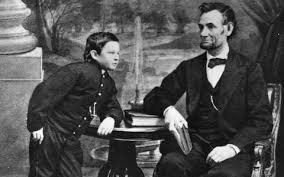
Abraham and Willie
They instead believe themselves to be injured, but with a chance of exiting their “sick-boxes” (a euphemism for coffins) and returning to their former lives. They argue that as they are able to think and feel, they cannot be dead, although the word itself is scrupulously avoided. The principal narrators, quoted above, are Hans Vollman, who longs to return to his unconsummated marriage, forever cursed him with a freakishly engorged member, Roger Bevins iii, ashamed of his gay feelings, who cut his wrists only to change his mind moments too late, and Reverend Thomas, hiding in the Bardo from the threat of eternal damnation, and trying to find in his memories the reason for his fall.
The arrival of young Willie provides a distraction from the eternity of waiting they face, as they struggle to persuade him to move on. He is reluctant to do so because of his grieving father’s visits. Saunders builds a compelling portrait of these and the other inhabitants of the bardo, a cast of desperate, sad, lonely and disturbed “survivors” refusing to accept the fact of their own deaths, under regular siege from recruiters – angels or demons – from the next world. Many of the ghosts are hideously deformed with physical representations of their moral failings or the worries that tie them to the world of the living: for example a miser is “compelled to float horizontally, like a human compass needle, the top of his head facing in the direction of whichever of his properties he found himself most worried about at the moment”. These sections of the novel are often disturbing – the idea of death as something that can be ignored by strength of will alone is not in itself original, but the troubled lives of so many of Saunders’s characters are sometimes not easy to read. The portrait of Lincoln, a devastated father trying to continue his burdensome duties as President, is convincing, and strikes a different tone from the strangely light, almost comic scenes in the cemetery. Lincoln comes to see his bereavement as the price he must pay for committing his country to a war in which so many other sons and fathers were to die.
I can see why this novel won the Booker, although I confess I have not read any of the other short-listed candidates. This was a £1 charity shop buy of a near immaculate copy – someone obviously wasn’t that impressed – which always makes the read that little bit sweeter!


I loved this book so much. It just took a little time to get into the format but once I understood it, I had no problem with it but so many readers gave up on it before they even hit 20 pages.
LikeLiked by 1 person
Really surprised people gave up – didn’t find it hard at all. I wonder if its reputation was the problem?
LikeLike