
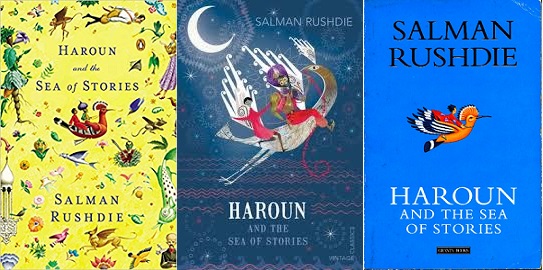
I didn’t realise when I picked Haroun and the Sea of Stories as my next read that it was a children’s book. Despite the publisher’s description of it as such, I’m still not convinced. Granta is not widely known as a publisher of children’s literature, and the front cover of the edition I read (the version on the right) is not particularly child-like. It doesn’t contain any illustrations and the font is a traditional size.
The concept of ‘children’s literature’ is one I often struggle with. When I find ‘children’s novels’ on a reading list I am torn – the completist in me wants to read the whole list, but is reading books specifically written for children a good use of my time? More to the point, the definition of children’s literature changes (quite rapidly actually) over time, and categorisations widely accepted in one generation look out-moded and ridiculous a few years later. There are books written with the intention to be read by children; books to be read to children; picture books; comics; books that were written for children but read by adults (for example the Harry Potter series) and books written for adults that are read by children (e.g Alice in Wonderland). That’s not to mention the whole arena of “young adult” fiction, a relatively recent concept, which bridges many of the gaps between books for children and those for adults. Other novels are re-categorised over time – originally intended for adult readers they eventually become perceived as children’s novels (Black Beauty for example).
Content is obviously what drives the categorisation of a novel as being suitable for children or otherwise; themes, language, and complexity are all factors. As society changes, what is considered acceptable in one generation would have caused apoplexy in an earlier age. Similarly language or attitudes in older novels make them challenging for modern readers (for example the extensive use of the n-word in Huckleberry Finn).
Where does Haroun and the Sea of Stories fit on this spectrum? There’s no doubt it was written for children, more specifically for a child, Rushdie’s son, from whom he was separated while in hiding due to the fatwa pronounced upon him by the Ayatollah Khomeini. Knowledge of this fact gives the story an added poignancy. Like all great children’s books, Haroun works on many levels. For younger children it is a fantastical adventure story. Young Haroun Khalifa looks up to his father Rashid, who is a famous storyteller. Rashid uses his narrative ability to campaign for various corrupt and untrustworthy politicians. One terrible day Haroun’s mother runs away from home with their neighbour, and Rashid is struck dumb, unable to tell his stories. You will probably have spotted by now the allegorical message regarding censorship underlying the narrative. Rashid and Haroun travel to the ‘Valley of K’ to speak for ‘Snooty Buttoo’, a local politician. On the way Haroun meets Iff, a Water Genie’, who has been sent to disconnect Rashid’s imagination. Thus begins a fantastical journey to the ‘Sea of Stories’ in the Kingdom of Gup. The Sea is slowly being poisoned by Khattum-Shud, a fairly sinister character, who very young readers might find scary. The conflict between the forces of good and bad is over quickly, and I don’t think it will spoil the book for you if I reveal it ends with a happy ever after.
This is a charming and very readable little parable. The humour is mainly ‘dad” jokes, appropriately – there are ‘Plentimaw’ fish in the sea for example – and adults will find the articulate defence of freedom of speech and the importance of story-telling quite touching. Younger readers and the read-to will be entertained. Eventually whether this is a children’s novel or not probably doesn’t really matter, but I wonder whether in years to come it will be read mainly by adults for its commentary rather than by children for its whimsy.


This is such an interesting review – I find the categorisation of fiction fascinating because there are so many overlaps between children’s / YA / adult novels. Stories that capture the imagination can resonate with anyone, at any time, at any age I guess!
LikeLiked by 1 person