
It was the river’s most elusive hour, when darkness lifts off darkness, and from one minute to another the shadows declare themselves as houses or as craft at anchor.
Well, it can’t be said that I haven’t given Penelope Fitzgerald’s fair crack of the whip. This, the third novel of hers I have now read, won the 1979 Booker Prize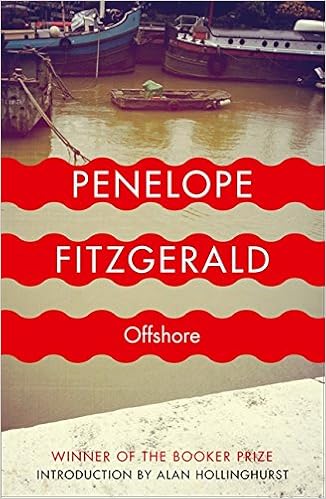 . Three I think is more than enough. When the Guardian’s reviewed the novel in 2009 the kindest thing the reviewer could find to say was that it “isn’t awful”, which is about right.
Offshore is set in early 1960’s London, described more than once as “swinging” although that seems a bit early to me. Post-war, depressed and crime-ridden would be nearer the mark. It focuses on a community of houseboat owners living on the Thames at Battersea Reach.
This was typical Fitzgerald – more a sketch than a novel, with few plot points, little structure, and an entirely open-ended conclusion. I actually don’t have a problem with ambiguous endings, where the details of what happens next is left to the reader to decide. But there is a difference between this and the approach Fitzgerald uses, which is to just simply stop writing once things have just started to get interesting.
I didn’t find her cast of characters that interesting either. Early 1960’s London was not brought to life – this is a marginal community living on the edges of the city and not prospering very well with it. Characters behave eccentrically with little if any explanation of their motives. Nenna, for example, a Canadian woman living with her two children in one of the run-down barges that are home for this group, is separated from her husband, who has returned from working abroad but made no attempt to contact her. She eventually goes to see him, but he rejects her telling her she is “not a woman”. No, I have no idea why.
Maurice, Nenna’s neighbour, is a male prostitute and allows his boat to be used to store stolen goods. There are other neighbours who appear briefly, but I didn’t find it easy to differentiate between them, even though they are given their own idiosyncrasies. Willis is a painter; Woodie is a retired businessman; Richard lives on a converted minesweeper. The only characters that really engage our attention are Nenna’s precocious children Martha, 12 and Tilda, 6. They skip school and go ‘mudlarking’ finding valuable tiles in a wreck which they sell in order to buy Cliff Richard records.
The novel is mainly pre-occupied with the boats in which the characters live and the river on which they float, and occasionally sink. There is, for me, far too much detail about life on the river, such as the various repairs the boats are constantly in need of. The autobiographical elements of the novel seem to be what interested Fitzgerald rather than her characters or anything resembling a plot.
One disturbing scene jumped out as being something that in 1979 an author might get away with, but today would surely not be published. Maurice’s boat is being used as a lock-up for stolen goods by Harry, a lightly sketched villain. While he is trying to fix the hatch to the boat to give “a mild electric shock to anyone who might try to get into it“, he is disturbed by six-year old Tilda:
“Tilda did not understand what he was doing, but she stared at him …until he became conscious of her and turned around. His eyes were curious….
“Want some sweeties?” ‘No’
‘Want me to show you a comic?’ ‘No’
‘Come on, you can’t read, can you?’ ‘I can’
You could get over here, couldn’t you? You can come and sit on my knee if you like, and I’ll show you a comic.’
(The exchange continues, then Harry says)
“You haven’t seen the things I’ve got to show you’
‘What are they like?’ ‘Something you’ve never seen before, love’.
He then chases after her, and while she escapes into a neighbouring barge, there is no doubt he intends her serious harm. This is a disturbing scene when read today, but I wonder how it would have been seen in the late 1970’s? Was it really intended as comic? The tone of the rest of the novel is whimsical and this scene jars alarmingly, irrespective of the author’s intention. The 1970’s were closer to the Second World War than they are to today, and social attitudes have shifted dramatically, but this isn’t funny, and I can’t believe it was thought humorous back then either.


I enjoyed this rather more than you did, though I agree it’s not her best. I’d forgotten about that disturbing scene with the child, and you’re right to call it out. Also the ‘swinging 60s’ setting seemed out of sync with reality, and the threadbare plot is desultory. But I still enjoyed it. Wouldn’t do if we all agreed, would it?!
LikeLiked by 1 person
What was it you enjoyed about the novel?
LikeLike
Probably easiest to give a link to my post on it, if that’s ok: https://wp.me/p3oBGt-sX
LikeLike