
These diaries cover the long slow death of the New Labour experiment from Blair’s comfortable third win in 2005 to Labour’s election defeat in May 2010. The diaries were published later that year, which suggests either that Mullin used his self-imposed retirement productively or that he was actively preparing them for publication while still writing them. Is this different from keeping a diary and one day getting round to editing it for publication? I think so, although I recognise the distinction is a narrow one. Mullin’s earlier edition of his diaries A View From the Foothills was published during the period covered by this book, so you have the slightly surreal occurrence of a diary recording the publication of and reaction to a diary. He was later to go on to publish a third edition of his diaries A Walk on Part covering the period 1995 to 1997.
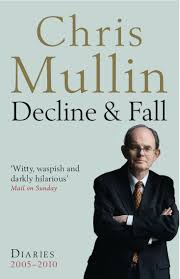
It goes without saying that on the course of a politician’s day-to-day life they will have lots of conversations about politics. It must be so tempting to just publish those conversations that appear prescient, making one look a wise political forecaster, and edit out any instances where one gets it spectacularly wrong. To be fair to Mullin he studiously avoids this temptation; these diaries book is full of forecasts that make him look like he really didn’t know what was going on. He confidently predicts David Davis will win the contest for leadership of the Conservatives (David Cameron won) for example, and that Gordon Brown will not lead Labour into the 2010 general election (he did). Sometimes he does get it right of course, such as this entry November 2005, only a few months after Blair’s third election victory:
“I think we will lose the next election. The Tories will come to some sort of understanding with the Lib Dems”.
In 2005 that wouldn’t have been an obvious outcome, but I can see why that conversation would have seemed important when editing the diaries in 2010, because of course that is precisely what did happen. This sense of foreboding about Labour’s prospects suffuses almost every entry. Labour seemed to Mullin, and to most people he spoke to, to be in irreversible decline, and he often refers to the inevitability of the party not just losing the 2010 general election but being displaced from power (or office) for good, and it losing its ‘historic purpose’.
The Labour Government of 2005-2010 had a secure majority of over 60, not that much smaller than the current administration. This was the third consecutive Labour Government, and the malaise of all long-term administrations is clearly articulated in these entries. Large numbers of disaffected former Ministers now on the back-benches led to lots of resentment against whips and party leaders. In the early years plotting over the succession to Blair gripped the Parliamentary party. Incompetence ruled – if it could go wrong it did, and the atmosphere was suffused with decay and corruption. This was also the period of the huge expenses scandal, with hundreds of MPs over-claiming their expenses, and several eventually going to prison.
It is hard to see from these diaries whether this administration achieved anything much at all. If it did Mullin didn’t seem to notice, and the best he can say about the Government is that it is not as bad as the Tories. It was obsessed with the idea that to build on the successes of the previous Blair Governments it had to be as right-wing as possible. New Labour as an ideology still gripped the party. The diary is full of daft right-wing proposals that Mullin feels compelled to vote against. The Government tries time and again, expending huge amounts of political capital, to extend the period of detention without charge for terror suspects, without anyone other than Ministers thinking it a good idea. I had forgotten that it was a New Labour idea to privatise the probation service, an idea that the Tories subsequently pushed through and have just had to unpick because it was so stupid. It is almost as if the party had a death-wish, recognising the need for a period in opposition to cleanse itself of New Labour and to put the calumny of the Iraq War behind it. (Incidentally, Ed Miliband features very little – when the surname Miliband is used it almsot always refers to David, always seen as the more senior figure.)
Much of the headline stories of this period are familiar, and Mullin’s observations are more in the way of reminders rather than new insights. This in part is because he was by this time a peripheral figure – he does not appear in any of the extensive memoirs of Tony Blair, Peter Mandelson or Alastair Campbell. This sense of being an observer was partly what drove his decision to stand down at the 2010 election. Revisiting this period does bring home the tragic mismanagement of the opportunities a 60+ majority brings. Mullin records in detail the period when Gordon Brown took over from Blair (in 2007) and flirted with the idea of calling a snap election. At the time it seemed another daft idea, with three years left to run on the Government and a secure majority, but no-one foresaw the banking collapse of 2008 which was to inflict such damage on the Government’s reputation for fiscal rectitude.
With maybe one or two honourable exceptions it is hard to over-state just how catastrophically bad this Government was. Initially the pressure on Blair to stand aside for Brown was hugely damaging, but that is only one small part of the problem. Politically the party was bankrupt; financially things were equally disastrous, with membership in freefall. If a mistake was there to be made the Government embraced it enthusiastically, from the expenses scandal to cash for questions. If bringing Peter Mandelson back into Government was the right answer then you have to wonder what the question was. The sense of decay is compounded by the regular visits by the grim reaper as various Labour figures met their maker – Robin Cook, Michael Foot, and Mo Mowlam to name a few.
For anyone supportive of the Labour Party this is sad but instructive read. The Party was captured by a right-wing faction that was very good at what it set out to achieve – to win elections – but missing many of the other qualities needed to form a successful reformist Government. Lessons for today are there for the taking.

