
The Man Who Would be King runs to not much more than 20 pages. It was first published in Kipling’s collection The Phantom Rickshaw and other Eerie Tales and later in Wee Willie Winkie and Other Child Stories. So there can be no argument that Kipling conceived the story as an adventure tale for children. But it is equally true that today, perhaps in part because of the success of the book’s 1960’s film adaptation, but more probably because of its what are now perceived as out-dated attitudes to empire, it is more often read by adults. It’s interesting how some books originally written for children over time become seen as books for adults and vice-versa. An example of a book travelling in the opposite direction is Black Beauty which was first published for adults but is now mainly read by or to children.
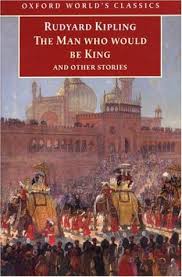
The Man tells the story of two adventurers, Daniel Dravot and Peachey Carnehan, as told by the narrator journalist they meet during their travels in Imperial India. They have concocted a mad, dangerous plan – to become kings of the remote country of Kafiristan. Their plan involves using firepower – rifles – the likes of which the natives will not have seen before and will consider almost magical in their ability to kill a man stone date at great distances. They also plan to use the standard imperialistic playbook of divide and conquer between the local chieftains and kings.
Two years pass and Carnehan returns alone, a broken man, crippled and in rags. He tells the narrator that he and Dravot succeeded in becoming kings, but ultimately at great cost. The pagan mountain tribesmen acclaimed them as beyond kings, as gods, helped by a bizarre form of Masonic ritual which Dravot and Carnehan were able to show knowledge of, perhaps as a legacy of some long-forgotten previous explorers. But becoming gods is a dangerous position, and when Dravot was exposed as only human after all this was seen as a shocking betrayal. Retribution was swift. Carnehan survived and escaped with only his life and one grisly memento of his adventure. The price of colonialism in this part of the world is high.
The Man Who Would be King would make a great companion text for anyone studying Heart of Darkness. Both are explorations of the impact of colonialism on the colonisers, who go too far in their efforts to conquer the unconquerable. The two main characters in The Man, Daniel Dravot and Peachy Carnehan pose as gods to impress the people they are attempting to subdue in Kafiristan, in the same way Kurtz assumes a god-like status in the Congo. Empire itself is described in similar ways. Kipling’s narrator describes the native states of India (those not under direct British rule) as
“the dark places of the earth, full of unimaginable cruelty”.
Compare Marlow’s first words in ‘Heart of Darkness’
“And this also [. . .] has been one of the dark places of the earth”.
Both stories are told by survivors of the expeditions that form the central narratives, stories which are then retold by the anonymous narrator. The process by which the local people are subdued is very similar, and the objectives of the protagonists – a dangerous combination of greed and a lust for adventure – are also alike. Equally the resolution of each story is essentially the same. The experience of being god-like drives the protagonist mad and leads to their downfall. In The Man when Carnehan bleeds he is shown to be merely human and is killed; in Heart Kurtz dies suddenly of a fever. In both stories the secondary narrator (the person who recounts the story to the actual narrator) escapes by the skin of his teeth with a memento of their adventure.
As far as I have been able to establish Conrad did not acknowledge The Man as a source for or influence on Heart, and many of the elements I have described here are, one might argue, standard components of all adventure stories. I’m not going to try and resolve the question as to the relationship between the two texts, other than to recognise there must surely be one, because this is a review rather than a thesis, but I think it is worth further investigation.
The narrative style of The Man is informal. The Kipling character is relaxed, recounting a story from his days in India, probably one of many, but chosen as a warning of the dangers of colonialism. He heavily foreshadows the story’s ending in his first paragraph:
I once came near to kinship with what might have been a veritable King and was promised the reversion of a Kingdom — army, law-courts, revenue and policy all complete. But, to-day, I greatly fear that my King is dead, and if I want a crown I must go and hunt it for myself.
Carnehan and Dravot are introduced as eccentric, larger than life adventurers,
“a huge gentleman, …a wanderer and a vagabond like myself, but with an educated taste for whiskey. He told tales of things he had seen and done, of out-of-the-way corners of the Empire into which he had penetrated, and of adventures in which he risked his life for a few days’ food.”
“He’s a big man with a red beard, and a great swell he is.“…“We have been all over India, mostly on foot. We have been boiler-fitters, engine-drivers, petty contractors, and all that, and we have decided that India isn’t big enough for such as us.”
The Kipling narrator by comparison is a passive observer, spending his time waiting for things to happen:
One Saturday night it was my pleasant duty to put the paper to bed alone. A King or courtier or a courtesan or a community was going to die or get a new Constitution, or do something that was important on the other side of the world.
The outlandish plan Carnehan and Dravot outlined to the narrator is obviously extremely risky:
“You’ll be cut to pieces before you’re fifty miles across the Border,” I said. “You have to travel through Afghanistan to get to that country. It’s one mass of mountains and peaks and glaciers, and no Englishman has been through it. The people are utter brutes, and even if you reached them you couldn’t do anything.”
Their expedition starts in a typically unconventional fashion, with Dravot and Carnehan disguised as a mad priest and his follower:
A priest attired in fragments of ribbons and rags stalked up to me, gravely twisting a child’s paper whirligig. Behind him was his servant, bending under the load of a crate of mud toys. The two were loading up two camels, and the inhabitants of the Serai watched them with shrieks of laughter. “I will go even now!” shouted the priest. “I will depart upon my winged camels, and be at Peshawar in a day! Ho! Hazar Mir Khan,” he yelled to his servant “drive out the camels, but let me first mount my own.”
The element of theatre in this start to their journey is key to their plan – they are going to hoodwink their way onto the throne. The narrator doesn’t expect to see them alive again. His life continues as before with world affairs happening elsewhere, life leaving him behind:
The wheel of the world swings through the same phases again and again. Summer passed and winter thereafter, and came and passed again. The daily paper continued and I with it, and upon the third summer there fell a hot night, a night-issue, and a strained waiting for something to be telegraphed from the other side of the world, exactly as had happened before. A few great men had died in the past two years, the machines worked with more clatter, and some of the trees in the office garden were a few feet taller. But that was all the difference.
In Heart of Darkness there is little ambiguity about Kurtz’s attitudes towards the people he comes to lead – they are brutish and anonymously disposable. Carnehan and Dravot have a less directly racist attitude to the people they come to reign over. For a start they are not as dark-skinned:
“The Chiefs come round to shake hands, and they was so hairy and white and fair it was just shaking hands with old friends.”
They also have some understanding and possibly even experience of the masonic rituals that Carnehan and Dravot enact, with the suggestion that they are not the first white men to travel in the area:
“The old priest was a stranger come in from beyond the village of Bashkai. The minute Dravot puts on the Master’s apron that the girls had made for him, the priest fetches a whoop and a howl, and tries to overturn the stone that Dravot was sitting on…ten priests took and tilted over the Grand-Master’s chair … The priest begins rubbing the bottom end of it to clear away the black dirt, and presently he shows all the other priests the Master’s Mark, same as was on Dravot’s apron, cut into the stone.”
Dravot claims to be able to detect that ethnically the locals are closer to being European than Asian, not so much by their skin colour but by their behaviour:
“‘I won’t make a Nation,’ says he. ‘I’ll make an Empire! These men aren’t n******; they’re English! Look at their eyes — look at their mouths. Look at the way they stand up. They sit on chairs in their own houses. They’re the Lost Tribes, or something like it, and they’ve grown to be English.
Englishness is defined by the way people sit!
Dravot then outlines his plan to make his kingdom a strategically important part of the British Empire:
I’ll take a census in the spring if the priests don’t get frightened. There must be a fair two million of ’em in these hills. The villages are full o’ little children. Two million people — two hundred and fifty thousand fighting men — and all English! They only want the rifles and a little drilling. Two hundred and fifty thousand men, ready to cut in on Russia’s right flank when she tries for India! …When everything was ship-shape, I’d hand over the crown — this crown I’m wearing now — to Queen Victoria on my knees, and she’d say:— “Rise up, Sir Daniel Dravot.”
This is the ultimate objective for Dravot, something, Kipling hints, behind the schemes of all colonial adventurers – acceptance by the British establishment, a knighthood, and being able to leave behind his days as a disreputable character in the border countries of the Empire and on the edges of criminality. It is a dream he does not live to see fulfilled.
It is easy to forget when reading boy’s own adventure stories of this kind, with slightly cartoonish characters and uncomplicated plot-lines, that Kipling won the Nobel Prize for Literature at an early age (I believe he remains the youngest person to have ever won this award) and was a dominant figure in English literature for decades. His status now is much reduced. He is largely remembered as a teller of children’s stories and one or two great poems, but also as a representative and defender of all that was wrong with the British Empire. He is probably overdue a re-evaluation. The Man Who Would be King might be a good place to start.


I loved reading his stories to my kids. The writing is very sophisticated for children’s literature.
LikeLiked by 1 person
Did you read them this story, or just the Jungle book?
LikeLike
We read the Jungle Book, the Just So Stories, and the one that we read the most was a beautifully illustrated version of Rikki-Tikki-Tavi.
LikeLiked by 1 person
Lovely. Reading to my kids was probably the thing I enjoyed most about spending time with them. But we never got round to Kipling. I think they would have really like this story when they were a little older. Instead Harry Potter took over!
LikeLiked by 1 person
When it came to series, I would often read book 1 to them and then they were on their own if they wanted more which they often did.
LikeLike
Pingback: #Book review: The Man Who Would be #King, by #RudyardKipling [#TheJungleBook @amazon], 1888 — The Reading Bug via @youtube @thewritealice @olaqueenbee – thewritealice MLS – Let Us Write You The World In Our Eyes.