
Ben Okri’s The Famished Road won the Booker Prize in 1991. I found it a difficult, challenging book. I am not the only one – many reviewers (good example here) have found the novel so hard to read to the extent they reported giving up in frustration at the bewildering narrative style. Which is a pity, because underneath all the badly written magical realism is an interesting, even uplifting story about life in a rapidly changing African village.
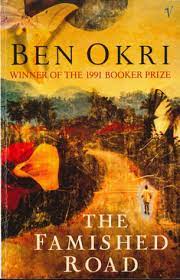
The Famished Road tells the story of Azaro, an abiku, a child spirit who repeats over and over again the cycle of life and death. For reasons that never become clear Azaro finally decides to stay on earth and live a full life. But his family have a hard existence – they live in one, damp-sodden room, haunted by rats in the walls. Work is brutally exhausting. The family is always crippled by debt and any time they do have any money it is quickly frittered away. Political parties promise change but are obviously, openly corrupt. They have no real friends – their neighbours are hostile and unwelcoming. Meanwhile all around the forest is being cut down to make space for more roads and housing.
Early in the novel Azaro is kidnapped and about to be sacrificed by a police officer and his wife before being saved by his mother. But he is a resilient child, bouncing back after being beaten or thrown out of the local bar. His father has the same irrepressible spirit. He is an amateur boxer who seems to win every fight against all the odds. His mother sells small household goods from the street, scratching out a living in pennies.
As an abiku, Azaro often sees spirits and enters the spirit world. These dreamlike scenes were the most difficult to read – intensely episodic and devoid of any logic or structure. This is not the magical realism found in authors such as Garcia Marquez; magic is not integrated into the everyday work, experienced by everyone and accepted as normal. Here it happens to Azaro alone – no-one else can see the spirits that appear to him. These scenes have a drug-induced quality and go on for many long pages. I could quote them at length but here are a few shorter examples:
“The trees were running away from human habitation. My eyes became charged too and I saw people with serene bronze masks emerging from trees. I saw a bird with a man’s hairy legs flying clumsily over the branches of the rain-tree. An antelope with the face of a chaste woman stopped and stared at me…An old man emerged from the anthill that had been following me”.
“I heard the cry of a cat. A dog’s eyes stared into mine…An eagle flew in from the door and landed on the old one’s head. He touched the eagle with his good hand and a black light shot into my eyes. When I opened them I saw I was in a field. Around me snaked a green river. I looked up and saw a blue mountain…A cat jumped right through me…The beggar laughed. “
“Inside a cat there are many histories” (572). (Indeed there are).
I like to think I am a bit of a connoisseur of the meaningless sentence, and The Famished Road added quite a few to the collection. For example: “I stayed outside for while, planting my secrets in the silence of my beginnings”. (288) That sounds meaningful, but it could mean so many different things it ends up meaning nothing. Perhaps it is intended to mean something different to each reader. I recognise that in quoting it I have had to strip the sentence from its context, but there are times when you just have to abandon attempts at understanding and listen to the poetry.
“Her snoring altered the geography of our destinies” (568)
And so on. I am sure it is these exhausting sequences which will have put off so many readers. The story of Azaro and his family’s struggles failed to escape from the burden of this dominant element of the narrative. Okri has some important points to make about the reasons for the family’s impoverishment:
“He saw the world in which black people always suffered and he didn’t like it. He saw a world in which human beings suffered so needlessly from Antipodes to Equator, and he didn’t like it either. He saw our people drowning in poverty, in famine, drought, in divisiveness and the blood of war. He saw our people always preyed upon by other powers, manipulated by the Western world, our history and achievements rigged out of existence.”
The novel ends with this message of hope:
“There will be changes. Coups. Soldiers everywhere. Ugliness. Blindness. And then when people least expect it a great transformation is going to take place in the world. Suffering people will know justice and beauty. A wonderful change is coming from far away and people will realise the great meaning of struggle and hope. There will be peace.”
The unnamed African country Okri describes is very undeveloped even though it is rapidly modernising. Witchcraft and primitive medicine – juju – is a dominant theme throughout the novel. Herbalism is the term used to describe traditional medicine but it appears as a little more than a rebranded and sanitised version of witchcraft. These scenes and characters have a troubling subtext, and it concerned me that Okri appeared to give serious credence to the concept of child-spirits and witchcraft. This concept of the spirit child may have been society’s way of rationalising high rates of infant mortality. Children die because they are spirits fated to be reborn, rather than because of preventable disease or deprivation. But Okri doesn’t introduce this idea. Instead spirit children are presented as a fact of life. No-one questions their existence in the novel.
Even in the twenty-first century, African witchcraft beliefs are widespread, and have been incorporated by some into a local brand of Christianity. This has led to much violence against young Nigerians in particular. Children and babies branded as ‘evil’ are being abused, abandoned and even murdered. Preachers provide expensive exorcism services, profiting from childhood illnesses. Human rights activists opposing this practice are threatened and harassed. One source quoted in Wikipedia estimates 15,000 children in the Niger Delta alone have been forced onto the streets by witchcraft accusations. “Children are taken to churches where they are subjected to inhumane and degrading torture in the name of ‘exorcism’. They are chained, starved, hacked with machetes, lynched or murdered in cold blood. In Akwa Ibom State and Cross River State of Nigeria, about 15,000 children were branded as witches and most of them end up abandoned and abused on the streets.”
It is easy for me to preach but I think an author has a responsibility when writing about these topics to not passively endorse the wide-scale harm that occurs due to these ideas. Okri may have wanted to reflect a genuine part of African culture, without passing judgment and allowing the reader to draw their own conclusions. However, there is a difference between reflecting people’s lived experiences and presenting their superstitions in a vivid and confirmatory manner, especially in a novel that is otherwise realistic. Okri needs to show recognition of the negative impacts of the perception of spirit children and do more than just reflect the existence of these beliefs.
I would love to hear what you thought of the novel and specifically this particular issue.

