
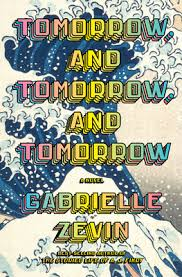
Tomorrow and Tomorrow and Tomorrow by Gabrielle Zevin, 2022
Don’t be misled by the Shakespearean reference in this novel’s title – any Macbeth-related themes such as ambition are introduced late in the day and add little to the narrative overall. Which is a pity, because without the attempt to be more academic than it otherwise is, Tomorrow (etc) is a perfectly readable portrait of the durable friendship between two millennial gamers.
The novel opens with Sam Masur and Sadie Green meeting on the underground in Boston (at least I think it was Boston, my knowledge of New England geography is a little shaky). We find out that they are old friends who have drifted apart. The novel then jumps back in time to show us when they first met. Sadie is visiting her sister who is being treated for leukaemia. In the same hospital Sam is having reconstructive surgery on his foot, crushed in the crash that killed his mother. They bond over a shared love of video games and Sadie’s visits to Sam become an important part of his extended recovery. Visiting Sam in hospital counts as community service for Sadie, something she doesn’t tell him about as she is slightly embarrassed about it. Eventually he finds out, and is upset and understandably angry, and their friendship is ruptured.
Once reunited, older and wiser, the pair begin working on a computer game, inspired by their mutual love of gaming and supported by their friend Marx. Sadie starts a relationship with her married lecturer, Dov, the nearest thing the novel has to a villain. Their game – Ichigo – about a child lost at sea, is a huge success. A seed of resentment is sown when journalists assume that Sam is the inspiration for the character of Ichigo and give him more credit than Sadie feels is due. This festers and eventually cases a rift between the two, although not for several years, during which time the company they found, Unfair Games, (with Marx as their manager) moves to the West Coast and becomes commercially very successful.
Unfair Games diversifies into world-building and non-combat games, and Sadie begins work on a solo project, a Shakespearean-themed game. I’m going to leave the plot summary there (about halfway through the novel) to avoid spoilers, but I don’t think I am giving too much away when I say that Sadie and Sam’s friendship dominates the rest of the novel. I am sure there are plenty of novels about the early days of gaming, but this was the first I have come across/read. The notorious misogyny of this environment is a secondary theme in the novel, but most people are fairly nice – with one dramatic exception there is little of the toxicity exposed in, for example, gamergate. Even Dov, an exploitative and arrogant philanderer, is not condemned by the other characters and shows some development when he returns to the novel near the close.
I know this is going to sound strange but this felt like a young adult novel for grown-ups. What do I mean by that? Well, it has a lot of young adult themes; it follows the characters through their teenage years and into adulthood, coming to terms with the world as technological change accelerates around them. Friendship is as important as love, and casual relationships are unproblematic. I wasn’t at all surprised that the author also writes YA novels – you can tell. At the same time the novel is strangely old-fashioned – because it is set in the 1990’s (at first) in the early days of computer gaming, the author gives the period setting authenticity by numerous references to things such as Magic Eye books (where you stare at a pattern and an image emerges, or not) and Donkey Kong. The novel concludes with a chapter written from the perspective of a character in one of Sadie and Sam’s games. I am sure this was conceived as a neat way of breaking the fourth wall and bringing the plot to a conclusion, but I would have put a big red line through had I been Zevin’s editor – it was ill-conceived and distracting.
I can easily see Tomorrow being adapted for television or film, where the medium would allow time to explore the world-building and the development of the relationships. The narrative structure would work well with a series of one hour episodes, which is another way of saying that the story-line was a little episodic – something happens, a few years pass, something else happens, etc. A stronger author would have crafted the storyline so the seams weren’t quite so obvious. Sam and Sadie, and actually Marx as well, secondary character though he is, are very well developed and believable people, and it was easy to become invested in their outcomes, even if a happy ever after ending was never really on the cards. Would I read more by this author? Possibly – I definitely will keep an eye out for their next book.

