
Burmese Days, by George Orwell, 1934
Yes, Burmese Days is flawed. But I would argue it is overdue a re-evaluation. As a portrait of colonialism it is not quite as devastating as, say, Heart of Darkness, one of the more obvious influences on an inexperienced writer. But it is powerful and effective, and tells us a lot about the early formation of Orwell the author.
Orwell was in his late twenties when Burmese Days was published, first in the US in 1934 and the following year in a a slightly redacted form in the UK, redacted because his publisher was worried about potential libel suits. It was his first novel. Early drafts date back to 1928, shortly after he had resigned his commission in the Burmese Military Police and decided to become a writer.
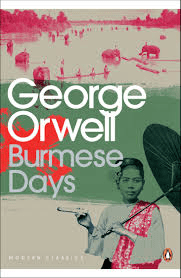
His first four novels, (Burmese Days, 1934, Coming Up for Air, 1939, Keep the Aspidistra Flying, 1936, and A Clergyman’s Daughter, 1935) form a coherent group. They are naturalistic novels of ideas, with a central character loosely based on Orwell himself, each with significant autobiographical components. They are a world apart from Animal Farm, which itself is utterly distinct in form and style from 1984. At some point in the 1940’s Orwell developed from being a moderately successful jobbing writer/journalist to one of our finest novelists. What caused that transformation (some speculate it was the influence of his first wife) is unclear. But there’s little trace of the later author in the earlier novels. I am not sure it helps to see them through that lens – i.e. as just early Orwell novels. They are more than that.
Burmese Days is a passionate anti-colonialism novel, written by someone with a detailed knowledge of the Raj and a love of Burmese people and culture. Set in 1920s British Burma (which at the time was part of India), it follows long-term ex-patriate John Flory, a timber merchant, part of a small group of hard-drinking, embittered English settlers. There are some Burmese characters, but they principally serve as plot devices rather than being fully-fleshed real people. In particular U Po Kyin, a corrupt Burmese magistrate, is a one-dimensional monstrous figure without any redeeming features, evilly plotting to destroy the reputation of his nemesis, Dr Veraswami, an archetype of the ‘good’ Indian. The British characters are not much more rounded – they are
Flory has been in Burma for fifteen years, and has become incredibly jaded. He has a Burmese concubine Ma Hla May (“He had bought her from her parents two years ago“) which is an open secret amongst his British compatriots. Flory has a birthmark on his face which dominates his perception of himself – he thinks women find him ugly and unattractive. He finds it hard to form relationships with the British people and feels increasingly isolated. The arrival of Elizabeth Lackersteen, the orphaned niece of the manager of the local timber firm, fleetingly promises the possibility of a conventional relationship. They grow close as he shows her some of the sights of the Burmese countryside, but she is appallingly shallow and vapid, and is at best confused by his appreciation of Burmese culture. Initially it appears Elizabeth might be prepared to marry Flory given her very limited options and to escape the advances of her drunken uncle. But her affections are quickly transferred to Verrall, a handsome military police lieutenant new to the area. To spoil any chance of Flory’s relationship with Elizabeth surviving, her aunt tells her that Flory has a Burmese mistress, which is of course true. Verrall leaves without saying goodbye to Elizabeth and she quickly pivots back towards her original romance with Flory.
A sub-plot sees U Po Kyin’s attempt to prevent Dr Veraswami joining the local European Club (“In any town in India the European Club is the spiritual citadel, the real seat of the British power, the Nirvana for which native officials and millionaires pine in vain.”). U Po Kyin foils the plan for Dr Veraswami to be elected by fomenting a small-scale rebellion of the locals against British rule.
So what’s wrong with Burmese Days, and why is it worth reading anyway? The characters are entirely one-dimensional, with the exception of Flory who is a thinly disguised self-portrait (as to a greater or lesser extent are all Orwell’s main characters, even the eponymous Clergyman’s Daughter.) (I thought I would illustrate this point – that Flory is a self-portrait – with an example; towards the end of the novel Flory pays a social visit to his neighbours and is shown into the house and asked to wait while the person he is visiting – Elizabeth – is fetched. Orwell describes this situation thus: “Mrs Lackersteen left him standing up in the drawing-room, feeling lumpish and abnormally large as one does at such times”. Not everyone feels this way but one can easily imagine the very tall and slightly socially awkward Orwell would.)
The obese and sexually predatory U Po Kyin is an archetypal, comic book villain; Elizabeth is little more than a plot device; the thinly sketched other ex-patriates are angry, entitled racists. The plot is clumsy and predictable, and the novel’s ending is probably its worst feature, showing every sign of simply being a rushed way of ending the book. Flory’s sudden decision at the end of the novel (trying to avoid spoilers here) makes no narrative sense and appears a way of bringing matters to a close, the novelist perhaps working to a publisher’s deadline or just being bored with the whole thing!
What of the novel’s redeeming features? For a start we get a really clear, unambiguous picture of the source of Orwell’s anti-imperialism. There is a strong argument to be made that this in turn is the source of his socialism, and explains why he always kept coming back to his time in Burma. I’ve written before why it is wrong to see Orwell’s time here as a short intermission after Eton and before the interesting bits of his biography. He spent longer in the Burmese Military Police than he did in any other job he held for the rest of his life and obviously tried hard to make a success of the job. Orwell the writer was formed in the heat of Burma. He writes with passion about the corrosive impact of being part of an imperialistic occupation:
“In the end the secrecy of your revolt poisons you like a secret disease. Your whole life is a life of lies. Year after year you sit in Kipling-haunted little Clubs, whisky to right of you, Pink’un to left of you, listening and eagerly agreeing while Colonel Bodger develops his theory that these bloody Nationalists should be boiled in oil. You hear your Oriental friends called ‘greasy Little babus’, and you admit, dutifully, that they are greasy little babus. You see louts fresh from school kicking grey-haired servants. The time comes when you burn with hatred of your own countrymen, when you long for a native rising to drown their Empire in blood.
This is as fine as anything in A Hanging or Shooting an Elephant.
The other feature of the novel that I enjoyed was the quality of the descriptive writing, not something Orwell is particularly well known for. His prose style may have been still developing, and here is more florid than it would eventually become, but the evocation of the Burmese countryside and especially the stifling heat is very well done:
“North of Mandalay the train, fuelled with wood, crawled at twelve miles an hour across a vast, parched plain, bounded at its remote edges by blue rings of hills. White egrets stood poised, motionless, like herons, and piles of drying chilis gleamed crimson in the sun. Sometimes a white pagoda rose from the plains like the breast of a supine giantess. The early tropic night settled down, and the train jolted on, slowly, stopping at little stations where barbaric yells sounded from the darkness”.
Finally, I thought I would share with you this gem. Goodreads one star reviews are often worth a laugh, but this one was special:
“This was my first George Orwell novel read as an adult, having somehow managed to avoid reading 1989 in high school like everyone else.”


I read Burmese Days recently and found it enjoyable despite the flaws you mention – certainly better than Keep the Aspidistra Flying, which I found tedious. I haven’t read his other early novels but your review reminds me that I should.
LikeLiked by 1 person