100 Best Novels Guardian list, 20th century Literature, Book review, Classics, http://schemas.google.com/blogger/2008/kind#post

Supplementary: A Passage to India – E.M.Forster (1924) (2)

This blog entry follows on from the previous review of A Passage to India, and focuses on the novel’s opening paragraph. This kind of detailed, deep dive analysis of text is a different approach to the reviews I have been writing over the last couple of weeks.

“Except for the Marabar caves – and they are 20 miles off – the city of Chandrapore presents nothing extraordinary.

This is an unusual opening. Novels usually tell us that the scene they are about to describe will be interesting, not “nothing extraordinary”. The term “presents” is a hint that there will be a difference between the outward appearance of the city, and what is to be found behind the façade. Obviously, the reference to the caves is a hint that these are to play a key part in the novel’s events, and come back to mind when the trip to the caves in being planned, and underway. Overall the tone here, deliberate I suspect, is of a sneering Victorian tour guide, summarising the merits or otherwise of this backwater for the benefit of our incoming tourists, Mrs Moore and Miss Quested.

Edged rather than washed by the river Ganges, it trails for a couple of miles along the bank, scarcely distinguishable from the rubbish it deposits so freely.

Here the description strikes an even more unusual note. Firstly, what is the difference between edged and washed, a distinction the narrator takes care to point out. The simple answer is dirt – the river runs past the city, regardless of verb choice, but does not flood, and therefore the city remains filthy. This description is reinforced by the verb choice “trails” – the city lacks energy, spreading itself pointlessly along the banks of the river. It – the city – must be relatively small if it only runs ( a more traditional verb choice) for two miles, but it is “scarcely distinguishable from the rubbish it deposits”. Hold up – the narrator tells us that he cannot tell the difference between the city and the rubbish it produces. It is a rubbish tip. In any other context this would be dismissed as ridiculous hyperbole – no city in the world, however polluted, is indistinguishable from a rubbish tip. This is more than hyperbole – it is abuse.

There are no bathing steps on the river front as the Ganges happens not to be holy here;

Another sentence that is easy to pass by, but once more, hold up. The Ganges is the holy river of Hinduism, and that holiness doesn’t switch on and off as the river passes through the landscape. Forster must surely have known that. So what is he doing saying this? Is the reader being invited to question the narrator’s veracity (this early in the novel)? Is Forster assuming lazily that his readers will allow this to pass, being ignorant of other faiths? This is part of the “nothing to see here” lacklustre description of the city, but I find this approach puzzling – if Forster wanted to imagine a non-descript city in the middle of India, why set it on the banks of one of the greatest rivers in the world? And then proceed to ignore this setting for 300 or more pages?

indeed there is no river front,

What? For an innocuous piece of description this is the third time in two sentence that I have to ask that question. No river front? Ignoring the fact that a few lines earlier we have been told that the city trails along the river bank (I appreciate that there is a subtle difference between a river bank and front), why would a city be built on the bank of (to repeat myself) one of the greatest rivers in the world, and then effectively turn its back on it? Surely one of the reasons the river is worshipped as a God is because of its life-giving properties. The citizens of Chandrapore would need access to the river for water, for washing, for cremations, for leisure – the idea that they would ignore this incredible resource beggars belief. By now this narrator is losing credibility. This is not a realistic portrait that is being painted, which alerts the reader to the fact that there is more to Chandrapore than we are being led to expect.

and bazaars shut out the wide and shifting panorama of the stream. The streets are mean, the temples ineffective, and though a few fine houses exist they are hidden away in gardens or down alleys whose filth deters all but the invited guest.

Here we have filth again. The narrator/Forster’s sense of disgust with this city is palpable. One has to ask, in what sense are the temples “ineffective”. Presumably architectural, although there may be a small comment on the spiritual ineffectiveness of these foreign religions.

Chandrapore was never large or beautiful but 200 years ago it lay on the road between Upper India, then imperial, and the sea, and the fine houses date from that period. The zest for decoration stopped in the 18th century, nor was it ever democratic. There is no painting and scarcely any carving in the bazaars.

Confirmation, if it were needed, that this is a tour guide, or an effective parody of one. The emphasis on the absence of tourist goods in the bazaar and the imperial history of the town put the reader in the role of armchair traveller, learning about the city by proxy, but guided by a very unreliable mentor.

The very wood seems made of mud, the inhabitants of mud moving.

What wood? The wood of the carvings which scarcely can be found? Or something else – this is ambiguous, but leads to the next thought – the people of Chandrapore are “inhabitants of mud”. Literally of course this means ‘people living in mud – that is, the mud-like wood” – but the very clear reference is to ‘people of mud’ – that is mud-people. This is an old racist taunt which JK Rowling references in her use of the term “mud-blood” as a deeply offensive term, as indeed it is.

So abased, so monotonous, is everything that meets the eye, that when the Ganges comes down it might be expected to wash the excrescence back into the soil.

We return to the Ganges. I take the phrase “come down” to mean flood or burst its banks. Excrescence is a powerful word, expressing a sense of disgust, and the speaker here seems to anticipate a flood almost wishfully, looking to see a cleansing of the filth that appals him so much, back into the soil – note back into, not just into, again referencing the idea that the people of India have arisen from the soil, are people of mud.

Houses do fall, people are drowned and left rotting, but the general outline of the town persists, swelling here, shrinking there, like some low but indestructible form of life.

As throughout this paragraph, there is ambiguity here. The tour guide voice has been abandoned for something much more expansive. It is not clear whether “houses do fall” (as opposed to ‘houses fall’) refers to what happens when the Ganges comes down, or as something that periodically happens in any event. People are drowned and left rotting is also ambiguous – if people drown their bodies would normally be washed drown stream, or eaten by crocodiles. This phrase could mean either ‘people are drowned, and then their bodies are left to rot’ or ‘some people drown, and others die in the streets where their bodies are left to rot’. The ambiguity doesn’t rest there – people are drowned actively, rather than drown passively – is this something done to them, or something that happens. Leaving bodies to rot is unlikely to be something that actually happened in India other than in a major disaster, but the narrator gives the impression it is a common occurrence.

Here as throughout ‘A Passage to India’, the narrative voice shifts subtly, and can never be trusted. In an apparently innocuous scene-setting paragraph, numerous under-currents lead the reader to understand that India may seem harmless, but if you scratch the surface you will find it threatening, distressing, and dangerous. Miss Quested is about to find that out.
Standard
100 Best Novels Guardian list, 20th century Literature, A Passage to India, Book review, E.M.Forster, Empire

A Passage to India – E M Forster – 1924

The narrative point of view in A Passage to India is elusive. At points, particularly when describing (supposedly) neutral scenes such as landscape, Forster uses a traditional, omniscient narrative voice. The landscape (or similar) is not however simply described – the description includes subtle (and sometimes not so subtle – see below) judgments and observations. We are being shown India through the eyes of a distinct person or character, albeit one that doesn’t appear in the novel. Would it be safe to assume this point of view is as close to Forster’s as makes no difference?
I’m not sure, because when portraying conversations and interactions between characters, the narrative voice changes. The narrator tells the reader what the characters are thinking and feeling – sometimes even identifying feelings that the character is only dimly aware they are experiencing, such as when the romantic feelings of Ronny and Adela are re-kindled in their ride home and subsequently accident. But again this is not the whole story – the narrator may see all, but reveals the story’s events only as and when they are observed or participated in by the characters. There is no breaking of the fourth wall, no jumping forward in time, and scenes from the past are strictly confined to memories, such as Dr Aziz’s memories of his wife. We observed the complex interactions between the characters with an informed understanding of their nuances, but the narrator is a guide rather than a translator – we are helped to understand what the characters are thinking and feeling, but don’t simply step inside their heads.
The narrator’s partial omniscience takes a further knock during and after the “incident” in the caves. The scene is initially shown from Dr Aziz’s point of view, and then recounted to Fielding. Fielding notes that this initial recount is already beginning to get slightly confused. The puzzling departure by Adela is unexplained – the point of view is limited. This scene is immediately preceded, and foreshadowed, by a scene narrated from Mrs Moore (Adela’s prospective mother in law, and de facto guardian). When the narrative finally portrays the scene from Adela’s perspective, her recollection is clouded and incomplete. In fact the narrative is completely confused through this part of the novel – it is never explained what the charge/allegation against Dr Aziz’s is. The one thing Adela is consistent about is “the man had never actually touched her” (208), but the English community reacts as if she has been ravaged, and indeed the doctor tells them that her life is at risk.
Why does this matter? I think it is always important to ask questions about the point of view. Who is telling me this? Are they telling me the whole truth? Is there something that is being kept from me? Are my thoughts and feelings being manipulated, and if so how.
I am sure Forster intended this story as a positive commentary on the Raj, and specifically the late colonial period when India was ruled, ineffectively, by the British. Forster portrays the effect that colonial power has on well meaning British people who come to India with the best of intentions – to be compassionate, to help the local population, to foster (near-pun intended) good relations between Hindu and Muslim, and so on. These intentions are eroded by the force of circumstances, until they become hard-faced colonial administrators, making decisions based upon what is best for Great Britain, not India, and living largely segregated lives apart from the local population. As the Collector says: “I have had 25 years in this country … and during those 25 years I have never known anything but disaster result when English people and |Indians attempt to be intimate socially.” (161). Newcomers quickly come to understand (or are taught) that mixing with the locals is harmful to both parties. His target is the Raj (and by extension, the Empire) not the people who kept it running.
You could see this all as liberal far-sightedness, Forster predicting the end of the Empire and the resulting inevitable partition between the majority Hindus and the minority Muslims, and commenting on the corrosive effect of Empire on the people administering it. Orwell’s “Shooting an Elephant” makes similar points. But I am not sure this is the whole story. “A Passage to India” doesn’t simply portray the effects of colonialism. There is a portrait of India and Indians themselves which at points is unsympathetic. Indians are shown to be pompous, unreliable, volatile, and dishonest, not just as individual character traits but consistently. When the narrator claims “Suspicion in the Oriental is a sort of malignant tumour, a mental malady, that makes him self-conscious and unfriendly suddenly; he trusts and mistrusts at the same time, in a way the Westerner cannot comprehend. It is his demon, as the Westerner’s is hypocrisy” (272) it is unclear whether this is the narrator voicing a judgment of one of the characters, or Forster’s personal judgment. This racism is more subtle than that of many of Forster’s characters, but forms a backdrop to the novel. I wanted to illustrate this by looking in more detail at the book’s opening paragraphs, which unusually I am going to repeat here in full to avoid you having to go and look it up.  
“Except for the Marabar caves – and they are 20 miles off – the city of Chandrapore presents nothing extraordinary. Edged rather than washed by the river Ganges, it trails for a couple of miles along the bank, scarcely distinguishable from the rubbish it deposits so freely. There are no bathing steps on the river front as the Ganges happens not to be holy here; indeed there is no river front, and bazaars shut out the wide and shifting panorama of the stream. The streets are mean, the temples ineffective, and though a few fine houses exist they are hidden away in gardens or down alleys whose filth deters all but the invited guest. Chandrapore was never large or beautiful but 200 years ago it lay on the road between Upper India, then imperial, and the sea, and the fine houses date from that period. The zest for decoration stopped in the 18th century, nor was it ever democratic. There is no painting and scarcely any carving in the bazaars. The very wood seems made of mud, the inhabitants of mud moving. So abased, so monotonous, is everything that meets the eye, that when the Ganges comes down it might be expected to wash the excrescence back into the soil. Houses do fall, people are drowned and left rotting, but the general outline of the town persists, swelling here, shrinking there, like some low but indestructible form of life.
This analysis will follow in my next post, found here. 
Standard
100 Best Novels Guardian list, 20th century Literature, Book review, First World War, John Buchan, Spy stories, The 39 Steps

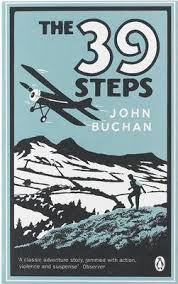
The Thirty-Nine Steps by John Buchan, 1915

This is the novel for which the phrase “what a load of old tosh!” was invented. Buchan, in a short introduction, described it as coming from a genre “which we know as the ‘shocker’ – the romance where the incidents defy the probabilities, and march just inside the borders of the possible”. This is a thinly veiled attempt to pre-empt some of the more obvious criticisms of the utter implausibility of his story. Although having been told that the story will be wildly implausible doesn’t make the plot much easier to swallow.

Positives about the novel are elusive. If the plot is ludicrous, the characterisation is not much better. The descriptive writing, which some reviewers and readers enjoy, left me cold. And the politics of the novel are appalling – a point to which I will return. However, “The 39 Steps” is an important part of the “German spies in the UK” genre, which before the war was used to bolster the re-armament position, and which after the start of the war were all part of the literary attempt to portray the Germans as cunning and dastardly, but beatable, with the right amount of pluck and stiff upper lip. Hannay, the lead character, is thinly drawn – he is a Scottish ex-patriot used to hunting on the veldt, and finds the confines of London life boring and stifling. He treats the improbable events he finds himself engulfed in as an adventure – it would be no surprise to any reader to hear that this novel was first published as a weekly serial in Blackwood’s magazine, which not many years earlier had published Conrad’s “Heart of Darkness”.

Through a series of increasingly outlandish plot twists, none of which are particularly inventive or entertaining, Hannay finds himself forming a thin blue line between the Great British Empire and the Hun. He slips through the fingers of his pursuers in a way that is so predictable as to deprive the novel of any suspense whatsoever, and the bad guys are eventually bested through a combination of Hannay’s intelligent deductions, clues left by his accomplice, and some good old British spunk. It almost defies parody. The novel is barely 100 pages long, and speeds along at a good pace, so if you have a couple hours spare I suppose there are worse ways of wasting them.

But be prepared for some really unpleasant racism and anti-Semitism, particularly the latter. This is more than simply the prevailing casual racism of the British upper classes of the early 20th century. Jewish conspiracy theories are referred to explicitly, and shown to be genuine. These ideas have no meaningful part whatsoever in the plot, other than to provide the vague suggestion that the plot underfoot is more than a simple case of one nation against another (the gang trying to steal British military secrets calls itself the “Black Stone” – amazingly the Black Stone have a secret base in the Scottish Highlands, right in the path of Hannay’s attempt to lay low). This all leaves a bad taste. It’s not thought through in any coherent way, and while done in an apparently off-hand way, without any apparent spite, represents more that the simple racist assumptions and language that were current at this time – they give a platform and credence to anti-Semitic ideologies that were to prove so poisonous only 20 years later.

Standard
100 Best Novels Guardian list, 20th century Literature, Aldous Huxley, Book review, Brave New World, dystopian fiction, science fiction'

Brave New World by Aldous Huxley, 1932

Read in a Vintage edition, with forewords by Margaret Atwood and David Bradshaw

Set 600 years in the future, Huxley’s Brave New World is run by a benevolent scientific despotism. Science has eliminated most diseases and slowed the ageing process, but has also been used to socially engineer society. Many aspects of our present society are inverted, so drug taking is encouraged, as is promiscuity, books (other than instruction manuals) are forbidden or unknown, and, in a convincing piece of cod-science, parenthood has also been eliminated – children are instead grown in factories, and engineered to fill their pre-designated station in life.

If Huxley had left it there, this would have made an interesting short piece of science fiction, a gentle satire on the way science could lead society. People are relatively happy with their lot in life, and society can even allow dissent, albeit dissent that is quickly isolated and neutered (rather than completely extinguished). There is a certain prurience in the portrayal of sexual liberation in life After Ford, (AF), but titillation in science fiction is nothing new.
However, at this point Huxley introduces a character, Bernard Marx, who is presented as an outsider, one who can see beyond the drug induced façade to the rottenness of society, the emptiness of people’s lives. During a visit to a reservation, Marx “discovers” a savage, John, living among a surviving population of unmodernised indigenous people in Mexico. John has read Shakespeare, and sees the world much as Miranda may have done when first discovering she is not alone on her island.

“Oh, wonder!
How many goodly creatures are there here!
How beauteous mankind is! O brave new world,
That has such people in ’t!”

John has been treated as an outsider all his life by the Indians he grew up with, but his reaction to the new world he finds himself in is anything but positive. He is repelled by the absence of romantic love, his perspectives having been distorted by his reading of Romeo and Juliet and the like. He finds the new world disgusting, and despite a long and didactic conversation with the Controller, Mustapha Mond, remains unconvinced about the merits of this new world:


“All right then,” said the savage defiantly, I’m claiming the right to be unhappy.”
There was a long silence.
“I claim them all,” said the Savage at last.”
When John’s desperate attempts to retreat from society fail, he kills himself in the novel’s final scene. Meanwhile Bernard does not emerge as the hero we originally expect him to be – he uses his notoriety as “discoverer” of the noble savage to sleep with a variety of important women, despite his previous objection to people being treated like pieces of meat, and offers no help to John as he struggles in his new environment.
While a more optimistic view of the future than the later “1984”, “Brave New World” is still bleak. Several of the characters are given the names of well known Communists – Marx, Lenina, Trotsky – suggesting that this world is a socialist experiment, where the attempt to nationalise parenthood and use science to eliminate difference, has failed.
Brave New World is a novel of ideas, where none of the characters are convincing or particularly interesting, and where few of the ideas are fully developed or followed through. The ending is predictable, unconvincing and melodramatic. It really only works as a companion piece to the infinitely darker “1984”. In “1984” the vision of the future is of a boot continually smashing into a face – in “Brave New World” the future is “seven and a half hours of mild, unexhausting labour, and then the soma ration and games and unrestricted copulation and the feelies.” (197) 


Standard
20th century Literature, Book review

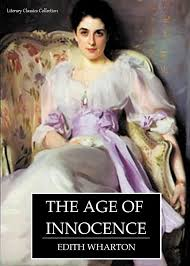
The Age of Innocence, Edith Wharton, 1919

I went through a long journey with this novel. The opening wasn’t promising, and I wondered if I was going to be able to complete it. By the end I was captivated.
Set in 1870’s New York, although written in 1919, Wharton portrays in miniaturist detail the lives and relationships of a tightly-knit, closely-related upper middle class community. This community has a rigid code of conduct, from which any deviation is met with rejection. Sexual conduct between men and women in particular is the most closely monitored of all behaviours. Men and women operate under different codes, nevertheless – some male characters conduct affairs quite blatantly, whereas women have significantly less freedom.
The novel focusses on a newly engaged character, Archer Newland. Wharton packs a lot of significance into that name – Archer, the hunter, Newland, echoing New York and indicating that the character is an archetype for the country itself, which in the 1870’s was still very much a new land. His fiancé, May, represents a virginal innocence – she is even described as looking virginal after their marriage – although that innocence is shown to be a façade, and one which cracks near the end of the novel.
Archer, during the course of his engagement to May, falls under the spell of his fiancé’s exotic cousin, Ellen Olenska, newly returned to New York to escape the deprivations of her beastly husband. There is a whispered insinuation that in order to escape her husband she may have conducted an affair herself. Archer has a history of similar infatuations, previously with another married woman, and at first the reader is led to believe that this relationship will go the same way, particularly when his fiancé’s family agree to a short engagement, and he marries.
“He had married (as most young men did) because he had met a perfectly charming girl at the moment when a series of rather aimless sentimental adventures were ending in premature disgust; and she had represented peace, stability, comradeship, and the steadying sense of an unescapable duty.”
But given the close nature of New York society his path constantly crosses Ellen’s, and the relationship deepens into something much more, to the extent that he dreams of his wife’s death as a means of escape:
“She (May) bent over to lower the wick, and as the light struck up on her white shoulders and the clear curves of her face he thought: “How young she is! For what endless years this life will have to go on!”
He felt, with a kind of horror, his own strong youth and the bounding blood in his veins.” (269)
The subject that Wharton constantly refers to, but never quite confronts, is sex. Sex is everywhere in this novel. Even in the quote above, as his wife symbolically “lowers the wick”, we are left to wonder which particular vein in his body feels “bounding blood”. We are told, obliquely, that Archer and May do not share a bedroom, despite his urgency for their marriage to be brought forward, and pregnancy is not mentioned as a possibility until it is required as a means of finally persuading him not to pursue his intention to leave her. Other men in the novel undoubtedly do maintain mistresses, some quite openly, so this is not a sexless world. Equally, the nature of Ellen’s problems with her middle-European husband revolves around some unspoken beastliness which is never made explicit, but surely is more than simple infidelity.
There are two primary ways of reading this novel. On one level it is a pretty scathing portrait of the hypocrisy of New York society of the time, obsessed with the minutiae of an unreal code of conduct, but ignoring the important relationships in life. Ellen refreshingly ignores many of these conventions, and the closing chapter of the novel confirms that looking back they seem unreal and fantastical to Archer as well:
“In reality they all lived in a kind of hieroglyphic world, where the real thing was never said or done or even thought, but only represented by a set of arbitrary signs.”
There is, it is suggested, a high price to pay for this hypocrisy in terms of human unhappiness, but the compensations – in terms of material comforts – are high. As satire however, the novel skewers some easy targets, and the points is well made not far into the second chapter – after this the repetition is unnecessary –we know these people are shallow and unhappy.
Another reading focusses on the love story which emerges between Archer and Ellen, which I found surprisingly touching. They struggle with their feelings for one another throughout the novel, and there are many moments of unexpressed longing. Towards the end of the novel Archer is eventually ready to abandon his struggle to suppress his feelings, leave his wife and follow Ellen to Europe, to live out their lives in disgrace and social exclusion. At that point May, which we are led to believe has been aware of her husband’s feelings for Ellen all along, announces she is pregnant, effectively checkmating her rival. The closing “flash-forward” chapter sees Archer as a widower some thirty years later, surrounded by his affectionate family, but still with fond memories of Ellen. He has a chance to rekindle the affair, but probably wisely decides against it at the last minute.
Archer and Ellen’s romance is not a sudden “bolt of thunder” affair, but a slow, unavoidable compulsion, best summarised by Ellen’s wonderful phrase when they meet after a long separation:

“Each time you happen to me all over again”. (289).

I am going to end this review with one quote which stood out for me as an outstanding example of Wharton’s power as a portraitist. Archer is visiting a house where he hopes to find Ellen, accidentally to the outside world. The house’s garden has been neglected:
The patch of lawn before it had relapsed into a hayfield; but to the left an overgrown box-garden full of dahlias and rusty rose-bushes encircled a ghostly summer-house of trellis work that had once been white, surmounted by a wooden Cupid who had lost his bow and arrow, but continued to take ineffectual aim.” (225)
In this novel Cupid is not a chubby baby, but made of wood, and his aim is ineffectual. Eden is overgrown, rusty, and ghostly. Wharton gently mocks the concept of romantic love here, warning the reader that there will be no happily ever after for her characters, but that there are other lives to be led.
P.S. An afterthought. It is interesting what is notin “Age of Innocence”. Wharton makes some relatively playful references to telephones not yet being available in the 1870’s, but there is no mention of the sweeping changes that had just crossed America, with the Civil War barely over. Black people remain shadowy background figures in this novel, only occasionally referenced as “mulatto” servants. Equally, despite being written in 1919 after the end of the Great War, this is never hinted at as a shadow about to fall over the world. The New Yorkers of the novel exist in a blissful bubble where the only thing to worry about is someone wearing this season’s fashions, or the wrong colour ball gown. The only exception to this rule is the banking scandal which engulfs one of their number, but this is really little more than a ripple on an otherwise smooth surface.
Standard
20th century Literature, Book review

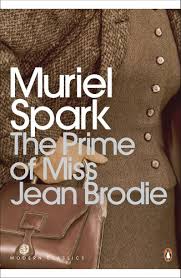
The Prime of Miss Jean Brodie – Muriel Spark, 1961

Read in a Penguin edition

Following on from The Maltese Falcon, this is another novel arguably better known for its film adaptation than the original novel. The film was a success, in its own terms, but of necessity made some significant changes to the novel, in structure if not in spirit.

Miss Jean Brodie teaches at a small private girl’s school in 1930’s Edinburgh. She believes herself to be in her prime of life, and the novel focusses on her relationship with her “set” – a small group of girls who she adopts as her favourites, and who she dedicates herself to moulding in her own image. This experiment largely fails. While she has a significant impact on the girls’ lives, they all outgrow her and go their own separate ways, remembering her with little more than wry fondness.

Described as an experimental novel when first published at the start of the 60’s, the main innovation Spark uses justifying this label, and elevating this from a traditional school days tale, is her use of a fractured time scheme. Instead of a chronological approach to story telling, in which the events of the story are presented in the order in which they happened, the events of the novel leap forward and back in time, as if presented through the recollections of one of the participants. The reader therefore knows what happens to the principal characters – often the main focus of interest of many novels – early on, and is free to focus on other issues. This approach to presenting the events of the novel is a fragmented order is less innovative now of course, but at the time was considered daring. It leads to an interesting case of “negative foreshadowing”, a term I just made up, where a character’s ultimate fate is described, followed by an incident which in a traditional novel would be described as foreshadowing. (A good example of this in its traditional context is the scene in “Of Mice and men” where a character is pressurised into putting down his old, sick dog).  

For a very short novel Spark manages to include a large number of themes and ideas in “The Prime”. The religious issues of 1930’s Scotland, and their impact on the girl’s emerging sexuality features heavily. Equally, the social divisions of the time are also central to the background of the narrative. Education, and the ability of a teacher to influence the attitudes and perspective of their students, and not least politics are also consistently featured. The girl’s vivid imagination is portrayed very effectively – they imagine themselves as heroines of stories inspired by Miss Brodie, and as they get older these stories inevitably get more explicit, while retaining an innocence suitable to 1930’s Presbyterian Scotland:

“Allow me, in conclusion, to congratulate you warmly upon your sexual intercourse, as well as your singing.”

But the novel is not didactic – this is background, not much more, and the primary interest is in character. The success of this is evidenced by the fact that as well as translating to the cinema, “The Prime” has also been performed successfully as a stage play, and was made into a television series. The portrayal of the central characters in the film was sufficiently vivid to have stayed with me for a long time, so much so that reading the novel felt in many ways like a re-read.


Standard
20th century Literature, Book review, Detective fiction

Comment: Spade and Marlowe

There’s no denying the huge influence Hammett had on Philip Chandler’s work. Chandler acknowledges this in “The Art of Murder” when he wrote:

“Hammett gave murder back to the kind of people that commit it for reasons, not just to provide a corpse; and with the means at hand, not with had-wrought duelling pistols, curare and tropical fish. He took murder out of the Venetian vase and dropped it in the alley.”
Even in a paean to another writer’s style, Chandler can’t avoid using his own, unique turn of phrase.
Marlowe is a subtle evolution of Spade, rather than a straight tribute act. He contains many of his characteristics, but there are some important differences. For a start, Marlowe is smarter. He is usually (but not always) one step ahead of the bad guys. There is a scene in Falcon where Spade is held at gunpoint by Joel Cairo, who wants to search his office. (The Levantine). Spade disarms him, they talk and come to an arrangement, then as he leaves Cairo asks for his gun back. Spade obliges, and is promptly help up again, and searched. My reaction reading that scene was that Marlowe would never have fallen for that – he would have taken the bullets out of the gun. Having said that, Marlowe is not infallible – he has a particular soft spot for the good old Mickey Finn. After having been tricked by Cairo, Spade enjoys the pleasures of a traditional drugged drink scene, a favourite plot device of Chandler’s (Marlowe seems to drink a lot of drugged drinks, and seems to have a blind spot for them – the reader is screaming “no, don’t drink it you fool, it will be drugged”, but he sips away anyway, then gradually his vision fades, his speech blurs, and he falls to the ground…..). The scene in the Maltese Falcon, where Spade is drugged by the Fat Man, could easily be the archetype for that recurring nightmare.

Another difference between Spade and Marlowe is that Marlowe is significantly more pious. He is a man of high principle. Marlowe will sleep with the women he encounters in his adventures, but he won’t allow them to use their sexuality to influence him – in “The Big Sleep” for example he throws the dangerous but highly attractive Carmen Sternwood out of his apartment when she climbs uninvited into his bed. Spade has fewer scruples – he sleeps with Brigid even though he knows she is using him.

Spade is also a bully, hurting his secretary when Brigid runs away, which is in no way her fault. “I won’t be able to wear an evening gown for two weeks, you big brute.” (477) Marlowe would never bruise a woman’s shoulders, certainly not his secretary, which of course he could never afford.

Another strong echo of Chandler is the scene where Spade confronts the young man, who we later find is working for the Fat Man:
“The boy spoke two words, the first a short guttural verb, the second “you”.
“People lose teeth talking like that.” Spade’s voice was still amiable, though his face had become wooden.” (457)

In the Big Sleep there is a scene where Marlowe captures Carol Lundgren and is given the same two-word response, repeatedly, and reacts with the same dry wit.

The one thing Chandler does above all others which elevates Marlowe is giving him a voice – by using a first person, interior monologue narration, we are given an insight into Marlowe’s thoughts and feelings in a way we only peep into those of Spade’s. It is this above all else that allows us to empathise with Marlowe, to walk in his steps, even if he hides some key facts and conclusions from the reader, to keep us guessing. With Spade we only see and hear what the omniscient narrator allows us to see. This leads to explanatory scenes, where the characters’ dialogue is primarily there to help the reader “catch-up”. Marlowe is the more rounded creation, and Chandler’s narratives are the more complex and interesting, but the debt he and many other detective fiction authors owe to Hammett is unambiguous and significant.

Standard
20th century Literature, Book review, Detective fiction

Supplementary: The Maltese Falcon (2) – A Different Approach

In this alternative review of TMF I wanted to consider some parts of the text in more detail, rather than the broad sweep of the admittedly complex story line.
Sam Spade, the central character and archetype of the hard-boiled American detective, is emotionally stunted. He shows no grief whatsoever at the death of his partner, Miles Archer, and avoids telling Archer’s wife, who he has been having an affair with, about his murder. Hammett shows this in the constant references to Spade’s lack of reaction and his woodenness. His only reaction is to tell his secretary to “Have the Spade & Archer taken off the door, and Samuel Spade put on” (398)
Hammett is really good at noticing the small, subtle movements we all make which convey emotion or intention but which are easily missed. Here for example Spade’s client, Brigid Shaugnessey, picks up his hat:
“She came back and stood in front of him holding the hat, not offering it to him, but holding it for him to take if he wished”. (My emphasis)
The difference in the two ways of holding a hat here is slight, but in a novel where every word counts Hammett conveys a lot about Brigid and her relationship to Spade – she is a consummate performer, and knows offering him the hat would convey “let’s go”, whereas “holding it for him to take if he wished” is a more passive gesture, conveying “let’s go?”, giving him control of the situation. Later, in the eponymous chapter, Brigid is described while Spade rolls yet another cigarette:
“She put a finger-tip to her mouth, staring across the room at nothing with widened eyes, and then, with narrower eyes, glanced quickly at Spade. He was engrossed in the making of his cigarette. ”Oh yes”, she began, “of course –“ She took the finger away from her mouth and smoothed her blue dress over her knees. She frowned at her knees.”

This is extraordinary writing. Hammett uses these small movements, even down to the width of her pupils, to tell us so much about what is going on. Brigid has widened her eyes as part of her seduction technique. She narrows them to glance at Spade, who is studiously ignoring her performance. The fingertip to the mouth is a classic sexual invitation, mimicking fellatio. When this doesn’t work she moves to smoothing her dress, drawing her attention down to her legs and groin. She is an expert temptress, using her sexuality to get what she wants. Later, after they share a supper of sausage, (little subtlety there!), “Spade’s arms went around her, holding her to him, muscles bulging his blue sleeve, a hand cradling her head, its fingers half lost among red hair, a hand moving groping fingers over her slim back. His eyes burned yellowy” (453). She has won – or has she? (Incidentally, I am not sure about the word “yellowy”).

There is a fascinating snippet of dialogue between Spade and Brigid immediately after this scene, the morning after they sleep together. He has crept out to search her apartment, demonstrating that although she may have seduced him, he is still in control. When he comes back to his apartment she is alarmed, or claims to be, and has “her right hand out of sight under a pillow”. (454). “I’m sorry angel, I thought you’d sleep through it. Did you have that gun under your pillow all night?

“No, you know I didn’t” (455)
He knows she didn’t have the gun under her pillow, because her pillow didn’t stay in place all night, suggesting that their sex was reasonably active. Pretty racy stuff for 1920’s American literature?

I’m going to write separately about the parallels between The Maltese Falcon and the writing of Raymond Chandler, but for now, while Hammett can’t hold a candle to Chandler when it comes to crafting a phrase, few can, I should acknowledge that there are still some treasures here. For example he describes Brigid’s eyes as “cobalt-blue prayers”, which I thought was extraordinary. There is also the description of the Fat Man, which was one of the best descriptions of obesity I can remember reading:

The fat man was flabbily fat with bulbous pink cheeks and lips and chins and neck, with a great soft egg of a belly that was all his torso, and pendant cones for arms and legs. As he advanced to meet Spade, all his bulbs rose and shook and fell separately with each step, in the manner of clustered soap bubbles not yet released from the pipe through which they had been blown. ” Clustered soap bubbles – isn’t that fantastic?


Standard
20th century Literature, Book review, Detective fiction

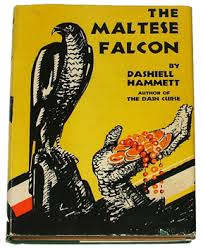
The Maltese Falcon, Dashiel Hammett, 1929

Read in Picador edition as part of “The Four Great Novels”

Dashiel Hammett’s “The Maltese Falcon” (1929) is a devastating critique of the American Dream. Often seen as a straightforward detective novel, a closer contextual reading reveals a damning indictment of American capitalism and society.

At the heart of the novel is the quest for the Maltese Falcon, an elusive golden statute encrusted with highly precious stones. The falcon is never seen, never found, always slipping through the hands of the pursuers and melting away, like the proverbial pot of gold at the end of the rainbow. There is little evidence it actually exists, but the treasure hunters seek it obsessively, and great financial and physical cost to themselves. What is this if not the perfect metaphor for the American Dream, the promise of wealth and happiness that so many Americans pursed (and pursue) but can never quite attain? When the gang think they have at one point found the statue, it turns out to be a fake, lead instead of gold. Hammett is surely saying that the American Dream, like the falcon, is a myth and a fake.

The falcon is also the loot of imperialism, made from gems and gold stolen by the Crusaders: “For years they had preyed on the Saracens, had taken nobody knows what spoils of gems, precious metals silks, ivories – the cream of the cream of the East. Hammett identifies the Crusades as not a matter of religion, but plunder: “We all know that the Holy Wars to them, as to the Templars, were largely a matter of loot”. (483)

In Hammett’s prohibition-era America, society is unjust and intolerant. The police in Hammett’s novel are incompetent and corrupt, agents of a corrupt and unjust society. At one point Spade tells Iva, Archer’s widow, in relation to talking to the police “Maybe it’d be best to say “no” right across the board”. This was Hammett’s response (in effect) when question by the McCarthy investigation into communism in the arts in America in the 1950’s (to be precise, he pleaded his 5th Amendment rights to all questions”) a stance which eventually landed him in jail. The novel ends with Spade turning his lover into the police, and turning his back on love, another rejection of the romantic illusion of middle class life.
 

Or is this all nonsense? Does knowing that Hammett was a communist, was black-listed, and jailed for his politics make such a reading of “The Maltese Falcon” sustainable? I have to admit I had never thought of it as a critique of the American Dream until I read a short biography of him. Until then I thought of it as a straightforward albeit genre-defining detective novel. Is contextual analysis, in which the author’s life is mined for lenses through which the novel can be read, a sensible approach to reading? I confess until now, I thought not, but the idea that the falcon is a metaphor for the American Dream is a pretty powerful one.
Standard
20th century Literature, Book review, Evelyn Waugh, humour, Scoop

Scoop – Evelyn Waugh – 1938

Read in a Penguin Classics edition

Scoop is, by Waugh’s standards, a fairly light-hearted satire on Fleet Street, Government, and the British upper classes. Nobody dies or gets stranded in remote jungles; instead we have what comes closest to a happy ending, in which everyone gets what they wanted. I usually avoid writing at too much length about the context in which a novel was written, but given the date of publication (1938) you would expect the novel, with its themes of colonialism and Imperialism, whereby a proxy European war is fought over the resources of a remote African country, to be much darker than it is.

The plot is simplicity itself. By a confusion over names, William Boot, the Daily Beast’s rural affairs correspondent, is sent to cover a conflict in Ishmaelia, a North African country where gold has just been discovered, and where the European powers are struggling, through proxies, for control. War has yet to be declared – it never really is – and the journalists have little to do except follow one another around. Boot stumbles upon the real story by accident, and returns to acclaim, only for the case of mistaken identity to be repeated, leaving him in the countryside seclusion her prefers.

Waugh portrays Fleet Street as a wholly corrupt organisation, which an appallingly cynical approach to foreign news. Lord Copper, press magnate, and owner of the Daily Beast gives his new war correspondent some guidance on the conflict thus:

“The British Public has no interest in a war which drags on indecisively. A few sharp victories, some conspicuous acts of personal bravery on the Patriot side, and a colourful entry into the capital. That is the Best Policy for the war.”

If Fleet Street is shown as a irredeemably corrupt, Government doesn’t come out any better. The European countries trying to exploit Ishmaelia and its gold are incompetent and amateurish. Salter, the Beast’s foreign affairs editor, summarises he conflict by explaining:
“when you say black you mean red, and when you mean red you say white, and when the party who call themselves black say traitors they mean what we call blacks, but what we mean when we say traitors I really couldn’t tell you…..But, of course it’s really a war between Russia and Germany, and Italy and Japan who are all against one another on the patriotic side.” (43)

Elsewhere a fellow journalist explains in anecdote the power of the press, and why it should not be ignored:

“Once Jakes went out to cover a revolution in one of the Balkan capitals. He overslept in his carriage, woke up at the wrong station, didn’t know any different, got out, went straight to a hotel, and cabled off a thousand-word story about barricades in the streets, flaming churches, machine guns answering the rattle of his typewriter as he wrote. Well they were pretty surprised at his office, getting a story like that from the wrong country, but they trusted Jakes and splashed it in six national newspapers. That day every special in Europe got orders to rush to the new revolution. Everything seemed quiet enough, but it was as much their jobs were worth to say so, with Jakes filing a thousand words of blood and thunder a day. So they chimed in too. Government stocks dropped, financial panic, state of emergency declared, army mobilized, famine, mutiny — and in less than a week there was an honest to god revolution under way, just as Jakes had said. There’s the power of the press for you. They gave Jakes the Nobel Peace Prize for his harrowing description of the carnage”.
Boot is an ingénue, wandering through the conflict understanding little, but accidentally discovering the scoop that all his professional rivals are looking for.
So is it funny, and is it racist? Occasionally – the jokes are clever, but entirely predictable. The stereotypes that Waugh describes, such as the decaying Boot Magna with its retinue of servants having to fit in their duties around five meals a day, would, in the 1930’s, have been a lot fresher and more original than they are now. The racism is of course a more serious charge. On the one hand Waugh treats the Europeans trying to exploit the Ishmaeli’s as the inferior race – they invariably come off second best. It would have been remarkable given the context if Waugh had written respectfully about the Africans in his novel when everyone else is given such a hard time, and I can’t think of a novel of this period written by a European when the accepted racist attitudes towards “colonial races” are challenged. If you want to understand how most European’s thought about the people of Africa this is as good a starting point as any. Whether any of that is an acceptable excuse is for you to decide.
Standard