
Time has not been particularly kind to Arnold Bennett. Once a pre-eminent Edwardian novelist, he is now little read. If pressed I might have been able to come up with the names of one or two of his many other novels, and to be fair they mostly remain in print, but if the Goodreads or Amazon reviews are anything to go by they are dropping rapidly into obscurity.
Bennett is arguably best known today for the occasion when he crossed swords with Virginia Woolf – she took issue with his review of Jacob’s Room – and came off by far the worst. In doing so the dividing line between traditional story-telling novelists in the Victorian tradition and the modernist novelist of the early decades of the twentieth century was drawn, with Bennett widely considered emblematic of the former. He tells stories about realistically drawn people in recognisable settings, that have a beginning, middle and end. Which is fine, but the twentieth-century was ready for so much more.
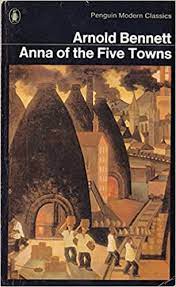
In brief, Anna of the Five Towns is D.H. Lawrence without the sex. Set in the Staffordshire potteries, the five towns of the title, in which a fortnight on the Isle of Man is considered an exotic adventure of a lifetime, the vice-like grip of Wesleyan morality enslaves lonely Anna to a life of subjugation to her bullying father. Marriage is offered as a way out of this servitude, but while the novel ends with Anna marrying her fiancé, this is hardly the happy-ever-after romantic finale of earlier Victorian novels.
Anna lives with her younger sister and her widowed father, Ephraim Tellwright, in Bursley in the industrial heart of the Staffordshire potteries. Mr Tellwright is a misanthrope and a miser. Despite being wealthy by any objective standard, he begrudges spending on any comforts – life is unnecessarily hard. Anna’s social life centres on the local Methodist church. On her 21st birthday she finds out that she is rich through a family inheritance. But there is a catch – her father controls all access to her account, and in practice she has no more money than before. Now people expect her to be well-dressed and able to afford things, but she has to continue to scrape by with the pennies that form her house-keeping ‘allowance’.
As part of her inheritance she acquires ownership of a rundown pottery operated by father and son Titus and Willie Price. The Prices’ business is approaching bankruptcy, unable to compete with the larger potteries in the area. They owe Anna arrears of rent. She would happily waive this debt, but her father insists she collects it in full (despite that it was under his stewardship the arrears built up in the first place). While they come up with some of the arrears, it is not enough, and we find out later that they have only been able to find this through desperate measures. By contrast the up-to-date and prosperous works of Henry Mynors, Anna’s suitor, is presented as an investment opportunity. While Anna respects Mynors, her affections are drawn towards Willie Price. She knows he is an unsuitable match, all the more so now his father is nearly bankrupt, but the heart wants what the heart wants.
On a short holiday in the Isle of Man with her friend Beatrice Sutton and her family, Anna becomes engaged to Mynors. She is not really in love with him but sees him as a route out of the servitude imposed by her father. On her return to Bursley, Anna arranges for Mynors to visit her father and ask for her hand in marriage. When he doesn’t come at the arranged time, she begins to worry, but soon finds out that he has been caught up in dealing with the suicide of Titus Price. Faced by financial ruin and possible imprisonment, he hangs himself. Anna can’t avoid the self-recrimination, the thought that her compliance in her father’s pursuit of the Prices debt will have been a cause of his death.
Social commentary in the novel is done with a light touch. This is not a state of England novel with an analysis of its ills. Industrialisation is neither good nor evil – it is the backdrop against which people live their lives.
“The entire landscape was illuminated and transformed by these unique pyrotechnics of labour atoning for its grime, and dull, weird sounds, as of the breathings and sighings of gigantic nocturnal creatures, filled the enchanted air.”
The gigantic nocturnal creatures are not malevolent but neither are the benevolent. In Mynor’s well-run pottery employment is provided for both men and women and good craftsmen are well rewarded and have opportunities to express their creativity. It’s a far cry from the dark satanic mills of many Victorian novels.
Similarly Bennett has little to say on the emancipation of women. Tellwright is a bully and treats his daughters as domestic servants, and marriage as a route to freedom is a mixed blessing for Anna. But she has the prospect of economic independence (indeed, wealth), is eventually able to stand up to her father and even goes on holiday against his wishes. She is also partially unshackled from the ever-present constraints of Wesleyanism, although finally unable to follow her heart in terms of her engagement to Mynors, which she feels compelled to accept.
There is no happy ever after ending on the cards for Anna. Willie declares himself bankrupt and is allowed just enough money to emigrate to Australia. Anna gives him a parting gift of £100, but will not go with him, and commits herself to Mynors. The final, impactful lines of the novel reveal Willie’s despairing response. Anna of the Five Towns may not be a tragedy on the scale of, say, Tess of the D’Urbervilles, but for Willie it is.

