
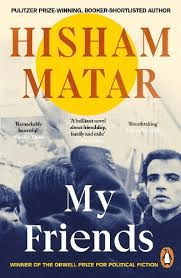
My Friends, by Hisham Matar, 2024
My Friends is a very personal narrative about the experiences of the narrator, Khaled, a Libyan student who in 1983 goes to study at the University of Edinburgh. There he meets fellow Libyan Mustafa, who becomes a life-long friend. Despite being aware of the risk to both themselves and their families they attend an anti-Gaddafi protest outside the Libyan embassy in London in 1984. This was the infamous occasion when Libyan secret police opened fire on the protest from within the embassy, killing Yvonne Fletcher, a Metropolitan police officer.
Khaled and Mustafa are wounded in the attack and spend weeks recovering in hospital under police guard. They realise that as soon as the Libyan authorities discover they were present at the demonstration that not only will they be at risk but so will their families. While the Gaddafi regime survives they can never go back to Libya. Their involvement in the demonstration is kept strictly secret, revealed only to the most trusted, closest friends. Their close-knit friendship is later joined by another Libyan ex-patriate, Hosam, a writer, one of whose anti-Gaddafi poems is read on the BBC Arabic World Service, thus putting a target on his back. This small group of friends share their longing to return to Libya and their families and a life-long fear of retribution by the Gaddafi regime.
For almost thirty years the friends keep in touch, on and off, while Khaled tries to settle in London, teaching and occasionally starting relationships, but never seriously committing to either a job or a partner. Finally, during the 2011 Arab Spring, the friends feel compelled to choose between staying in London or returning to Libya to fight. Mustafa chooses to return to fight – Hossam and Khaled stay in London.
As with all plot summaries, I have evened out the chronology – in the novel itself the chapters jump between time periods as Khaled looks back over his friendships with Hosam and Mustafa. It opens in the present with Khaled saying farewell to Hosam at St Pancras Station. Hosam is leaving for California, and Khaled recognises he is unlikely to see him again. As Khaled wanders through the London streets he reminisces about his friendships, and this walk forms the framework for the novel.
Exile is the central theme of the novel and this is the closest I am likely to ever get to experiencing this sense of loss, of one’s life being almost permanently on hold, never being able to commit to a relationship or a career. But equally the novel is about friendship, particularly the type of friendship forged in crisis and a shared experience of trauma than can endure for decades and through long periods of separation and distance.
Although My Friends won the Orwell Prize for Political Fiction in 2024, it is not an overtly political novel. Opposition to the Gaddafi regime forms a backdrop to the exiles’ lives, but it is taken as read, without the need for any overt criticism of the dictatorship. While the Arab Spring saw the end of that generation of political figureheads, a new generation has emerged. Political opposition and protests is as unsafe as it ever was, now in the West as much as elsewhere. This gives My Friends a renewed political relevance, urgency and resonance.
It’s great to see the Orwell Foundation expanding its scope and awarding prizes for a wider variety of writing. The results of this year’s prizes are announced later this month (June 2025) – well worth watching out for.

