
There are certain authors I feel a sense of guilt about not admiring. Coetzee is the obvious example – everyone tells me Disgrace is a masterpiece, but it left me cold. Hilary Mantel’s novels fall into the same category – even as I was reading Bring up the Bodies I could feel the pressure to enjoy the craftsmanship and characterisation, to marvel at the wealth of detail, and to ignore some of the problematic issues (which of course I am not going to do.)
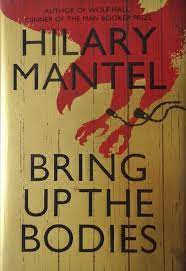
Bring up the Bodies is the second novel in Mantel’s series about the life of Thomas Cromwell, a sequel to Wolf Hall. It recounts the dramatic events running up the end of Henry the Eighth’s marriage to Anne Boleyn. It imaginatively recreates these events from Cromwell’s Machiavellian perspective, using his inner monologue as the narrative voice. The novel is prefaced by five pages of characters and several family trees, which I referred to throughout the novel (‘Which one is he?’). This should give you some idea of the complexity of the narrative. I certainly know more now about the history of this period than I did previously!
I confess I did not know what happened to Cromwell after he engineered the end of Henry’s second marriage – but I was sure that it did not work out well (spoiler – it does not). I think we are intended to see he, Cromwell as a master manipulator, someone pulling all the strings, carefully orchestrating the downfall of the Boleyns, serving the interest of the king but at the same time ensuring his own position is secured. But actually he is not in control of events in any sense. Henry is volatile and dangerous. While Cromwell is on the right side of the king he prospers, but it is clearly only a matter of time before he falls out with him and is used as a scapegoat for all the king’s crimes and misdemeanours. He’s simply too convenient an excuse – ‘Cromwell made me do it’ – not to be used sooner or later, not to mention the fact that his money and his offices of state could then be redeployed around the court for more influence and favour. As he becomes more powerful at court, he accrues more enemies, and comes closer to the day of his eventual demise. He is a threatening figure at Court, and dangerous people are likely to be brought down sooner or later. No-one can be more powerful than the king. As Call-me Wriothesley puts it:
“If this is what Cromwell does to the cardinal’s lesser enemies, what will he do by and by to the king himself?”
Henry is dangerous and ruthless, and there is no way this is going to end well for Cromwell. He seems to sense this himself – it’s hardly the most profound of insights:
“You can be merry with the king, you can share a joke with him. But as Thomas More used to say, it’s like sporting with a tamed lion. You tousle its mane and pull its ears, but all the time you’re thinking, those claws, those claws, those claws.”
There is a lot we do not know about the end of Anne and Henry’s marriage. At its most basic, we do not know if she was guilty as charged. She was charged with and convicted of adultery with a number of other men, including George Boleyn, her brother. It seems highly unlikely that she would have risked her life for – what? The chance of another pregnancy, or simply because Henry was an inadequate lover? For perfectly understandable reasons Mantel does not try to answer this – she leaves it ambiguous as to whether Boleyn was guilty or not. The obvious answer – that Henry was bored with Anne and didn’t want to go through another protracted divorce, so turned to Cromwell to fix the problem – is avoided, I suspect simply because it is not that interesting an answer. Instead the solution presented to the reader is that this outcome is the result of Cromwell’s deviousness.
At the heart of the novel is his investigation into this allegation. As part of his enquiry he, Cromwell, invites one of the suspects, Mark Smeaton, to supper. Mark is a Flemish lute-player, the most junior of the suspects, and a member of the queen’s court. Court gossip has implicated him as one of the queen’s lover. Here he jokes with him (he, Cromwell) and in the course of the conversation Smeaton confesses to sleeping with the Queen. Smeaton must have been profoundly stupid to think he could boast of cuckolding the King, a man not known for his patience or understanding, to a senior minister with a fearsome reputation for being the King’s enforcer, and that there would be no consequences. The traditional or conventional explanation of Smeaton’s confession is that he was brutally tortured, but that would make Cromwell seem more of a brute and less of a manipulator, able to coax a damning confession out of a man using flattery and suggestion.
The passage where Smeaton confesses is key to the novel’s denouement. For Cromwell this is an interrogation; Smeaton thinks it is an informal chat, a delusion Cromwell fosters:
(Cromwell to Smeaton): “I ask your charity… I come to you because you are close to the queen, and the other gentlemen will not help me.
(This is of course flattery. Cromwell gives Smeaton the title of ‘gentleman’ even though he is a commoner, and appeals to his sense of importance as someone close to the queen.)
I have the power to reward you, and will make sure you have everything you deserve, if only you can give me some window into the queen’s desires.
(Cromwell makes it clear he is the one in control of the conversation (I have the power), but hints he wants to reward Smeaton rather than punish him. Smeaton should have noticed the reference to him having what he deserves rather than desires. The next reference to the queen’s desires introduces the idea of her as someone with bodily appetites).
I need to know why she is unhappy, and what I can do to remedy it. For it is unlikely she will conceive an heir while her mind is unquiet. And if she could do that: ah, then all our tears would be dried.’
Mark looks up. ‘Why, it is no wonder she is unhappy’, he says. ‘She is in love’.
‘With whom?’
‘With me.’
He, Cromwell, leans forward, elbows on the table: then puts a hand up to cover his face. (To disguise his reaction)
‘You are amazed’ Mark suggests.
That is only part of what he feels. I thought, he says to himself, that this would be difficult. But it is like picking flowers.” (273/274)
There’s no question this is subtly done – Cromwell flatters the young man and gives him a false sense of security. He implies he is acting in the queen’s best interests, and that if he is able to help he will get everything he ‘deserves’, a dangerous ambiguity. Later Cromwell encourages Smeaton to be more explicit about his relationship with the queen by suggesting he thought he was a ‘sodomite’.
But despite all this, it still beggars belief that Smeaton would confess so casually and freely. This is not a bar-room boast, but a conversation with the King’s most senior and most dangerous advisor. Smeaton is aware that Cromwell is not his ally, and realises his mistake, but far too late, and he is placed under arrest. From this point the whole case against the queen and the others accused is constructed, and leads quickly to their conviction and execution. In the moment this account is a plausible explanation for the known historical events, but when one takes a step back and considers the conversation in context it seems highly unlikely that Smeaton would have blurted his confession out with nothing more than flattery to persuade him to cooperate.
That is one example, but the rest of the historical interpretation of the novel is often equally hard to swallow. The popular myth that the queen had six fingers on one hand and was therefore condemned at trial as a witch is demonstrably untrue, (none of her contemporaries mention any such feature, nor do any of the paintings of her show it – it’s not something that would have been easy to hide!) but instead of treating it with the contempt it deserves Mantel nods to the idea, suggesting that the myth may have had its origins in the belief that Boleyn had in some way enchanted the king.
ButB is an easier read than Wolf Hall. The irritating over-use of the personal male pronoun is not dropped, but Mantel clarifies who the ‘he’ is where it is ambiguous by persistently inserting the phrase ‘he, Cromwell’. I would rather she did this than spending half the novel wondering what is going on/who is speaking, but as a device it seemed clumsy given how flexible English is in telling us who is doing what.
I would never say never, but I doubt I am going to read The Mirror and the Light, the third in the trilogy, any time soon. For one thing it is around 800 pages long, and I know how it ends! I appreciate that sounds infantile, but with so many books and so little time this is all about choices. Historical novels always have to address the fact that the outcome of the novel is known. There’s no suspense about how it ends. Mantel deals with this by imaginatively showing us events through the eyes of a character who previously has not been given a central role in earlier histories, and by speculating on details of the key turning points in these tumultuous and dangerous times. Cromwell always remains just out of reach, never the hero, never entirely sympathetic. His cold-bloodedness is excused, even justified, but is harm to stomach at times.
Struggling to put my finger on the source of my mild dissatisfaction with this novel, I thought back to Maggie O’Farrell’s Hamnet. Set only a few decades later, this historical novel aims to do much of what Mantel aspires to with Bring up the Bodies – to bring to light some historical events through the eyes of a character who previously has not been a focus of analysis compared to the major protagonists, and to speculate about some of the questions that have puzzled historians for so long. Both authors bring to life their narrators and imaginatively recreate what living at this time must have been like. Perhaps O’Farrell simply chose a more sympathetic narrator, but Hamnet has a vitality and authenticity that BuTB does not. I can’t be sure but I suspect it all comes down to the fact that I found the lives of Warwickshire working people more interesting than Tudor court intrigue, however much more ostensibly dramatic and historically significant the latter may have been.


